A Novel Technique for Restoring Endodontically Treated Tooth with Custom Fiber Post
Department of Conservative Dentistry and Endodontics Darshan Dental College and Hospital, Loyara, Udaipur Rajasthan, India
Abstract-
The advent of fiber posts has enhanced the quality of the treatment of endodontically treated teeth by increasing the retention and distributing the stress along the root in order to reduce the risk of fracture. The present clinical case elaborates the use of fiber post during the prosthetic rehabilitation of severely compromised teeth in the anterior segment.
INTRODUCTION
Root canal treated teeth with loss of coronal portion of the teeth need to be restored with a post and core as foundation for the final coronal restoration1-4. In the last decade or so, cast posts were most commonly used because of their favourable physical properties and biocompatibility with the surrounding tooth structure and soft tissue. Unfortunately, several disadvantages associated with conventional cast post-and-core were found both clinically and in literature, such as loss of retention of the post or of the crown5, potential for unfavourable post and root fractures8 and risk of corrosion when different metals were used in the system4-8. The advent of fiber posts in restorative endodontics has brought in a massive change in the prognosis, longevity and of endodontically treated teeth in need of rehabilitation9-11.
Regarding the shape of the posts, the trend has shifted from the double cylinder of the carbon posts, the cylindrical or conic profile of the endoposts and DT posts, respectively. These latest designs are meant for a better adaptation of the post to the canal anatomy12.
Since their introduction, technology has modified and further improved fiber post shape and material. In addition, the use of innovative adhesive systems and cementation techniques have offered the possibility to achieve high level of adhesion within the root canal13-16, producing new posts which ensure tooth structure conservation17. This clinical case describes the use of posts during the prosthetic rehabilitation of severely compromised teeth in the anterior segment.
CASE REPORT
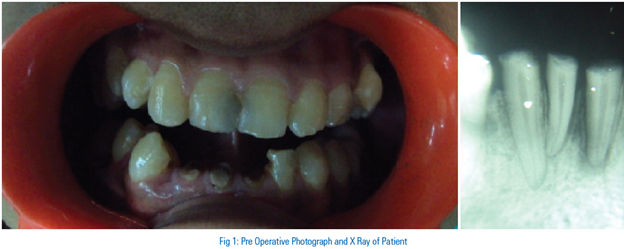
A 29-year-old male patient visited Department Of Conservative And Endodontics for rehabilitation of the anterior superior segment, which had been traumatised 12 years before our first clinical examination. Both 21 and 22 had lost pulp vitality (fig-1). Apical radiolucency was seen wrt 21 and 22 in radiographic examination.

Fig.1. pre-operative view
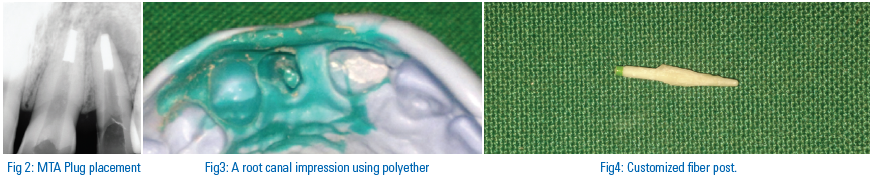
The initial clinical examination revealed dental caries of 22. Once a careful excavation of caries had been performed; it was observed that the remaining radicular canal walls were extremely thin (fig.2).
Root canal therapy was done wrt 21& 22 with apical MTA Plug placement, obturation and then post space was prepared (fig.2).
A root canal impression using polyether (fig.3) was performed in order to fabricate customized fiber posts, avoiding any further removal of dental tissue. These posts were created using siliceous fiber posts (EasyPost , Dentsply Maillefer , Switzerland) that were covered with a layer of composite resin (Tetric N-Ceram, ivoclar vivadent , Liechtenstein)(fig.4).
Once the post insertion in root canals had been verified, roots were prepared for adhesive cementation. The root canal walls were etched with 35% phosphoric acid for 15 sec, washed with water syringe and gently air-dried. Excess water was removed from the post space using paper points. Self Cure Activator (Dentsply, DeTrey GmbH, Konstanz, Germany) mixed with fifth-generation bonding agent XP Bond (Dentsply Caulk, Milford, USA) applied on canal wall and post by using micro brush following manufacturer’s instruction after which it was light-cured. Fluorocore 2+ (Dentsply caulk, Milford, Delaware, USA) core build up material was used for fiber post cementation. Base and catalyst (1:1) were mixed for 30 seconds, and then the material was applied on the post and the post was seated immediately into the canal and sustained under finger pressure.
Excess material extruding out of the root was removed with a spatula. After the first 7 minutes of auto-cure, the material was light-cured using a conventional quartz halogen light (Dentsply, DeTrey GmbH, Konstanz, Germany) for 40 seconds by placing the light tip on the coronal end of the post(fig.5).

Fig 5: Post inserted
Adhesive cementation of the posts was completed .Metal Ceramic crown preparations was done wrt 21 & 22. A polyether impression was taken. Prosthetic restoration cementation was performed with a rubber-dam, using the same adhesive system used for the fiber post cementation The final view of the anterior segment shows a good aesthetic result (fig.6) with a successful adaptation of the customized post in the root canals at the radiographical examination (fig.7).

DISCUSSION
It is quite common to observe a residual root canal after endodontic treatment which is not perfectly round18,19. These cases are suitable for using the customised post. This new technique is advantageous in a case like the one discussed where the young age of the patient required rehabilitation of anterior teeth. A significant improvement in fiber post adaptation and retention can be achieved with the ‘customized post’.
A layer of composite resin is applied to the post surface, to create the precise shape of the root canal without the need for further dentine removal. In this way, the fiber post takes the shape of the root canal which needs prosthetic restoration. Since the anatomical post fits the root canal shape perfectly, a thin and uniform layer of resin cement is simply required for further adhesion. This layer of cement creates a higher level of uniformity in the distribution of occlusal forces transmitted on to the tooth, reducing the effect of polymerization contraction of the resin material as well as the number and dimension of bubbles within the cement itself26.
A monobloc of multilayered structures with high bond strength at each interface can be created, when dentin, adhesive, resin cement, post, core, and final restoration are directly or indirectly bonded to each other. The modulus of elasticity of the fibre post is 16-40 GPa which is similar to dentin and resin cements. XP Bond and SCA is dual curable adhesive, indicated for bonding indirect restoration in conjunction with a dual curable or self curable resin based luting agent27. The XP Bond mixed with SCA can cure even in the absence of light. In this study the post used is opaque which does not allow the transmission of light through it, so dual cured resin cement was used for cementation of the post.
It is important to remember that a conservative approach should be planned for the residual tooth structure to achieve clinical success of the prosthesis20-25. In the case described, the prognosis of the severely damaged teeth, whilst still uncertain, has been improved because of the use of customized fiber posts and self-adhesive resin cement, increasing post retention and reinforcing the teeth structure. Careful and regular follow-up is needed in order to evaluate the long-term prognosis of the restored tooth clinically.
CONCLUSION
This clinical procedure of making a customized post can be used for reconstructing an endodontically treated tooth when the posts do not perfectly fit the root canal shape and when there is loss of dentin at the coronal level. In this manner, it is possible to use the customized fiber post which is superior to any other prefabricated fiber post system.
REFERENCES
- . Gutman JL The dentin-root complex: anatomic and biologic considerations in restoringg endodontically treated teeth. J Prosthet Dent 1992; 67: 458-67.
- Cohen BI, Pagnillo MK, Condos S et al. Four materials measured for fracture strengthh in combination with five designs of endodontic posts. J Prosthet Dent 1996; 76:: 487-95.
- .. Sorensen JA, Engelman MJ Effect of post adaptation on fracture resistance of endodonticallyy treated teeth. J Prosthet Dent 1990; 64: 419-24.
- . Trabert KC, Cooney JP. The endodontically treated tooth. Restorative concepts andd techniques. Dent Clin North Am 1984;28:923-51.
- .. Lewis R, Smith BG. A clinical survey of failed post retained crowns. Br Dent J 1988;; 165:95-7.
- . Morgano SM, Milot P. Clinical success of cast metal posts and cores. J Prosthet DentDent 1993; 70: 11-16.
- . Goodacre CJ, Spolnik KJ. The prosthodontic management of endodontically treatedd teeth: a literature review. Part I. Success and failure data, treatment concepts.. J Prosthodont 1994;3:243-50
- . Torbjoner A, Karisson S, Odman PA. Survival rate and failure characteristics for twoo post designs. J Prosthet Dent 1995; 73: 439-44
- Duret B, Reynaud M, Duret F. Un noveau concept de reconstitution corono-radiculaire:le composiposte (1). Chirurg Dent France 1990;540:131–41.
- Asmussen E, Peutzfeldt A, Heitmann T. Stiffness, elastic limit, and strength of newer types of endodontic posts. J Dent 1999;27:275–8.
- . Drummond J, Toepke R, King T. Thermal and cycling loading of endodontic posts. Eur J Oral Sci 1999;107:220–4
- .simone grandini,serena sapio,marco simonetti.Use of anatomic post and core for reconstructing an endodontically treated tooth J adhes dent 2003;5:243-247.
- Ferrari M, Vichi A, Grandini S. Influence of adhesive application technique on efficacy of bonding to root canal walls: an SEM investigation. Dent Mater 2001;17:422–9.
- Ferrari M, Vichi A, Grandini S, Goracci C. Efficacy of a selfcuring adhesive-resin cement system on luting glass-fiber posts into root canals: an SEM investigation. Int J Prosthodont2001;14:543–9.
- Grandini S, Gorracci C, Tay FR, Grandini R, Ferrari M. Clinical evaluation of fiber posts and direct resin restorations for endodontically treated teeth. Int J Prosthodont 2005;18:339–404.
- Carvalho CA, Valera MC, Oliveira LD, Camargo CH. Structural resistance in immature teeth using root reinforcements in vitro. Dent Traumatol 2005;21:155–9.
- Grandini S, Sapio S, Simonetti M. Use of anatomic post and core for reconstructing an endodontically treated tooth: a case report. J Adhes Dent 2003;5:243–7.
- Davis SR, Brayton SM, Goldman M. The morphology of the prepared root canal: a study utilizing injectable silicone. Oral Surg 1972;34:642-648.
- Walton R, Torabinejad M. Principles and practice of endodontics. 2nd ed. Philadelphia: W.B. Saunders, 1996:212-214.
- Grandini S, Gorracci C, Tay FR, Grandini R, Ferrari M. Clinical evaluation of fiber posts and direct resin restorations for endodontically treated teeth. Int J Prosthodont 2005;18:339–404.
- . Carvalho CA, Valera MC, Oliveira LD, Camargo CH. Structural resistance in immature teeth using root reinforcements in vitro. Dent Traumatol 2005;21:155–9.
- Boudrias P, Sakkal S, Petrova Y. Anatomical post design applied to quartz fiber/epoxy technology: a conservative approach. Oral Health 2001;11:9–16.
- Ferrari M, Scotti R. Fiber-posts: clinical and research aspects. Milano: Masson 2002; pp. 25–37.
- Ferrari M, Vichi A, Mannocci F, Mason PN. Retrospective study of the clinical performance of fiber posts. Am J Dent 2000;13:9B–13B.
- Fidel SR, Sassone L, Alvares GR, Guimaraes RP, Fidel RA. Use of glass fiber post and composite resin in restoration of a vertical fractured tooth. Dent Traumatol 2006;22:337–9.
- Grandini S, Sapio S, Simonetti M. Use of anatomic post and core for reconstructing an endodontically treated tooth: a case report. J Adhes Dent 2003;5:243–7.
- Ying-jie wang ornella raffaelli. Effect of different bonding procedures on micro-tensile bond strength between a fiber post and resin bonded luting agents. Journal of oral science 2007.vol.49,no.2,155-160
Disclaimer from Guident
The views and opinions expressed in articles published in Guident are solely those of the authors and do not necessarily reflect the views of the editors, the editorial board or the publisher, Ivory India. Guident does not endorse any product, technique or treatment described. Clinical content is intended for qualified dental and medical professionals and is not a substitute for individual clinical judgement. Guident, its editors and the publisher accept no liability for any consequence arising from the use of information published in the journal.
How to cite this article
Dr. Smita Singh, Dr. Jitendra Lohar, Dr. Gautam Singh. A Novel Technique for Restoring Endodontically Treated Tooth with Custom Fiber Post. Guident. 2013 Sep;6(11). Available from: https://ivoryindia.in/articles/endodontics/a-novel-technique-for-restoring-endodontically-treated-tooth-with-custom-fiber-post.html