Eagle Syndrome: A Case Report and Review of Literature
K.D Dental College & Hospital, Mathura, India
ABSTRACT
Patients with pain in pharynx and neck, symptoms can lead to an extensive differential diagnosisof Eagle’s syndrome. Eagle defined “stylalgia” as an autonomous entity related to abnormal length of the styloid process or to mineralization of the stylohyoid ligament complex. The stylohyoid complex derives from Reichert’s cartilage of the second branchial arch. The styloid process is an elongated conical projection of the temporal bone that lies anteriorly to the mastoid process. The incidence of Eagle’s syndrome varies among population. Usually asymptomatic, it occurs in adult patients. It is characterized by pharyngodynia localized in the tonsillar fossa and sometimes accompanied by disphagia, odynophagia, foreign body sensation, and temporary voice changes.Cervicofacial pains of unknown origin are common findings. Diagnosis and treatment planning of cervicofacial pains because elongated styloid apparatus is important. Eagle’s syndrome features of pain due to elongated styloid apparatus. Pain, dysphagia and burning sensation are findings in Eagle’s syndrome. This paper highlights the key diagnostic features for Eagle’s syndrome.
KEYWORDS:Elongated styloid process, Eagle,s syndromes, head and neck pain.
INTRODUCTION
A specificorofacial pain secondary to calcification of the stylohyoid ligament or elongated styloid process has been known as “Eagle’s Syndrome” (ES) since 1937, when an otolaryngologist of the Duke University, Watt W. Eagle, described the first cases.1-4 This syndrome was characterized by symptoms typically occurring after pharyngeal trauma or tonsillectomy and presents as a nagging dull, long-term ache in the throat, sometimes radiated to the ipsilateral ear, sensation of foreign body, occasionally odynophagia, dysphonia, increased salivation and headache. Notrarely patients believe that they have not properly healed from their tonsillectomy. The second and lesser-know presentation is constant throbbing pain through either the internal or external carotid artery distributions.5 Eagle considered tonsillectomy responsible for the formation of scar tissue around the styloid apex, with consequent compression or stretching of the vascular and nervous structures contained in the retrostyloid compartment (in particular glossopharyngeal nerve and perivascular carotidsympathetic fibres).2 In the ensuing years, the term “Styloid Syndrome” was created to describe a cervico-pharyngeal pain related to the styloid process, when no previous history of trauma can be found.6Pathophysiologically, the styloid syndrome is related to an irritation of the surrounding nerves,the carotid artery or the pharyngeal mucosa.The normal length of the styloid process varies greatly, but in the majority of patients it is 20 to30 mm; it is considered elongated when it islonger than 25 mm.7-9 In about 4% of general population, an elongated styloid process occurs, while only about 4%of these patients are symptomatic; thus the trueincidence is 0.16% with a female predominance of 3:1.10 Wereport a case of an adult man with anEagle’s Syndrome.
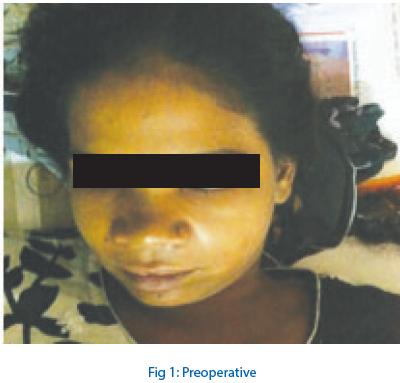
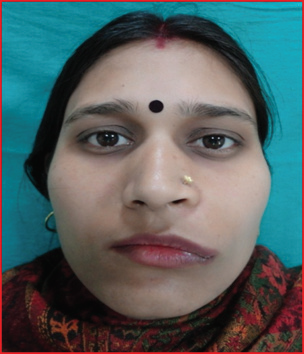
A 55 year old male patient, reported in the department of oral and maxillofaocial surgery, K.D.Dental College &Hospital,mathura with complaint of burning mouth, hypersalivation, pain around left ear since about one year. The burning sensation in mouth was localised to palate region. Hypersalivation was noted during sleep hours. Patient also complained of dysphagia. Patient had restricted mouth opening. Patient gave history of similar symptoms for right side. Patient was under medication for pain without any relief. (Figure 1-3) Clinically, nothing significant was found. Temporomandibular joint was clinically and radiographically normal. Patient’s panoramic view and CTScan revealed bilaterally elongated styloid apparatus. Patient was clinically and radiographically diagnosed with Eagle’s syndrome.(Fig 4,5) Treatment planned was bilateral extraoralstyloidectomy to relive symptoms of Eagle’s syndrome.
CASE REPORT
 |
 |
 |
| Figure 1 | Figure 2 | Figure 3 |
 |
| Figure 4 |
 |
| Figure 5 |
DISCUSSION
Patients with vague head and neck pain symptoms can lead to an extensive differential diagnosis 11. Although the incidence of the styloid process elongation or mineralization of the stylohyoid complex is not uncommon, only a small percentage of these cases are symptomatic. The vagueness of symptoms and the infrequent clinical observation are often misleading. These patients may be seen by a surgeon, a dentist, a neurologist, and a psychiatrist, often receiving a variety of treatments that do not relieve the symptoms and that cloud the clinical picture.Medical history is the main guide for the diagnosis of Eagle’s syndrome.The patient’s description of the symptoms is very important.Then, it is necessary to make a local examination palpating the tonsillar fossa, which should reveal a bony formation and should exacerbate pain aggravating symptoms with local tenderness. Usually patients have temporary relief of symptoms from the local infiltration of lidocaine.Radiological examination confirm the diagnosis: an orthopantomography and CT scans are required. Using CT scans is indicated for diagnosis, although also an accurate case history, local examination, and orthopantomography are required.12The surgical treatment is the first choice in the literature.When it is possible, the transoral approach is preferable. An intraoral approach results in a safe, simple, and less time consuming procedure than an extraoral approach and there is an absence of visible scars. We suggest the transoral approach in cases of Eagle’s syndrome with palpable styloid process.
CONCLUSION
Dentists have an important role to play in the diagnosis of Eagle’s syndrome, as the presenting symptoms in most cases lead patients to a dental practice (office). More and more dentists use OPGs for everyday diagnosis and documentation, from which a number of different pharyngo-cranialfacial disorders can easily be diagnosed.
REFERENCES
- EAGLEWW. Elongated styloid process: report oftwo cases. Arch Otolaryngol 1937; 25: 584-586.
- EAGLEWW.Elongated styloid process: further ob-servations and a new syndrome. Arch Otolaryn-gol 1948; 47: 630-640.
- EAGLEWW.Symptomatic elongated styloidprocess: report of two cases of styloidprocess–carotid artery syndrome with operation.ArchOtolaryngol 1949; 49: 490-503.
- EAGLEWW. Elongated styloid process; symptomsand treatment.AMA Arch Otolaryngol 1958; 67:172-176.
- Sohnah M, BerkeGS.Hetero-geneity in the clinical presentation of Eagle’s syn-drome. Otolaryngol Head Neck Surg 2006; 134:389-393.
- Mardaaz CA, DeschampsC, ForestD. Stylohyoidchain ossification: a discussion of etiology. OralSurg Oral Med Oral Pathol 1989; 67: 515-520.
- OffartDA, RamdentRT, ShawHJ. The styloidprocess syndrome: aetiological factors and surgicalmanagement. J LaryngolOtol 1977; 91: 279-294.
- Kaufmansm, ElzayRP,Irish EF. Styloid processvariation.Radiologic and clinical study.Arch Otolaryngol 1970; 91: 460-463.
- StraussM, ZoharY, LaurianN. Elongated styloidprocess syndrome: intraoral versus external approach for styloid surgery. Laryngoscope 1985;95: 976-979.
- Harmar, LindenWF. Indications for esophagealreconstruction of corrosive structures.ActaOto-laryngol 1966; 62: 27-32.
More references are available on request.
Disclaimer from Guident
The views and opinions expressed in articles published in Guident are solely those of the authors and do not necessarily reflect the views of the editors, the editorial board or the publisher, Ivory India. Guident does not endorse any product, technique or treatment described. Clinical content is intended for qualified dental and medical professionals and is not a substitute for individual clinical judgement. Guident, its editors and the publisher accept no liability for any consequence arising from the use of information published in the journal.
How to cite this article
Dr Anshul Jaidev, Dr. Shishir Mohan, Dr. Arti Department of Oral & Maxillofacial Surgery. Eagle Syndrome: A Case Report and Review of Literature. Guident. 2015 Mar;8(4). Available from: https://ivoryindia.in/articles/oral-surgery/eagle-syndrome-a-case-report-and-review-of-literature.html