Camouflage Treatment of Anterior Open Bite in Nongrowing Patient
Rajnandgaon (c.g), India
ABSTRACT
Open bite is vertical malocclusion. It is defined as condition in which no vertical relation between maxillary and mandibular teeth. It may be anterior, posterior open bite or dental or skeletal open bite. This case report presents the orthodontic treatment of 19 year female patient with large anterior open bite (6mm) and increased anterior facial height. Patient had angles class I malocclusion, convex profile, incompetent lip seal. Extraction of all first premolar was decided for correction of anterior open bite and convex profile. Total treatment time was 2 years. The open bite was reduced (5 mm) by retraction of anterior teeth. After 2 years of treatment, good occlusion and lip competency achieved. Now patient is happy with her new face and smile.
Keyword: Anterior open bite, class I malocclusion, first premolar extraction, aesthetic
INTRODUCTION
Anterior open bite is most unaesthetic malocclusion. It can be defined as a malocclusion without contact in the vertical relation of anterior region of the dental arches, being the posterior teeth in occlusion.[1]
Simple open bite usually related to the teeth or alveolar due to extrusion of posterior molars or intrusion of anterior teeth and complex openbite primarily based on skeletal dysplasia. The etiology of anterior open bite has multifactorial origin such as retained infentile swallowing, premature loss of anterior teeth, mouth breathing, nasal obstruction, tongue thrusting, hypertropic tronsil which causes esthetic and functional problem.
It was verified a 12% prevalence of anterior open bite, more frequently in males, in patients with Class I and in the age group of 7 to 9, showing the significant difference if it is compared to the prevalence found in the permanent dentition9. In the mixed dentition the prevalence of the anterior open bite can reach up to 18.5%, decreasing age. [2]The successful treatment of anterior open bite malocclusion is big challenge for orthodontics. Correct diagnosis and treatment planning provide good treatment results. Orthognathic surgery is best treatment modalities for correction of open bite in adult patient. The purpose of this article is present an adult case with anterior open bite with convex profile treated by extraction of all first premolars.
CASE REPORT
A 19 year old female patient was visited in Chhattisgarh dental college and research institute Rajnandgaon with her chief complain of proclination of maxillary and mandibular anterior teeth and unable to close mouth properly. She had no any previous medical and dental history. History of tongue thrusting due to increased tongue size. Extraoral photographs showed mesomorphic facial type, vertical growth pattern, and no gross facial asymmetry, unable to close her lips due to anterior open bite and protruded upper and lower lip with convex profile. Facial midline was shifted right side by 3 mm. She was not satisfied with her smile also


Fig.2 Intraoral photographs before treatment
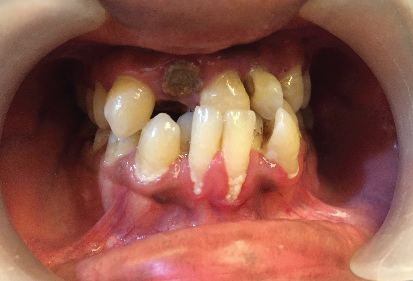
Intraoral photographs showed she had class I molar relationship with anterior open bite due to tongue thrusting. Overjet was 3 mm and anterior open bite was 6 mm. Spacing was present in maxillary arch and crowing in mandibular arch. Occlusal caries was present with mandibular second molar in both sides.
The panoramic radiograph showed no evidence of bony pathology (fig3). All permanent teeth were present. The lateral cephalometric radiograph (fig3) and analysis (Table1) showed a class I skeletal pattern due to orthognathic maxilla and mandible.

The cephalometric analysis was indicated the features of a dental open bite. The mandibular plane and gonial angle was normal according Indian norms. Dental open bite was due to intrusion of maxillary anterior teeth and extrusion of mandibular posterior teeth.
From these finding patient was diagnosed as class I skeletal pattern with orthognathic maxilla and mandible. She had vertical growth pattern due extrusion of posteriors molars. Dentoalveolar relationship was angles class I Dewey type 1 malocclusion with convex profile due to protruded upper and lower lip with incompetent lip seal and anterior open bite due to anterior tongue thrusting.


TREATMENT OBJECTIVE AND TREATMENT PLANNING
For this case, primary treatment objective was to improve the facial esthetic and achieving lip competency by reducing the protrusion of maxillary and mandibular anterior teeth and achieve a normal inclination of the incisors and also maintain class I skeletal pattern. Soft tissue objective was to reduce the procumbency of upper and lower lip. For the occlusion to achieve normal overjet and overbite and maintain class I molar relationship.
Finally, based on clinical examination, cephalometric finding, and study model analysis treatment plan was decided to use orthodontic mini implant for intrusion of mandibular molars to allow autorotation of mandible. But patient was not willing for this treatment plan. Later we decided to extract maxillary and mandibular first premolar. This case was considered as moderate anchorage case. Mesial migration of posterior teeth allows anticloclockwise rotation of mandibular plane to reduce the anterior facial height. Fixed palatal crib appliance was given to prevent anterior tongue thrusting.
TREATMENT PROGRESS
After extraction of first premolars, fixed preadjusted edgewise appliances (MBT 0.022 slot) were used. Initially maxillary and mandibular arches were banded and bonded. Transpalatal, lingual arch and fixed palatal crib appliances was used in initial phase. Initial levelling and aligining was started with 0.014” niti arch wire followed by 0.016x0.022”, 0.017x0.025” niti , 0.017x0.025” ss, 0.019x0.025”niti, 0.019x0.025”ss arch wire. The maxillary and mandibular first premolar spaces were planned so as to use half of the extraction site for the anterior retraction and the other half to move the molars mesially. The retraction of anterior teeth and the mesial movements of molars were started simultaneously with labial elastics followed by 0.019x0.025”ss arch wire. After nine months, the original open bite was almost closed by retraction of anterior teeth and the mesial movement of molars without the aid of vertical elastics. It took about 18 months for the treatment to be completed and the patient was shifted to the retention phase. In debonding visit fixed lingual bonded retainer given in both maxillary and mandibular arch from second premolar to second premolar.
TREATMENT RESULT
Post treatment facial photographs showed that overall facial balance was improved (Figure 5). The lower anterior facial height was decreased, and the lips showed less tension in lip closure. Acceptable occlusion was achieved, and the overbite was improved to 1.2 mm and the overjet to 1.5 mm (Figure 6). The molar relationship maintained to Class I on both sides. Panoramic radiograph showed less root resorption (Figure 7). Cephalometric analysis indicated a counterclockwise rotation of the mandible (Table1). The lower anterior facial height (ANS-Me) was decreased to 77.5 mm. The inclinations of the upper and lower central incisors still remained within the normal range. From the superimposition of maxilla and mandible, the mesial movement of molars and the retraction of anterior teeth occurred with no or less molar intrusion or incisor extrusion (Figure 8).


Fig5. Panoramic radiograph before Debonding

DISCUSSION
Anterior open bite is one of the most complicated malocclusion. It has also associated with increases lower anterior facial height, convex profile and incompetent lip seal. Treatment for this malocclusion is often directed at controlling vertical development of maxilla and extrusion of posterior teeth as well as anterior teeth in growing patient, but it might include orthognthic surgery LeFort osteotomies to correct the skeletal vertical or transverse discrepancies of maxilla in the adult patient. [3] Other nonsurgical therapies is multiloop edgewise archwires, chincups, functional appliances, and bite blocks with and without magnets. [4]
Kim5 proposed the non surgical treatment to correction of open bite by using multiloop edgewise archwire (MEAW). This technique is mainly use for the correction of open bites in terms of uprighting the posterior teeth leading to the correction of the cant of occlusal plane and the posterior discrepancy[5]. However they demonstrated that correction of anterior open bite by extrusion of anterior teeth and uprighting the posterior teeth. Skeletal changes not found. That indicated the anticlockwise rotation of mandibular plan leading to reduce lower anterior facial height is not produce by MEAW technique[6]. Therefore we decided to use MEAW technique and treated the patient with extraction of maxillary and mandibular first premolar for correction of convex profile and reduce anterior facial height.
Etiology of anterior open bite was due to anterior tongue thrusting. Tongue crib was used to prevent tongue thrusting and reduce tongue pressure. In this case fix tongue crib with acrylic pad was used for 12 month until initial levelling and alignment was completed. Tongue crib was removed after 1 year for retraction of maxillary anterior teeth and allowed mesial movement of maxillary molar. Sinem Taslan [7]found tongue pressures at the 12th month remained lower than initial values in the study group and swallowing tongue pressures returned to baseline values in the study group at the 12th month.
Martina et al [8]found there was no decrease in the mandibular plane angle when molar was protracted forward in the first premolar extraction cases. In present case Y axis, GO-GNSN and palatal plane angle were changed. Camouflage treatment usually involves extraction of the first premolars and retraction of the anterior segments to mask or cover up mild, underlying Class II or Class III skeletal problems and enhance facial esthetics. Lip competence without mentalis strain is often an appropriate treatment goal for functional and esthetic reasons. Extraction of teeth can often help to achieve lip competence and closure of bite.
CONCLUSION
Open bite is a distinctive and easily recognizable characteristic of some malocclusions; it has significant functional and esthetic consequences. An adult patient with a dental open bite and a large lower anterior facial height was treated by means of first premolar extraction to achieve stable occlusion with a well-balanced face. Correction of the habit before orthodontic therapy is crucial to the treatment and long term stability of the result. Carefully evaluation of soft tissue and hard tissue relationship is important for good diagnosis and treatment planning.
REFERENCES
- RE, M., Ortodontia. Trad. coord. Por Aloysio Cariello. 1991, Rio de Janeiro: Guanabara Koogan.
- de Oliveira, J.M.L., et al., Etiology and treatment of anterior open bite. Health Sci Inst J, 2011. 29: p. 92-95.
- Nielsen, I.L., Vertical malocclusions: etiology, development, diagnosis and some aspects of treatment. The Angle orthodontist, 1991. 61(4): p. 247-260.
- Chandna, A., A. Singla, and V.P. Singh, Anterior Open Bite Treated with Premolar Extractions.
- Kim, Y.H., Anterior openbite and its treatment with multiloop edgewise archwire. The Angle orthodontist, 1987. 57(4): p. 290-321.
- Kim, Y.H., et al., Stability of anterior openbite correction with multiloop edgewise archwire therapy: a cephalometric follow-up study. American Journal of Orthodontics and Dentofacial Orthopedics, 2000. 118(1): p. 43-54.
- Taslan, S., S. Biren, and C. Ceylanoglu, Tongue pressure changes before, during and after crib appliance therapy. Angle orthodontist, 2010. 80(3): p. 533-539.
- Martina, R., A. Laino, and A. Michelotti, Class I malocclusion with severe open bite skeletal pattern treatment. American Journal of Orthodontics and Dentofacial Orthopedics, 1990. 97(5): p. 363-373.
Disclaimer from Guident
The views and opinions expressed in articles published in Guident are solely those of the authors and do not necessarily reflect the views of the editors, the editorial board or the publisher, Ivory India. Guident does not endorse any product, technique or treatment described. Clinical content is intended for qualified dental and medical professionals and is not a substitute for individual clinical judgement. Guident, its editors and the publisher accept no liability for any consequence arising from the use of information published in the journal.
How to cite this article
Dr. Akhilesh Belchandan. Camouflage Treatment of Anterior Open Bite in Nongrowing Patient. Guident. 2016 Jun;9(7). Available from: https://ivoryindia.in/articles/orthodontics/camouflage-treatment-of-anterior-open-bite-in-nongrowing-patient.html