Interception of Skeletal Class III in a 2-Year-Old Using Modified Acrylic Planas Direct Track Appliance: A Case Report
Department of Pedodontics and Preventive Dentistry, Government Dental College, Thiruvananthapuram, Kerala, India
ABSTRACT
Anterior crossbite is a malocclusion that warrants immediate management. However, this is often tricky in young children. In such patients, Planas Direct tracks are a boon. The technique was introduced by Pedro Planas (1971). “Planas Direct Tracks are prism-shaped blocks incorporating inclined planes made up of composite resin, directly built or cemented on the occlusal surfaces of deciduous molars. The planas direct track is designed such that the distal incline of the upper block occludes with the mesial incline of the lower block, so that the mandible will have a posterior path of closure and condyles in centric relation”.1,2 This is a case report of a 2-year-old child who presented with anterior crossbite which was corrected using a modified acrylic planas direct track.
Keywords: Acrylic resin, Anterior Crossbite, Malocclusion, Planas direct tracks, Modified Planas direct track, Interception of skeletal class III.
INTRODUCTION
A crossbite is an abnormal relationship of maxillary and mandibular teeth with the dental arches in centric relation.3 According to Pedro Planas2 who introduced Planas direct tracks, “Crossbites are very easy to correct, whenever diagnosed early. If not treated, they can produce severe difficulties in the future, due to skeletal modifications that may occur and might be irreversible.”1 Planas Direct Track is a part of Neuroocclusal Rehabilitation (NOR). It is a subfield of dentistry that finds and eliminates the etiology of functional and morphological alterations of the stomatognathic system.4 This means that it is indicated in cases where there is a functional class III/pseudo-class III malocclusion. The original Planas direct track consisted of prism-shaped composite blocks that incorporated an inclined plane which were cemented onto the deciduous molars so as to guide the mandible in centric occlusion. They can either be made directly onto the patient's teeth or indirectly on a cast after bite registration with the mandible in the most retruded position.1,2 Over the years the technique received many modifications, the prominent one being the use of acrylic instead of composite which decreased chairside time significantly and made it cost-effective.5 However the risk of aspiration mainly with the acrylic ones is an important factor to consider. This is a case report of a 2-year-old child who presented with anterior crossbite which was corrected using a modified acrylic planas direct track with incorporated trans palatal arch and lingual arch.
CASE REPORT
This is a case report of a 2-year-old child (Fig:1) who presented with anterior crossbite irt 51, 52 and 61 (Fig:2), which was corrected using a modified acrylic planas direct track with incorporated trans palatal arch and lingual arch (Fig:3).
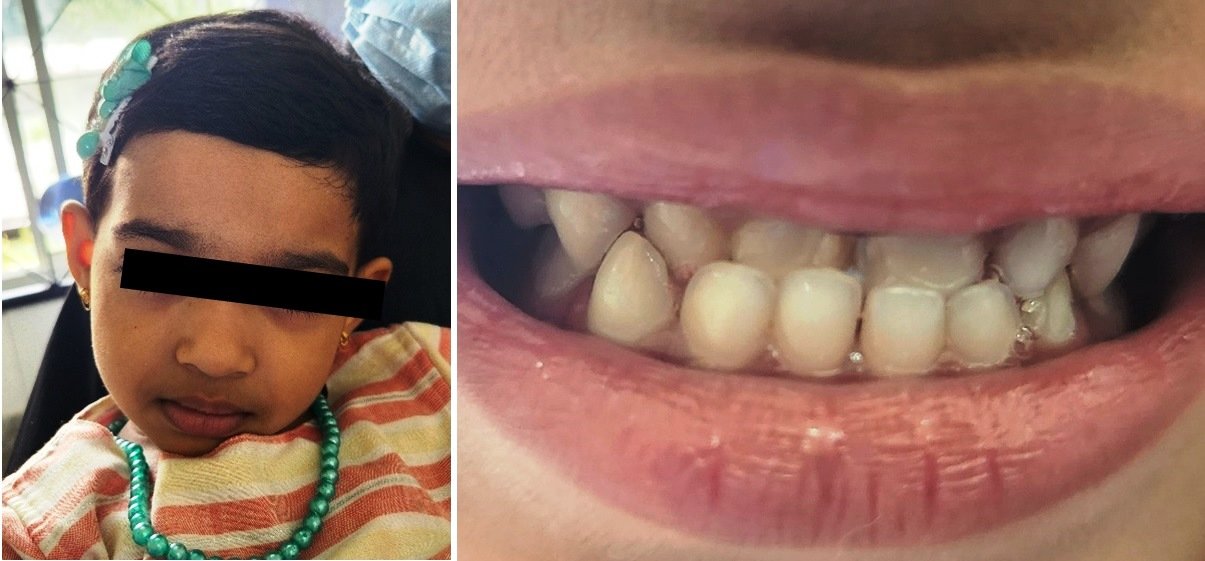
Fig 1: 2 year old child & Fig 2: Anterior crossbite irt 51, 52, 61

Fig 3: Planas direct track
Extraoral examination showed a straight profile with a mild lower lip protrusion. Intraorally patient had a full set of deciduous dentition with mesial step molar relation. The patient had a fairly good oral hygiene and there were no carious teeth. Considering the young age of the child, removable appliances were ruled out and a decision was made to go with Planas direct track appliance. Anticipating a lack of cooperation from the child an indirect technique was chosen. A bite registration was made and the appliance was fabricated using acrylic instead of composite to make it more cost-effective for the patient. Moreover, to decrease the chances of aspiration a trans-palatal arch was incorporated into the two maxillary blocks and a lingual arch into the mandibular blocks. The appliance was cemented on the patient's teeth using luting GIC after full mouth oral prophylaxis (Fig:4).
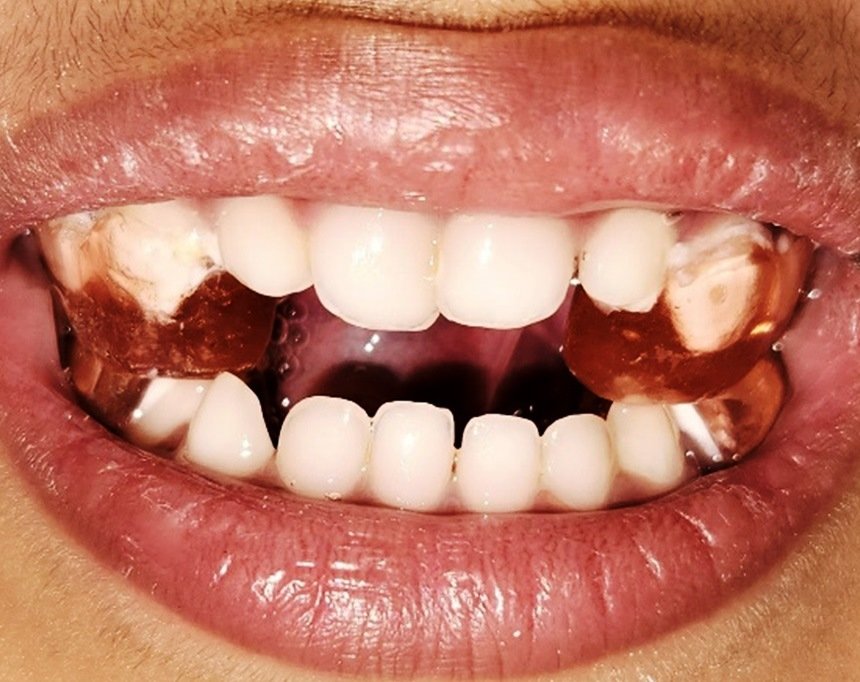
Fig 4: Planas direct track cemented with luting GIC
The patient was kept in follow-up every 2 weeks. Crossbite correction was achieved by the patient's 2nd follow up visit (Fig:5), but the appliance was kept for 2 more weeks to prevent relapse.
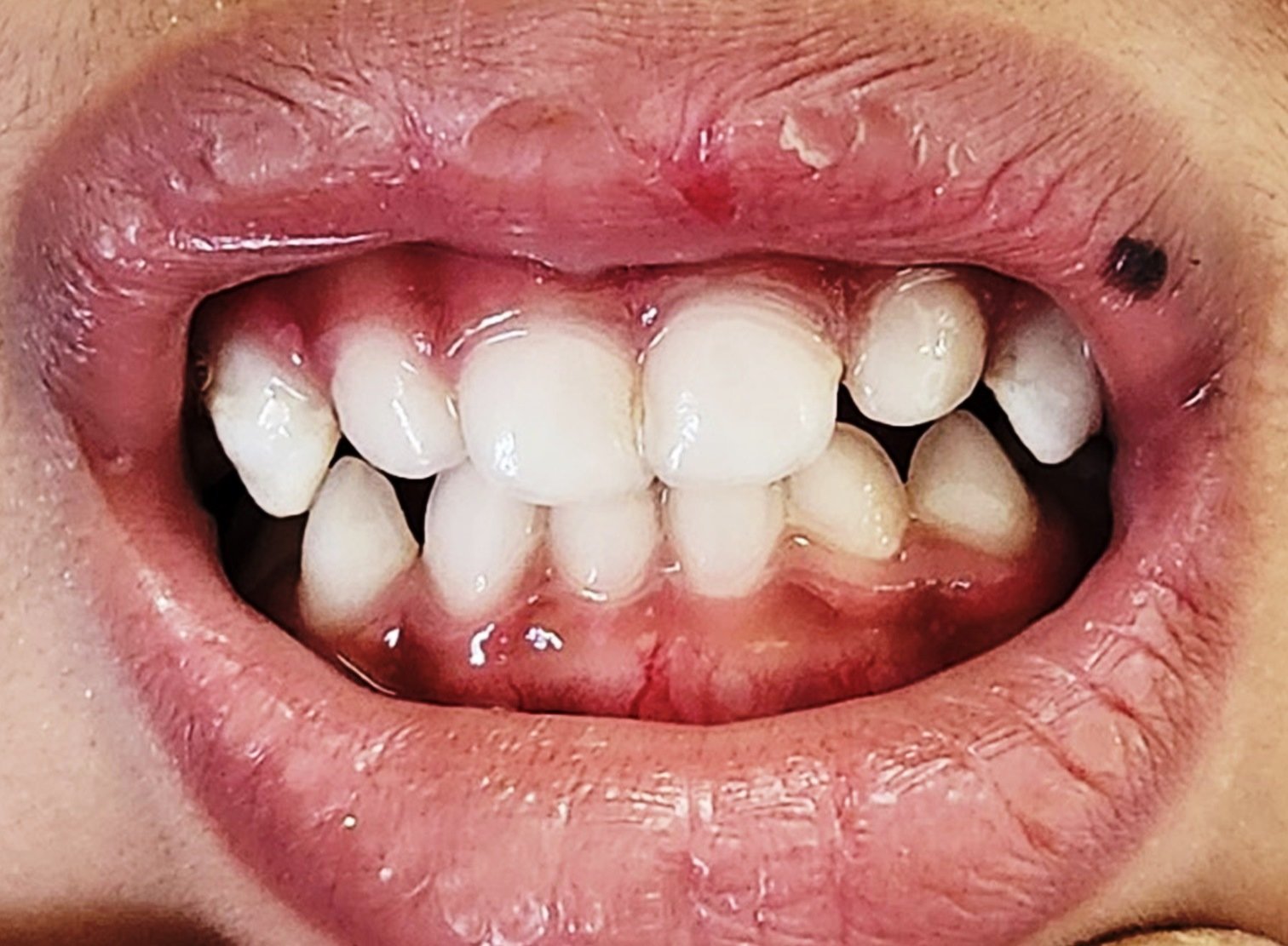
Fig 5: Cross bite correction achieved
The total duration of treatment was 1 and a half months.
DISCUSSION
Any form of malocclusion is difficult to treat in young children with a primary dentition mainly due to poor patient compliance. Anterior crossbite is a malocclusion that warrants immediate treatment. The incidence of anterior crossbite in primary dentition is 4 to 5%.6 Early correction of these malocclusions may completely eliminate the need for a second phase of treatment and may lead to normal growth and development.7 If left untreated it can affect the overall growth of the dentofacial structures. Management techniques for anterior crossbite in young children are limited. The possible treatment options may be the use of removable and fixed appliances like the Hawley appliance with Z spring, Frankel appliance, removable mandibular retractor, Quad helix, and Chin cap.8 The main disadvantage of these appliances is poor patient compliance.3 Planas direct track alleviate this problem by effectively correcting crossbite and still being comfortable for the patient. Planas direct track work by seating the condyles in centric relation with the glenoid fossa which is otherwise prevented by a crossbite. This abnormal positioning causes muscle tension in the posterior temporalis muscle making it more active which in turn stimulates condylar and mandibular growth, further worsening the malocclusion. They work best for either anterior or posterior crossbite correction in the primary dentition where skeletal discrepancy has not yet been established.9 Some important factors to consider before deciding on a Planas direct track are development of posterior open bite, they can only be used on a caries free dentition and they are contraindicated in vertical growing individuals.1 Though various modifications exist for the appliance we went for a modification with acrylic blocks and an incorporation of trans palatal arch with the 2 maxillary blocks and a lingual arch with the 2 mandibular blocks. The main disadvantage that we found with this design was an increased plaque accumulation and gingival inflammation, which was controlled by instructing the caretakers to follow meticulous oral hygiene. The outcome was achieved within a period of one and a half months.
CONCLUSION
Among the available treatment options to correct crossbite in young children, Planas direct track proves to be the best. Despite its minor shortcomings like development of posterior open bite and contraindication for its use on caries teeth and vertical growers, Planas direct track offers better patient compliance and results in a swift correction of malocclusion.
BIBLIOGRAPHY
- Mani, Shubhangi A., Krutika M Gaitonde and Ankita A. Sawant. “Planas Direct Tracks-For Correction of Class III Malocclusion In Deciduous Dentition-: A Case Report.” (2016).
- Planas P.: Rehabilitation Neuro occlusal (RNO), Masson- SalvatOdontologia Barcelona, Spain, 1994.
- Devasya A, Ramagoni NK, Taranath M, Prasad KEV, Sarpangala M. Acrylic Planas Direct Tracks for Anterior Crossbite Correction in Primary Dentition. Int J Clin Pediatr Dent 2017;10(4):399-403.
- Renata Reis dos Santos, Artênio José Isper Garbin, Cléa Adas Saliba Garbin, “Early Correction of Malocclusion Using Planas Direct Tracks”, Case Reports in Dentistry, vol. 2013, Article ID 395784, 4 pages, 2013. https://doi.org/10.1155/2013/395784.
- Vora KS, Misal A, Toshniwal NG. An innovative approach for correction of pseudo class III malocclusion with the use of “Planas direct tracks”. APOS Trends Orthod 2013;3:190-6.
- Devasya A, K Ramagoni N, Taranath M, Ev Prasad K, Sarpangala M. Acrylic Planas Direct Tracks for Anterior Crossbite Correction in Primary Dentition. Int J Clin Pediatr Dent. 2017;10(4):399–403.
- Gribel MN, Gribel BF. Planas direct tracks in young patients with Class II malocclusion. World J Orthod. 2005;6(4):355–68.
- Sarangal H, Namdev R, Garg S, Saini N, Singhal P. Treatment Modalities for Early Management of Class III Skeletal Malocclusion: A Case Series. Contemp Clin Dent [Internet]. 2020 [cited 2023 Apr 27];11(1):91–6. Available from: https://www.ncbi.nlm.nih.gov/pmc/articles/PMC7580742/
- Ramirez-Yañez GO. Planas direct tracks for early crossbite correction. J Clin Orthod. 2003 Jun;37(6):294-8. PMID: 12866209.
Disclaimer from Guident
The views and opinions expressed in articles published in Guident are solely those of the authors and do not necessarily reflect the views of the editors, the editorial board or the publisher, Ivory India. Guident does not endorse any product, technique or treatment described. Clinical content is intended for qualified dental and medical professionals and is not a substitute for individual clinical judgement. Guident, its editors and the publisher accept no liability for any consequence arising from the use of information published in the journal.
How to cite this article
Dr. Danu Dayakar P S, Dr. Rita Zarina A, Dr. Yadukrishnan M S. Interception of Skeletal Class III in a 2-Year-Old Using Modified Acrylic Planas Direct Track Appliance: A Case Report. Guident. 2023 Jul;16(8). Available from: https://ivoryindia.in/articles/pedodontics/interception-of-skeletal-class-iii-in-a-2-year-old-using-modified-acrylic-planas-direct-track-appliance-a.html