Oral Healthcare Management of HIV-Infected Children: Unfolding the Role of a Dentist
Department of Pedodontics GNIDSR, Kolkata, West Bengal, India
Abstract
HIV/AIDS is now increasingly being viewed not as a fatal and acute disease, but as a chronic disease that, while it cannot be cured, can be managed. The progression from HIV infection to AIDS varies considerably among individuals, it is faster and more severe in children, due to the immaturity of the immune system. Given the increasing frequency of paediatric HIV infection, all dental health care providers should familiarize themselves with the early diagnosis of pathological conditions of the oral cavity and recommend management strategies for the treatment of such children. This paper aims to unfold the role of a dentist in the management of such pediatric patient and prevention of the spread of infection.
KEYWORDS: HIV, AIDS, MTCT, OI, HAART
INTRODUCTION
In today’s world, the three biggest challenges facing and posing a threat to the very existence of human race are nuclear build up, global warming and finally AIDS (Acquired Immunity Deficiency Syndrome). Never in the past, has man been put against such a formidable triology of enemies. The first two are the direct result of technical advancement and the last is a result of promiscuous life style.
WHO defines Health as a state of complete physical, mental and social well-being, and not merely the absence of disease and infirmity. This state of well-being has been guaranteed as a ‘human right’ through a number of international human rights treaties. But the rapid spread of HIV/AIDS has led to an infringement of the human rights of men, women and children affected by the epidemic in various ways.
Worldwide, Human immunodeficiency virus (HIV) is a common problem among children. HIV infection is a viral infection that progressively destroys certain white blood cells and causes AIDS, the most severe form of HIV infection. HIV infection is caused by the viruses HIV-1 and HIV-2 and, in young children, is typically acquired from the mother. Signs of infection include slowed growth, developmental delay, recurring bacterial infections, and lung inflammation. The diagnosis is based on special blood tests. HIV infection may lead to various troublesome infections with organisms that do not ordinarily infect healthy people. These are termed opportunistic infections (OI), and they may result from viruses, parasites, and in children, unlike in adults - bacteria.1
“Mouth is the mirror of the health” so it is that the Dental Surgeons have a very important role to play, in the early diagnosis of HIV / AIDS by picking up the early oral clinical manifestation .The ever growing presence of HIV infection necessitates that dental professionals should have the knowledge about HIV/AIDS as it relates to the
provision of dental care. It is mandatory for every dental surgeon to know about the specific oral lesions to arrive at the diagnosis and do the needful.
HISTORICAL REVIEW
Disease syndrome similar to clinical manifestation of AIDS have been described into the ancient Ayurvedic Literature – “Sushruta” in 800 B.C. and later Charaka and Vagbatha described conditions as “loss of muscle mass, fever, skin eruptions and ulcers, complexion changes, neurological disorder, exhaustion, coma and death. In mid-1981, AIDS was first recognized, when unusual clusters of PNEUMOCYSTS CARINI PNEUMONIA and KAPOSIS SARCOMA were reported in young, previously healthy homosexual men in New York City, Los Angeles and San Francisco. In 1986, the first case of AIDS in India was reported in Mumbai stated by WHO and NACO (India) although HIV infection in children was first described in 1983.2
EPIDEMIOLOGY OF PEDIATRIC HIV INFECTION
According to UNICEF and new HIV Sentinel Surveillance, the number of new HIV infections in India increased marginally between 2010 and 2011. Today, there are 5.7 million people living with HIV/AIDS in India. It is estimated that 220,000 children are infected by AIDS and 55,000 to 60,000 children are born every year to mothers being HIV positive. The epidemic in children has risen globally due to the worldwide increase in HIV prevalence in women of childbearing age. Though the source and route of transmission is multifactorial, Mother to child transmission (MTCT) accounts for the vast majority of HIV infected children.3
BREASTFEEDING AND HIV TRANSMISSION
Breastfeeding carries significant health benefits for infants and young children and is an essential child survival intervention. Without intervention, about 35% of HIV-positive pregnant women will pass on the infection to their babies during pregnancy, delivery and postnatally through breastfeeding. Without preventive interventions, about 10-20 per cent of infants born to infected mothers will contract the virus through breastmilk if breastfed for two years. The risk of postnatal HIV transmission after 6 weeks of age is estimated at around 1% per month of breastfeeding (WHO 2006). Several other factors affect the risk of transmission, including the “viral load” or amount of virus in the mother’s body, the duration of breastfeeding and the condition of the breasts.4
With the new recommendations, it is postulated that an HIVinfected woman taking ARVs and mix-feeds may still have a higher rate of transmission than a mother who exclusively breastfeeds and takes ARVs: Therefore continued emphasis needs to be placed on discouraging mixed feeding in the first six months. The 2010 UN recommendations on prevention of mother to child transmission (PMTCT) of HIV and on infant feeding in the context of HIV highlight that the overall risk of mother to child transmission of HIV can be reduced to less than 5% in breastfeeding populations (from a background risk of around 35%) and to less than 2% in nonbreastfeeding populations (from a background risk of around 25%)(WHO 2010, Rapid Advice on PMTCT version 2). A 2011 systematic review reports that the risk of transmission can be reduced to 1-2% when ARVs are provided (Siegfried et al 2011).5
COMMON ORODENTAL LESIONS IN HIV INFECTED CHILDREN
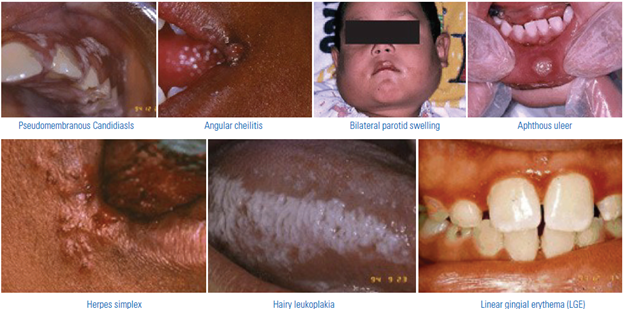
The most frequently associated oral lesions are: candidiasis (typically pseudomembranous), herpes simplex infection, linear gingival erythema (LGE), parotid enlargement and recurrent aphthous stomatitis. Other viral and bacterial infections, including periodontal infections are less commonly associated, while hairy leukoplakia and Kaposi’s sarcoma are rarely seen in HIV infected children.6, 7, 8
ORAL HEALTH MANAGEMENT IN CHILDREN WITH HIV INFECTION.
Oral health care is an integral part of comprehensive health care and is particularly true in the management of patients with HIVinfection. In these patients, poor oral health resulting in pain and discomfort can complicate the management of systemic conditions, lead to nutritional deficiencies, affect antiretroviral treatmentcompliance and can adversely affect quality of life. To provide safe treatment for HIV-infected children, dentists must know the child’s CD4+ T-lymphocyte count and percentage, when to use antibiotic prophylaxis, and when to order additional laboratory tests, including liver function tests, INR, and CBC with differential. Caring for these patients also requires great coordination between the dentist, the physician, and the child’s parents. Prevention is key to maintaining oral health in this population.9
The diagnosis of HIV infection in the exposed infants is difficult because routine screening tests like rapid test, ELISA will only detect presence of maternal antibodies. Hence, these tests are useful in children > 18 months of age; and for children < 18 months it is necessary to do DNA- PCR testing using dried blood spots (DBS) which detects viral DNA. All diagnostic HIV testing of children must be confidential, accompanied by counselling and informed consent of the parent or guardian.10
To assess the patient’s immune status, obtain a current CD4+ T-lymphocyte count and percentage that has been taken within the last three months; if this information is not available, a new CD4+ T-lymphocyte count and HIV viral load should be ordered. To evaluate the patient’s ANC, platelet count, and RBC count, dentists should obtain a current CBC with differential. Patients with an ANC count below 1,500/mm3 will require antibiotic prophylaxis. Patients with low platelet counts may require additional hemostasis measures or
a platelet transfusion prior to surgery.9
Liver function tests are essential to determine if patients require antibiotic prophylaxis for routine dental work. HIV patients who have not been diagnosed with AIDS may still require antibiotics if their liver function is abnormal. Again, tests taken within the last three months are necessary before even routine dental care can be performed, especially in patients who are co-infected with hepatitis. Importantly, sugar-free HIV drugs should be prescribed when possible to reduce the patient’s caries risk.9
MANAGEMENT OF OPPORTUNISTIC INFECTIONS (OI):ANTIRETROVIRAL THERAPY
After commencing an infant or child on ART it is vital for frequent clinical monitoring at 2 wk. after initiation and every 4 wks. thereafter. These visits are to evaluate growth and development, immunization status and provide nutrition counselling. There is also an opportunity to educate the parents and care providers on adverse drug reactions, ART adherence and symptoms of common OIs.11
THE ROLE OF DENTAL SURGEON IN PREVENTING SPREAD OF HIV INFECTION
The expanding role of the dentist in AIDS era, can be classified by six issues.12, 13
1. Provision of routine dental care.
2. Oral lesions-screening, diagnosis, treatment and recognition of their significance.
3. Collaboration with the other healthcare workers and social support systems.
4. Education of other health care workers.
5. Education in the community
6. Resource to HIV infected health care workers.
1. Provision of Dental care:
Patients infected with HIV can safely be treated in general dental settings. The establishment of dedicated clinics for HIV-infected patients, however may still be justified without abrogating the responsibility to treat such patients in general setting.
2. Oral lesions-screening
, diagnosis, treatment and recognition of their significance: Dentists should be prepared to recognize, identify, and manage oral lesions in children with HIV infection. Dental surgeon should refer to the primary medical care provider for diagnoses, observation, and management of any lesions that disrupt the integrity of the oral mucosa in children. Fluocinonide ointment 0.05% and hydrocortisone acetate oral paste can be used to provide pain relief. As nutrition often plays a role in the prevention of these lesions, maintaining and increasing caloric intake is very important. Dental sealants, optimal systemic and topical fluoride, and fluoride varnish supplementation are keys to preventive strategy.
3. Collaboration with other health care workers and social support systems:
Frequently, oral lesions interfere with masticatoryfunctions and result in unintentional weight loss and even wasting.Thus, collaboration with patients’ physicians and social caseworkers is necessary to address a patient’s needs.
4. Education of other health care workers:
Dental health care workers need to educate their health care colleagues on how to perform oral examinations and how to distinguish between normal and abnormal oral tissues. This contribution can be accomplished by linking up with regional AIDS education and Training Centers; giving formal and informal lectures; and sending informational newsletters and updates to health care institutions, support networks, and community based organizations.
5. Education in the community:
Dentists can play an important role in AIDS education and prevention by encouraging patient’s caregivers to voice their concerns regarding possible infectious exposures in adental setting and explaining the rationale for employing infection control procedures. Written patient education books and materials in waiting room addressing are also recommended.
6. Resources to HIV-infected health care workers:
Unquestionably, dental care providers should discontinue practicing when impaired. This is true for all impairing conditions, not only HIV. It is extremely difficult, however, to ascertain when someone has developed diminished motor functions or intellectual capabilities. This has become one of the most important issues with regards to the right of HIV infected health care providers to continue to practice.
CONCLUSION
Children with HIV must have access to dental services at the earliest possible stage following their diagnosis to prevent and treat dental disease. Such children should receive a periodic dental examination every three to six months. Depending on the patient’s current liver function tests and their immunological and clinical categorization, antibiotic prophylaxis may be necessary, even for routine dental care. Hence the early diagnosis of the lesions by a Dentist can foresee the developments of a suppression of the immune system and can be important as an indicator of the possibility of the early detection of AIDS.
Disclaimer from Guident
The views and opinions expressed in articles published in Guident are solely those of the authors and do not necessarily reflect the views of the editors, the editorial board or the publisher, Ivory India. Guident does not endorse any product, technique or treatment described. Clinical content is intended for qualified dental and medical professionals and is not a substitute for individual clinical judgement. Guident, its editors and the publisher accept no liability for any consequence arising from the use of information published in the journal.
How to cite this article
Dr. Roshni Maurya, Dr. Gautam Kundu, Dr. Shabnam Zahir. Oral Healthcare Management of HIV-Infected Children: Unfolding the Role of a Dentist. Guident. 2014 Jan;7(2). Available from: https://ivoryindia.in/articles/pedodontics/oral-healthcare-management-of-hiv-infected-children-unfolding-the-role-of-a-dentist.html