Full Mouth Rehabilitation of a Patient with Multiple Missing Teeth and Excessive Loss of Vertical Dimension
(Professor & Head), Department of Prosthodontics K.D Dental College and Hospital, Mathura, India
INTRODUCTION
A biologic and functional approach to restorative dentistry is essential for the satisfactory performance and fulfillment of those requisites basic to prosthodontics. Accordingly, the masticatory organ must be considered as a functional, consolidated unit, with proper attention being directed to all the elements that comprise this unit. All functional factors are interrelated, and proper regard for each aspect is essential, if the restoration and maintenance of the health of the entire functioning mechanism is to be a realization.
The goal of dentistry is to increase the life span of the functioning dentition, just as the goal of medicine is to increase the life span of the functioning individual. In striving to achieve its goal, dentistry uses its knowledge, skill, and all the resources at its command in both maintenance work and rehabilitation. Thus, the continuing prophylactic program of childhood, including the
regulation of the teeth for good occlusion, and the rehabilitation of the neglected adult mouth have one and the same goal. The techniques of these two areas in dentistry obviously differ, but they should be viewed as integral parts of an over-all dental program.
Rehabilitating the occliusion of a mutilated dentition is biologically and technically a challenging task. The challenges faced by the restorative dentist are to achieve the comprehensive treatment goal to maintain the optimum health of the stomatognathic system by restoring the lost anatomic form and functional harmony, and occlusal stability. The masticatory system is the functional unit of the body, primarily responsible for chewing, speaking and swallowing.
Deterioration of anatomic form of teeth and its supporting structures due to microbial cause or stress factors can produce occlusal instability that may lead to temporomandibular problems, or vice versa. Extensive generalized destruction of natural form of teeth and supporting structure make an individual physically and esthetically handicapped. Often demand for esthetics, motivates these patients to seek dental treatment.
Functional and esthetic rehabilitation of mutilated occlusion is started with careful evaluation of every component of the masticatory system, diagnosis, conceptual analysis of need and proper treatment planning for such complete restoration.
This article describes a clinical report of a patient with multiple missing teeth and severe loss of vertical dimension and hence requiring full mouth rehabilitation.
CLINICAL REPORT
The American College of Prosthodontists’ Classification System for Partial Edentulism allows the diagnosis of patients based on the oral condition at the time they initially present to the practitioner. The Classification System has recently been renamed the Prosthodontic Diagnostic Index (PDI), and allows patient to be classified based on the severity of their pretreatment dental condition. This clinical report documents the treatment of a 75-year-old male who reported to the department of prosthodontics (K.D. Dental College & Hospital). The patient was classified as PDI Class IV—characterized by severely compromised location and extent of edentulous areas with guarded prognosis, abutments requiring extensive therapy, occlusion characteristics requiring reestablishment of the occlusion with a change in the occlusal vertical dimension.
Chief complaint: The patient’s chief complaint was “I have missing teeth in upper and lower arches and want a fixed replacement for the same.”
Medical History: A review of the patient’s medical history revealed he was in excellent health, with no signs of systemic disease.
Past dental history: patient had undergone extraction of several teeth and endodontic treatment of remaining natural teeth.
CLINICAL FINDINGS
Extra-oral findings: There was no cervical lymphadenopathy. The patient had no muscle tenderness, or facial asymmetry. Mandibular range of motion was within normal limits. The temporomandibular joints, the muscles of mastication, and facial expression were asymptomatic.
Intra-oral findings: Fig: 1-2 shows pre-treatment photographs of the patient. The maxillary and mandibular arches were partially dentate with teeth 11,16,21,22,26,31,32,33,34,41,42,43,44 present with tooth 11 being root stump. All the teeth present had access opening done and prepared for final prosthesis by a private clinician. Periodontal condition of the present teeth was sound. Excessive loss of vertical dimension and a resorption in the posterior mandible was seen.
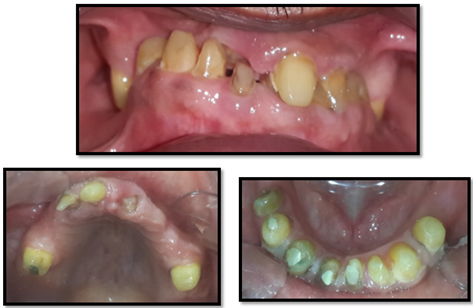
Fig-1: Pre-operative view
TREATMENT PLAN
The following treatment plan was based upon clinical findings, articulated casts, radiographic examination, and periodontic and endodontic consultations.
- An oral and written presentation of the treatment plan was made to the patient, including risks, alternatives, and benefits of treatment. Alternative treatments were discussed. The patient selected oral rehabilitation with anterior fixed prostheses and flexible removable partial denture for distal extension. His approval was obtained.
- Complete endodontic therapy for all remaining teeth
- Post and core treatment for tooth 11
- Raising bite in accordance with rest position dimensions.
- Metal ceramic restoration for tooth 16-26 and 34-44.
- Posterior flexible removable partial denture.
TREATMENT SEQUENCE
- After the completion of endodontic treatment of remaining teeth and post and core treatment on tooth 11.
- Two sets of study casts were made for diagnosis and treatment planning purposes. on 1 set of cast, denture base and rims were made to record the bite at a vertical dimension compatible with the physiologic rest position.
- The casts were mounted on an articulator with the help of bite recorded.
- Diagnostic wax-up on the articulated cast were done for the teeth which were to receive fixed restorations.
- Tooth preparation was modified for all the teeth to receive metal ceramic restorations.
- Temporary restorations with tooth-colored polymethyl methacrylate resin were fabricated according to the diagnostic wax-up and placed over tooth 16-26 & 34-44.
- Interim removable partial denture was also given to the patient for distal extension edentulous space in maxillary and mandibular arches.
- Temporary restoration was kept in place for more than a month to get accustomed to the new vertical dimension.
- After one and half months, TMJ was evaluated for pain, clicking, deviation.
- TMJ was found to be normal with the new vertical dimension and procedure for final permanent restoration was initiated.
- First, mandibular arch was restored with metal ceramic restoration for tooth 34-44 followed by fixed prosthesis in the maxillary arch i.r.t 16-26.
- For distal extension partial dentures, physiologic impressions were made after the fabrication of maxillary and mandibular fixed prosthesis and flexible partial dentures were fabricated.
- Post-operative view of the patient is shown in figure – 2

Fig 2: post- operative view with metal ceramic restoration on 16-26 and 34-44 & posterior flexible partial denture for maxillary and mandibular arch.

Fig-3
Post treatment therapy
The patient was seen at 1- and 2-week follow up appointments. The patient stated that he was pleased with esthetics, function, and comfort of the prostheses. Oral hygiene was excellent. The patient was given instructions to seek 6- month prosthodontic and periodontic recall appointments.
CONCLUSION
Most patients with severe wear of teeth can be managed by restoring the occlusion and without much increase in the vertical dimension.
If the vertical dimension has severely collapsed like in present case, it must be restored cautiously.
Rehabilitating a case of severe loss of vertical dimension with multiple missing teeth requires a multidisciplinary approach and the optimum restoration of function, occlusion and esthetics in perfect harmony with stomatognathic system is always our supreme objective.
REFERENCES
- Treatment of a Patient with Severely Worn Dentition: A Clinical Report. Sudsukh Thongthammachat-Thavornthanasarn DDS, MSD. J Prosthodont 2007;16:219-225.
- Functional aspects of complete mouth rehabilitation. Harry Kaziz. J. Prosth. Dent 1954
- The goal of full mouth rehabilitation. Irving Goldman. J. Pros Dent 1952.
- Occlusal consideration, concepts, and treatment planning for full mouth rehabilitation of mutilated dentition. Jogeswar Burman. Indian J Stomatol 2014;5(3):102-7
Disclaimer from Guident
The views and opinions expressed in articles published in Guident are solely those of the authors and do not necessarily reflect the views of the editors, the editorial board or the publisher, Ivory India. Guident does not endorse any product, technique or treatment described. Clinical content is intended for qualified dental and medical professionals and is not a substitute for individual clinical judgement. Guident, its editors and the publisher accept no liability for any consequence arising from the use of information published in the journal.
How to cite this article
Dr. Neelansh Sikri, Dr. Manesh Lahori Dean. Full Mouth Rehabilitation of a Patient with Multiple Missing Teeth and Excessive Loss of Vertical Dimension. Guident. 2017 Jul;10(8). Available from: https://ivoryindia.in/articles/prosthodontics/full-mouth-rehabilitation-of-a-patient-with-multiple-missing-teeth-and-excessive-loss-of-vertical-dimension.html