Overdenture- an Anchored Denture
Department of Prosthodontics AME, s Dental College & Hospital, Raichur, India
Abstract
Problems associated with a complete denture, such as lack of stability and retention, can be solved with the use of overdentures. Historically, this technique was an attempt on the part of a few innovative dentists to provide their patients with retention and stability
beyond that which could be achieved with a regular complete denture 1. Teeth supported or an implant supported overdenture helps improve the retention and stability of the final prosthesis significantly. Bone is a dynamic tissue. The extraction of teeth results in the initiation of the bone resorption pattern. However, when tensile stress is received by bone, additional bone formationtakes place. Such stresses occur when occlusal forces are transmitted to the alveolar bone by the periodontal ligament. This principle helps preserve bone1,2. The concept of overdentures may not be the elixir, but it is a positive means for delaying the process of complete endentulism and helps in the preservation of bone. To top it all, it gives the patient the satisfaction of having prosthesis with his natural teeth still present. In this article, case reports with three different types of Overdentures are discussed: Overdenture with cast copings with short dowels, O-ring attachments, a customized bar supported overdenture with copings and in cases where the teeth cannot be preserved we opt for implant supported overdenture1,3
Key words: Bar supported overdenture, bone preservation, bone resorption, cast copings, O-ring attachment, tooth retained overdenture, implant supported overdenture .
INTRODUCTION
An overdenture is a complete denture supported by both soft tissue and a few remaining natural teeth. The natural teeth have been altered to permit the denture to fit over them. Historically, this technique was an attempt on the part of a few innovative dentists to provide their patients with retention and stability beyond that which could be achieved with a regular complete denture.1,2,3
NEED TO USE AN OVERDENTURE
A complete denture patient goes through a sequel of events like:3
- loss of discrete tooth proprioception,
- progressive loss of alveolar bone,
- transfer of all occlusal forces from the teeth to the oral mucosa
- the most depressing sequel is the loss of patient’s self-confidence
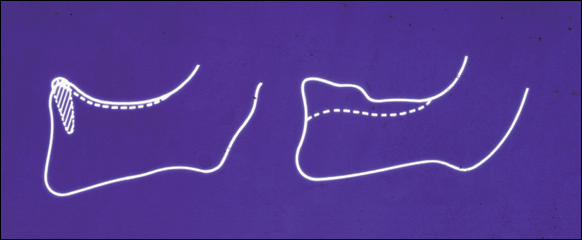
Comparison of bone loss in a patient with a root supported overdenture (A) and a conventional complete denture (B) 5 years after extraction of teeth and insertion of dentures
An overdenture: 1,3
- delays the process of resorption,
- improves denture foundation area and increases masticatory efficiency
- helps preserve the bone in that the remaining natural teeth are used to withstand some of the occlusal forces. Since all of the teeth are not extracted, vertical bone height is maintained.
- Stability of the denture is enhanced by the retained natural teeth. Since the denture will only seat in one exact position and may even be retained by an attachment, denture retention is improved.
- The periodontal membrane around the remaining teeth improves the denture patient’s tactile sense.
OVERDENTURES SHOULD NOT BE USED AS A SUBSTITUTE FOR A FIXED OR REMOVABLE PARTIAL DENTURE.3
INDICATIONS: 3,4
- patients with few remaining retainable teeth in an arch.
- patients with malrelated ridge cases;
- patients needing single denture;
- patients with unfavorable tongue positions, muscle attachments, and high palatal vault, which render the stability and retention of the prosthesis difficult
CONTRAINDICATIONS:
Patients with questionable oral prophylaxis, systemic complications, and inadequate interarch Distance.4
TECHNIQUE
The overdenture technique can be used in following ways: 2,3,4
1.tooth supported ( most commonly preferred
a.short-coping method
b.long-coping method
c.attachment-coping method,
2) implant supported
Tooth supported overdenture:
The most important advantage is that the patient has the psychological benefit of having his own teeth and it is cost effective.
Short-coping overdenture
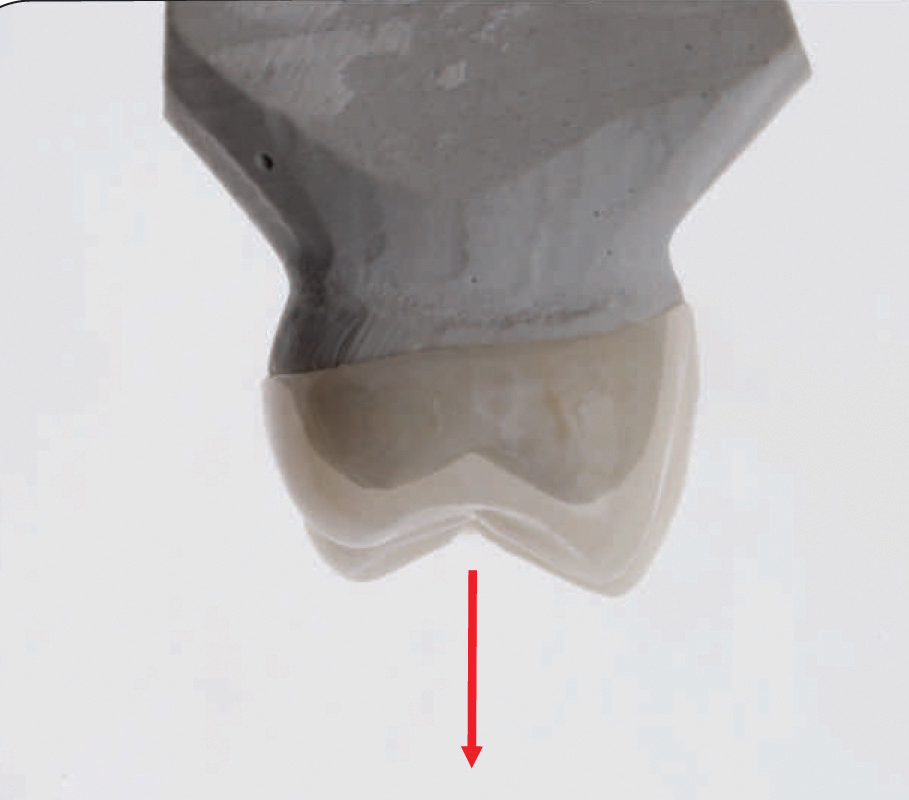
The remaining natural teeth are treated endodontically, reduced in vertical height to the level of the gingiva, and covered with a short, rounded gold coping.3,4 round coping are 1-2 mm high.

. The prognosis for the teeth used is enhanced if most of the root structure is in bone, if the root canals are easily negotiable, and if the patient has demonstrated the ability to performadequate oral hygiene procedures.
Long-coping overdenture
The long-coping method does not excessively reduce the vertical height of the tooth. This technique
provides improved stability, but it only should be used when the additional tooth height will not jeopardize artificial tooth placement or denture contour. Since the improvement in crown-root ratio is minimal, adequate bone support is mandatory.3,4

Attachment-coping overdenture

Improved denture retention has been a sought after goal. Retention of the overdenture with long copings has been attempted by placement of an undercut in the coping and a retentive clasp in the denture base. This improves the retention, but does nothing for the disadvantages of long coping mentioned previously.
Another means to improve denture retention has been the use of attachments.4,5
- Attachment-coping overdenture with Dalbo 604 attachment. Round portion permits denture movement without twisting of abutment tooth

2.Attachment coping overdenture with use of zest anchor

3.Attachment coping overdenture with the use of dolder – bar

Cross-section view of Dolder bar apparatus. Thin horseshoe-shaped sleeve is retained without denture base. Wire spacer is used only during processing and produces 1-mm space between bar and sleeve in finished denture.5
IMPLANT SUPPORTED OVERDENTURE
Branemark and co-workers presented a fixed prosthesis on 5-6 implants as a viable treatment for edentulous jaws, and during many years this was the dominating concept with extremely successful long-term results. However, in the mid 1980’s treatments with mandibular implant overdentures were introduced. Being less expensive and less complicated but yet successful, mandibular implant overdentures soon became popular in many countries. Maxillary implant overdentures on few implants have in general been found less successful than the mandibular 2-implant overdenture.6,7
1.MANDIBULAR IMPLANT OVERDENTURES
i.Two implant overdenture:
The retention systems for the 2-implant overdenture can be divided into:
- splinted
- unsplinted ones.
The splinted systems use an interconnecting bar and a retentive clip; the unsplinted implants there are several retention types available such as ball attachments and magnets8,9

ii. Single midline overdenture


Prosthetic space analysis: At least 13-14 mm interocclusal space is required for bar supported OD considering teeth size, denture base thickness, bar thickness for the rigidity, the space from the mucosa to the bar for hygiene and the soft-tissue thickness. Minimum space requirement for ball attachment is 10-12 mm and for locators is 8.5 mm. Inadequate space for prosthetic components can result in an overcontoured prosthesis, excessive occlusal vertical dimension, fractured teeth adjacent to the attachments, attachments separating from the denture, fracture of the prosthesis and overall patient dissatisfaction.7,8,9
Types of attachments:
The attachments used for implant ODs are mainly divided into the bar type and the solitary type and into
the resilient type and the rigid type, depending on the movement allowance. Popular OD attachments used are:
1. Ball attachments with rubber o-rings and/or metal housings
2. Bar attachments with clips
3. Locators
4. Magnets
5. Bar with locators cast or tapped into the framework.8,9,10,11,12
2.MAXILLARY IMPLANT OVERDENTURE
Implant overdentures in the maxilla have in general not been as successful as in the mandible, but the early poor results were probably partly due to the fact that maxillary implant overdentures often were made as a “rescue treatment” when a fixed prosthesis had failed. The results improved when maxillary implant overdentures were made as a planned treatment following strict protocols.13 Nevertheless it is evident that maxillary implant overdentures present a number of different challenges compared to the predictable benefits of mandibular 2-implant overdentures. Systematic reviews concluded that maxillary overdentures on 4 or more implants in a splinted construction provided high survival (> 95% for the first year) both for implants and overdenture 11,12
REFERENCES
- Dhir RC. Clinical assessment of overdenture therapy. J Indian Prosthodont Soc 2005;5:187-92.
- Brewer AA, Morrow RM. Overdentures Made Easy. 2nd ed. St. Louis: The C. V. Mosby Co.; 1980.
- Rahn A, Heartwell C. Textbook of Complete Dentures. 5th ed. Philadelphia: WB Saunders Co.; 1993.
- 4) Lord, J.L., and Teel, S. The overdenture. Dent Clin North Am 13:871 Oct 1969. Brill, N. Adaptation and the hybrid-prosthesis. J Prosthet Dent 5:811 Nov 1955
- Preiskel HW. Precision Attachments in Prosthodontics: Overdentures and Telescopic Prostheses. Vol 2. 2nd ed. Chicago, IL: Quintessence Publishing Co.; 1985.
- Morrow RM, Feldmann EE, Rudd KD, Trovillion HM. Tooth-supported complete dentures: An approach to preventive prosthodontics. J Prosthet Dent 1969;21:513-22
- Preiskel HW. Overdentures Made Easy: A guide to Implant and root supported prostheses. London, UK: Quintessence Publishing Co.; 1996.
- Malone, W.F., and others. Imaginative prosthodontics. J Acad Gen Dent 18:21 June 1970.
- Morrow, R.M., and others. Tooth-supported complete dentures: description and clinical evaluation of a simplified technique. J Prosthet Dent 22:414 Oct 1969.
- Miller, P.A. Complete dentures supported by natural teeth. J Prosthet Dent 8:924 Nov-Dee 1958.
- Prince, I.B. Conservation of the supportive mechanism. J Prosthet Dent 15:327 March-April 1965.
- Dolder, E.J. The bar joint mandibular denture. J Prosthet Dent 11:689 July-Aug 1961.
Disclaimer from Guident
The views and opinions expressed in articles published in Guident are solely those of the authors and do not necessarily reflect the views of the editors, the editorial board or the publisher, Ivory India. Guident does not endorse any product, technique or treatment described. Clinical content is intended for qualified dental and medical professionals and is not a substitute for individual clinical judgement. Guident, its editors and the publisher accept no liability for any consequence arising from the use of information published in the journal.
How to cite this article
Dr. Aroma Reji, Dr. Sunil Dhaded. Overdenture- an Anchored Denture. Guident. 2019 Jan;12(2). Available from: https://ivoryindia.in/articles/prosthodontics/overdenture-an-anchored-denture.html