
Recent Ceramic Materials: An Esthetic Promise to Patient
Seema Dental College & Hospital, Rishikesh, India
Abstract
In today’s world looking good is the prime concern. Beauty in health is the new mantra. Keeping with this trend, Dentistry also has evolved from a curative to a creative science in a very short span of time. Dental ceramic technology is one of the fastest growing areas of dental material. In past decades numerous newer types of dental ceramics materials, Dicor, Inceram, OPC 2, IPS Empress, Zirconia with improved composition and the method of forming core have greatly enhanced our ability to produce more accurate and fracture resistant crowns made entirely of ceramics. Future of dental ceramics is bright because increase demand for tooth colored restorations will lead an increased demand for ceramic based restoration. The purpose of the present paper is to discuss the newer materials and processes available for all-ceramic dental restorations.
Key Words:Ceramics, Crystalline phases, Dental.
INTRODUCTION:
Desire to possess a beautiful smile has always existed with the human race. Dental ceramics are materials that are part of systems designed with the purpose of producing dental prostheses that in turn are used to replace missing or damaged dental structures. Since the introduction of porcelain jacket crown in the early 1900’s, dental ceramics have been praised for their esthetic appearance. The development of aluminous core and veneer porcelains was first described in 1965 by McLean and Hughes1. But with the advancement in esthetic dentistry, newer types of ceramics and processing method have been introduced in recent years for all types of indirect restorations, from very conservative no-preparation veneers, to multi-unit posterior fixed partial dentures. As per GPT 8 ceramic is defined as compounds of one or more metals with a non metallic element, usually oxygen. They are formed of chemical and biochemical stable substances that are strong, hard, brittle, and inert non conductors of thermal and electrical energy. As compared from metal ceramic restoration that can cause true allergic reaction or may produce unsightly gingival tissues around the crown margins, all ceramic restoration can be an alternative option due to principal reasons like improvements in strength, clinical performance, esthetic & biocompatibility which have made these restorations more popular and more predictable. So the purpose of present paper to overview the newer materials and processes available for all ceramic restorations.
RECENT ADVANCEMENT IN CERAMIC
Two concepts help in simplifying the understanding of dental ceramics.2 First, ceramics fall into three main composition categories: Predominantly glass, Particle –filled glass, Polycrystalline. Second, ceramics can be considered as a composite material, in which the matrix is a glass that is lightly or heavily filled with crystalline or glass particles.

Predominantly glass ceramics:
have a high content of glass making this type of dental ceramic highly esthetic. This type is the best in mimicking the optical properties of enamel and dentin. Optical effects are controlled by manufactures by adding small amount of filler particles like in Mark II VITA blocks milled with Cerec 3 or Lucite crystals as in IPS Empress.
Particle-filled glass ceramics
: Filler particles are added to the glass matrix to improve the mechanical properties. Fillers can be crystalline particles of high-melting glasses. Like in Inceram Spinell, Inceram Zirconia, Inceram alumina.
Polycrystalline ceramics:
This type of ceramic contains no glass. Atoms are packed into regular crystalline arrangement making it tougher and less susceptible to crack propagation. Example: Ceron, Lava, Procera. It is important to understand the fact that highly esthetic ceramics are predominately glass, and ceramics that exhibit high strength are generally crystalline.
Within the last ten years, an increasing number of ceramic materials for all-ceramic restorations have been developed. Each of these materials uses a different approach in attempting to improve the mechanical properties without being detrimental to the esthetic qualities of the ceramic.
CONVENTIONAL SINTERED PORCELAINS
Leucite-reinforced feldspathic porcelain3:
It is feldspathic porcelain containing up to 45 vol% leucite. The greater leucite content leads to a higher modulus of rupture, compressive strength and high thermal contraction coefficient. In addition, the large thermal contraction mismatch between leucite and the glassy matrix results in the development of tangential compressive stresses in the glass around the leucite crystals when cooled. These stresses can act as crack deflectors and contribute to increase the resistance of the weaker glassy phase to crack propagation. A second metastable phase identified as sanidine forms at the expense of the glassy matrix. The crystallization of sanidine is associated with a modification of the optical properties of the material from translucent to opaque. Example: Optec HSP leneric/Pentron, Inc.
Alumina-based porcelain
The first aluminous core porcelains contained 40 to 50% alumina by weight1. The core was baked on a platinum foil and later veneered with matched-expansion porcelain. Aluminous core porcelain is a typical example of strengthening by dispersion of a crystalline phase4. Alumina has a high modulus of elasticity and high fracture toughness. Its dispersion in a glassy matrix of similar thermal expansion coefficient leads to significant strengthening of the core. Hi-Ceram Vident, Baldwin Park, CA is a more recent development of this technique. (Fig. 1)

Fig 1: Conventional Sintered Ceramics
CASTABLE CERAMICS:
Mica-based: Fredrick carter, the founder of the steuben division of the corning glass works, perfected fabricating objects in glass with the lost wax casting process. Dicor Dentsply Inc., York, PA is a mica-based glass-ceramic. The Dicor glass-ceramic have a tetrasilicic fluormica 55% by volume as the major crystalline phase. A nucleating agent that acts as a starting point for the controlled crystals growth created by a regulated heat process called Ceramming. A Chameleon effect is produce as it acquires color from adjacent teeth. It can be used for single restoration or extensive reconstruction not involving FPD’S. Inlays, onlays, three quarter crowns and other partial veneer restorations can also be fabricated, laminate veneers are recent application of the castable ceramic. It is especially indicated in periodontal compromised patients because of plaque resistance and excellent periodontal response. (Fig. 2)
Lithia-based:
Experimental glass-ceramics in the system Li2O-Al2O3-CaO-SiO2 are currently the object of extensive research work. The choice of adequate additives is critical in the development of tougher and higher-strength glass ceramics. Differential thermal analysis can be efficiently used to determine the heat treatment leading to the maximum lithium disilicate crystal population in the shortest amount of time, thereby optimizing the nucleation and crystallization heat treatment of this type of glass-ceramic.
Hydroxyapatite-based:
The process of dispersion strengthening has resulted in substantial improvement in the porcelain, but has not overcome problems related to firing shrinkage that potentially lead to distortion of the matrix, marginal inaccuracy and inadequate functional strength. The development of non shrinking ceramics such as Cerapearl Kyocera, San Diego, CA a castable glass ceramic in which the main crystalline phase is oxyapatite, transformable into hydroxyapatite when exposed to moisture has provided an alternate treatment.

Fig 2: Castable Ceramics
SLIP CASTING CERAMICS 5,6 :
Slip-casting involves the condensation of an aqueous porcelain slip on a refractory die. The porosity of the refractory die helps condensation by absorbing the water from the slip by capillary action. The piece is then fired at high temperature on the refractory die. Usually, the refractory shrinks more than the condensed slip, and the piece can be separated easily after being fired. The fired porous core is later glass infiltrated, a unique process in which molten glass is drawn into the pores by capillary action at high temperature.
In-Ceram Alumina
This material was first introduced in 1989, and was the first all-ceramic system available for single unit restorations and 3-unit anterior FPDs. Slurry of Al2O is applied on a refractory die and sintered to produces a porous framework of alumina particles which is infiltrated with lanthum glass during a second firing. Then feldspathic porcelain is used to veneer the produced coping. In-Ceram Alumina is considered to be a strong material having mean biaxial flexure strength of 600 MPa.The material should not be used in esthetic zones because it does not fully allow light transmission. (Fig. 3)

Fig 3: Slip Cast Ceramics
In-Ceram Spinell
It was introduced in 1994 to overcome the opacity of In-Ceram Alumina. The Framework contains a mixture of magnesia and alumina to improve the translucency of the material. It has a flexural strength of 250 Mpa which is lower than that for In-Ceram Alumina7. InCeram Spinell is indicated for anterior crowns because of its low flexural strength.
In-Ceram Zirconia
It is considered a modification of In-Ceram Alumina system with the addition of 35% of partially stabilized zirconia oxide to the slip to increase the strength of the ceramic. In-Ceram Zirconia is considered the strongest of three cores of the slip-casting technique having a flexural strength of 700 MPa. The material is considered opaque and has poor translucency limiting its use for posterior crowns and posterior FPDs.
PRESSABLE CERAMICS8:
They are available as ingots of various shades and are manufactured in a pre-cerammed condition. They are casted pneumatically using lost wax method high temperature injection molding technique. Hot-pressing classically helps avoid large pores caused by non-uniform mixing. It also prevents extensive grain growth or secondary crystallization, considering the temperature at which sintering is obtained. The mechanical properties of many ceramic systems are maximized with high density and small grain size. Therefore, optimum properties can be obtained by hot-pressing techniques.
IPS Empress
IPS Empress is a leucite-reinforced glass ceramic. It has a low flexural strength limiting its use to single unit complete-coverage restorations in the anterior region.
IPS Empress2
IPS Empress 2 is a lithium-disilicate glass ceramic. IPS Empress 2 has a flexural strength which is much higher than that of IPS Empress. Its increased flexural strength makes it suitable for the usage for fabrication of 3-unit FPDs in the anterior region, and can extend to the second premolar9. Both IPS Empress and IPS Empress 2 are recommended in situations where average to high translucency is needed. They are considered as monochromatic restorations which can be surface characterized to the desired shade and produce comparable esthetics to the layering techniques. Another example is the IPS e.max Press Ivoclar Vivadent, which was introduced in 2005. It is considered as an enhanced press-ceramic material when compared to IPS Empress 2. It has better physical properties and improved esthetics. (Fig. 4)

Fig 4: Pressable Ceramics
CAD/CAM CERAMICS10,11:
Machinable ceramics are available as prefabricated glass-ceramic ingots. They are cut by tools that are controlled by the computer. After the tooth is prepared, an optical impression is taken for the preparation by a special scanner. The image is then transferred to the system’s software. Then the software designs the restoration and sends the data to the computer controlled milling machine that grinds the ceramic block according to the desired shape.
Examples of materials available for the CAD/CAM technology
(a) Silica based ceramics
(b) Infiltration ceramics
(c) Oxide high performance ceramics
Silica based ceramics: Several CAD/CAM systems offer silica based ceramic blocks for the fabrication of inlays, onlays, veneers, partial crowns and full crowns. Blanks with multicolored layers VitaBlocks TriLuxe, IPS Empress CAD Multi Ivoclar Vivadent are available in addition to the monochromatic blocks for the fabrication of posterior crowns. Lithium disilicate ceramic blocks have high stability making them suitable for fabrication of posterior crowns and 3-unit FPDs. An example of a lithium disilicate ceramic block is the IPS e.max CAD which is used frequently because of its superior esthetics, excellent color stability, and its high resistance to wear.
Infiltration ceramics:
Blocks of infiltrated ceramics for CAD/CAM systems originate from the Vita In-Ceram system. They have the same composition and clinical indications of Vita In-Ceram products.
Oxide high performance ceramics: Blocks of aluminum oxide and zirconium oxide are currently available for the CAD/CAD technology. It is considered as a high performance ceramic. It is ground then sintered at a temperature of 1520°C. It is clinically indicated in cases of crown copings in the anterior and posterior area, and 3-unit FPDs in the anterior region. In-Ceram AL Block Vita and InCoris Al Sirona are examples of alumina oxide blocks that are available in the market.
Yittrium stabilized zirconium oxide ceramics have excellent mechanical properties. They have high flexural strength when compared to other dental ceramics. Yttrium-oxide is added to zirconia in order to stabilize the tetragonal phase at room temperature, as a result can prevent crack propagation in the ceramic. Zirconium oxide ceramics are indicated for the fabrication of crowns, FPDs and individual implant abutments. The cores have high radiopacity which is very useful in evaluation of marginal integrity. Zirconia has a color similar to teeth but if translucency is needed then other ceramic materials should be considered12. (Fig. 5)
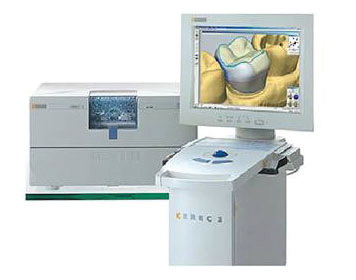
CAD/CAM

Digital impression
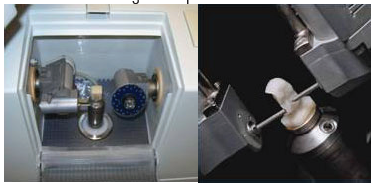
Copy milling

Milled Block
Examples of Zirconium oxide blocks
- Lava Frame (3M ESPE)
- Everest ZS und ZH (KaVo)
- InCoris ZR (Sirona)
- In-Ceram YZ (Vita) - Lava Frame (3M ESPE)
- Everest ZS und ZH (KaVo)
- InCoris ZR (Sirona)
- In-Ceram YZ (Vita) - Lava Frame (3M ESPE)
- Everest ZS und ZH (KaVo)
- InCoris ZR (Sirona)
- In-Ceram YZ (Vita)
Systems available for the machining of the ceramic blocks
- DCS Precident( 1989)
- Procera (1993)
- CEREC inLAB (2001)
- Cercon (2001)
- Lava (2002)
- CEREC 3D (2003)
- TurboDent (2005)
- E4D Dentist (2008)
DISCUSSION/ FUTURE TRENDS
The materials and methods for fabrication of all-ceramic restorations are changing rapidly and significantly. Each system has its own merits, but may also have shortcomings. Combination of materials and techniques are beginning to emerge which aim to exploit the best feature of each. The use of CAD/CAM and copy milling, particularly with regard to core material, is increasing. There is also an increase in the use of pressed ceramic rather than conventional hand layering techniques. The zirconia based systems are another exciting area of development which may finally mean that predictable metal free bridges are to become a reality and it is anticipated that this trend is likely to continue.
REFERENCES
- McLean JW, Hughes TH. The reinforcement of dental porcelain with ceramic oxides. Br Dent I 1965; 119:251-267.
- Kelly JR. Dental ceramics: what is this stuff anyway? J Am Dent Assoc 2008; 139 Suppl: 4S-7S.
- Katz S, inventor American Thermocraft Corp., assignee. High strength feldspathic dental porcelains containing crystalline leucite. US patent 1989; 4,798,536. Ian 17.
- McLean JW, Kedge MI High-strength ceramics. Quintessence Int 1987; 18:97-106.
- Antonson SA, Anusavice KJ. Contrast ratio of veneering and core ceramics as a function of thickness. Int J Prosthodont 2001; 14(4):316-20.
- Craig's Restorative Dental Materials, ed 12. Mosby, 2006.
- Philips' Science of Dental Materials,ed 11. Saunders,2003
- Kingery WD, Bowen HK, Uhlmann DR 1976. Introduction to ceramics. 2nd ed. New York: John Wiley & Sons.
- Oh SC, Dong JK, Luthy H, Scharer P. Strength and microstructure of IPS Empress 2 glass-ceramic after different treatments. Int J Prosthodont 2000; 13(6):468-72.ll-ceramic crowns. Int J Prosthodont 2000; 13(5):420-4.
- Luthardt RG, Sandkuhl O, Herold V, Walter MH. Accuracy of mechanical digitizing with a CAD/CAM system for fixed restorations. Int J Prosthodont 2001; 14(2):146-51.
Disclaimer from Guident
The views and opinions expressed in articles published in Guident are solely those of the authors and do not necessarily reflect the views of the editors, the editorial board or the publisher, Ivory India. Guident does not endorse any product, technique or treatment described. Clinical content is intended for qualified dental and medical professionals and is not a substitute for individual clinical judgement. Guident, its editors and the publisher accept no liability for any consequence arising from the use of information published in the journal.
How to cite this article
Dr. Akanshya Nautiyal, Dr. Shashank Uniyal, Dr. Himanshu Aeran Department of Prosthodontcs. Recent Ceramic Materials: An Esthetic Promise to Patient. Guident. 2015 Feb;8(3). Available from: https://ivoryindia.in/articles/prosthodontics/recent-ceramic-materials-an-esthetic-promise-to-patient.html


