Resto Ration of Badly Broken Teeth : An Endo-Prostho Approach
Department of Prosthodontics, Department of Conservative Dentistry and Endodontics, Department of Prosthodontics, Seema Dental College and Hospital, Rishikesh
ABSTRACT
Restoration of the damaged teeth in the esthetic zone is a difficult challenge specially when functional loads are concerned. A post and core system is required to provide retention and support for restoration of the teeth lacking coronal tooth structure. Among the various prefabricated post and core, fibre reinforced post are more preferred because of their strength, easily retrievability and superb esthetics. This article describes a procedure for the management of endodontically treated teeth with damaged coronal portion using a fibre reinforced post to achieve high level of esthetics.
KEY WORDS: Endodontically treated tooth, Fibre Post, Post and Core.
INTRODUCTION
Severely broken teeth or tooth due to caries or trauma is difficult to restore with conventional restorations or even with a crown. In patients having insufficient coronal tooth structure, the tooth is not able to meet the biomechanical considerations of retention of a crown. So in such cases it is desired to improve the retention offered by the remaining tooth structure which is derived in the form of intraradicular retention using post and core.
Mostly, severely damaged teeth showed pulpal involvement so an endodontic therapy is often required. The restoration of an endodontically treated tooth with a favourable prognosis still poses a great challenge to the dentist due to complexity of process and the controversial selection of treatment options that exists1.The quality of the root canal treatment, periodontal support, height of available bone, occlusion, available interarch space, para-functional habits and the intended function of the tooth or teeth are the necessary parameters to be considered before opting post and core treatment. Amongst the post and cores we have a choice for the custom post & core and the prefabricated post & core systems ,but both have their own pros and cons. A number of prefabricated post systems are available in the market with different types of materials and retentive devices. To name a few like: Zirconium dioxide post and core system, Para post system, flexi post system, Pro post system etc.
The increasing demand for more biocompatible and esthetic post and core has led to the development of metal free post and core systems2. This article describes a series of two case reports highlighting the management of badly broken teeth with endodontic therapy , fibre reinforced post & core build up followed by porcelain fused to metal crown showing good esthetic and functional results.
CASE REPORT 1
A 28 years old female patient presented with a fractured right maxillary tooth and complains of loss of esthetics. On examination, Ellis Class III fracture involving pulp was found with respect to the right maxillary central incisor ( figure 1). Root canal treatment was done using crown down technique and the canal was obturated. The success of the root canal treatment was accessed and when found satisfactory the canal was prepared with specific instruments.

After this, post space preparation was done with the help of color coded Peesoreamer of various sizes available, assuring that pulpal axial line angles was rounded and not sharp. Shade of dentin was selected with a conventional shade guide.The available shades are limited but a closer approximation to the dentin color was achieved.
The canal was thoroughly cleansed with NaOCl and dried with paper points. A dual-curing, self-etch adhesive was applied with an applicator to the base of the post space and air-dried. Any excess adhesive was absorbed with an endodontic paper point using a rapid intermittent movement. A dual-cure, resin cement was injected into the post channel using an angled tip. The fiber post was immediately inserted into the post hole to the base of the prepared channel and light-cured from different positions for about 2 minutes .After polymerization, the fiber post was cut with a diamond bur to the predetermined length. Serrated instrument never be used because they can damage the integrity of the post. Luting of the fibre post with the help of flurocore post luting material (Dentsply) was done .A dual-curing self-etch adhesive was applied to the remaining dentin surface and light-cured for 10 seconds. A dual-cure, radiopaque flowable core-build-up composite material was injected over the coronal aspect of the post, sculpted with a long bladed interproximal instrument, and smoothening was done followed by light cure for 40 seconds(figure 2). Now, tooth preparation was done in conventional manner. Impression was made with the help of addition silicone elastomeric impression material (Reproseal Light body impression material, Dentsply)(figure 3).Final impression was poured in die stone .Die pinning was done using pin-dex system .Wax pattern was fabricated ,invested,casted and finished. Ceramic application was done over the metal coping as per the shade matched.. Finally, a porcelain fused to metal crown was luted onto the prepared tooth.(figure 4).
CASE REPORT 2
A female patient aged 52 years reported with a chief complaint of broken teeth in the upper left front tooth region since past 3 months. On examination, it was found that Ellis Class III fracture involving pulp was seen. Root canal treatment was done using crown down technique and the canal was obturated. Choice was made to restore these teeth with fibre post ( figure 5).After this, post space preparation was done with the help of color coded Peesoreamer available. Then the canal was thoroughly cleansed with NaOCl and dried with paper points. Now a corresponding fibre post was inserted into the canal and the fitting of the post was checked radiographically. Luting of the fibre post with the help of flurocore post luting material( Dentsply) ( figure 6) was done and then with the same material preparation of a core was done(figure 7).
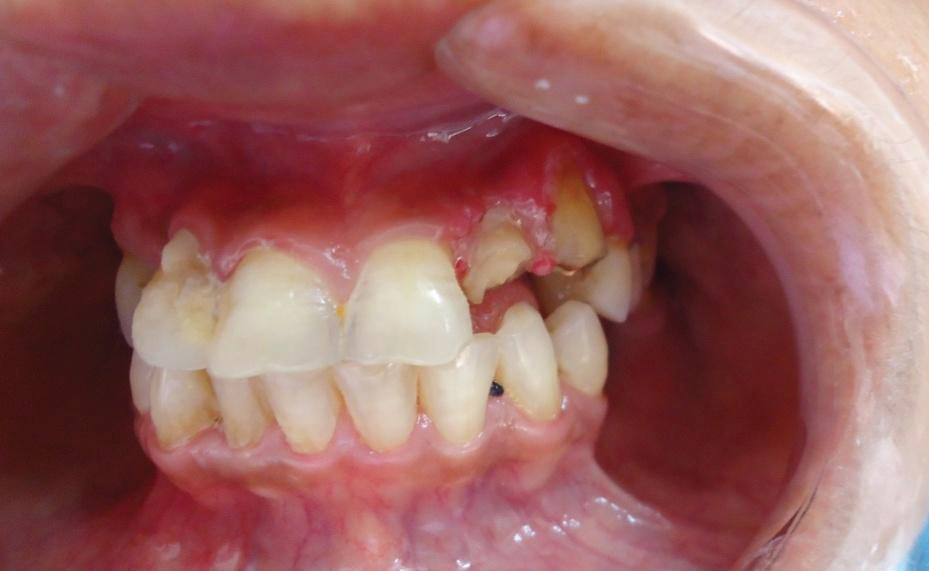
Fig 5: Pre-operative view

Fig 6: Cementation of prefabricated fibre post

Fig 7: Core build up

Fig 8: Elastomeric final impression
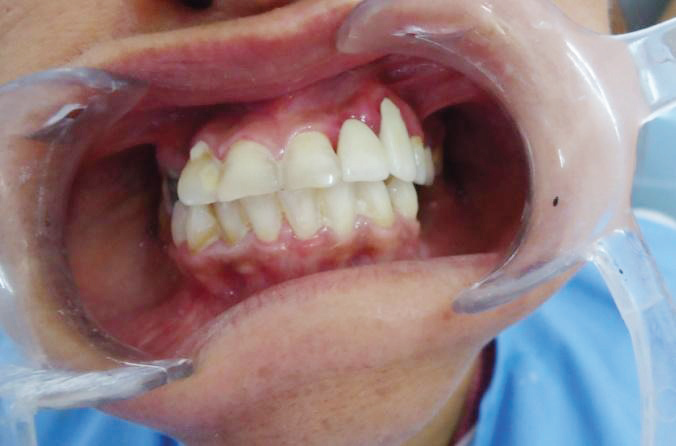
Fig 9: Porcelein fused to metal crown
Now, tooth preparation for porcelain fused to metal crown was done. Final impression was made with the help of addition silicone elastomeric impression material (Reproseal Light body impression material, Dentsply)(figure 8). Finally, a porcelain fused to metal crown was luted onto the prepared tooth (figure 9).
DISCUSSION
The restoration of severely damaged tooth or teeth can be done with the help of post and core. ‘Post’ or ‘Dowel’ should be used in endodontically treated tooth to retain the core only when little dental substance remains i.e. one or no cavity walls3. Post are recommended to strengthen weakened endodontically treated teeth against intraoral forces by distributing torquing forces along the root. A ferrule of approximately 2 mm greately increases the prognosis of endodontically treated tooth when it is to be restored with a crown4. The remaining tooth structure is much more crutial than the post length in avoiding tooth fracture as an endodontically treated tooth becomes brittle, so the post length should be limited by a necessary apical seal of 4mm to 6mm. Endodontically treated tooth is a unique subset of teeth requiring restoration because of several factors such as dehydrated dentin, decreased structural integrity and impaired neuro sensory feedback mechanism when compared to a vital tooth. Prosthetic restoration of non vital anterior teeth often requires making a post and core to support a crown and restore the remaining tooth structure5. The traditional custom-cast dowel core provides a better geometric adaptation to excessively flared or elliptical canals, and almost always requires minimum tooth structure removal. Custom cast post-and-cores adapt well to the extremely tapered canals or those with a noncircular cross section and/or irregular shape, and roots with minimal remaining coronal tooth structure.6 Patterns for custom cast posts can be formed either directly in the mouth or indirectly in the laboratory. Regardless, this method requires atleast 2 appointment visits and a lengthy laboratory procedure.
Considering aesthetics , the cast metallic post can result in discoloration and shadowing of the gingiva and the cervical aspect of the tooth .A prefabricated fibre reinforced post offers many advantages i.e. aesthetics, single appointment procedure ,no laboratory fees, no corrosion ,negligable root fracture,no designated orifice size, increased retention due to surface irregularities, conserved tooth structure and no negative effects on esthetics7,8. Posts should be of an adequate length and should fit well into the canal. Therefore, with direct systems, precision drilling and matching of the post can be carried out9. Core fabrication using prefabricated posts and composite resin is the ideal technique for restoration of endodontically treated teeth. Prefabricated composite post systems are replacing metal post systems because adhesive procedure with the fiber-reinforced composite post system adds strength to the tooth-restorative interface after bonding The procedure described in the case reports is easy to use, less expensive and less chair side time needed. After insertion, aesthetics was improved and patients were satisfied.
CONCLUSION
Most endodontically treated teeth require a post-and-core build-up for restoring the teeth to optimum health and function. Selection of an appropriate post-and-core system from the wide variety of those available may be a clinical dilemma. Comparatively, the procedure is less time-consuming than conventional procedures resulting in good esthetics and function The clinical results are promising and a favorable prognosis can be expected.
REFERENCES
- Alan AM, Raman P, Restoration Of The Endodontically-Treated Tooth: Treatment Planning Concepts For Optimal Results in Restorative Dentistry. Dental Learning 2012; 1(5): 3-18.
- Mclean A. Criteria for The Predictably Restorable Endodontically Treated Tooth. J of Can Dent Asso 1998;64:652-6.
- Ingrid Preoz I et al. Restoring Endodontically Treated Teeth With Post And Cores- A Review. Quint Int 2006;36(9): 737-744.
- Pereira Jr, De Ornelas F, Rodrigues Conti Pc, Lins Do Valle A. Effect Of A Crown Ferrule On The Fracture Resistance Of Endodontically Treated Teeth Restored With Prefabricated Posts. J Prosthet Dent 2006;95(1):50-4.
- Kumar V, Jurel SK, Gupta DS, Singh RD. Treatmentof PulpLess Tooth Using Prefabricated Post and Core And Fixed Restoration. Int J of Dent clin 2012; 4(3):48-49.
- Rosenstiel SF, Land MF, Fujimoto J. /Contemporary Fixed Prosthodontics/. St. Louis, Mo: Mosby; 1988:198-218.
- Shillingburg Jr Ht, Fisher Dw, Dewhirst Rb. Restoration Of Endodontically Treated Posterior Teeth. J Prosthet Dent 1970;24(4):401-9.
- Zalkind M, Hochman N. Esthetic Considerations In Restoring Endodontically Treated Teeth With Posts And Cores. J Prosthet Dent 1998;79(6):702-5.
- Pereira Jr, Valle Ald, Juvêncio Tm, Fernandes Tmf, Ghizoni Js, Só Mvdr. Effect Of Post Length On Endodontically Treated Teeth: Fracture Resistance. Braz J of Oral Sciences. 2010;9(3):371-5.
Disclaimer from Guident
The views and opinions expressed in articles published in Guident are solely those of the authors and do not necessarily reflect the views of the editors, the editorial board or the publisher, Ivory India. Guident does not endorse any product, technique or treatment described. Clinical content is intended for qualified dental and medical professionals and is not a substitute for individual clinical judgement. Guident, its editors and the publisher accept no liability for any consequence arising from the use of information published in the journal.
How to cite this article
Dr. Himanshu Aeran, Dr. Ajeet Singh Bhalla, Dr. Rahul Dhami. Resto Ration of Badly Broken Teeth : An Endo-Prostho Approach. Guident. 2014 May;7(6). Available from: https://ivoryindia.in/articles/prosthodontics/resto-ration-of-badly-broken-teeth-an-endo-prostho-approach.html