The Ceramic Steel - Monolithic VS Veneered
s Dental College & Hospital, Raichur, Karnataka, Maharashtra
ABSTRACT
The intent of the article is to give a thorough knowledge and impact on zirconia all ceramic restorations and its recent trends. It is a known fact that CAD CAM technology plays a vital role in the application of zirconia for tooth colored restorations, fixed dental prosthesis and implants. This article presents the development of different generations of zirconia along with their range of indications from veneered to monolithic restorations. Nowadays the number of patients opting for metal free restorations is high due to their superior esthetics and enhanced mechanical properties. Zirconia or The Ceramic Steel has been widely used in the market over 15 years whether as a framework material or a fully anatomical alternative. Interest is increasingly focused on the latter given the efficient mode of production as a restorative option.
Keywords: ceramic steel, monolithic,veneered zirconia, flexural strength, wearand translucency.
INTRODUCTION
Zirconium dioxide (ZrO2) or zirconia is a white crystalline oxide of zirconium. The most naturally occurring form is the mineral baddeleyitewith a monoclinic crystalline structure. Zirconia is produced by calcining zirconium compounds to form white, high-fusing, crystalline powder which is then press formed and sintered.
Zirconia exists in three phases with change in temperature i.e.monoclinic <1,170 °C, tetragonal 1,170–2,370 °C, and cubic >2,370 °C.1(Fig 1)When zirconia changes from tetragonal to monoclinic phase i.e. martensitic transformation, there will be increase in volume leading to excessively high tension and the development
of cracks in the ceramic structure, which makes it impossible to produce sintered ceramics from pure zirconia. This transformation can be prevented by the addition of stabilizing oxides, which are incorporated into the crystal lattice of the zirconia. So the structure is maintained even at room temperatures, into thetetragonal or the new cubic-tetragonal condition. Theoxides most commonly used are yttrium oxide (Y-TZP) or cerium oxide (Ce-TZP/Al2O3).2

Fig 1: Phase transformation of zirconia with increase in temperature.
Zirconia An yttria-stabilized tetragonal zirconia polycrystal (Y-TZP) popularly called “zirconia” has been the most common dental high-strength ceramic for some years. Y-TZP contains only polycrystalline particles in a metastable tetragonal crystal structure and is the dental ceramic material with the highest fracture strength available till date. The strength of zirconia depends on the density of the polycrystalline particles and quality of the product.3
THREE GENERATIONS OF ZIRCONIA
First-generation zirconia (3Y-TZP) or theConventional zirconia is metastable and can be rendered more translucentby changing the sintering temperature, dwell time and cooling. The highest sintering temperature (1600°c) although increases translucency it also leads to increased grain size thereby decreasing flexural strength.4Due to these negative behavior with regard to strength and long-term stability, the first monolithic generation of zirconia failed to become established.
Modification of zirconia in molecular level resultsin second-generation zirconia (3Y-TZP).The number and grain size of the aluminum oxide (Al2O3) grains were reduced and were relocated in the zirconia framework. This leads to higher transmittance of light with consistently good long-term stability and high strength.In-vitro studies on this generation show not only higher translucencies but also higher strengths both initially and after diverse artificial aging processes. But the translucency was still inferior to that of glass-ceramics, so Modification of the crystal structure was made which results in third-generation zirconia (5Y-TZP).
The third generation zirconia is not only metastable in the tetragonal phase but also contains a cubic phase proportion of up to 53%. It is described as fully stabilized zirconia with a mixed cubic/ tetragonal structure. The cubic portions were achieved through addition (9.3 wt%/5 mol%) of yttrium oxide. Due to higher volume of cubic crystals light scatters less strongly at the grain boundaries and residual porosities, making the material more translucent. No hydrothermal aging occurs withthird-generation zirconia, which means that the material retains its microstructure and strength even with increasing wearing time. One disadvantage of thisgeneration is the potentially lower fracture toughness of the material because of the cubic/tetragonal stabilization.2
VENEERED ZIRCONIA
In the first-generation zirconia, the restoration framework is veneered with suitable glass-ceramics to improve the esthetics. The difference in the coefficients of thermal expansion (CTE) of the framework material and veneering ceramic results in inner tension which gives overall stability to the prosthesis. The masticatory
Force on the restoration acts as external tension. When the sum of the inner tensions and externally induced tensions exceeds the strength of the materials, a fracture develops. The veneering ceramic has significantly lower strengths than the zirconia, it fractures more rapidly. This is known as chipping. (Fig 2, 3)
Chipping always occurs within the veneering ceramic due to cohesive failure. This phenomenon is most common in zirconia compared to metal ceramics.5The design of the restoration framework has a critical influence on the overall stability of the restorations. The fracture resistance can be increased by suitable design of the restoration.
Layering technique: It is the conventional ceramic build up procedure carried out manually on the zirconia framework and sintered at higher temperature. Clinical studies have showed that chipping or delamination of veneering ceramic is most common in this technique.

Fig 2: Different areas of fracture of veneered restoration.

Overpressing technique:The "overpressing technique" has been followed for veneering zirconia. A specific ceramic is pressed onto the zirconia framework. The incidence of chipping is reduced, since the heatpressing fabrication method would reduce the formation of large flaws and minimize the thermally induced residual stresses. The shrinkage level of the porcelain may be related to the ratio ofthe mixed powder/liquid veneering ceramic and firing cycle. Catastrophic failures can be induced by the incorporation of small impurities like inhomogenities,pores. The pressing technique permit the creation of desired tooth anatomy while minimizing firing shrinkage.Higher tensile strength of press-on veneers and the superior quality of the interface can prevent porcelain chipping. These materials exhibited better fracture strength and fatigue behavior when compared to the hand-layered ceramics.6
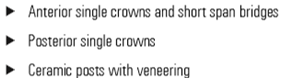
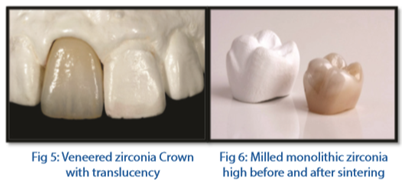
Indications :
MONOLITHIC ZIRCONIA
To avoid the risk of chipping, a monoblock of zirconia are introduced. Monolithic comes from “monolith” (Greek word “monolithos” meaning “single stone”).
The nonveneered full cast crowns, pressed or milled glass-ceramic crowns without veneering, or non-veneered zirconia crowns are examples of typical monolithic restorations. Due to the opaque nature of zirconia it is highly not pleasing to be used in esthetic areas.Because of high flexural strength, monolithic restorations are ideally indicated for stress-bearing areas and only a reduced space of 0.5mm is required compared to veneered restorations.7 (Fig 7, 8)
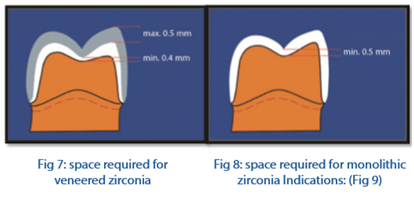


Fig 9: Indications of monolithic zirconia A- Inlays and onlays, B- Resin bonded bridge and inlay retained bridge, C- Single Crowns and Bridges, D- Implants and implant abutments.
MONOLITHIC VS VENEERED ZIRCONIA
Translucency
The transmittance value is low for monolithic zirconia resulting in decreased translucency.8The need for “high translucency” zirconia is related to the possibility of aesthetic improvement for monolithic restorations. Eventhough the glass ceramics are superior in translucency compared to zirconia, the reduced thickness in monolithic restorations increases the translucency relatively.Veneered zirconia shows improved translucency so it can be indicated in esthetic areas and due to the risk of chipping it is not indicated in high stress bearing areas. The luting cement, firing temperature(the contrast ratio decreased from 0.75 to 0.68)9 and the thickness of restoration alters the translucency. Improved translucency combined with coloring techniques could yield promising clinical outcomes for monolithic zirconia fixed prostheses, ensuring adequate durability.(Fig 10)
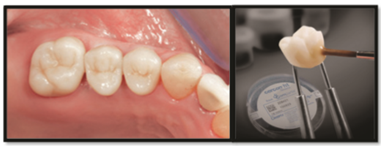
Fig 10 (A and B): monolithic zirconia FPD with added stains to match the natural tooth
FLEXURAL STRENGTH
Monolithic zirconia ceramics were found to have superior chipping resistance and flexuralStrength compared to veneering porcelain. The flexuralstrength (1235 MPa), compressive strength and elastic modulus (113.1 GPa) of anatomic contour zirconia were found to be significantly higher than those of veneered restoration.10This superior property of monolithic zirconia makes suitable for use in high load bearing areas whereas the veneered zirconia is contraindicated in such conditions.
FRACTURE RESISTANCE
Zesewitz et al. reported Monolithic zirconia showed the highest fracture resistance compared to veneered ceramics. The highest mean fracture force was reported as 5.620 N for zirconia crowns.11Beuer et al. reported that the mean fracture load for both polished and glazed zirconia was above 10,000 N. Polished, sintered and glazed zirconia showed a significantly higher loadbearing capacity than conventional veneering.12 Sun et al. reported that the fracture load for Monolithic zirconia crowns (1.5 mm), calculated as 4109.93§610.18 N, was found to be significantly higher than that of layered zirconia (2308.0§510.94 N), which indicates better resistance of MZCs to fracture load than veneered crowns.13Johansson et al reported that high translucent zirconia crownswere found to have higher fracture resistance (2795 and 3038 N) than porcelain-veneered zirconia crowns (2229 N) and porcelain-veneered high translucent zirconia (1480 and 1808 N).14Full-contour polished or glazed zirconia FDPs might be an alternative to veneeredrestorations because of their high resistance tofailure and fracture.
HARDNESS
Mormann et al. reported that the mean hardness (Martens Hardness, MH) value of monolithic zirconia is 7996 (MH) which is superior to all other types of ceramics. Among the aesthetic CAD/CAM materials,a resin-based nanocomposite, human enamel and a zirconia had the greatest hardness.15Thisincreased hardness of zirconia have greatest wear potential to antagonist teeth but the polished surface of zirconia hampers such wear.
SURFACE ROUGHNESS AND WEAR
Surface roughness could affect the amount of wear on porcelain or natural enamel antagonists.Janyavula et al. reported that glazed zirconia (Ra: 0.76 § 0.12 mm) and polished and then glazed zirconia (Ra: 0.69 § 0.1 mm) had smoother surfaces than enamel (2.6 § 1.1 mm) and veneered zirconia (1.6 § 0.16 mm) but were rougher than polished zirconia (Ra: 0.17 § 0.07 mm).16Hmaidouch et al. found that the maximum roughness depth of glazed zirconia (4.311§0.93 mm) was higher than that of fine-polished zirconia surfaces (2.41 § 0.51 mm). Polishing of zirconia decreases the surface roughness and wear compared to glazing of veneered zirconia.17Grinding significantly increased the roughness of sintered zirconia, whereas, polishing significantly reduced it. So the zirconia restorations are required to be polished after the final occlusal adjustments.(Fig 11)
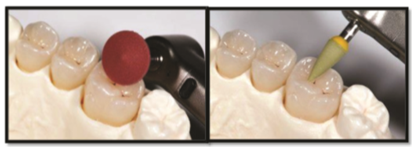
Fig 11: Different polishing burs are used to polish the surface of zirconia after occlusal adjustments.
CONCLUSION
Due to the advancements in digital dentistry the esthetic quality of zirconia has been improved significantly. To overcome the mechanical failures in veneered zirconia prosthesis, monolithic zirconia is widely used nowadays. Various modifications have been made in monolithic zirconia to improve the esthetic optimization which includes staining and individual coloring thereby resulting in quality of the restoration by mechanical as well as esthetic means. Higher strength, higher fracture resistance, decreased thickness of material and improved translucency makes the monolithic zirconia a superior option for fixed dental prosthesis. Furthermore improvements have to be made in the veneering material to overcome the problem of chipping and extended use of zirconia in other fields of dentistry also.
REFERENCES
- Tosoh Corporation. Herstellerangaben von eigenenUntersuchungen derGefügeumwandlung in monokline Phase [Manufacturer’s data on in-housestudies of structural transformation in the monoclinic phase]. Tokyo: ToshohCorporation, 2014.
- Stawarczyk B, Keul C, Eichberger M, Figge D, Edelhoff D, Lümkemann N. Three generations of zirconia: From veneered to monolithic. Part I. Quintessence International. 2017 May 1;48(5).
- Guazzato M, Quach L, Albakry M, Swain MV. Influence ofsurface and heat treatments on the flexural strength of Y-TZP dental ceramic. J Dent 2005;33:9-18.
- Stawarczyk B, Emslander A, Roos M, Noack F, Sener B, Keul C. (3) Zirconia ceramics, their contrast ratio and grain size depending on sintering parameters. Dent Mater J 2014;33:591–598.
- Heintze SD, Rousson V. Survival of zirconia- and metal supported fixed dental prostheses: a systematic review. Int J Prosthodont 2010;23:493–502.
- Daou EE. The zirconia ceramic: strengths and weaknesses. The open dentistry journal. 2014;8:33.
- Rinke S, Fischer C. Range of indications for translucent zirconia modifications: clinical and technical aspects. Quintessence International. 2013 Sep 1;44(8).
- Harianawala HH, Kheur MG, Apte SK, et al. Comparative analysis of transmittance for different types of commercially available zirconia and lithium disilicate materials. J AdvProsthodont. 2014;6:456_461.
- Ebeid K, Wille S, Hamdy A, et al. Effect of changes in sintering parameters on monolithic translucent zirconia. DentMater. 2014;30:419_424.
- Kok P, Kleverlaan CJ, Jager N, et al. Mechanical performance of implant-supported posterior crowns. J Prosthet Dent. 2015;114:59_66.
- Zesewitz TF, Dent M, Knauber W, et al. Fracture resistance of a selection of full-contour all-ceramic crowns: an in vitro study. Int J Prosthodont. 2014;27:264_266.
- Beuer F, Stimmelmayr M, Gueth J. et al. In vitro performance of full-contour zirconia single crowns. Dent Mater. 2012;28:449_456.
- Sun T, Zhou S, Lai R, et al. Load-bearing capacity and the recommended thickness of dental monolithic zirconia single crowns. MechBehav Biomed Mater. 2014;35:93_101.
- Johansson C, Kmet G, Rivera J, et al. Fracture strength of monolithic all-ceramic crowns made of high translucent yttrium oxide-stabilized zirconium dioxide compared to porcelain-veneered crowns and lithium disilicate crowns. ActaOdontol Scand. 2014;72:145_153.
- Mormann WH, Stawarczyk B, Ender A, et al. Wear characteristics of current aesthetic dental restorative CAD/CAM materials: two-body wear, gloss retention, roughness and Martens hardness. J MechBehav Biomed Mater. 2013;20:113_125.
- Janyavula S, Lawson N, Cakir D, et al. The wear of polishedand glazed zirconia against enamel. J Prosthet Dent.2013;109:22_29.
- Hmaidouch R, M€uller WD, Lauer HC, et al. Surface roughnessof zirconia for full-contour crowns after clinically simulatedgrinding and polishing. Int J Oral Sci.2014;6:241_216.
Disclaimer from Guident
The views and opinions expressed in articles published in Guident are solely those of the authors and do not necessarily reflect the views of the editors, the editorial board or the publisher, Ivory India. Guident does not endorse any product, technique or treatment described. Clinical content is intended for qualified dental and medical professionals and is not a substitute for individual clinical judgement. Guident, its editors and the publisher accept no liability for any consequence arising from the use of information published in the journal.
How to cite this article
Dr. Lokesh Kumar K Dr. Sai Swethaa S Dr. Sunil Dhaded Department of Prosthodontics Ame. The Ceramic Steel - Monolithic VS Veneered. Guident. 2017 Nov;10(12). Available from: https://ivoryindia.in/articles/prosthodontics/the-ceramic-steel-monolithic-vs-veneered.html