Management of a Traumatically Avulsed Tooth by Reimplantation
Department of Conservative Dentistry and Endodontics, Faculty of Dental Science, Institute of Medical Science, B.H.U, Varanasi
ABSTRACT
Trauma to the face comprises 5% of all injuries. Approximately 0.5-16% of traumatic injuries to the permanent anterior dentition results in tooth avulsion. Reimplantation refers to the insertion and temporary fixation of completely or partially avulsed teeth. Successful reimplantation of an avulsed tooth depends on certain conditions like physiological status of periodontal ligament, the stage of root development and the length of extra oral time. Reimplantation of the avulsed tooth can restore natural appearance immediately and occlusal function shortly after the injury. A 21 year male patient reported in out patient department with the chief complaint of tooth loss due to trauma 2 days back.The patient brought the tooth in dry state. As extra oral time was more than 24 hours, root canal treatment was done extra orally and the tooth was reimplanted in the socket and splinted after planting it in right position. After 2 weeks splint was removed and patient was kept on regular follow up.Avulsion of tooth is one of the emergency situations in dentistry. Immediate reimplantation or maintenance of the avulsed tooth in storage media compatible for survival of PDL cells before reimplantation is an imperious procedure. Replanted teeth should be monitored regularly clinically and radiographically.
Key Words: Avulsion,Reimplantation,Resorption,Splinting,Periodontal ligament
INTRODUCTION
Avulsion is defined as a complete separation of a tooth from its alveolus following a traumatic injury which results in extensive damage to the pulp and periodontal tissues.2Avulsion of teeth results from traumatic injuries in the oro-facial region. As per World Health Organization’s classification system which was later modified by Andreasen, avulsion is classified as an injury of periodontal tissues, as well as extrusive, lateral, or intrusive luxation1. Among all facial injuries, dental injuries are the most common3 of which avulsions occur in 1–16% of all dental injuries4.
Reimplantation refers to the insertion and temporary fixation of completely or partially avulsed teeth that have resulted from traumatic injury. As a treatment option, reimplantation restores occlusal function and esthetics shortly after injury. In reimplantation complete reestablishment of vitality of periodontal fibers is the prime objective. The percentage of success of tooth reimplantation has been observed to be low, ranging from 4 to 50%5.
When tooth is avulsed, attachment damage and pulp necrosis occurs. Tearing of the periodontal ligament leaves viable periodontal ligament cells on most of the root surface and due to the crushing of the tooth against the socket, small localized cemental damage also occurs. If the periodontal ligament left attached to the root surface does not dry out, the consequences of tooth avulsion are usually minimal6,7.The hydrated periodontal ligament cells will maintain their viability, allowing them to reattach on replantation. As the crushing injury is contained within a very localized area, inflammation stimulated by the damaged tissues will be limited, thus healing with new replacement cementum is likely to occur after the initial inflammation has subsided. If excessive drying occurs before replantation, the damaged periodontal ligament cells will elicit a severe inflammatory response over a diffuse area on the root surface. The slower moving cementoblasts cannot cover the entire root surface in time and bone will attach itself directly onto the root surface. Through physiologic bone re-contouring, the entire root will be replaced by bone; which is termed osseous replacement or replacement resorption8, 9.The combination of bacteria in the root canal and cemental damage on the external surface of the root results in external inflammatory resorption which can lead to the rapid loss of tooth10. Treatment should always limit the extent of the peri-radicular inflammation, thus tipping the balance towards favorable (cemental) rather than unfavourable (osseous replacement or inflammatory resorption) healing.
In this case study we have used reimplantation as an treatment alternative for a traumatically avulsed tooth kept dry. Follow up showing no sign of resorption and mobility.
CASE REPORT
21 year male patient reported out patient department with the chief complaint of tooth loss due to trauma, 2 days back and he brought the tooth in dry state. On clinical examination socket of tooth #21 was found filled with blood clot and tooth #11 was fractured(Fig1a). Radiographic examination revealed empty socket of tooth #21(Fig2a). As the avulsed tooth was sound without any damage, it was planned to reimplant the avulsed tooth. Although extra oral time was more than 24 hours all the pros and cons were explained to the patient. After taking consent from the patient tooth was placed in acid for 5 min(Fig1d), soaked in 2% stannous fluoride for 5mins(Fig1e), then root canal treatment was done extra orally(Fig1f) and the tooth was reimplanted in the socket and splinted in right position(Fig1c). After 2 weeks as no mobility was present and patient was asymptomatic splint was removed and patient was kept on regular follow up.
On 6 month and 1 year follow up clinically the tooth did not show any anomaly (Fig1g). Radiographically no resorption or ankylosis (Fig2d, 2e)was seen and patient was asymptomatic. Root canal treatment of adjacent tooth was done followed by crown and patient was kept on follow up.
DISCUSSION
A review of the literature shows that an extraoral time of less than 15 minutes gives a greater success rate of retention (11) of reimplanted teeth, but if the time lapse is between 15 to 60 minutes, some authors advise that the tooth must be stored in suitable storage medium and transported to the clinic.12Storage media that have been frequently used include Hanks balanced salt solution, modified Eagles solution, Via Span, Euro-Collins solution, Emergency Medical Tooth saver, saline, powdered or pasteurized milk, bovine milk, saliva, or chicken egg white.12
CLINICAL MANAGEMENT
Emergency Treatment of Avulsion at the Accident Site
Replant if possible or place in an appropriate storage medium.
Most important factor for a favorable outcome after replantation is the speed with which the tooth is replanted13.Prognosis depends on prevention of drying, which causes loss of normal physiologic metabolism and morphology of the periodontal ligament cells13.
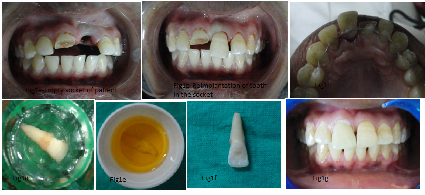
FIG1-a)Empty socket of tooth #21,b)Reimplantation of avulsed tooth in the socket,c)Splinting of reimplanted tooth,d)Avulsed tooth kept in acid,e)Tooth kept in 2% stannous fluoride solution,f)After root canal treatment of avulsed tooth,g)1year follow up photograph of patient.

FIG2-a)IOPA radiograph of empty socket of avulsed tooth,b)2 weeks follow up radiograph of splinted tooth,c)3 months follow up radiograph of patient,d)6 months follow up radiograph of patient,e)1 year follow up radiograph of patient.
The tooth should be reimplanted within the first 15–20 min14. Storage media in order of preference are; milk, saliva, either in the vestibule of the mouth or in a container into which the patient spits, physiologic saline or water15. It is found that cell culture media in specialized transport containers, such as Hank's Balanced Salt Solution (HBSS) or ViaSpan®, have superior ability in maintaining the viability of the periodontal ligament fibers for extended periods .(16 )
MANAGEMENT IN DENTAL OFFICE
Emergency Visit
If tooth was replanted at the site of injury, a complete history is taken to assess the favorable outcome. If the tooth is out of the mouth, the storage medium should be evaluated and, if required the tooth should be placed in a more appropriate medium. Hank's Balanced Salt Solution is considered the best medium for this purpose . Milk or physiologic saline is also appropriate for storage purposes.
The clinical examination includes an examination of the socket to ascertain if it is intact and suitable for replantation. The socket is gently rinsed with saline when clear of the clot and debris, its walls are examined for the presence, absence, or collapse of the socket wall. The socket and surrounding areas, including the soft tissues, should be radiographed.
Preparation of the root
If Extra – oral dry time is < 60 min
In Closed Apex cases:
Root should be rinsed of debris with water or saline and replanted gently. Revasculsarization is not possible17 but, as the tooth was dry for less than 60 min (replanted or placed in appropriate medium), the chance for periodontal healing is higher and the chance of a severe inflammatory response at the time of replantation is lessened. A dry time of less than 15–20 min is considered optimal where periodontal healing is expected6.Complications arise when tooth has been dry for more than 20 min (periodontal cell survival is assured) but less than 60 min (periodontal survival unlikely). Root surface consist of some cells with the potential to regenerate and some that will act as inflammatory stimulators. use of Emdogain® (Biora, Malmo, Sweden) has been found to be valuable in these cases. Endodontic treatment is performed at 7 to 10 days. If delayed or signs of resorption are present, then calcium hydroxide dressing upto 1 month is given followed by root canal filling.
In Open Apex cases
Tooth is soaked in doxycycline for 5 min, gently rinsed off debris and replanted. It helps in revascularization of the pulp as well as continued root development. Cvek et al. 17 found in monkeys that soaking the tooth in doxycycline (1 mg in approximately 20 mL. of physiologic saline) for 5 min before replantation significantly enhanced revascularization. Endodontic treatment is delayed and patient kept on follow up to check signs of revascularization. If signs of an infected pulp are found then apexification procedure is initiated.17, 18
If Exra-oral dry time is > 60 min
In Closed Apex cases:
The damaged periodontal ligament(which may initiate the inflammatory response on replantation) is removed by placing the tooth in acid for 5 min, soaked in 2% stannous fluoride for 5 mins or the root is covered with emdogain® and replanted in socket.6, 7, 19 The root is prepared to be as resistant to resorption as possible (attempting to slow the osseous replacement process). Aledronate was found to have similar resorption slowing effects as fluoride when used topically but further studies need to be carried out to evaluate whether its effectiveness is superior to fluoride and whether this justifies its added cost. Recent studies have found that Emdogain® (enamel matrix protein) may be extremely beneficial in teeth with extended extra oral dry times, not only to make the root more resistant to resorption but also to stimulate the formation of new periodontal ligament from the socket20. Endodontic treatment is performed at 7 to 10 days. If delayed or signs of resorption are present, then calcium hydroxide dressing upto 1 month is given followed by root canal filling.
In open apex cases
Similar root treatment as closed apex cases.As extra oral dry time is more there are no chances of revascularization.In these cases extra oral root canal treatment is preferred and then tooth is reimplanted in the socket.
SPLINTING
Splinting technique that allows physiologic movement of the tooth during healing and that is in place for a minimal time period results in a decreased incidence of ankylosis. Semi-rigid (physiologic) fixation for 7–10 days is recommended. In avulsion in conjunction with alveolar fractures, it is suggested that the tooth should be splinted for a period of 4–8 weeks20.
ADJUNCTIVE THERAPY
Systemic antibiotics at the time of replantation and prior to endodontic treatment are effective in preventing bacterial invasion of the necrotic pulp and, subsequent inflammatory resorption . Tetracycline has the additional benefit of decreasing root resorption by affecting the motility of the osteoclasts and reducing the effectiveness of collagenase . The administration of systemic antibiotics for patients not susceptible to tetracycline staining is Doxycycline 2× per day for 7 days at appropriate dose for patient age and weight or Penicillin V 1000 mg and 500 mg 4× per day for 7 days, beginning at the emergency visit and continuing until the splint is removed after 7–10 days22. Use of chlorhexidine rinses for 7–10 days is also useful.The patient should be sent to a physician for consultation regarding a tetanus booster within 48 h of the initial visit.22 Patient is kept on follow up.
Replanted teeth should be monitored during the first year (once a week during the months 1, 3, 6, and 12) and then yearly thereafter. Clinical and radiographic examination provides information to determine outcome. Evaluation includes the findings described below:
FAVORABLE OUTCOME
1 Closed apex. Asymptomatic, normal mobility, normal percussion sound. No radiographic evidence of resorption or periradicular osteitis; the lamina dura should appear normal.
2 Open apex. Asymptomatic, normal mobility, normal percussion sound. Radiographic evidence of arrested or continued root formation and eruption. Pulp canal obliteration.
UNFAVORABLE OUTCOME
1 Closed apex. Symptomatic, excessive mobility or no mobility (ankylosis) with high-pitched percussion sound. Radiographic evidence of resorption (inflammatory, infection-related resorption, or ankylosis-related replacement resorption).
2 Open apex. Symptomatic, excessive mobility or no mobility (ankylosis) with high-pitched percussion sound. In the case of ankylosis, the crown of the tooth will appear to be in an infra-occlusal position. Radiographic evidence of resorption (inflammatory, infection-related resorption, or ankylosis-related replacement resorption).
CONCLUSION
Immediate reimplantation or maintenance of the avulsed tooth in storage media compatible for survival of PDL cells before reimplantation is an imperious procedure. Inflammatory resorption and replacement resorption are usually observed after 1 and 1-2 months, respectively. However, when endodontic treatment is carried out on avulsed teeth, it improves the chances of retention and prevention of replacement resorption. Hence, when a patient presents with an avulsed tooth that is suitable for reimplantation, this treatment option must be evaluated as the reimpalnted tooth is always better than an artificial prosthesis.
REFERENCES
- Andreasen JO, Andreasen FM, Andersson L. 1. Textbook and color atlas of traumatic injuries to the teeth, 4th edn. Oxford: Blackwell Munksgaard; 2007.
- Decoronation – a conservative method to treat ankylosed teeth for preservation of alveolar ridge prior to permanent prosthetic Reconstruction: literature review and case presentation Dental Traumatology 2007.
- Petersson EE, Andersson L, Sorensen S. Traumatic oral vs non-oral injuries. Swed Dent J 1997; 21:55–68. )
- Glendor U, Halling A, Andersson L, Eilert- 3. Petersson E. Incidence of traumatic tooth injuries in children and adolescents in the county of Vastmanland, Sweden. Swed Dent J 1996; 20:15–28. )
- Andreasen JO, Borum MK, Jacobsen HL, Andreasen FM. Replantation
- of 400 avulsed permanent incisors. 4. Factors related to periodontal ligament healing. Endod Dent Traumatol. 1995; 11:76-89.)
- Andreasen JO. The effect of extra-alveolar period and storage media upon periodontal and pulpal healing after replantation of mature permanent incisors in monkeys. Int J Oral Surg 1981; 10:43–51.
- Soder PO, Otteskog P, Andreasen JO, Modeer T. Effect of drying on viability of periodontal membrane. Scand J Dent Res 1977; 85:167–172. ).
- Andreasen JO, Hjorting-Hansen E. Replantation of teeth, I: Radiographic and clinical study of 110 human teeth replanted after accidental loss. Acta Odontol Scand 1966; 24:263–269.
- Trope M. Root resorption of dental and traumatic origin. Classification based on etiology. J Pract Periodont Aesthet Dent 1998; 10:515–522. )
- Tronstad L. Root resorptionetiology, terminology and clinical manifestations,. Endod Dent Traumatol 1988; 4:241. ).
- Petrovic B, Markovic D, Peric T, Blagojevic D. Factors related to treatment and outcomes of avulsed teeth. Dent Traumatol 2010; 26:52-9. )
- Andreasen JO, Kristersson L. The effect of limited drying or removal of the periodontal ligament: Periodontal healing after replantation of mature permanent incisors in monkeys. Acta Odontol Scand 1981; 39:1
- Sottovia AD, Sottovia Fiho D ,Poi WR,Panzarini SR, Luize DS,Sonoda CK.Tooth replantation after use of Euro-Collins solution or bovine milk as storage medium: A histomorphometric analysis in dogs. J Oral MaxillofacSurg 2010; 68:111-9
- Barrett EJ, Kenny DJ. Avulsed permanent teeth: a review of the literature and treatment guidelines. Endod Dent Traumatol 1997; 13:153–163.
- Hiltz J, Trope M. Vitality of human lip fibroblasts in milk, Hanks Balanced Salt Solution and Viaspan storage media. Endod Dent Traumatol 1991; 7:69.
- Trope M, Friedman S. Periodontal healing of replanted dog teeth stored in Viaspan, milk and Hanks Balanced Salt Solution. Endod Dent Trau
- Cvek M et al. Effect of topical application of doxycycline on pulp revascularization and periodontal healing in reimplanted monkey incisors. Endod Dent Traumatol 1990; 6:170–177
- Yanpiset K, Trope M. Pulp revascularization of replanted immature dog teeth after different treatment methods. Endod Dent Traumatol 2000; 16:211–217
- Bjorvatn K, Selvig KA, Klinge B. Effect of tetracycline and SnF2 on root resorption in replanted incisors in dogs. Scand J Dent Res 1989; 97:477–482.
- Iqbal MK, Bamaas N. Effect of enamel matrix derivative (EMDOGAIN®) upon peirodontal healing after replantation of permanent incisors in Beagle dogs. Dent Traumatol 2001;17:36–46.19 Filippi A, Pohl Y, Von Arx T. Treatment of replacement resorption with Emdogain®– preliminary results after 10 months. Dent Traumatol 2001; 17:3–10.
- Andersson L, Friskopp J, Blomlof L. Fiber-glass splinting of traumatized teeth. ASDC J Dent Child 1983; 3:21.
- Hammarstrom L, Pierce A, Blomlof L, Feiglin B, Lindskog S. Tooth avulsion and replantation: a review. Endod Dent Traumatol 1986; 2:1–9.
Disclaimer from Guident
The views and opinions expressed in articles published in Guident are solely those of the authors and do not necessarily reflect the views of the editors, the editorial board or the publisher, Ivory India. Guident does not endorse any product, technique or treatment described. Clinical content is intended for qualified dental and medical professionals and is not a substitute for individual clinical judgement. Guident, its editors and the publisher accept no liability for any consequence arising from the use of information published in the journal.
How to cite this article
Dr. Mittal Neelam Dr.Swain Gitanjali). Management of a Traumatically Avulsed Tooth by Reimplantation. Guident. 2014 Jun;7(7). Available from: https://ivoryindia.in/articles/endodontics/management-of-a-traumatically-avulsed-tooth-by-reimplantation.html