Combined Orthodontic - Surgical Treatment of a Skeletal Class III Malocclusion
Department of Orthodontics & Dentofacial Orthopaedics, Post Graduate Instiute of Dental Sciences (Rohtak) University of Health Sciences, Rohtak
ABSTRACT
Severe orthodontic problems that neither growth modification nor camouflage offers a solution, orthognathic surgery is the only possible treatment . Surgery and Orthodontics in a combined approach achieves good overall results. A case report of an adult individual with Class III malocclusion having mandibular excess treated with bilateral sagittal split osteotomy technique for the correction of skeletal, dental and soft tissue discrepancy is herewith presented. Combined surgical-orthodontic approach helped the patient to improve the self confidence level.
Key words : Orthognathic surgery, Class III , Skeletal malocclusion
INTRODUCTION
The correction of dentoskeletal malocclusion always had a threefold goal of achieving a functional efficiency, structural balance and esthetics.1,2 In severe malocclusion cases with dentoskeletal discrepancy; there are generally only three possible therapeutic options: early modification of growth, orthodontic camouflage through dental compensations, or combined orthodontic and surgical ( Orthognathic ) repositioning of the jaw bases1.
The combined orthodontic and surgical treatment in adult individuals not only achieve a functional and stable occlusion but also establish normal skeletal relationships with soft tissue profile. In recent years an increasing number of patients elect to undergo orthognathic treatment to correct severe malocclusion that is not susceptible to a comprehensive orthodontic solution.
Orthognathic surgery and orthodontic therapy complement each other in these type of cases to achieve the desired results. A proper clinical examination followed by the appropriate diagnosis and treatment planning are essential
CASE REPORT
A 25 year old male patient with the chief complaint of coming out of lower anterior teeth reported to the Department of Orthodontics and Dentofacial Orthopedics, Post-Graduate Institute of Dental Sciences (PGIDS), Rohtak.
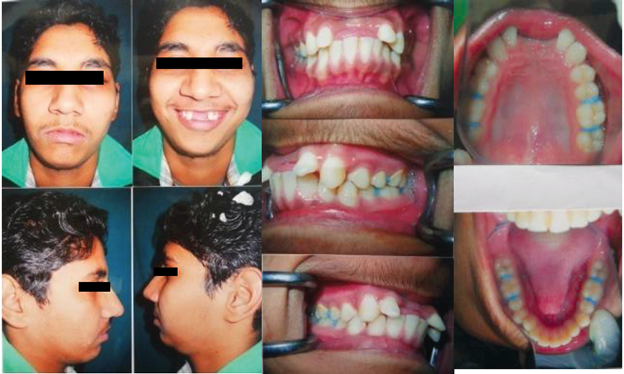
Clinically, profile view showed a concave profile (Fig.1), prognathic mandible, adequate nasolabial angle, severely protruded lower lip, flat mentolabial sulcus. The patient was healthy and no sign and symptoms of temporomandibular disorder were noted. Clinical frontal examination revealed a leptoprosorpic facial form, bilaterally symmetrical face, vertical assessment of the face showed increased lower anterior facial height. Dental examination revealed a class III molar relationship and Class III canine relationship, reverse overjet of 3 mm, anterior and posterior cross bite and individual tooth malpositions. Mandibular dental midline was shifted to the right by 1.5 mm. Cephalometric examination was done and it revealed a skeletal class III malocclusion on account of a normal maxilla (position and size ) , prognathic mandible and a vertical growth pattern, maxillary incisors were normally inclined and mandibular
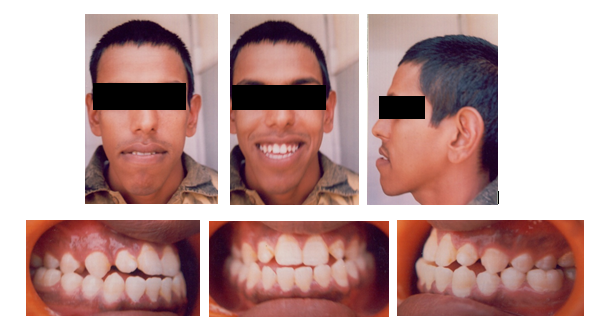
Fig. 1 Pre treatment photographs
incisors showed slight retroclination. Etiology in this case seemed to have a strong genetic component.
TREATMENT OBJECTIVES
- Attaining a pleasing profile by improving the relationship of jaw bases.
- Correction of cross bite.
- Correction of individual tooth malpositions.
TREATMENT ALTERNATIVES
Only orthodontic treatment with extraction of lower premolars would not have addressed the patients concern about facial esthetics and also there was a risk of of periodontal damage to mandibular incisors. Surgical option was the only possibility using a single jaw surgery i.e. mandibular set back ( using the bilateral sagittal split osteotomy )
TREATMENT PLAN
A presurgical orthodontic phase was started to align the arches and correct the individual teeth malposition. Bilateral sagittal split osteotomy was planned for 6 mm of mandibular setback which was to be followed by short phase of post surgical orthodontics to achieve final desired tooth intercuspation.
TREATMENT PROGRESS
The pre-surgical phase was initiated using a 0.022 slot pre-adjusted edgewise appliance using a MBT prescription. The maxillary and mandibular arches were aligned using 0.016 Ni-Ti arch wire which were followed progressively by heavy archwires like 0.016 SS, 0.018 SS, 0.017 X 0.025 SS arch wires. Final arch wires prior to surgery were 0.019 x 0.025 SS arch wires (Fig.2).
A bilateral sagittal split osteotomy was performed to setback 6 mm of mandible on both the sides using a splint (Fig.3,4). Post surgical phase was done using settling elastics to inter-digitate the individual teeth wherever required.
RESULTS
Most of the treatment objectives were achieved. There was a marked improvement in facial esthetics (Fig.5,6). Cross bite was corrected, reverse overjet was corrected, molar and canine relationship was corrected to Class I. Both maxillary and mandibular arches were aligned.
CONCLUSION
Skeletal Class III anomalies are one of the most complicated problems in childhood and adulthood of all dentofacial anomalies3,4. Class III skeletal problems are treated with a combination of Orthodontic and Orthopedic mechanics in growing individuals whereas correction of Class III malocclusion in adults requires .


Fig. 2 Mid-treatment photographs

Fig. 3 Splint fabrication


Fig. 4 Intra-operative photographs

Fig. 5 Post-treatment photographs

Fig. 6 Pre- (a) and Post- (b and c) treatment radiograph
complex surgical procedures for attainment of an optimal esthetic and functional result5. Facial balance, harmony, normal dental, skeletal and soft tissues relationships could be achieved in this case because of combined orthodontic – surgical approach
REFRENCES
- J.P.Reyneke, E ssentials of Orthognathic Surgery , Quintessence, Carol Stream, Ill, USA,2003.
- H.L.Legan, ‘’ Orthodontic considerations of Orthognathic Surgery’’, in Principles of Oral and Maxillo Facial Surgery, L..J.Peterson vol 3 Pg 1237-1278, Lipincott, Philadelphia, Pa U.S.A 1992.
- Takahashi H, Furuta H, Moriyama S. Assessment of three bilateral sagittal split osteotomy techniques with respect to mandibular biomechanical stability by experimental study and finite element analysis simulation. Med Bull Fukuoka Univ. 2009; 36: 187-192.
- Tompac PC, Wheeler J J, Fridrich KL. Orthodontic considerations in Orthognathic Surgery. Int J Adult Orthodon Orthognath Surg. 1995; 10 : 97-107.
- Szuhanek C, Paraschivesceu E. 87th Eurpeon Orthodontic society Congress. Istanbul, Turkey: 2011 . JUN 19-23, Interdisciplinary surg-Orthodontic Treatment of class III long face patients.
Disclaimer from Guident
The views and opinions expressed in articles published in Guident are solely those of the authors and do not necessarily reflect the views of the editors, the editorial board or the publisher, Ivory India. Guident does not endorse any product, technique or treatment described. Clinical content is intended for qualified dental and medical professionals and is not a substitute for individual clinical judgement. Guident, its editors and the publisher accept no liability for any consequence arising from the use of information published in the journal.
How to cite this article
Dr. Manisha Kamal Dr. Amit Dahiya Dr. Varun Goyal. Combined Orthodontic - Surgical Treatment of a Skeletal Class III Malocclusion. Guident. 2014 Jun;7(7). Available from: https://ivoryindia.in/articles/orthodontics/combined-orthodontic-surgical-treatment-of-a-skeletal-class-iii-malocclusion.html