Clinical Management of a Subgingivally Fractured Central Incisor Tooth
Department of Orthodontics & Dentofacial Orthopaedics, Department of Conservative Dentistry and Endodontics, Department of Orthodontics & Dentofacial Orthopaedics, Post Graduate Instiute of Dental Sciences (Rohtak), University of Health Sciences, Rohtak
Abstract
This case report describes the management of a root fractured maxillary left central incisor and a crown fractured maxillary right central incisor using orthodontic extrusion . A procedure was designed to manage this case using orthodontic extrusion to move the fracture line above the alveolar bone and a surgical recontouring of the altered gingival margin. The mobile segments were splinted using fixed lingual retainers. The treatment resulted in good esthetic and secured periodontal health. The case report describes a multi
disciplinary approach with a predictable option to save a tooth.
Keywords: Complicated tooth fracture, Orthodontic extrusion, Esthetic rehabilitation
INTRODUCTION
Traumatic injuries to the teeth and their supporting structures usually occur in young people and damage may vary from enamel fracture to avulsion, with or without pulpal involvement or bone fracture. A crown root fracture is a type of dental trauma , usually resulting from horizontal impact, which involves enamel, dentin and cementum occurs below the gingival margin and may be classified as complicated or uncomplicated depending on whether a pulp involvement is present or not.1,2 Most of these injuries occur in permanent maxillary incisor before complete root formation and cause pulp inflammation or necrosis.1 Dento-alveolar trauma during the maturation of permanent teeth may result in incomplete root formation and root resorption.3
Several therapeutic procedures can be indicated to treat teeth with complicated crown-root fracture,depending on fracture location .2,4,5 Treatment options of a sub-gingival or infra-osseous fracture include orthodontic or surgical extrusions, gingivectomy and osteotomy intentional replantation.Tooth traction(extrusion) was first described by Heithersay in 1973.6
Orthodontic extrusion is a conservative procedure that allows retention of a tooth without extraction . Inability to keep the restorative margins at the supragingival level leads to the ultimate failure of the restoration . Extusion is the easiest orthodontic movement to achieve because it closely resembles natural tooth eruption. Normally 0.2-0.3 Newton of force is required for the forced eruption of a single rooted tooth.7 A 3-4 mm distance from the alveolar crest to the restorative margin has been recommended for optimal periodontal health.8
CASE REPORT
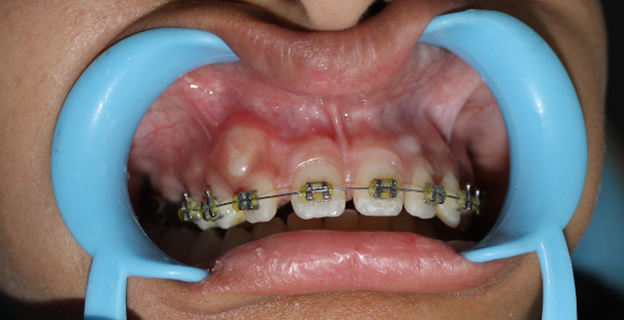
A 24 year old male patient was referred to the Department of Orthodontics and Dentofacial Orthopedics, Post-Graduate Institute of Dental Sciences (PGIDS), Rohtak with a fractured maxillary left central incisior and a crown fractured maxillary right central incisor (Fig. 1) subsequent to a sports injury. On clinical examination, it was observed that the upper left central incisior had a root fracture in the middle third of the root and upper right central incisor had a horizontal fracture at the cervical one third with the fracture line extending subgingivally on palatal side (Fig. 2a). There were no other injuries reported. Initially the mobile segments of the teeth were splinted using a braided wire (Fig. 2b). The traumatized maxillary teeth were first treated endodontically (Fig. 2c) and a fibre post (Fig. 2d) was inserted in the crown of the maxillary left central incisor to stabilize the fractured root followed by a crown build using composite (Fig. 3). Then the patient was referred to our department for orthodontic extrusion of the maxillary right central incisor using a 0.019 X 0.025 SS wire with a helix bent which was bonded on the six anterior teeth. To apply an orthodontic traction force a elastic chain was used from a premolar bracket bonded on the labial surface of right central incisior tooth to the helix bent in the wire (Fig. 4e-4h ). Before the orthodontic extrusion was initiated distance between the arch wire and the bracket was measured as 3.5 mm. Every week patient had a check up appointment in order to reactivate the orthodontic appliances. After 3 weeks of active orthodontic treatment 3.5 mm of extrusion was observed clinically and radiographically. At this stage , the gingivectomy of the gingival margin of the maxillary right central incisor was performed to restore the esthetics. At this stage, the labial wire used for extrusion was removed and the extruded right central incisor was build up with composite material which was followed by placement of a fixed lingual retainer (Fig. 5). The maxillary right central incisor tooth was planned to be restored prosthodontically using a post and core at a later stage as the patient was having a medical board for his selection in paramilitary forces. Placemement of the final restoration after orthodontic extrusion resulted in good esthetics and periodontal health post-operatively.

Fig. 1 Pre-treatment photographs


Fig. 3 Mid-treatment photographs for the crown build up

Fig. 4 (a) pre-extrusion

Fig. 4 b) post-extrusion


Fig. 5 (a)

Fig. 5

Fig. 5 (c)

DISCUSSION
The restoration of fractured incisor with a subgingival fracture line has been managed over the years with the comprehensive multidisciplinary approach, in various ways. The method of tooth extrusion , first described by Heithersay , uses the simple physiologic process of normal tooth eruption and applies it clinically to increase the clinical length of crown. Tooth extrusion has been achieved by different methods including labial fixed appliances, modified archwires, mini-implants and recently lingual orthodontic bracket systems. In this case report , a multidisciplinary approach of the fractured tooth using labial orthodontics has been highlighted.
CONCLUSION
In a case of crown-root fracture achieving a good esthetics, function and health of periodontal tissue is only possible when a good cooperation between patient and dentist exist. Specialist from orthodontic , prosthodontic , periodontic and surgical field are required to work as team in treating crown-root fracture.
REFRENCES
- Andreasen JO , Andreasen FM. Text book and colour atlas of traumatic injuries to the teeth 4th Ed. Oxford : Blackwell; 2007
- Turget MD , Gonul N , Altay N. multiple complicated crown root fracture of a permanent incisor . Dent Traumatol 2004;20:288-292.
- Oliveira TM , Sakai VT , Silva TC , Santos CF , Abdo RCC , Machado MAAM.Mineral trioxide aggregate as an alternative treatment for intruded permanent teeth with root resorption and incomplete apex formation.Dent Traumatol 2008;24:565-568.
- Olsburgh S , Jacoby T , Krejei I. Crown fracture in the permanent dentition: pulpal and restorative considerations. Dent Traumatol 2002;18:103-115.
- Caliskan MK , Turkan M , Gomel M . Surgical extrusion of crown root fractured teeth: a clinical review. Int Endod J 1999;32:146-151.
Disclaimer from Guident
The views and opinions expressed in articles published in Guident are solely those of the authors and do not necessarily reflect the views of the editors, the editorial board or the publisher, Ivory India. Guident does not endorse any product, technique or treatment described. Clinical content is intended for qualified dental and medical professionals and is not a substitute for individual clinical judgement. Guident, its editors and the publisher accept no liability for any consequence arising from the use of information published in the journal.
How to cite this article
Dr. Amit Dahiya, Dr. Mayank Arora, Dr. Manisha Kamal. Clinical Management of a Subgingivally Fractured Central Incisor Tooth. Guident. 2014 Jul;7(8). Available from: https://ivoryindia.in/articles/orthodontics/clinical-management-of-a-subgingivally-fractured-central-incisor-tooth.html