Ergonomics: A Pain Free Dentistry for Professionals
Department of Orthodontics & Dentofacial Orthopedics, Rural Dental College, Pravara Institute of Medical Sciences, Loni Maharashtra, India
Abstract
One of the most prevalent types of work-related injuries are musculoskeletal disorders. Work-related musculoskeletal disorders (WRMDs) result in persistent pain, loss of functional capacity and work disability, but initial diagnosis is difficult because they are mainly based on complaints of pain and symptoms. “An ounce of prevention is better than pounds of cure” ……That’s what dental health care workers spend their day telling their patients, but it also applies to working conditions that can cause pain in the neck, shoulder and hand to a dentist. Dentists and dental students often assume awkward physical positions while providing treatment to (a) get a better view of the intraoral cavity; (b) provide a more comfortable position for the patient; and/or (c) operate equipment and reach for instruments and supplies. This update reviews various causes, signs, symptoms of musculoskeletal disorder and their preventive measures and various exercises to work with comfort, efficiency and ease.
KEY WORDS: Ergonomics Exercises, Dentistry, Work-related musculoskeletal disorders
Dentistry is a social interaction between helper and recipient in their limited job setting and with personal characteristics. It is a profession where performance is restricted to an area covering only a few tens of millimeters (the mouth), and that it requires repeated, precise force applications. These situations demand a fixed posture that can create occupational hazards in both dentists and dental students.1 A healthy dentist is one of the most important component in a successful dental practice. Despite the fact, that though 88% of dentists report good or excellent health,2 some studies show that one out of ten dentists reports having poor general health and three out of ten dentists report having poor physical state.3 Dentists can, and do experience illnesses and problems that can disrupt or impair a practice. Yet, there are growing evidences that suggest increased vulnerability within the profession to certain disorders and afflictions that can only be categorized as practice related.
These problems can be avoided by increasing awareness of the postures used during work, redesigning the workstation to promote neutral positions, examining the impact of instrument use on upper extremity pain, and following healthy work practices to reduce the stress of dental work on the practitioner’s body.4
Recently, “Ergonomics” has become a popular term. The term has been used with most professions but increasingly in the dental profession. It is a discipline that studies workers and their relationship to their occupational environment. This includes many different concepts such as, how dentists position themselves and their patients, how they utilize equipment, how work areas are designed and how all of this impact the health of dentists.5
In Greek, “Ergo,” means work and, “Nomos,” means natural laws or systems. Ergonomics, therefore, is an applied science concerned with designing products and procedures for maximum efficiency and safety. It is also a study of the relationship among the personnel, equipment and environment in the work area.6,7 Proper ergonomic design is necessary to prevent repetitive strain injuries, which can develop over time and can lead to long-term disability. Dental ergonomics is concerned with the ‘fit’ between people and their work. It takes account of the worker's capabilities and limitations in seeking to ensure that tasks, equipment, information and the environment suit each worker (Fig.1).8

Fig.1 – Ergonomics
Dentists and dental hygienists are at a greater risk of work-related musculoskeletal disorders (MSDs) than is the general population. These disorders can result in pain and dysfunction of the neck, back, and hands and fingers. It has been estimated that work-related musculoskeletal injuries occur in 54% to 93% of dental professionals, with the most frequent injuries occurring in the spine (neck and back), shoulders, elbows and hands. Dental hygienists in one study reported neck pain associated with working in a bent neck position, and neck symptoms were reported by 72% of a sample of 94 experienced hygienists (mean age: 46 years). While the occasional backache or neck ache is not a cause for alarm, if regularly occurring pain or discomfort is ignored, the cumulative physiological damage can lead to an injury or a career-ending disability.9
Many work related MSDs are cumulative, building up over years or decades. A poor ergonomic choice may not have an impact today or even a few years down the road. But over a lifetime, it could result in pain or injury, affecting the productivity and earning potential of the dental professionals. Good habits, adopted early, are your best strategy when it comes to posturedontics (ergonomics). This update reviews the various causes, signs, symptoms of musculoskeletal disorder and their preventive measures and various exercises to work with comfort, efficiency and ease.
CLASSIFICATION OF MSDS10
1. Nerve Entrapment Disorders: carpal tunnel syndrome, ulnar neuropathy.
2. Occupational Disorders of the Neck and Brachial Plexus: tension neck syndrome, cervical spondylosis, cervical disc disease, brachial plexus compression.
3. Shoulder disorders: trapezius myalgia, rotator cuff tendonitis, rotator cuff tears, and adhesive capsulitis.
4. Tendonitis of the Elbow, Forearm and Wrist: deQuervain´s disease, tendonitis, tenosynovitis,epicondylitis
5. Hand-Arm Vibration Syndrome: Raynaud’s disease.
6. Low Back Disorders: chronic low back pain.
Some Symptoms of Musculoskeletal disorders (MSDs):
- Excessive fatigue in the shoulders and neck
- Tingling, burning, or other pain in arms
- Weak grip, cramping of hands
- Numbness in fingers and hands
- Clumsiness and dropping of objects
- Hypersensitivity in hands and fingers
Some Signs of MSDs
- Decreased range of motion
- Loss of normal sensation
- Decreased grip strength
- Loss of normal movement
- Loss of co-ordination
Some Risk Factors for MSDs
- Repetition
- Forceful exertions
- Awkward postures
- Contact stress
- Vibration
- Poorly designed equipment workstation
- Improper work habits
Lake4 in 1995 implicates several mechanisms in the generation of pains and soreness in dentists, such as:
a) Elevated work area with permanent static positions of more than 30 degrees, which would produce a reduction of blood flow in the supra spine tendon and would also originate high muscle tension on the trapezoids.
b) Lack of support of the forearms during repetitive holding of instruments which would compromise different body segments such as spine, shoulder, and wrists.
c) The handling of vibrating instruments is associated with specific lesions such as nerve trapping, early arthrosis and even, with Raynaud syndrome.
d) Forced cervical static postures.
e) Poor posture when seating. The flexion of the lumbar spine, when seating forward, produces marked pressure increments between the interdiscal spaces.
f) Lighting at the work place: the lack or excess of light can generate myopia and irreversible retinal lesions, among others.
g) Temperature, ventilation and humidity at the work place. If the temperature is high and the air is saturated with humidity, there is exhaustion, increased body temperature and, respiratory and circulatory disorders.
h) Intermittent and continuous noise produced by high and low speed instruments
i) Present dental chairs allow adaptation of the patient´s position in height, inclination of the torso, flexion or hyper extension of the head of the patient.
Mechanisms Leading to Musculoskeletal Disorders in Dentistry
- Prolonged Static Postures (PSPs): Dentists frequently assume static postures. When the human body is subjected repeatedly to PSPs, it can initiate a series of events that may result in pain, injury or a career-ending MSD.11
- Muscle Ischemia/Necrosis and Imbalances: During treatment, operators strive to maintain a neutral, balanced posture and find themselves in sustained awkward postures. These postures often lead to stressed shortened muscles which can become ischemic and painful, exerting asymmetrical forces that can cause misalignment of the spinal column.8
- Hypomobile Joints: During periods of PSPs or when joints are restricted due to muscle contractions, synovial fluid production is reduced and joint hypomobility may result.11
- Spinal Disk Herniation and Degeneration: In unsupported sitting, pressure in the lumbar spinal disks increases. During forward flexion and rotation, a position often assumed by dental operators, the pressure increases further and makes the structure vulnerable to injury.8
- Neck and Shoulder: Repetitive neck movements and continuous arm and hand movements affecting the neck and shoulder demonstrate significant associations with neck MSDs.11
- Wrist and Hand: Carpal Tunnel syndrome (CTS) has been associated with both repetitive work and forceful work. Symptoms can appear from any activity causing prolonged increased (passive or active) pressure in the carpal canal.11
- Low Back Pain: Low-back discomfort has been associated with dental work in numerous studies. Good posture correlated negatively with back pain and dentists who sat 80 percent to 100 percent of the day reported more frequent lower-back pain, than those that do not sit as often.12
- Psychosocial Factors: Dentists with work-related MSDs show a significant tendency to be more dissatisfied at work and to be more burdened by anxiety, experiencing poor psychosomatic health and feeling less confident with their futures.13
Many MSDs can be treated conservatively by modifying activities or using splints or anti-inflammatory drugs. Early intervention can reduce the necessity of steroid injections or surgery (Table.1).


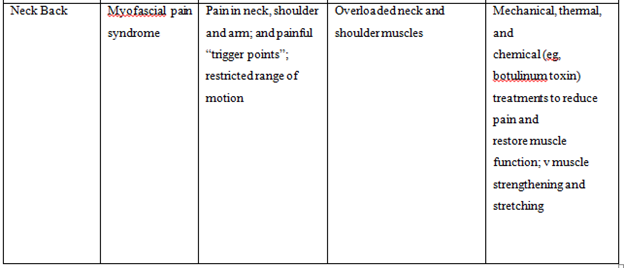
Table 1. Symptoms, Possible Causes, and Treatment Options for Common Musculoskeletal Disorders caused due to improper ergonomics in Dentist14,15
ERGONOMICS FOR DENTAL STUDENTS:
According to an article published in the January 2005 issue of JADA, more than 70 percent of dental students reported neck, shoulder and lower back pain by their third year of dental school. Dentists and dental students often assume awkward physical positions while providing treatment to (a) get a better view of the intraoral cavity; (b) provide a more comfortable position for the patient; and/or (c) operate equipment and reach for instruments and supplies.7
The Ergonomic Standard mandated by the Occupational Safety and Health Administration (OSHA) recommended that the most efficient and effective way to remedy “ergonomic hazards” causing musculoskeletal strain should be through engineering improvements in the workstation.16,17 Posturedontics have one primary objective – the prevention of work-related musculoskeletal disorders, or the symptoms that aggravate these disorders. In dentistry, bad working habits, repetitive tasks – such as scaling, root planning, and uncomfortable physical postures contribute greatly to musculoskeletal disorders, stress, and loss of productivity.18
Four-handed dentistry is ergonomically the most favorable way to provide dental services since it minimizes undesirable movements of the operating team and expedites the progress of most dental procedures.19 Available research supports the idea that ergonomic hazards can be managed or alleviated effectively using a multifaceted approach that includes preventive education, postural and positioning strategies, proper selection and use of ergonomic equipment and frequent breaks with stretching and postural strengthening techniques. This represents a paradigm shift for daily dental practice.20
Research shows that maintaining the low back curve-the lumbar lordosis-when sitting can reduce or prevent low back pain.18 Proper selection, adjustment and use of magnification systems have been associated with decreased neck and low back pain, as they allow operators to maintain healthier postures. Operators also need to know how to adjust the features of their chairs to obtain maximal ergonomic benefits and take the time to position their patients properly for mandibular and maxillary procedures. When possible, dentists should position instruments within easy reach.
To prevent injury of muscles and other tissues, the operator should allow for rest periods to replenish and nourish the stressed structures. Operators may use various stress-reduction techniques to decrease stress-related muscular tension.21 It is important that dentistry incorporate these strategies into practice to facilitate balanced musculoskeletal health that will enable longer, healthier careers; increase productivity; provide safer workplaces; and prevent work related MSDs.16
IMPORTANCE OF POSTURE
The elements of an improper workstation setup force the dental practitioner to assume many harmful postures when performing various procedures on the patient (Fig.2). These positions put pressure on nerves and blood vessels, cause excessive strain on muscles, decrease circulation and cause wear and tear on the joint structures.

Fig.2 - Improper Posture
Some Improper Postures That Dentists Take:
- Working with the neck in flexion and tilted to one side.
- Shoulders elevated.
- Side bending to left or right.
- Excessive twisting.
- Forward bending/overreaching at waist.
- Shoulders flexed and abducted.
- Elbows flexed greater than 90°.
- Wrists flexed/deviated in grasping.
- Thumb hyperextension.
- Position maintained for 40+ minutes per patient.
Some Tips for Working with Good Posture:22
(1) Maintain an erect posture: by positioning chair close to the patient, one can minimize forward bending or excessive leaning over the patient. Place feet flat on the floor to promote a neutral or anterior tilt to your pelvis, which keeps back aligned and promotes the natural curvatures of back (Fig. 3).

Fig.3- Proper Posture
(2) Use an adjustable chair with lumbar, thoracic and arm support: A good chair is essential for maintaining good posture. A chair should have important features like, adjustable height, width, tilt, backrest, seat pan and armrests, because in most dental offices, many people of different sizes use the same workstation.
(3) Work close to your body: Position the chair close to the patient and position the instrument tray close to the chair. This way, dentist does not have to overextend himself to reach the patient or instruments, putting excessive stress on back, shoulders and arms. Think of the 90° rule of having elbows, hips, knees, and ankles all forming 90° angles.
(4) Minimize excessive wrist movements: Try to keep them in a neutral position (palms facing each other, shoulder width apart with wrists straight), which puts wrist muscles and tendons in a much better relationship to perform the work.
(5) Avoid excessive finger movements: When one can combine the excessive forces needed to hold the instruments with the amount of repetitions that he/she can perform each day, one can see the tremendous toll that this takes on the small muscles of fingers. Retraining of shoulders and arms to position hands, rather than making the small, forceful movements with fingers.
(6) Alternate work positions between sitting, standing and side of patient: Switching positions allows certain muscles to relax while shifting the stress onto other muscles and increasing your circulation. Allow each side of your body to share the stress rather than performing the same motion in the same way which causes cumulative trauma in the overused side.
(7) Adjust the height of your chair and the patient’s chair to a comfortable level: If dentist’s chair is too low and the patient’s chair is too high, this causes elevation of shoulders and can lead to neck problems and can pinch nerves. Alternately, if dentist’s chair is too high and the patient’s chair is too low, flexion of neck down and bend wrists back to compensate can lead to neck and hand problems. Remember the 90° rule and keep elbows at a 90° angle with wrists straight and shoulders relaxed.
(8) Consider horizontal patient positioning: If workstation allows the patient to recline into a horizontal position, it will allow a dentist to sit above the patient’s head with good ergonomic posture and he can use each arm equally in more natural position.
(9) Check the placement of the adjustable light: Position the adjustable light to avoid strain on the neck
(10) Check the temperature in the room: Temperature of workspace should not be too cold because this will decrease the circulation and blood flow of extremities. Most often, the dental work environment is damp and cold, so be certain to wear gloves and warm up the hands before working.
Prevention of Musculoskeletal Disorders among Dental Professionals
This can be achieved by implementing various strategies. These have been summarized in Table 2.23
|
Postural Awareness Techniques |
* Maintaining a low back curve * Using magnification systems * Adjusting operator chair properly |
|
Positioning Strategies |
* Avoiding static postures * Alternating between standing and sitting * Repositioning patients at the proper height * Avoiding twisting |
|
Periodic Breaks and stretching |
* Chairside directional stretching * Stretching during microbreaks * Releasing trigger points |
Table 2. Implementation of various strategies
Dentists should also perform specific exercises for the trunk and shoulder girdle to enhance the health and integrity of the spinal column; stretching exercises for the hands and head & neck; maintain good working posture; optimize the function of the arms and hands; and prevent injuries.24 The following exercises can be practiced and performed by dentists on a regular basis in order to improve your posture and reduce muscle fatigue in a clinical environment:
Body Strengthening Exercises:
In a sitting position, extend one leg forward; bend and stretch hands as far as possible without bending the knee (Figure 4); repeat with the other leg. Stretch one leg and put the other leg over the stretched leg; turn around as far as possible without changing the position of the legs (Figure 4); repeat on the other side.24

Fig.4 - Body stretching exercises
Hand Exercises:
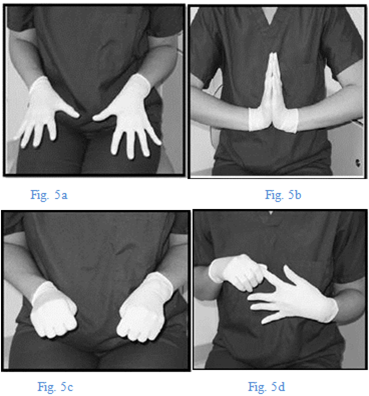
Slowly open and close hands from a completely open position (Figure 5a), to a completely closed position (Figure 5b), which ends with your fingers tucked into your palm; press the palms of your hands together and then relax them (Figure 5c); gently pull and relax each finger on each hand separately (Figure 5d); cross the wrists and gently stretch and relax.5Fig. 5a – d Various Hand Exercises
Some of the remedies recommended include:7
-Stretch your wrists and fingers, especially the area between the thumb and index finger.
-Stabilize your hand by resting your elbow on the chair’s back or arm.
-Use hand instruments with larger-diameter handles—a larger handle distributes pressure over larger surface area across a larger group of hand muscles.
-Use full-arm motions rather than wrist strokes when possible.
-Avoid coiled cords and hoses—the tension transfers to the hand when you stretch the cord
Wear gloves that fit and don’t restrict movement.
Neck Exercises:
Relax shoulders and tuck the chin into the neck, then raise the head back; tilt head to the side as if trying to touch ear to the shoulder; repeat on other side.5
Back Exercises:
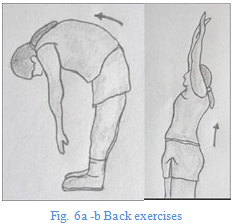
A “full back release” should be practiced. Relax the neck, roll down slowly letting the arms and head fall between the legs (Figure 6a); hold position for a while; raise slowly by contracting stomach muscles and rolling up, bringing the head up last (Figure 6b).5
Shoulder Exercises:
Raise shoulders up towards the ears and rotate head first in clockwise direction and then in anti-clockwise direction.24
Points to Remember:
• Perform a variety of stretches throughout the workday
• Stretching should be gentle and gradual
• Do not stretch a muscle to the point of pain
• Stretches can be held up to 10 seconds and repeat 3-5 times
• Breathe normally while stretching
• If you suffer from a musculoskeletal condition consult a Physician before attempting new exercises which you are unfamiliar with
ERGONOMICS AND EVERYDAY LIFE
Stress is cumulative, so ergonomic principles are just as important outside of the clinical environment. By making adjustments in everyday life as necessary to your work and play, you can reduce the likelihood of MSDs.7
- When sitting at a desk, adjust your chair so that your thighs are parallel to the floor
- When using a computer keyboard, use the padded wrist rest while taking a break, not while typing.
- Monitor your time spent text messaging or playing video games to avoid “Blackberry Thumb.”
- Holding your phone between your shoulder and ear can lead to a host of upper body difficulties—use a hands-free device whenever possible. But don’t talk on the phone while driving!
- Use caution when carrying groceries— carrying multiple plastic bags at once can strain fingers, wrists and elbows. A heavy, plastic bag can concentrate stress in a small area of your hand, increasing the likelihood of injury or damage.
FUTURE OF ERGONOMICS IN DENTISTRY
Dental work requires considerable concentration and attention to detail. Dental professionals are concerned about patients’ comfort, but probably pay little attention to their own until they begin to experience discomfort or pain.25 Today, more dentists are becoming aware of occupational hazards and paying more attention to the prevention of hazards. Ergonomics have come into the profession in a big way. Further development of dental ergonomics must take place on the basis of a coherent vision of the future. Aspects of particular interest are the prevention of occupational diseases, legal responsibility for protecting the health and safety of employees and students, education in dental ergonomics for dental and oral hygiene students, the academic development and research of dental ergonomics, using organizational models in daily dental practice, and the development of ergonomics at the global level.26
CONCLUSION
Ergonomics has come into the profession in a big way. Further development of dental ergonomics must take place on the basis of a coherent vision of the future. Repetitive strain injuries are on the rise in dentistry. Many dentists and dental hygienists have been diagnosed with MSDs, and majority have experienced some type of musculoskeletal pain in their shoulders and neck, hands and wrists, low back, or forearms and elbows. The importance of following proper ergonomic principles should be realized so that these problems can be avoided by increasing awareness of the postures used during work, redesigning the workstation to promote neutral positions, examining the impact of instrument use on upper extremity pain, and following healthy work practices to reduce the stress of dental work on the practitioner’s body. By practicing with correct postures the working capacity and productivity of dental professionals can be enhanced and thus can make a considerable difference to earning and quality of dental practice.
Disclaimer from Guident
The views and opinions expressed in articles published in Guident are solely those of the authors and do not necessarily reflect the views of the editors, the editorial board or the publisher, Ivory India. Guident does not endorse any product, technique or treatment described. Clinical content is intended for qualified dental and medical professionals and is not a substitute for individual clinical judgement. Guident, its editors and the publisher accept no liability for any consequence arising from the use of information published in the journal.
How to cite this article
Dr. Mayuresh J Baheti, Dr. Nandlal Girijalal Toshniwalv. Ergonomics: A Pain Free Dentistry for Professionals. Guident. 2014 Aug;7(9). Available from: https://ivoryindia.in/articles/orthodontics/ergonomics-a-pain-free-dentistry-for-professionals.html