Simplified Technique for Rebuilding a Fractured Abutment Tooth with Post and Core with a Pre-Existing Crown
Department of Prosthodontics, Yenepoya Dental College, Yenepoya University Mangalore, Karnataka, India
Abstract
A 34-year-old female patient presented with a dislodged crown and fractured endodontically treated maxillary right first premolar. A tapered glass-fiber post was adhesively cemented to the fractured abutment. The core foundation was completed by retrofitting the existing crown with a core build up material. The intaglio surface of the existing crown was lubricated with petroleum jelly and an aluminium foil acting as a separating medium between the crown and the core build up material, which allowed for easy removal of the crown. Adequate cement thickness was ensured by the aluminium foil and the finishing procedures of the core build up that respected the existing tooth margins. The glass-fiber post and core build up provided adequate stability and retention to the existing crown. The technique described in this short clinical report enables clinicians to rebuild a fractured abutment tooth using the existing crown without the original die or its replica in a simple, chair side and time-saving way.
Keywords: Post and core, chair side repair, post fracture, core build up, fibre post
INTRODUCTION
Fracture of abutment tooth/teeth is not uncommon in clinical practice,1 which can be due to caries or during removal of definitive crowns or provisional restorations Crowned teeth requiring retreatment due to fracture of the underlying tooth structure and/or foundation restoration often possess an undamaged extracoronal restoration. In such cases, it may be desirable to reuse the restoration for the sake of cost and time. Many techniques have been reported in the dental literature describing repair of the damaged foundation below existing single or multiple prosthetic restorations by fabrication of a cast post and core or utilizing fiber post and Core build up composite material under an existing restoration.2-4 making a post and core pattern with autopolymerzing acrylic resin or wax to retroï¬t an existing crown[5-7].Using the original die or its replica, a vinyl polysiloxane matrix, and autopolymerizing resin8.
This article describes a procedure to repair a fractured abutment using pre-existing crown to fabricate a core using a Core build up composite material in the same location as the previous core. After the fiber post is adapted and cemented, the core build up is done and the existing crown was cemented.
CASE REPORT
A 34-year-old female patient presented with a dislodged crown and fractured endodontically treated maxillary right first premolar to department of prosthodontics, Yenepoya University,
On clinical and radiographic examination the underlying abutment tooth was fractured and there was an over growth of mesial interdental papilla extending over the prepared tooth surface. The buccal surface was fractured till the middle 3rd (Figure1).The restoration was done 3 years back.

Figure 1: Pre-operative photograph.
Patient was offered fabrication of a new crown with post and core but the patient wanted an immediate treatment. So it was decided to use prefabricated post it was decided to place a prefabricated post and the same crown was used to make the core build up, and recement the same crown.
TECHNIQUE
The intaglio surface of the existing porcelain fused metal crown was cleaned by removing the old restoration fragments and luting agent. The marginal fit of the crown was evaluated with a pressure spot indicator (coltene PSI coltene). Then the intaglio surface of the existing crown was lubricated with petroleum jelly and then a thin aluminium foil is placed. This foil acted as a separating medium which prevented the Core build up composite material from sticking to the internal surface of the existing crown and would also ensure adequate cement space for the final restoration.
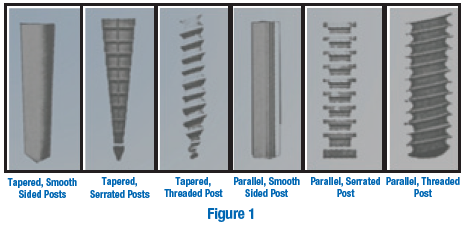
Post space was prepared with manufacturer specified peso reamer (Figure 2). A tapered glass- fiber post (radiopaque, glass fiber post-Reforpost) of appropriate size and length was selected.

Figure 2: Post space preparation using peso reamer
The post was placed inside the post space and the height was adjusted using the existing crown, excess post was removed with diamond points. (Figure 3). The gingival retraction was done (size: 000 ultra-pack,ultradent products .inc B5G37). Then the post was cemented with dual core, self-adhesive resin cement (relyxtm U200).

Figure 3: Glass fiber post placement
A dual core, Core build up composite material (Bis-Core Dual-Cured Core Build-up Material) was injected into the intaglio surface of the existing crown, on the post and on tooth surfaces. The crown was seated was seated in the place under digital pressure to ensure adequate fit and the excess material was removed (Figure 4). Then the Core build up composite material was polymerized under constant finger pressure. The crown was then removed easily and the Core build up composite material along with the foil stayed over the fractured tooth (Figure 5), thus reproducing the internal contours of the existing crown. After light curing, the excess material was removed and finishing is done using finishing diamonds (Figure 6).A dual core, Core build up composite material (Bis-Core Dual-Cured Core Build-up Material) was injected into the intaglio surface of the existing crown, on the post and on tooth surfaces. The crown was seated was seated in the place under digital pressure to ensure adequate fit and the excess material was removed (Figure 4). Then the Core build up composite material was polymerized under constant finger pressure. The crown was then removed easily and the Core build up composite material along with the foil stayed over the fractured tooth (Figure 5), thus reproducing the internal contours

Figure 4: Pre-existing crown placed with core build up composite material

Figure 5: Core build up composite material with aluminium foil over fractured abutment tooth
of the existing crown. After light curing, the excess material was removed and finishing is done using finishing diamonds (Figure 6).

Figure 6: Finished core build up
The crown was placed back on the abutment and the occlusion was checked then cemented with luting cement (GIC TYPE 1). Excess cement was removed (Figure 7).Radiograph was taken (Figure 8). The patient was recalled for follow up after one week and checked for the gingival condition, occlusion and Periapical changes
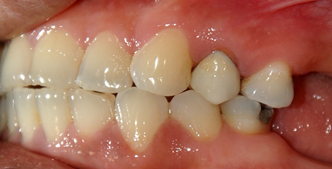
Figure 7: cementation of the crown

Figure 8: Post-operative radiograph.
DISCUSSION
This case shows a simple, chair side, technique for rebuilding a fractured abutment tooth with post and core with a pre-existing crown. The advantage of this technique is that the procedure for reproducing the internal contours of the pre-existing crown does not depend on the availability of the die of the original preparation9. The intaglio surface of the pre-existing crown was lubricated with petroleum jelly and an aluminium foil which acted as a separating medium which prevented the Core build up composite material from sticking to the internal surface of the existing crown and would also ensure adequate cement space for the final restoration. In this procedure, the same pre-existing crown was used, which maintained the existing esthetics and occlusal relationships and also it was economical to the patient. The technique mentioned here is a simple, less time consuming as it can be done in single appointment.
CONCLUSION
The use pre-fabricated glass fiber post and Core build up composite materials allows the clinician to quickly create a post and core in single appointment. The pre-existing crown allows to repair the fractured abutment tooth to obtain maximum retention and stability.
Even though several techniques have been discussed earlier, this article presents a simple chair side technique which is efficient, economical, time saving and comfortable to the patient.
REFERENCES
- De Backer H, Van Maele G, Decock V, Van den Berghe L. Long‑term survival of complete crowns, fixed dental prostheses, and cantilever fixed dental prostheses with posts and cores on root canal‑treated teeth. Int J Prosthodont 2007; 20:229‑34.
- Chan DC. Technique for repair of multiple abutment teeth under preexisting crowns. J Prosthet Dent 2003; 89:91-2.
- Jahangiri L, Feng J. A simple technique for retrofitting a post and core to a crown.J Prosthet Dent 2002; 88:234-5.
- Iglesia-Puig MA, Arellano-Cabornero A. Fiber-reinforced post and core adapted to a previous metal ceramic crown. J Prosthet Dent 2004; 91:191-4.
- Shirdel K, Azarmehr P, Raouï¬ M. Construction of a post and core to ï¬t a completed restoration. J Prosthet Dent 1977; 38:229-31.
- Beheshti N. Fabricating a post and core to ï¬t an existing crown. J Prosthet Dent 1979; 42:236-9.
- Priest G, Goerig A. Post and core fabrication beneath an existing crown. J Prosthet Dent 1979; 42:645-8.
- Leila J, Jian F. A simple technique for retroï¬tting a post and core to a crown. J Prosthet Dent 2002; 88:234-5.
- Signore A, Benedicenti S, Kaitsas V, Barone M. Simplified technique for rebuilding a post and core foundation with a preexisting crown: A case report. Quintessence Int 2010; 41:205‑7.
Disclaimer from Guident
The views and opinions expressed in articles published in Guident are solely those of the authors and do not necessarily reflect the views of the editors, the editorial board or the publisher, Ivory India. Guident does not endorse any product, technique or treatment described. Clinical content is intended for qualified dental and medical professionals and is not a substitute for individual clinical judgement. Guident, its editors and the publisher accept no liability for any consequence arising from the use of information published in the journal.
How to cite this article
Dr. Abubakkar Dr. Katheesa Parveen Dr. Shamshad M.P. Simplified Technique for Rebuilding a Fractured Abutment Tooth with Post and Core with a Pre-Existing Crown. Guident. 2014 Aug;7(9). Available from: https://ivoryindia.in/articles/prosthodontics/simplified-technique-for-rebuilding-a-fractured-abutment-tooth-with-post-and-core-with-a-pre-existing-crown.html