Restoration of Multilated Teeth with Post and Core : A Prosthodontic Approach
Department of Prosthodontics Seema Dental College & Hospital, Rishikesh, India
ABSTRACT
Coronal restorations and posts can positively influence the long term prognosis of teeth following root canal therapy. After completing the obturation of the canal by placing an appropriate post and core with good cementing media will minimize leakage of oral fluids and bacteria into the periradicular area. Loss of inherent dentinal fluid may also effect an alteration in tooth properties. It is therefore accepted that endodontically treated teeth are weaker and tend to have a lower lifetime prognosis. They require special considerations for the final restoration, particularly where there has been extensive loss of tooth structure. The special needs involve ensuring both adequate retention for the final restoration and maximum resistance to tooth fracture. To accomplish this objective, the restorative procedure should be primarily concerned with prevention of tooth fracture. In view of this, this review article focuses primarily on major decisions making elements in post placement and restoration of endodontically treated teeth.
Key Words: post and core, post endodontic treatment, restoration.
INTRODUCTION
It is essential to determine if the tooth is restorable before endodontic treatment is performed . Successful endodontic treatment is of no value if the tooth is extensively damaged to be reliably restored. The strategic importance of the tooth should be determined. The tooth to be restored should be able to withstand functional forces placed upon it after reconstruction. It generally is agreed that the successful treatment of a badly broken down tooth with pulpal disease depends not only on good endodontic therapy, but also on good prosthetic reconstruction of the tooth after endodontic therapy is completed.With increasing numbers of teeth being retained by endodontic therapy, there is a concomitant need for the dentist to have the knowledge and skills to restore them. Coronal tooth structure may be lost for a variety of reasons. Caries, previous restorative treatment, traumatic injury, attrition, erosion, Abrasion and resorption (internal and external) may contribute to loss of coronal tooth structure1. The extent of the destruction is an important determinant factor in deciding on the restorative techniques and materials to be used in restoring the tooth to normal form and function.
Long term success of endodontic treatment also depends on restoration of the endodontically treated tooth. It is also important to remember that the prognosis of endodontically treated teeth depends not only on endodontic treatment success itself, but also on the amount of remnant tooth tissue and the definitive restoration that will be placed onto the dental element. The motive for formulating post endodontic restoration guidelines, aimed at long term success of the treatment2: Enable full coronal sealing, Enable resistance of the remaining tooth structure and retention of the filling & Fulfill functional and aesthetic criteria. According to the key directions for post endodontic treatment, three main procedures are defined for the basic plan: Adding vertical stabilizers to the remaining tooth crown, restoration of hard dental tissues using alloplastic materials & final restoration procedure restoring the tooth’s mechanical, physiological and aesthetic properties.
Replacement of lost tissues using alluoplastic materials directly or indirectly by amalgam, composite resin and glass-ionomer cement fillings, inlay, overlay or crown restorations depending on amount of coronal loss. In cases of severly or badly lost tooth structure the alloplastic material crown restorations using intracanal posts or parapulpal pins along with core buildup are treatment of choice. The restoration of such lost tooth structure may be done by using custom made or prefabricated post3.
POST: A post usually made of metal that is fitted into a prepared root canal of a natural tooth. When combined with an artificial crown or core, it provides retention and resistance for the restoration4. (GPT 8)
CORE: A centre or a base of a structure. The core is designed to resemble or become the crown preparation or crown itself4. (GPT 8)
CROWN: An artificial replacement that restores missing tooth structure by surrounding part or all of the remaining structure with a material such as cast metal, porcelain, or a combination of materials such as metal & porcelain4. (GPT 8)
Restorative Treatment Planning Of badly Mutilated teeth or Endodontically Treated Teeth:
Retention and resistance of restoration and also resistance of remaining tooth structure are very significant for maintaining integrity of postendodontic system and function of treated tooth, as well as for preserving the filling of the root canal. Inadequate postendodontic treatment could lead to fractures and gap formations inside the restoration, tooth tissue or luting cement.
If certain basic principles are followed in the restoration of endodontically treated teeth, it is possible to achieve high levels of clinical success with most of the current restorative systems5. These principles include:
- Avoid bacterial contamination of the root-canal system
- Provide cuspal coverage for posterior teeth
- Preserve radicular and coronal tooth structure
- Use posts with adequate strength in thin diameters
- Provide adequate post length for retention
- Maximize resistance form including an adequate ferrule
- Use posts that are retrievable.
Temporary restoration: Tooth’s restorative treatment after endodontic therapy should be initiated as soon as possible. However, because this is not possible in some cases, an adequate temporary restoration is extremely important to assure an efficient sealing and avoid contamination, among other features, high mechanical resistance, good marginal sealing, and low solubility, thermal expansion coefficient close to tooth tissues, aesthetics, as well as easy handling, insertion and removal from the preparation.
When immediately restoration is not possible, a temporary restorative material should be used to prevent root canal system from saliva and microorganism contamination. Restorative materials showing any bonding mechanism to tooth structure, such as composite resins and glass ionomer cements (conventional or resin-modified) are good options. Nevertheless, the most common materials employed for this purpose are temporary restorative materials, such as zinc oxide eugenol cements or plaster-based materials that are premixed and then cured when in contact with saliva (e.g., Cavit, Cimpat or Cotosol). It is important noting that temporary restoration, mainly place into greater access cavities or into teeth presenting greater coronal destruction, does not adequately protect the tooth against fracture occurrence. It is important to highlight that endodontic retreatment should be considered in teeth which lost their coronal sealing or presented problems in their restorations, by any reason. Based on the penetration rate of bacteria and their endotoxins, accurately filled root canals of teeth which have lost their coronal sealing and have been exposed to oral environment for a period longer than two to three months need to be submitted to endodontic retreatment prior to definitive restoration placement6.
Definitive restoration: The amount of coronal remnant is one of the main factors to be analysed during the restorative step of endodontically treated teeth. Therefore, a careful evaluation of each case should be executed to indicate the best restorative treatment option. Definitive restoration of endodontically treated teeth aims not only to promote coronal sealing and avoid microleakage/contamination, but also to replace the lost tooth structure and protect the remnant tooth structure, mainly against fractures7. This restorative stage may involve the placement of one or more of the following elements: intraradicular post and core and coronal restoration itself. Notwithstanding, not all teeth undergoing endodontic treatment will necessitate the placement of intraradicular post and core/indirect restoration (e.g., full crown). Coronal restorations and posts can positively influence the long-term prognosis of teeth following root canal therapy. Final sealing the canal by placing an appropriate post and core will minimize leakage of oral fluids and bacteria into the periradicular area and is recommended as soon as possible after completion of root canal filling. Glass ionomer or MTA placed over the residual rootcanal filling after post space preparation may be effective to prevent bacterial leakage. (Figure 3 & 4)
Some recent studies have indicated that either coronal restoration or apical sealing microleakage negatively affects the endodontic treatment success. To prevent root canal system contamination within the period between endodontic treatment ending and the beginning of tooth’s definitive restoration is a key factor for success. Therefore, the dentist should be concerned because bacterial contamination is considered an important cause of further problems in endodontically treated teeth. Currently, it has been suggested that apical microleakage may not be the most important factor for endodontic treatment failure and that coronal microleakage is the most likely cause and the key factor for endodontic and restorative treatment success or failure.
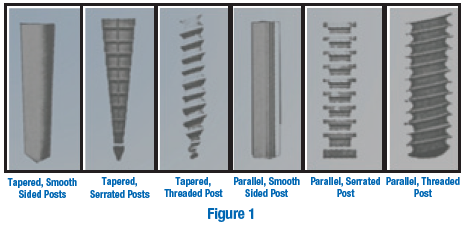
Selection of Post Type: a post should be used only when there is insufficient tooth substance remaining to support the final restoration. In other words, the main function of a post is the retention of a core to support the coronal restoration. The requirements for an ideal post-and-core system should consider physical properties such as modulus of elasticity, compressive strength, and coefficient of thermal expansion that are close to that of dentin8. Additionally, posts should demonstrate high retention, good biocompatibility, esthetics and retrievability. For good prognosis the post diameter should not exceed one third of the cross-sectional diameter of the root. A minimum of 1 mm of sound dentin should be maintained circumferentially, especially in the apical area where the root surface usually becomes narrower and functional stresses are concentrated. Post surface texture can be smooth, serrated with or without vents, or threaded using taps or self-threading. A serrated or roughened post is more retentive than a smooth one. Ideally the post length is 5 mm (3-6mm) apical seal should be maintained. For posterior post retention is better provided by two or more relatively short posts in the divergent canals. If retaining the tooth is critical, a cast core can be used. Fiber-reinforced composite (FRC) post systems have been introduced with the proclamation of avoiding root fractures due to a modulus of elasticity close to that of dentin. Esthetic requirements were fulfilled with the development of quartz and glass fiber posts9. Due to the fact that practitioners judged these posts as a viable alternative to metal posts, a significant number of different fiber posts were introduced onto the market. Two (DT Light Post, a and FRC Postecb) of eight different fiber post systems revealed sufficient ability to resist fatigue stress, thus suggesting considerable reliability of these materials when used clinically. The determining factors for the differing flexural strengths have been described as integrity, size, density, and distribution of the fibers and the nature of the bond between matrix and fibers. Therefore, the type of the resin matrix and the fabrication process applied to promote bonding between fiber and resin may be one of the key factors concerning the flexural strength of the fiber posts. In recent years, non-metallic posts havebeen introduced including carbon fibre posts (black) and more recently, composite posts (white) and zirconium posts (white)10. (Figure 1)
DIFFERENT SYESTEMS OF POST
Prefabricated Post Types-
Choice of Core Materials: In teeth with little or no coronal remnant, coronal restorations generally involve full crowns, such as metallic, metal-ceramic, or all-ceramic crowns. Cases in which some coronal remnant (e.g., one wall) is present and can be preserved, onlay restorations with cusps coverage used in endodontically treated teeth. Ideally, core material should have properties, such as: high tensile and bond strength, biocompatibility, easy handling, bond to the remaining tooth structure, thermal expansion coefficient, shrinkage similar to tooth structure and dimensional stability. Clinically, there are times when the remaining tooth structure is so reduced that the margins of the crown must be placed at or just below the core. It is under these conditions that the choice of core material may be critical. Core build-up materials for direct placement include: dental amalgam11, resin composite, reinforced glass ionomer cements, light - polymerized hybrid composite resin, resin-modified glass ionomers/compomers, polyacidmodified resin composites12. (Figure 2)
Restoration plan for anterior teeth: The restoration needs to satisfy both functional and aesthetic requirements, and full prosthetic crown is indicated13. Sometimes, a post can be

used to retain coronal restoration. Anterior teeth have to resist lateral forces of the mandible, which are transferred along the post and have a tendency to break the tooth. The construction needs to put as little pressure as possible on the anterior teeth, and transfer the pressure on the adjacent and structurally stronger, intact teeth. Keeping esthetic consideration while selecting post & core, the post may be tooth colored or transparent like fiber post and for core buildup choice material is usually composite resin. Sometimes a customized post is required as per patient need then a metal post and core made of alloplastic materials like composite, compomers is needed. (Figure 3).

Restoration plan for posterior teeth: In posterior teeth, the occlusal forces are directed more axially than in anterior teeth in whose case the forces are more lateral. Posterior teeth always require coronal protection, as they are subject to greater occlusive pressure, regardless of the loss in hard dental tissues. When more than one-half or almost all of the coronal tooth structure has been removed in an endodontically treated tooth, it is logical to place a post, attaching the root structure to a core material that is bonded to the remaining tooth structure. The indication of such a post is based on retention and stabilization of the core rather than reinforcement of the root. In posterior teeth, with minimal remaining tooth structure that cannot retain an amalgam core, a cast post should be placed to retain the core14. The number of surfaces included in coronal preparation depends on the status of proximal surfaces. In case the remaining cusps are undermined, the base of the tooth must be restored using an alloplastic material with parapulpal pins, and full reconstruction is performed by one of the extra coronal methods, such as onlay, overlay or prosthetic crown. In case the cusps are missing, the root canal is used as a space for intraradicular retention. (Figure 4)

Crown:The type of crown among metal ceramic & all ceramic crown we have to select as per clinical situation keeping in mind the requirement of function & esthetics. The principles of tooth preparation for better longevity of entire restoration should be kept in the mind. The mechanical consideration like retention & resistance form should be maintained. The final restoration should always be on sound tooth structure, and apical to margin of any internal core build up15. The buildup core will work as a tooth. This allows for control over margin design, minimizes leakage at the final margin and facilitates continuation of the internal core. With endodontically treated teeth, extension of the final crown below the internal core provides a more even stress distribution of functional forces and serves to minimize the risk of coronal radicular fractures. The successful rehabilitation of any endodontically treated tooth using the post-retained system requires the consideration of one specific structural design characteristic: the ferrule effect. The completed crown preparation should have a ferrule design that encapsulates the endodontically re-stored tooth complex. This collar effect provides an antirotational feature for the stability of the crown.The crown should extend, where possible 1.5 to 2 mm on tooth structure beyond the tooth core junction to ensure a protective ferrule effect (Crown ferrule). This surrounding band of metal helps to prevent vertical fractures in the root or horizontal fractures of the crown. Ferrule can also be used in dowel core casting (core ferrule). However care should be taken to avoid damage to the epithelial attachment.
CONCLUSION
Endodontic procedure requires removal of the pulp tissue and necrotic dentine, as well as a significant amount of healthy hard dental tissue, which results in reducing the resistance of the tooth to the occlusal loading forces. Restoration of such a tooth needs to satisfy requirements for retention of the restorative material, its resistance. As well as the resistance of the remaining dental tissue to occlusal forces also aesthetic requirements. It is necessary to restore the original morphology and function of the tooth, which is accomplished by crown restoration. Less extensive damage to the crown is restored by alloplastic materials, securing its retention. In the case of more extensive loss of tissue, restoration is only possible with additional retentive elements such as parapulpal or intracanal posts. The purpose of such retention is to anchor the filling and prevent fracture. Restoration should begin at the earliest possible moment. The tooth exposed to oral conditions without adequate restoration cannot resist occlusal forces and oral fluid bacteria for an extended period. Incidence of fracture or periapical process in such teeth is only a matter of time. In case the adequate final restoration has to be delayed, a temporary filling needs to prevent complications. Postendodontic restoration is as important as the endodontic treatment itself, as successful treatment cannot be achieved without correct postendodontic restoration.
REFERENCES
- Sedgley CM, Messer HH. Are endodontically treated teeth more brittle? J Endodon 1992;18:332–5.
- Iqbal MK, Johansson AA, Akeel RF, Bergenholtz A, Omar R. A retrospective analysis of factors associated with the periapical status of restored,endodontically treated teeth. Int J Prosthodont 2003;16:31–8.
- Aquilino SA, Caplan DJ. Relationship between crown placement and the survival of endodontically treated teeth. J Prosthet Dent 2002;87:256–63.
- Textbook of Glossry of Prosthodontics Terminology, Edition 8
- Mannocci F, Bertelli E, Sherriff M, Watson TF, Ford TR. Three-year clinical comparison of survival of endodontically treated teeth restored with either full cast coverage or with direct composite restoration. J Prosthet Dent 2002;88:297–301.
- Wolanek GA, Loushine RJ, Weller RN, Kimbrough WF, Volkmann KR. In vitro bacterial penetration of endodontically treated teeth coronally sealed with a dentin bonding agent. J Endodon 2001;27:354–7.
- Alves J, Walton R, Drake D. Coronal leakage: endotoxin penetration from mixed bacterial communities through obturated, post-prepared root canals. J Endodon 1998;24:587–91.
- Hunter AJ, Feiglin B, Williams JF. Effects of post placement on endodontically treated teeth. J Prosthet Dent 1989;62:166–72.
- Baratieri LN, De Andrada MA, Arcari GM, Ritter AV. Influence of post placement in the fracture resistance of endodontically treated incisors with direct composite. J Prosthet Dent 2000;84:180–4.
- Mannocci F, Ferrari M, Watson TF. Intermittent loading of teeth restored using quartz fiber, carbon-quartz fiber, and zirconium dioxide ceramicroot canal posts. J Adhes Dent 1999;1:153–8.
- Kane JJ, Burgess JO. Modification of the resistance form of amalgam coronal-radicular restorations. J Prosthet Dent 1991;65:470–4.
- Martinez-Insua A, da Silva L, Rilo B, Santana U. Comparison of thefracture resistances of pulpless teeth restored with a cast post and core or carbon-fiber post with a composite core. J Prosthet Dent 1998;80:527–32.
- Heydecke G, Butz F, Strub JR. Fracture strength and survival rate of endodontically treated maxillary incisors with approximal cavities after restoration with different post and core systems: an in-vitro study. J Dent 2001;29:427–33.
- Oliva RA, Lowe JA. Dimensional stability of silver amalgam andcomposite used as core materials. J Prosthet Dent 1987;57:554–9.
- Aquilino SA, Caplan DJ. Relationship between crown placement and the survival of endodontically treated teeth. J Prosthet Dent 2002; 87: 256-63.
Disclaimer from Guident
The views and opinions expressed in articles published in Guident are solely those of the authors and do not necessarily reflect the views of the editors, the editorial board or the publisher, Ivory India. Guident does not endorse any product, technique or treatment described. Clinical content is intended for qualified dental and medical professionals and is not a substitute for individual clinical judgement. Guident, its editors and the publisher accept no liability for any consequence arising from the use of information published in the journal.
How to cite this article
Dr. Himanshu Aeran, Dr. Jyotsna Seth, Dr.Akanksha Nautiyal. Restoration of Multilated Teeth with Post and Core : A Prosthodontic Approach. Guident. 2014 Sep;7(10). Available from: https://ivoryindia.in/articles/prosthodontics/restoration-of-multilated-teeth-with-post-and-core-a-prosthodontic-approach.html