Bioterrorism: The Role of a Dentist
Seema Dental College and Hospital Rishikesh, Uttrakhand, India
ABSTRACT
The threat of bioterrorism has been ignored and denied for long, and it has increased over the past few years. We are all poorly prepared to deal with a terrorist attack that employs the use of biological weapons.Bioterrorism is the intentional use of micro-organisms and toxins to produce disease and death in humans, animals and crops. Terror comes from a Latin word which means fright. Terror is practised and spread by collecting people from different regions, religions and ages with an intention related to political, social or economy. Terror groups may sometimes stop or pause their activity when their needs are met. These attempts may be done just to spread fear and to gain publicity. In bioterrorism biological agents are used to cause harm. Biological weapons strike in all of a sudden and then linger for a long time.Thus creating a high level of panic, environment contamination and extreme pressures on emergency health services. An accurate and quality information given to the public by credible public health and medical experts can do a lot in controlling fears and encouraging cooperation and participation from masses in a constructive and organized manner. Dental professionals can potentially play a very significant role in the response to the big emergency of a bioterrorism attack.
KEYWORDS: Bioterrorism, Terrorism, Biological Agents, Oral health, public health.
INTRODUCTION
Bioterrorism is the intentional use of biological agents like viruses, bacteria, toxins and other harmful agents to cause illness or death in people, animals or plants. These agents are typically found in nature but they can be mutated to increase their ability to cause disease, to make them act faster, to make them resistant to current medicines or to increase their ability to spread wider into the environment. Terrorists use them as these agents are very tough to detect and they don’t cause their effects till a few hours or days.
Biological agents are a sharp weapon as they are inexpensive to use, can be easily disseminated and cause panic and tremendous fear among masses beyond the actual physical damage they can cause.1 And thus it is the duty of public health experts and medical professionals, dentists included to help in managing an emergency like it!
HISTORY
The use of biological weapons for spreading terror has been practised since ancient times:
Dates back to Ancient Rome, when faeces were thrown into the faces of their enemies.2Assyrian politicians got fungus from rye dumped into their opponents′ wells, giving them fatal ergot poisoning in 650 BC.[3]The armies besieging a town dependedupon spreading disease among the defending population and so they threw dead animals into the towns water supplies, to spread it.[3]Tatars of the 14th century spread bubonic plague by catapulting diseased corpses into towns.[3]During World War I, United States of America and Germany developed biological weapons to contaminate the animal fodder.[3]In Cold War, United States of America and the Soviet Union created arsenals of biological agents for use in battle and against civilian populations.[3]Dr.AntonDilger worked with cultures of anthrax and glanders, between 1915 and 1916, with the purpose of biological sabotage on behalf of the German Government.[4]Modern Incidences of Bioterrorism 5:
In 1984, Rajneeshee cult distributed Salmonella in restaurants and grocery stores in Oregon to poison civic leaders so as to gain control over the local Government.[3]In 1992, . A number of terrorist organizations, including Al-Qaeda, have explored the use of biological agents.[3] and Russia had the ability to launch missiles containing biological weapons of small pox.1994 Pneumonic Plague attack in Surat.In 1995, Sarin gas was released in a subway at Tokyo, by the religious sect AumShinrikyo, which immediately killed 12 people and hospitalized 5000 .[3]1996, Dengue Haemorrhagic fever attack in Delhi.In 2001, letters containing anthrax spores were mailed to a television news anchor, US senator, and others, leading to the death of a few people and hospitalization of the others.[3]
DIFFERENCE BETWEEN TERRORISM AND BIOTERRORISM:Though both are for fear, But a Terrorist attack and bioterrorist attack differ in the
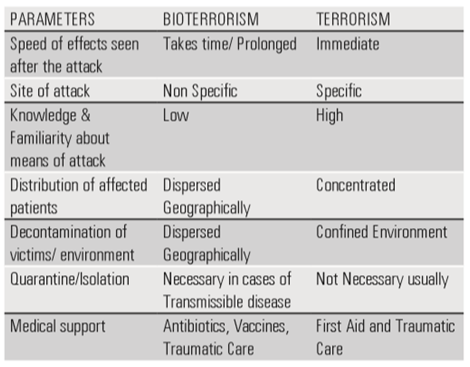
CATEGORIES OF THE AGENTS
These biological agents have been categorized by the US Centre for Disease Control (CDC) into 3 divisions- A, B & C:
- CATEGORY A: These post the highest risk to national security, are easily transmitted and are capable of causing high mortality. Thereby causing mass public panic and requiring immediate attention and action by the professionals! The following are some examples of the agents falling under category A:
1.ANTHRAX: A non-contagious disease caused by the spore-forming bacterium Bacillus anthracis. If diagnosed early it can be cured by antibiotics like Ciprofloxacin.6
The 1st incident of Anthrax use as a biological weapon was when the Scandinavian freedom fighters as supplied by the German General Staff used anthrax against the Imperial Russian Army in Finland in 1916 with unknown results.7
Anthrax in powdered form was mailed and used in a series of attacks on the officers of several UnitedStates Senators in late 20018.
Also in 1993, Anthrax was used as an unsuccessful attempt in Tokyo by AumShinrikyo9
It causes abrupt fever, respiratory distress and chest pain.
2.SMALLPOX: One of the very contagious viruses spread through air route having a high rate of mortality about 20-40%10. Though eradicated since 1970s all thanks to the world vaccination program11 but small samples are known to exist in the Russian and American Labs. Which since the collapse of the Soviet Union have been found in other countries as well.
As a biological weapon smallpox is dangerous because of the highly contagious nature of both the infected and their pox. Also, the infrequency with which vaccines are administered among the general population since the eradication of the disease would leave most people unprotected in the event of an outbreak. Small pox occurs only in humans, and has no external hosts or vectors.12
It causes popular rash that begins on the face and extremities and uniformly progresses to vesicles and pustules.
3.BOTULISM: Caused from Bacterium Clostridium Botulinum. It a deadly threat as it causes death by respiratory failure and acute bilateral descending flaccid paralysis beginning with cranial nerves palsies. Furthermore, the toxin is readily available worldwide due to its cosmetic application in injections.13, 14
4.BULBONIC PLAQUE: Caused by bacterium Yersinia Pestis. It is transmitted to humans through flea bites and aerosols, rodents are the hosts for it, causing Pneumonic Plaque. It is a threat as it is cultured easilyand remains in circulation due to local rodents.15
5.TULAREMIA: Caused by bacterium Francisellatularensis. Also known as rabbit Fever, Has a low fatality but is highly incapacitated. It can be transmitted through contact with the fur, inhalation, and ingestion of contaminated water or insect bites. The bacterium is highly contagious as a very small number e.g. 10-50 organisms are capable of causing the disease. If used for a bioterrorism attack it can be released into the air and people who inhale this infectious aerosol would generally experience severe respiratory illness. Including life-threatening pneumonia and systemic infection, if they are not treated. This bacterium is easily available and can be cultured in labs. 16,17
6.HAEMORRHAGIC VIRAL FEVER:Including haemorrhagic fevers caused by the Filoviridae (Marburg and Ebola) and by the Arenaviridae ( Lassa fever and the Bolivian haemorrhagic fever).
Ebola fever has fatality rates ranging from 50-90%. Death from Ebola is commonly because of multiple organ failure and hypovolemic shock. Marburg had been first discovered in Marburg, Germany and thus named so. Arenaviruses have a lower fatality rate, but are found largely, mainly in central and South America.18
- CATEGORY B:They have the second highest priority. Has a low mortality rate, moderate morbidity, and is moderately easy to disseminate. It includes26.:
- Brucellosis (Brucella species)19
- Epsilon toxin of Clostridium perfringens
- Threats fromFood safety by Salmonella species, E coli O157H7, Shigella&Staphylococcus aureus.
- Glander (Burkholderia mallei) 20 Melioidosis (Burkholderiapseudomallei)21,22
- Psittacosis (Chlamydia Psittaci)
- Q Fever (Caxiellaburnetii)23
- Ricin toxin from Ricinuscommunis (castor beans)24
- Abrin toxin from Abrusprecatorius (Rosary peas)
- Staphylococcal enterotoxin B Typhus (Rickettsia prowazekii)
- Viral encephalitis (alphaviruses, for example,: Venezuelan equine encephalitis, eastern equine encephalits, western equine encephalitis)
- Threats from Water supply by Vibrio cholerae,25 Cryptosporidium parvum
- CATEGORY C: They are the third highest priority and are considered as emerging threats for a disease. They have high mortality and morbidity rates. They can be engineered for mass dissemination in the future. These include27:
- NIPAH virus
- HIV
- Severe Acute Respiratory Syndrome (SARS).
- Hantavirus
STRATERGY & RESPONSE: The planning starts with the development of biological identification system.26
- BEING PREPARED: Early detection and rapid response is dependent upon the close cooperation between the Public Health Authorities & Law Enforcements.28
- BIOSURVEILLANCE:Real-Time Outbreak Disease Surveillance, RODS is developed to collect the data from sources including hospitals, clinics, labs,data over the counter about drug sales is used to perform signal detection, that is, to detect the a possible bioterrorism attack as early as possible. Health related data from Hospitals, SOS call centre computers, and veterinary medical record systems could be of much help. Researchers are also making use of data from school attendance records, drinking water supplies, food processing units, feedlot operations.28 Researchers are working towards the development of devices to detect the existence of a threat by the tiny electronic chips that would contain living nerve cells to warn about the presence of bacterial toxins.29
A DENTIST’S ROLE: Dentists can play a very important role towards the preparation of a bioterrorism attack and its immediate response thus working towards a significant outcome. In case of a major bioterrorism attack, the local needs could be immediate& huge. As hospitals become filled, alternate sites for providing health care would be required, and dental offices could fill in that need.30
Thus a dentist can work towards:
In general:
- Preparation for a bioterrorism attack
- Immediate response towards an attack.
- Diagnosis and monitoring
- Referrals
- Triage
- Immunizations
- Infection control
- Medical care augmentation.
In Specific:
- Treatment of craniofacial injuries
- Administration of anaesthesia
- Starting Intravenous lines
- Providing Cardiopulmonary resuscitation and
- Other Basic Life Support measures.
- Dentists trained in forensic odontology can work closely with local Disaster Mortuary Operational Response Teams(DMORTs)
- Do Local Surveillance to know about the spread of the disease apart from the original site of attack.26
As from 1st January 2001, The Dental Practice Act was modified and it’s stated that in cases of emergencies, the dentists who were a part of the local emergency response team and were trained as a Dental Emergency Responder(DER) could provide facilities for which they are trained.31
CONCLUSION
Bioterrorism is a threat worldwide, and would remain so until anything is done about it. So for long term solutions our Medical fraternity should take charge and educate the public and policy makers about it. According to the current scenario there are increasing number of countries which are involved in the proliferation of such biological weapons and their acquisition by terrorist organizations. So there is an ardent need to develop biodefense by full international cooperation. Also to educate the likely target population about the precautions, responseand protective measures to be taken in case of a bioterrorism attack.32
We, Dentists can be very helpful[30]at such times to provide our support to our fraternity, give quality information to the masses about precautions and responses, and with training help in the patient management also as discussed above during such a catastrophe.
REFERENCES
- Biologics as Weapons Bioterrorism: A Threat to National Security or Public Health Defining Issue? MM&I 554 University of Wisconsin– Madison and Wisconsin State Laboratory of Hygiene, September 30, 2008 http://www.medmicro.wisc.edu/undergraduate/courses/554/ppt/BTPHproblem081030.ppt#332,5,Advantages)
- Steven Block, The growing threat of biological weapons, American Scientist (American Scientist) Vol:89: No. 1: Pg: 28, doi:10.1511/2001.1.28,2001.
- BIOTERRORISM Bioterrorism refers to the intentional release of toxic biological agents to harm and terrorize civilians, in the name of a political or other cause. www.indiandentalacademy.com
- Nilima Prakash, P Sharada,1 and GL Pradeep; Bioterrorism: Challenges and considerations; PMC.
- Vietri N. J. et al (2009), A Short Course of Antibiotic Treatment Is Effective in Preventing Death from Experimental Inhalational Anthrax after Discontinuing Antibiotics. J Infect Dis. Feb 1; 199(3): 336-41.
- JemieBisher, "During World War I, Terrorists Schemed to Use Anthrax in the Cause of Finnish Independence," Military History, August 2003, pp. 17-22.Anthrax Sabotage in Finland http://web.archive.org/web/20091027151654/http://geocities.com/jami e_bisher/anthrax.htm accessed on August 12, 2011 9
- Puneet K. Dewan, Alicia M. Fry, Kayla Laserson, et al (2002). Inhalational Anthrax Outbreak among Postal Workers, Washington, D.C., 2001 Emerging Infectious Diseases, Vol 8, No 10, October 2002.
- Hiroshi Takahashi et al. (2004) Bacillus anthracis Incident, Kameido, Tokyo, 1993: Emerging Infectious Diseases Vol. 10, No. 2 Jan.2004.
- http://www.bt.cdc.gov/agent/smallpox accessed on August 10, 2011
- What CDC Is Doing to Protect the Public From Smallpox http://emergency.cdc/agent/smallpox/prep/cdc-prep.asp.
- CDC Botulism http://emergency.cdc.gov/agent/botulism
- CDC Botulism Factsheet http://emergency.cdc.gov/agent/botulism/factsheet.asp
- CDC Plague http://emergency.cdc.gov/agent/plague
- CDC Plague www.cdc.gov/agent/ncidod/dvbid/plague/index.htm
- Centers for Disease Control and Prevention, USA: Tularemia: http://www.bt.cdc.gov/agent/tularemia Accessed on August 19, 2011.
- http://www.bt.cdc.gov/agent/tularemia/facts.asp Accessed on July 30, 2011.
- CDC Brucellosis http://emergency.cdc.gov/agent/brucellosis
- CDC Glanderswww.cdc.gov/nczved/dfbmd/disease_listing/glaners_gi.html
- CDC Melioidosiswww.cdc.gov/nezved/dfbmd/disease_listing/melioidosis_gi.html
- CDC Why has melioidosis become a current issue? www.cdc.gov/nezved/dfbmd/disease_listing/melioidosis_gi.html#2)
- CDC Q Fever (http://emergency.cdc.gov/agent/qfever)
- CDC Ricin (http://emergency.cdc.gov/agent/ficin/)
- http://www.webmd.com/a-to-z-guides/cholera -11156. Accessed on 18-08-2011.
- Edmond Hooker, Melissa Conrad Stoppler, BioterrorismMedicineNet.com
- Deepak Bhargava;KalyaniBhargava;ImranSabri;MSiddharth;AparnaDave;Jagadeesh;ManishGoel; Bioterrorism - “My Role as a Dentist”; J Indian Acad Forensic Med. July-September 2011, Vol. 33, No. 3 ISSN 0971-0973
- KshirsagarMinal M. DodamaniArun S, Prashanth VK, DodamaniGirija A, Jadhav Harish C, Deshmukh Chetan V;Bioterrorism- A Global Threat; Journal of Oral Health & Community Dentistry.
- Wagner MM, Espino, Jeremy;et al. ;"The role of clinical information systems in public health surveillance", Healthcare Information Management Systems (3 ed.), New York: SpringerVerlag, pp. 513–539;2004.
- Wagner MM, Aryel R, Dato V. Availability and Comparative Value of Data Elements Required for an Effective Bioterrorism Detection System. Washington, DC: Agency for Healthcare Research and Quality, 2001
- Prakash N, Sharada P, Pradeep GL.Bioterrorism: Challenges and considerations. Forensic Dent Sci 2010; 2: 59-62.
- Nathan MDE; Sakthi DS; Dentistry and Mass Disaster- A Review, J ClinDiagn 2014;8(7);ZE01-ZE03
- Alok Kumar, Archana Verma, Mukesh Yadav, Imran Sabri, Ashish Asthana, Biological Warfare, Bioterrorism and Biodefence; J Indian Acad Forensic Med. Jan-Mar 2011, Vol. 33, No. 1; 60-73.
Disclaimer from Guident
The views and opinions expressed in articles published in Guident are solely those of the authors and do not necessarily reflect the views of the editors, the editorial board or the publisher, Ivory India. Guident does not endorse any product, technique or treatment described. Clinical content is intended for qualified dental and medical professionals and is not a substitute for individual clinical judgement. Guident, its editors and the publisher accept no liability for any consequence arising from the use of information published in the journal.
How to cite this article
Dr. Yogeshwari Krishnan Dr. Jyotsna Seth Dr.Himanshu Aeron Department of Prosthodontics. Bioterrorism: The Role of a Dentist. Guident. 2018 Aug;11(9). Available from: https://ivoryindia.in/articles/general/bioterrorism-the-role-of-a-dentist.html