CAD-CAM: Standing on the Shoulder of Giants-a Review
ABSTRACT
The future of dentistry is increasingly being defined by digital dentistry. As dental field transitions into the digital era of image capture, robotic dental restoration and computer design manufacture, the dental laboratory must advance with dentistry. Because of computer-aided design/computer-aided manufacture (CAD/CAM), we have the opportunity now. In many different industries, CAD/CAM technologies are well-established methods for product design, prototyping, and manufacturing. The market for patient-specific medical devices is quickly developing and adopting these technologies. This article has gathered a wealth of data in order to give a comprehensive overview of the present situation and prospective future of dental CAD/CAM applications in the prosthodontics field.
Keywords: CAD/CAM, Digitizing, 3D Printing, Stereolithography, Rapid Prototyping
INTRODUCTION
Prosthodontics is experiencing a significant uptick in innovation, and new devices have arisen that exhibit exceptional strength and high aesthetics. As a result of the digital revolution, which has an impact on almost all fields and businesses, it seems inevitable that dental offices and labs would eventually use digital technology. In the past few years, both fixed and removable prosthodontics have made significant breakthroughs thanks to the fusion of materials and digital technology. This synergistic combination has aided dentistry's evolution by giving clinicians and dental laboratory technicians better prostheses with enhanced clinical reliability that are also manufactured more quickly, more efficiently, and more cheaply.
In dentistry, the laboratory technician's key focus is to accurately transfer all of the dentist's established functional and aesthetic factors into a restorative solution. From first consultation to treatment planning, temporization, and final prosthesis, the entire restorative process necessitates a thorough data transmission to and from the therapeutic setting in terms of the current, desired, and reasonable circumstances and expectations. The dental laboratory must develop with dentistry as it enters the era of digital imaging, computer designing, and robotic dental restoration production. Computer-aided design/computer-aided manufacture (CAD/CAM) restoration has given us the opportunity.
Initially, CAD/CAM technologies could only be used to create single crowns, onlays, and inlays. It is now possible to fabricate any type of dental restoration, from single-unit inlays, onlays, full and partial crowns, veneers, restorations, implant abutments, to fixed and removable dental prostheses for patients who are partially or completely edentulous, thanks to the abundance of CAD/CAM technologies, systems, milling machines, and other tools.
History 1
- Dr. Duret, one of the pioneer in the area of CAD/CAM development for dentistry.
- The second, Dr. Moermann, simply machined the interior surface of the inlay after taking a single image of the tooth preparation.
- Dr. Andersson, who created the Procera system, came in third.
- In 1970s, Swiss François Duret, American Bruce Altschuler , Werner Mormann, and Marco Brandestini made the CAD/CAM technology's initial applications in dentistry
- After the first dental CAD/CAM prototype was shown at the Ganaciene Conference (France) in 1983, first and foremost crown was machined and placed in the oral cavity without the aid of a laboratory in 1985.
- The CEREC 1 system was the first to be introduced for dental use in the middle of the 1980s. Its development was overseen by Siemens Corporation.
- The Microna Technologic, Spreitenbach, Switzerland company developed the incredibly small Celay system in 1990.
- The BEGO, Bermen (Germany), and Denticad, Waltham (USA) companies together developed the Denticad system, which consists of CAD-CAM software, a milling machine, and an expert system that enables fully automated design.
- CICERO Dental technology B.V. (Hoorn, The Netherlands) is the company responsible for developing the computer integrated crown reconstruction (CICERO) technology.
- Steinbichler Optotechnik Technique GMBH, Neubeuern, invented the Coordinate Measuring Technique System.
- In 2002, Lava CAD/CAM System was released.. For all ceramic restorations, it has always been used to construct zirconia frameworks.
CAD/CAM
In dental field CAD / CAM systems consists of 3 components2:
- The first part refers to a tool for digitalizing spatial data that shows how teeth and other supporting tissues are being prepared (CAI - Computer Aided Inspection).
- The Second part is a Computer that calculates and Designs the body's restorative form (CAD- Computer Aided Designing).
- The third part refers to a numerical based milling machine that builds dental restorations from basic shapes, which corresponds to the CAM region. Normally, a dental professional will recommend additional processing, such as polishing or personal taste.
CAD/CAM COMPONENTS
Scanner:
In dentistry, the term "scanner" refers to devices that collects data and assess three-dimensional maxillary or mandible and teeth features and them into groups of digital information.3
There are essentially 2 different scanning options:
- Optical scanners: The triangulation technique, which is the basis of this sort of scanner, is the collecting of three-dimensional structures.
- mechanical scanners: In this form of scanner, the three-dimensional structure is evaluated following a mechanical line-by-line reading of the master cast using a ruby ball. Look no farther than Göteborg's Procera Scanner from Nobel Biocare for mechanical dental scanners.
optical scanners used in the dentistry industry include:
- Everest Scan (KaVo, white light projections).
- Lava Scan ST (3M ESPE, white light projections).
- es1 (etkon, laser beam).
Design software:
The producers provide specialised software for creating different several types of dental restorations. Such software makes it possible to create crown frameworks and fixed partial dentures (FPD). Inlays, onlays, inlay retained FPDs, entire anatomical crowns, half crowns, 3/4 crowns, adhesive FPDs, telescopic primary crowns, and FPDs are only a few of the additional options that some systems do support.3
Processing Devices:
The data from the CAD programme is converted into milling strips before being fed into the milling machine for CAM processing. Identification of processing devices is based on the number of milling axes.4:
- 3-axis devices: These milling machines may move to varying degrees in all three spatial directions. Thus, the X-axis, Y- axis, and Z- axis values serve as the sole definitions of the mill route points.
- 4-axis devices: Along with the 3 spatial dimensions, the component's tension bridge can be infinitely changeable.
- 5-axis devices: In a 5-axis milling machine, along with the three spatial dimensions and the rotating tension bridge (4th axis), the milling spindle can also be rotated.
CLASSIFICATION OF CAD/CAM SYSTEMS 5
The following categories of systems have been created based on their production techniques:
- In office system or Chairside system:
- CAD/CAM- Dental laboratory systems:
- CAD/CAM using network system for outsourcing dental lab work:
The Cerec System is the most popular. This technology allows for the creation and delivery of a restoration in a single appointment by scanning the prepared tooth intraorally and choosing the proper materials.
In the dental lab (such as Cerec-in lab), this indirect technology scans a prepared tooth cast in stone or used as a die. The technician finishes the restoration by adding aesthetic porcelain to the copings that are produced by several of these systems.
Technique matters when it comes to the design and production of the framework for high strength ceramics, hence network machining centres and CAD/CAM technologies have been used. This requires outsourcing the creation of the framework online.
Stages in fabrication of prosthesis with CAD/CAM technology 6 :
- Computer surface digitization
- Computer-aided designing
- Computer assisted manufacturing
- Computer-aided esthetics
- Computer-aided finishing
The last two stages are more complex and are still being developed for inclusion in commercial systems.
I. Computer surface digitization
With either LED-based or laser-based scanners, prepared teeth are scanned.
- LED based scanner:
Above the occlusal surface of the preparation, a compact video camera (scanner) is used which is 1 cm wide lens emits infrared light, which passes through an internal grid made up of multiple parallel lines. The intensity of the dark and light striped pattern on the prepared tooth surface is measured when it is reflected back to the scanning head and onto a photoreceptor, it is converted into a voltage measurement and sent as digital data to the CAD unit.6
- Laser based scanner:
The prepared tooth and the proximal teeth are digitally scanned by a high-speed laser to create an interactive 3D image. Fast scanning offers powder for oral or extra-oral scanning on traditional imprints or models.-free automated digital photo capture at the speed that the operator chooses. Based on optical coherence, contemporary laser-based scanners may do subgingival level (OCT) scanning. The image must be created from at least nine scans. The scanning gadget includes stabilisers.6
II. Computer-aided designing (CAD)
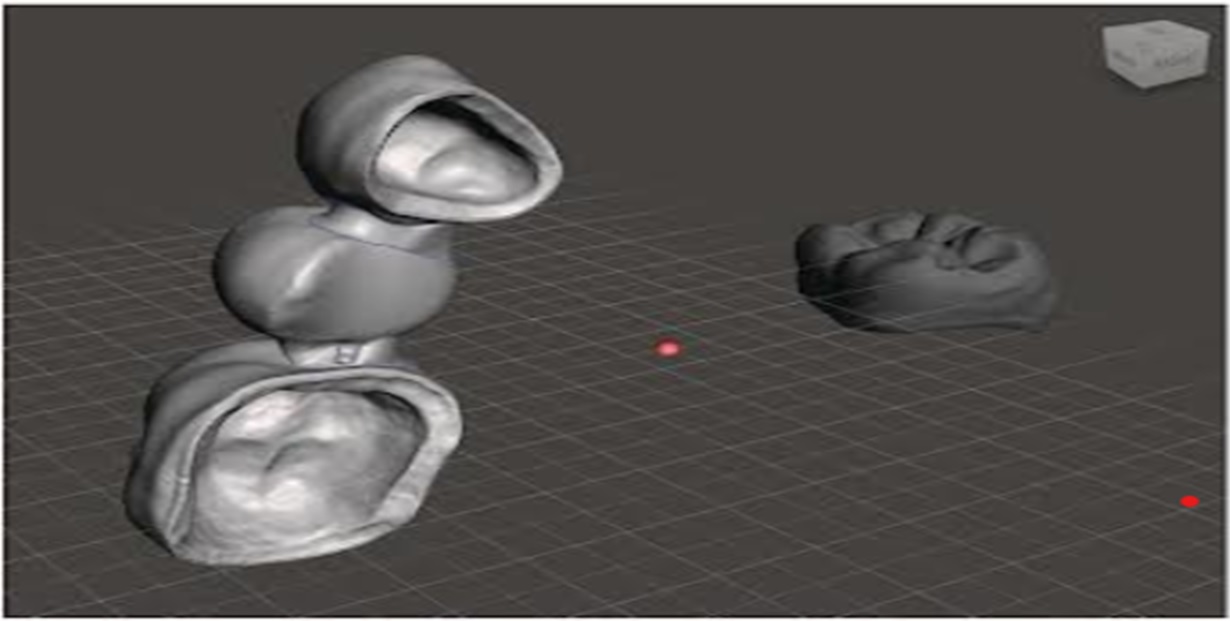
Over the screen, the die appears in three dimensions and may be rotated to be seen from the any desired angle. The 3-D image is processed after being created using one of the computer surface digitization methods, and the digitised data is then loaded into the computer.7
It is now possible to do undercut blocking, data compression, and curve smoothing. Before giving a CAM machine instructions to build the restoration, the restoration is created using CAD software.
III. Computer-aided manufacturing (CAM)
Computer-aided manufacturing, or CAM, is the last stage. Based on the approach used, CAM technology can be categorised into three categories.8
- Subtractive method from a Solid Block: In this stage, the restoration is cut from ingots using computerised electrically driven diamond discs or burs. The size of the material blocks that can be used for milling machines and the CAM technique that is generally used in fabrication of single crowns which determines the sizes of the FPDs.8
- Additive method: In this method, Dry pressing of zirconia or alumina onto the die occurs as the temperature is increased to a point that resembles the pre-sintering state. Expanded and permeable coping is stable at this point. The object is removed from the die, its outside surface is milled into the required form and coping, and it is then sintered into the fire furnace to complete the sintering process.7
- Solid free form fabrication is a newest technology that comes from the field of Rapid Prototyping (RP) and has been adjusted to meet the requirements of dental technology.9
RAPID PROTOTYPING TECHNIQUES
- Stereolithography
- Selective Laser Sintering (SLS)
- 3-DPrinting
- Fused Deposition Modeling (FDM)
- Solid Ground Curing
Stereolithography: In the layer-by-layer construction method known as stereolithography, a moving laser beam under computer control is used to create 3D objects. This technique can be used to make diagnostic templates for occlusal splints and oral implantology.9
Selective Laser Sintering: The CAD data is first transformed layer by layer in this method. The additive SLS machine receives these layers and begins to apply the initial layer of powder. The substance is heated and fuses together as the laser scans the surface. When the single layer formation is complete, the powder bed is lowered, and the subsequent layer of powder is rolled out smoothly and exposed to laser. Consequently, the item is created layer by layer.9
3-D printing: In this method, a wax model of the repair is built (printed) by a machine using computer-aided design. The obtained wax pattern is then cast using a lost-wax casting method. The use of resin-like substance rather than wax to produce patterns is a result of development.9
Fused Deposition Modeling (FDM): Metal and plastic materials are produced using this sophisticated 3D printing technique. Due to its ease of use, accuracy, and affordability, additive manufacturing is a technology that is frequently used.
Solid Ground Curing (SCG): In this form of additive manufacturing known as solid ground curing (SCG), resin is placed in layers through a stencil utilising ultraviolet light before being successively laser-polymerized.
RECENT ADVANCES IN CAD/CAM TECHNOLOGY
The performance and perceived aesthetics of restorations milled using CAD/CAM chairside systems have undergone a radical transformation as a result of recent improvements in ceramic mono block technology. For dental practitioners, there are now four chair side CAD systems on the market: Cerec CA, Lava TM C.O.S., ED4 Dentist TM and Cadent Itero TM. Only two of these CAD systems—Cerec AC and ED4—have linked CAM system units that can mill the restoration in 7 to 30 minutes, depending on its intricacy and size.10 Eg: Computer guided flapless surgical implant insertion, customised implant abutments, CAD/CAM in maxillofacial prosthodontics, CAD/CAM in temporomandibular disorders, and CAD/CAM restorations for implants.
ADVANTAGES OF CAD-CAM SYSTEMS 10
- Eliminates steps like taking impressions, preparing models, and creating temporary prosthetics.
- Rehabilitation with a single visit and positive patient acceptance.
- A CAD-CAM system can be used to fabricate a ceramic restoration, such as an inlay or an onlay, at the side of the chair.
- Using CAD/CAM technologies, dentists may provide their patients with attractive tooth-colored restorations.
- To ensure that crowns and FPDs fit snugly against abutment teeth, CAD-CAM technology is adept at adjusting for variations in dimensions that result from material processing and post-treatment.
- When compared to the traditional powder buildup and baking of porcelain, CAD/CAM technology requires less labour and completes the operation faster.
- The CAD/CAM machine handles the majority of the process automatically; the operator just needs to be present at the machine for 5–6 minutes. Utilising CAD/CAM technology enables reproducible processing by designing optimal shapes based on material characteristics, which prevents degradations like residual strain caused by processing effects. In addition to shaping restorations by milling, this technique also allows for quality control of the dental prosthesis.
- In contrast to conventional powder builds up and porcelain baked items, both of which frequently have internal porosity, milling a pre-fabricated block whose quality has been validated in advance by the maker virtually eliminates internal faults. Zirconia's uniform, monolithic nature integrates astonishingly well with natural tooth structure in contrast to conventional dental restorations, where porcelain is glued onto a metal basis.
- CAD ensures durability and reduces fracture risk. Dark metal substructures are not the best choice for a natural appearance; patients frequently find milled CAD/CAM restorations to be more aesthetically pleasing.
- While typical porcelain fused to metal or gold crowns block x-ray radiation, making such a long-term examination of potential day beneath a CAD/CAM restoration difficult, these restorations do not contain any metal to prevent further x-rays from being taken.
- Due to the uniformity of the substance, opposing tooth structure is barely abraded.
DISADVANTAGES
- Restrictions on how many units can be manufactured.
- Failing to describe hues and transparency.
- the inability to scan in wet settings (the inability to get an accurate image when there is too much saliva, water, or blood).
- Compatibility issues with other image programmes.
- Very pricey and scarcely available.
- The delicate, technique-based surface imaging approach needed for the teeth that had been prepared.
SUMMARY
Computer-aided design and manufacturing (CAD/CAM), which are standard procedures in the industrial world, have penetrated the area of dentistry over the past ten years. People became interested in the prospect that this approach of designing and making dental restorations could replace the lost-wax technique, which has been used for many years. Recent articles in the literature have given a thorough overview of the CAD/CAM methods utilised in dentistry. The number of papers documenting the improved quality and clinical success of restorations made utilising these CAD/CAM procedures is also amazing.
REFERENCES
- Aeran H, Kumar V, Seth J. Computer Aided Milling in Prosthodontics: A Promising Technology for Future. IJSS Case Rep Rev. 2014;1(1):23-7.
- Abduo J, Layons K. Rationale for the use of CAD/CAM Technology in Implant Prosthodontics. Int J Dent. 2013; 1-8.
- Prajapati A, Prajapati A, Mody DR, Choudhary AB. Dentistry goes digital: a CAD-CAM way-a review article. IOSR J Dent Med Sci. 2014;13(8):53-9.
- Parasher P, Tarun K. Functioning of Chairside CAD-CAM systems. J Adv Med Dent Scie Res 2014; 2(4): 38-44.
- Tamrakar AK, Rathee M, Mallick R, Dabas S. CAD/CAM in prosthodontics-a futuristic overview. Annals of Dental Specialty. 2014; 2(1):14-20.
- Patil M, Kambale S, Patil A, Mujawar K. Digitalization in Dentistry: CAD/CAM - A Review. Acta Scientific Dental Sciences 2018; 2(1): 12-16.
- Liu P. A panorama of dental CAD/CAM restorative systems. Compendium. 2005; 507-513.
- Beuer F, Schweiger J, Edelhoff D. Digital dentistry: an overview of recent developments for CAD/CAM generated restorations. Br Dent J. 2008;204(9):505.
- Mehl A, Gloger W, Kunzelmann K H, Hickel R. A new optical 3-D device for the detection of wear. J Dent Res.1997; 76: 1799–1807.
- Lee C, Alex T. CAD/CAM Dentistry: A new forum for dentist-technician Teamwork. Inside Dentistry. 2006;2(7).
Disclaimer from Guident
The views and opinions expressed in articles published in Guident are solely those of the authors and do not necessarily reflect the views of the editors, the editorial board or the publisher, Ivory India. Guident does not endorse any product, technique or treatment described. Clinical content is intended for qualified dental and medical professionals and is not a substitute for individual clinical judgement. Guident, its editors and the publisher accept no liability for any consequence arising from the use of information published in the journal.
How to cite this article
Dr. Awani Gupta, Dr. Kunwarjeet Singh, Dr. Pallavi Sirana. CAD-CAM: Standing on the Shoulder of Giants-a Review. Guident. 2023 Sep;16(10). Available from: https://ivoryindia.in/articles/general/cad-cam-standing-on-the-shoulder-of-giants-a-review.html