Fluoride Mitigation-a Review
Department of Public Health Dentistry, K. D. Dental College and Hospital, Mathura, Uttar Pradesh, India
INTRODUCTION
Fluoride is the ionic form of fluorine, the thirteenth most abundant element in the earth’s crust. It is released into the environment naturally in both water and air. Its concentration in water is variable.1 Water is the major dietary source of fluoride. The variability in water content explains much of the variability in total fluoride intake. Other important sources of fluoride are tea, seafood that contains edible bones or shells, medicinal supplements, and fluoridated toothpastes. Fluoride compounds are also produced by some industrial processes that use the mineral apatite, a mixture of calcium phosphate compounds.2 Dietary fluoride is absorbed rapidly in the stomach and small intestine. One-quarter to one-third of the absorbed fluoride is taken up into calcified tissues, whereas the rest is lost in the urine. In bone and teeth, fluoride can displace hydroxyl ions from hydroxyapatite to produce fluorapatite or fluorohydroxyapatite.3 In its classical meaning, mitigation refers to a sustained action taken to reduce or eliminate risk to people and property from hazards and their effects. Mitigation activities address either or both of the two components of risk, which are probability (likelihood) and consequence. Mitigation activities include many different methods and strategies that have the common goal of reducing the risk associated with potential hazards. To provide a deeper understanding of mitigation, it is important to first understand the nature of natural, man-made, and terrorism risk.4
India has only 4% of global water resources in spite of constituting 16% of the world’s population.5 In India, the extent of fluoride content in drinking water ranges from 1.0 to 48.0 mg/L.6 The World Health Organisation has set the upper limit of fluoride concentration in drinking water at 1.5 mg/L.7 Worldwide, approximately 100 million people are thought to suffer from fluorosis.8 According to the Ministry of Drinking Water and Sanitation in 2014, there were 14,132 habitations from 19 states which were yet to be provided with safe drinking water in India. The total population at risk of fluorosis in habitations with high fluoride in drinking water is estimated to be 11.7 million.9
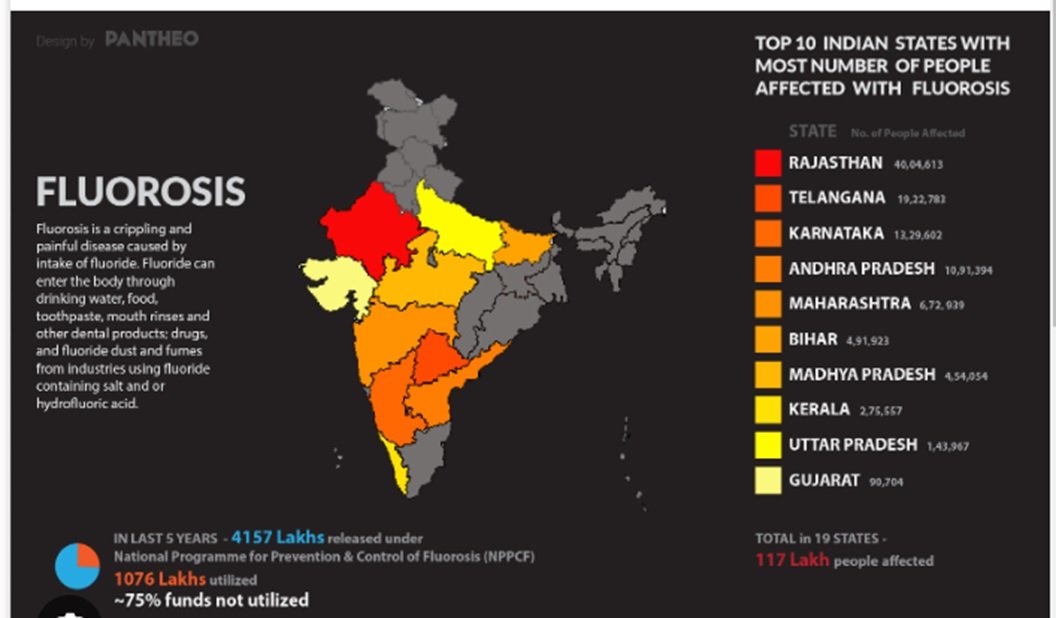
Photograph showing fluoride belt
In India, the states having some circumscribed areas of high fluoride levels (endemic fluoride belts with F content in ground water above 4 ppm) include Punjab, Haryana, Rajasthan, Gujarat, Madhya Pradesh, Andhra Pradesh, Tamil Nadu, among others.10 However, fluoride intake from other sources needs to be additionally considerable, especially from food. Traditionally, fluorosis has been directly correlated to the fluoride intake in water, however, studies in Madhya Pradesh have brought out the fact that nutritional habits play an important role in endemic fluorosis. Jolly et al highlighted the role of nutritional factors relative to different clinical patterns of fluorosis seen in India.11 Liang et al showed a 43.8% prevalence of skeletal fluorosis in those with adequate nutrition, and 69.2% in those with malnutrition.12
FLUROSIS MITIGATION PROGRAMMES
government and non-governmental agencies launched efforts to control fluorosis. However, most of attempts were mainly on defluoridation of water, so it cannot be proposed as the only or most effective solution to mitigate fluorosis. 13
1.Fluorosis Mitigation Programmes – The Global Scenario
2.Fluorosis Mitigation Programmes - The Indian Scenario
(i) Initiatives Taken by the Government of India
(ii) Initiatives by State Governments
(iii) Initiatives Taken by Private Sector
(iv) Initiatives Taken by Public-Private-Partnership
Public-Private Partnerships (PPPs) are collaborative ventures between government entities and private sector organizations.
1.Fluorosis Mitigation Programmes – The Global Scenario
If some form of fluoride mitigation is considered necessary, one or more of the following options may be applicable, including the provision of new or alternative source of water containing acceptable levels, blending of the existing water supply with another one containing lower level of fluoride, provision of bottled water, treating the water level at the point-of-use at domestic level in small treatment devices i.e. domestic defluoridation unit, treatment of water at the community level i.e. conventional treatment or hand pump attached package treatment, and resettlement of community.14
Globally, there are various fluorosis mitigation programs that have been conducted using defluoridation units. They include the defluoridation unit in Ngurdoto village, Tanzania by bucket defluoridator using bone char,15 fluorosis mitigation project in Ban Sankayom village in Thailand using bone char defluoridator,16 and the ICOH Mobile Bus Unit Project in Thailand,17 which emphasized creating awareness among the people regarding the health effects of excessive consumption of fluoride, helping them with on-site analysis of fluoride content of water samples and solve the problem using possible alternatives.
2. Fluorosis Mitigation Programmes - The Indian Scenario
A brief overview of fluorosis mitigation programmes in India.
(i) Initiatives Taken by the Government of India
The Government of India has undertaken numerous initiatives across various sectors to promote and improve the overall quality of life.
(A) Nalgonda Technique, Andhra Pradesh (1961) .
In 1961, in Kadri town of Nalgonda district in Andhra Pradesh, the first community defluoridation plant was constructed by the National Environmental Engineering Research Institute (NEERI), Nagpur. The technique involves the addition of aluminium salts, lime, and bleaching powder, followed by rapid mixing, flocculation, sedimentation, filtration, and disinfection.17The technology is excellent, provided the daily operations are entrusted to a trained, conscientious operator. However, it is less preferred due to water scarcity and daily disposal of sludge.18

Photograph showing steps of deflouridation
(B) National Drinking Water Mission (1986)
In 1986, Government of India (GOI) set up the National Drinking Water Mission to provide safe drinking water to its people and to combat the fluorosis problem.19
(C) National Rural Drinking Water Program (NRDWP) (2009)
In 2009, GOI launched NRDWP, with a goal to provide every rural person with adequate safe water for drinking, cooking, and other domestic basic needs on a sustainable basis. It also aimed to provide potable drinking water (55 litres per capita per day) by piped water supply to 50% of rural population, of which only 18% of the rural population have been provided till date. It also sought to provide household connections to 35% of rural households, of whom only 17% of rural households were benifitted.19
(D) National Programme for Prevention and Control of Fluorosis (NPPCF) (2008-09)
Government of India initiated the National Program for Prevention and Control of Fluorosis (NPPCF) as a new health initiative during the 11th Five Year Plan in 2008-09 in a phased manner. The program covered 100 districts of 17 States during the 11th Plan and additional 95 new districts were covered in a phased manner during the 12th Plan. In the 12th Plan the program has been brought under the NCD flexi-pool of the National Health Mission (NHM). Under the program, assistance to the states for strengthening manpower in endemic districts, purchase of equipment for lab including an ion meter, training at various levels, health education and publicity, treatment including reconstructive surgery, and rehabilitation to benefit the people in the affected districts.20
(ii) Initiatives by State Governments
(A)The Government of Gujarat identified a few long term schemes, some of which are as follows:
- Dharoi Reservoir Dependent Scheme:
A total of 68.86 million liters of water per day under group water supply to 371 villages belonging to Kheralu, Sidhpur, Visnagar and Patan taluks, at an estimated cost of Rs. 140 crores.21
- Sabarmati River Dependent Scheme:
Water drawn from the river Sabarmati to the 109 villages from Vijapur taluk at an estimated cost of Rs. 36 crores.21
- Narmada Canal Dependent Scheme:
Construction of necessary storage tanks and filtration plants, water from Narmada main canal to the 111 villages belonging to Chanasma Taluka, 118 villages belonging to Kadi Taluka and most villages belonging to Sami and Harij Taluka. 21
(B) Hogenakkal Integrated Drinking Water Project (2008)
Government of Tamil Nadu, with funding from Japan Bank for International Cooperation (JBIC) undertook the Hogenakkal Integrated Drinking Water Project using Tamil Nadu’s share of the Cauvery river water. The total cost in 2010 was Rs.1,928.80 crores for installation and Rs. 63.67 crores for annual maintenance.22
(C) Mission Bhagiratha (2016)
This project was undertaken by Government of Telangana in 2016 to provide safe drinking water to thousands of households long affected by fluorosis sourced from river Godavari and river Krishna in Nalgonda district through 150 water treatment plants.23
(iii) Initiatives Taken by Private Sector
Private sector initiatives in fluoride mitigation in India play a crucial role in complementing governmental efforts by bringing innovation, efficiency, and community-focused solutions to address the challenge of fluoride contamination in drinking water.
(A) People Science Institute, Uttarakhand, India through its Environmental Quality Group (EQMG), monitors environmental pollution. EQMG’s activities include monitoring water quality of rivers, fluorosis mitigation programme and providing technical support services to organizations, along with several other small public interest projects and activities. EQMG has also proposed plans for provision of safe drinking water to victims of fluorosis in many areas of Dhar (Madhya Pradesh), Nuapada district (Orissa), and Sonbhadra (Uttar Pradesh).
- Dhar, Madhya Pradesh (2008)
In 2008, Vasudha Vikas Sansthan undertook fluoride testing and fluorosis mitigation programme in Tirala, Dharampuri and Umarban blocks of Dhar district with the assistance of Water Aid and with the technical Support of Peoples’ Science Institute, Dehra Doon. The interventions included awareness about fluoride mitigation, removal of hand pumps (source of high fluoride water content) and providing safe water through collaborative effort. The programme assessed the impact of EQMG after six months of intervention in 2009. There was a significant difference in fluoride concentration in the urine samples of the subjects before and after intervention in the villages. The increase in urinary fluoride values observed in the non-implementation village should serve as an alarm for decision makers, implementation agencies and other concerned organisations.24
- Orissa (2005)
In 2005, Peoples’ Science Institute and Sahbhagi Vikash Abhiyan workers chalked out a detailed fluorosis mitigation programme to check the water quality and assess the prevalence of fluorosis within the selected villages followed by an awareness campaign for the villagers in four districts (Nuapada, Kalahandi, Bolangir, and Burger) of western Orissa. The plans included conversion of dug wells into safe sanitary wells, construction of sand wells in ponds with low fluoride concentration, domestic defluoridation kits and rainwater harvesting. The physical works and defluoridation kits amounted to about Rs. 29,19,000 for 6995 beneficiaries, with an approximate cost of Rs. 417/- per beneficiary.25
- Sonbhadra, Uttar Pradesh (2004)
In Sonbhadra district, with the assistance of BSA (Banwasi Seva Ashram) and PSI (Peoples’ Science Institute), a study conducted by EQMG presented the findings of the water quality tests, accompanying health surveys and the community-based activities for fluorosis mitigation planning in 2004, which led to the preparation of fluorosis mitigation plans for 21 villages, including conversion of an existing safe dug well and concrete well into sanitary wells, as well as hand pump with attached AA kit, AA domestic kit, individual roof rainwater harvesting, and community roof rainwater harvesting. Out of total 3875 households within the 21 targeted villages, a total 2146 households were covered. The estimated cost of Rs. 80,70,000.00 amounted to a cost of Rs. 632 per beneficiary, as compared to Rs. 417 per beneficiary of the project undertaken in Nuapada district, Orissa.26
(B) Prasanti Technology using Activated Alumina, Andhra Pradesh (1978)
Prasanti technology developed by Satya Sai University for Higher Learning, Puttaparthy used activated alumina for defluoridation based on adsorption. Each plant costs approximately Rs 35,000.27
(C) UNICEF in India using household based defluoridation, Andhra Pradesh and Rajasthan (1996- 2002)
Pilot projects were undertaken by UNICEF along with Water Environment Sanitation Section (WESS) Department of Chemistry, IIT Kanpur in Andhra Pradesh and Rajasthan, 1996-2002. Hand pump attached Defluoridation Units and Domestic Defluoridation Units were developed by using indigenously manufactured activated alumina. The advantages of this domestic defluoridation units included lower cost for treatment as only a limited volume of water required (for cooking and drinking) treatment, which lowered requirement of need of chemicals and generated lower volume of sludge. The project was implemented in three phases in Andhra Pradesh.28
- Fluorosis Mitigation in Dungarpur, Rajasthan (SARITA) (1996)
A pilot project was launched by SARITA in Dungarpur district of Rajasthan under the sponsorship of UNICEF, which included defluoridation using activated alumina filters, Nalgonda based drum sets and community awareness activities. A total of 800 households of five villages adopted both the techniques daily for the last four years to observe significant relief in several non skeletal symptoms of fluorosis.29
(D) Fluoride removal by IISc method at Kolar, Karnataka (2005)
A simple-to-use domestic defluoridation unit that relied on magnesium oxide based, precipitation-sedimentation filtration technique was developed by Indian Institute of Science (IISc) to reduce fluoride concentrations in water to permissible levels (< 1.5 ppm) at Kolar, Karnataka. The IISc method includes the cost of DDU at Rs. 2000/ unit and cost of treating one litre of fluoride water (2-5 ppm) by 7 paise/litre, which was lesser in comparison to the activated alumina method at 40 paisa per liter.30
(IV) Initiatives Taken by Public-Private-Partnership
Public-Private Partnerships (PPPs) encompass a wide range of initiatives aimed at leveraging the strengths of both public and private sectors.
( A) Sachetana plus drinking water project, Karnataka (2006)
In Karnataka, more than 6% of districts are affected by dental fluorosis. Bharatiya Agro Industries Foundation Institute of Rural Development (BIRD-K) along with Rural Development and Panchayat Raj, Government of Karnataka implemented a 5-year Fluorosis Mitigation Project to ensure safe drinking water through innovative technologies and to eradicate fluorosis in Tumkur, Gadag and Kolar District in 2006. Rainwater harvesting was the method of choice. Beneficiaries were 5600 families and the implementation cost was Rs 14.34 crores.31
(B) Mitigation of Fluorosis in Nalgonda District Village, Andhra Pradesh (2004)
The Government of Andhra Pradesh along with Sai Oral Health Foundation adopted a strategy of fluorosis mitigation by providing low fluoride water in affected villages in Nalgonda district using rainwater harvesting systems and bone char based domestic defluoridators. There was significant decrease in urinary fluoride levels, burning sensation during urination, relief in gastric problems, improvement in body movements and increase in serum alkaline phosphatase (KA units/L) among the residents of both villages.32
(C) Integrated fluorosis mitigation, Madhya Pradesh (MP) (2007)
In 2007, NEERI and UNICEF undertook an Integrated Fluorosis Mitigation programme in Jhabua district, MP that included understanding health impacts of excessive fluoride intake through information, education and communication. Quantitative Chemical Risk Assessment (QCRA), was used to establish tolerable levels of risk to human health, followed by development of specific strategies for fluorosis mitigation, such as water management solutions, domestic level defluoridation of drinking water and nutritional supplementation, all of which caused reversal of fluorosis.1
Mitigation through Nutritional Supplementation- Like other diseases, nutrition and diet of an individual play an important part in prevention of fluorosis. Chinoy et al indicated that nutrient supplementation has a beneficial effect on reducing fluoride induced liver toxicity and is necessary in recovering from fluoride toxicity.33 Studies have also shown that an individual’s calcium status modifies the type of bone changes seen in fluorosis. Clinical trials with therapeutic supplementation of micronutrients in fluorosis affected children in Rajasthan showed beneficial effects on skeletal deformities. Reversal of fluoride induced cell injury through nutritional supplementation of calcium, vitamin C and antioxidants have been reported from Delhi.1 In an epidemiological study carried out by RMRCT Jabalpur in 1995, fluorosis was found to be the cause of endemic genu valgum. Following this, an intervention was initiated with nutritional supplementation and safe drinking water in 1997.1 Nutritional supplementation was given mainly through change in the diet pattern. Micronutrient rich foodstuffs like Cassia Tora (chakoda bhaji) was advocated for increased use.1 Evaluation carried out in 2004 revealed a complete reversal of the bone deformities due to fluorosis in mild cases and partial reversal in severe cases. The reversal was not only in clinical pictures but also in biochemical and radiological parameters.1
Chakma et al observed reversal of fluorosis after the consumption of chakoda bhaji.34Consumption of chakoda bhaji is promoted as part of integrated fluorosis mitigation due to the following reasons, including high content of calcium, iron, vitamin C and other nutritional elements. Chakoda bhaji can be grown by using treated grey water in rural households without any additional requirement of fertilizer.1
ROLE OF THE DENTIST IN FLUOROSIS MITIGATION
Dentists, especially public health dentists, are positioned to address the heart of the matter. In their routine clinical practice, dentists can educate and motivate patients to adapt to practices regarding safe drinking water. Through routine surveys or during dental camps, public health dentists can utilize their knowledge and various education materials in educating people and making them aware about the hazards of fluorosis , emphasizing on the importance of drinking safe water. Public health dentists can play a very important role by helping the government in policy making, implementing various projects like NRHM, NRDWP etc.35
SUMMARY
Although mitigation programmes are effective approaches for fluorosis mitigation, its validation through pilot studies and full-scale projects under different conditions, possibly in various parts of the world, will be useful to further strengthen this approach for maximum benefits.
Implementation of a project involving public private partnership should be need based, with proper planning, monitoring, and regular reinforcement. Failure in any one aspect will lead to the project working only on paper but not reaching the intended beneficiaries. Lack of communication programs and a lack of awareness among people have made combating fluorosis on a mass scale a distant dream till date. Mass media or social media can play an important role in preventing and limiting problem of fluorosis.
REFERENCES
- NEERI Integrated Fluorosis Mitigation–Guidance Manual. National Environmental Engineering Research Institute, Nagpur, India.2007
- National Research Council. Recommended dietary allowances. 10th ed. The National Academies Press; Washington, DC, USA: 1989. pp. 235–240. [Google Scholar]
- National Research Council. Fluoride in drinking water: a scientific review of EPA’s standards. The National Academies Press; Washington, DC, USA: 2006. p. 74. [Google Scholar]
- Jane A. Bullock, George D. Haddow, and Damon P. Coppola. Mitigation, Prevention, and Preparedness. Introduction to Homeland Security. 2013 : 435–494.
- Stamp TC. Fluoride. In: Macrae R, Robinson RK, Sadler MJ, editors. Encyclopaedia of food science, food t echnology and nutrition. Academic Press; London, UK: 1993. p. 1932. [Google Scholar]
- Susheela AK. Fluorosis in developing countries: remedial measures and approaches. ProceedingsIndian National Science Academy Part B. 2002;68(5):389-400.
- Guidelines for safe drinking water quality. Geneva:WHO;2004:World Health Organisation.
- World Health Organization. Fluorides and oral health: report of a WHO Expert Committee on Oral Health Status and Fluoride Use [meeting held in Geneva from 22 to 28 November 1993.
- Ministry of Drinking Water and Sanitation. Available at https://jalshakti-ddws.gov.in/sites/default/files/5Operational_Guidelines_on_Implementation_of_Community.pdf.Accessed on 09 June 2024.
- Tewari A. Fluorides and Dental Caries: A compendium 1 st ed. Indore. J Indian Dental Association. 1986;17:24-9.
- Jolly S S, Singla V P, Sharma R, Ralham S M , Sandhu SS. Endocrine aspects of endemic fluorosis. Fluoride. 1974; 7(4):208-19.
- Chaoke L, Rongdi J, Shouren C. Epidemiological analysis of endemic fluorosis in China. Journal of Environmental Science & Health Part C. 1997;15(2):123-38.
- Indian Standard Drinking Water Specification. New Delhi: Bureau of Indian Standards; 2012.
- Cummins BT. Controlling fluoride levels: a literature review. Geneva, Switzerland, World Health Organization. 1985.
- Jacobsen P, Dahi E. Proceedings of the 2nd International Workshop on Fluorosis Prevention and Defluoridation of Water. 1997; Nazreth, Ethiopia. New Zealand: The International Society for Fluoride Research. Pp 156-59.
- Bravo A, Bregnhoj H, Sakolnakorn JPN, Rattanapibool N. Demand Responsive Fluorosis Prevention in a village in Thailand. In: Dahi E, Rajchagool S, Osiriphan N, editors. Proceedings of the 3rd International Workshop on Fluorosis Prevention and Defluoridation of Water. 2000; Chiang Mai, Thailand. Pp 111-19.
- Nasakolnakorn JP. Means and Mode of Providing Information to People in their Fluorosis Prevention. In: Dahi E, Rajchagool S, editors. Proceedings of the 4th International Workshop on Fluorosis Prevention and Defluoridation of Water. 2004; Colombo, SriLanka. Pp 66-72.
- Bulusu KR, Biswas SK. Prevention and control of Fluorosis-Water Quality &Defluoridation Techniques. Vol. II. Published by Ministry of Rural Development, Government of India. 1993.
- Department of Drinking Water Supply, Ministry of Rural Development, Government of India. Rajiv Gandhi National Drinking Water Mission, National Rural Drinking Water Programme. 2010. Pp 1-68.
- Directorate General of Health Services, Ministry of Health & Family Welfare, Government of India. National program for prevention and control of fluorosis (NPPCF) revised guidelines (2014). Available at: http://www.mohfw.nic.in/ WriteReadData/l892s/569857456332145987456. pdf. Accessed on 20 March 2020.
- Piddennavar R, Krishnappa P. Review on defluoridation techniques of water.The International Journal of Engineering and Science.2013;2(3):86-94.
- Hogenakkal Water Supply and Fluorosis Mitigation Project. Tamilnadu Water supply and Drainage Board. Available from http://www.twadboard.gov. in/twad/hogenakkal. Accessed on 20 March 2020.
- Sen S. Rural development approaches by the telangana government: a study. South -Asian Journal of Multidisciplinary Studies. 3(5): 2.246
- People’s Science Institute, Dehradun. Vasudha Vikas Sansthan (Dhar). Water Aid, India. Report on Fluorosis mitigation program in Dhar District (M.P.) 2011; 40.
- Fluoride Testing and Fluorosis Mitigation in Nuapada District Orissa: A Small PilotScaleExerciseAvailablefrom:http://peoplesscienceInstitute.org.pdf Accessed on 2 JUNE 2024
- Gautam A, Tripathi RC. Fluoride Testing and Fluorosis Mitigation In Sonebhadra District. Research Scientist, People Science Institute, Dehradoon. 2009 Feb.
- Rao VK. Defluoridation of drinking water by Prasanthi technique. National Workshop on defluoridation technologies for Fluorosis control, 1997.
- Daw RK. Experiences with domestic defluoridation in India. In Proceedings of the 30th WEDC International Conference on People-Centred Approaches to Water and Environmental Sanitation, Vientiane, Lao PDR 2004 ;25:467-73.
- Vaish AK, Vaish P. A Case Study of Fluorosis Mitigation in Dungarpur District, Rajasthan, India. In: Dahi E, Rajchagool S, Osiriphan N, editors. Proceedings of the 3rd International Workshop on Fluorosis Prevention and Defluoridation of Water. 2000; Chiang Mai, Thailand. Pp 97-104.
- Eswar P, Devaraj CG. Water defluoridation: Field studies in India. Indian Journal of Dental Advancements. 2011;3(2):526-33.
- Mythri H, Dinesh, Bennadi D. Current public health perspective of fluorosis mitigation project in Pavagada taluk, Karnataka. Indian J Occup Environ Med. 2012;16(3):124-26.
- Narayana AS, Khandare AL, Krishnamurthi MV. Mitigation of fluorosis in Nalgonda district villages. In Proceedings of the fourth international workshop on fluorosis prevention and defluoridation of water 2004:2-6.
- Chinoy N J, Dilpi M. Beneficial effects of a protein supplementation diet on fluoride induced toxicity in liver of male mice. Fluoride. 2005; 3(4):276-83.
- Chakma T, Rao V P, Singh S B, Tiwary R S. Endemic genuvalgum and other bone deformities in two villages of Mandla district in central India. Fluoride. 2000; 33(4): 17-195.
- Khairnar MR, Dodamani AS, Jadhav HC, Naik RG, Deshmukh MA. Mitigation of fluorosis-a review. J Clin Diagn Res.2015;9(6):ZE05-09.
Disclaimer from Guident
The views and opinions expressed in articles published in Guident are solely those of the authors and do not necessarily reflect the views of the editors, the editorial board or the publisher, Ivory India. Guident does not endorse any product, technique or treatment described. Clinical content is intended for qualified dental and medical professionals and is not a substitute for individual clinical judgement. Guident, its editors and the publisher accept no liability for any consequence arising from the use of information published in the journal.
How to cite this article
Dr. Garima Rani, Dr. Navpreet Kaur, Dr. Vivek Kumar Sharma. Fluoride Mitigation-a Review. Guident. 2024 Sep;17(10). Available from: https://ivoryindia.in/articles/general/fluoride-mitigation-a-review.html