
Rehabilitation of an Edentulous Patient by Using an Implant Supported Overdenture: A Case Report
Department of Prosthodontics and Crown & Bridge, K.D. Dental College & Hospital, Mathura, UP, India.
ABSTRACT
Loss of retention and progressive ridge resorption are frequently linked to traditional mandibular complete dentures. Overdenture patients have reported great success with dental implants placed in the anterior jaw. It has been used to increase patient satisfaction as well as mandibular denture retention. Instead of using four implants and a bar to retain the overdenture, edentulous individuals are sometimes treated with just two implants and ball attachments due to their excellent success rates and cheaper costs. This article describes a straightforward procedure that houses the retentive materials directly into the impression surface of the denture utilising a chairside method, turning a current conventional denture into an implant supported overdenture.
INTRODUCTION
Overdenture treatment involves using a removable complete denture that fits over retained teeth, tooth roots, or dental implants. For many years, practitioners have utilized pre-existing tooth structures or roots to support dentures, but this method has its drawbacks, including issues like dental caries, periodontal disease, and challenges in denture construction. These complications often make clinicians hesitant to recommend tooth-supported overdentures, particularly for patients with compromised dentition.
In contrast, implant-supported overdentures have demonstrated long-term success and have become a recognized therapeutic option. This approach focuses on improving patient satisfaction and enhancing mandibular denture retention. Compared to fixed restorative procedures for edentulous patients, implant-supported overdentures are more cost-effective. Additionally, this method addresses some of the most significant issues associated with tooth-supported overdentures, such as dental decay and periodontal disease, while offering many of the same benefits.
Implant-retained overdentures are particularly effective for the mandible, especially when the implants are placed in the intercanine spaces. Ball attachments have proven to be a reliable mechanism for securing these dentures. These attachments consist of a spherical patrix screwed into the implant assembly, with a matrix that fits over it using elastic rings or spring-action arms for retention. There are both direct and indirect methods for connecting the denture to the matrix.
This article specifically details the clinical procedure for establishing a direct connection between two nonsplinted ball attachments and a complete mandibular overdenture. This technique allows the denture to sit fully on the supporting surface without compressing the peri-implant soft tissue, ensuring both comfort and functionality for the patient.
CASE REPORT
A 65-year-old male patient reported to the Department of Prosthodontics with the chief complaint of broken lower complete overdenture prosthesis. The patient was unable to eat or speak properly as the lower denture was broken. The patient gave a history of wearing complete denture for 2 years. Clinical examination revealed that the patient has completely edentulous upper and lower arches. The ridge was U shaped, smooth with no irregularities, no bony spicules or root pieces, 2 implants were present in the canine regions of the mandibular ridge (Fig. 1). After discussion with the patient a new upper conventional complete denture and lower implant supported overdenture were planned. Maxillary and mandibular diagnostic casts were made (Fig. 2), a panoramic radiograph was taken to assess the bone. Radiographic examination of the patient did not show any abnormal findings. The implants on the diagnostic casts were blocked out with modelling wax. Special trays were fabricated over the diagnostic casts. Border moulding was done and secondary impression was made (Figure 3). The implants on the master cast were blocked out with plaster (Figure 4 & 5). After fabrication of temporary denture bases and occlusal rims jaw relation was recorded. Try-in was done after teeth arrangement. The dentures were fabricated using heat cure acrylic resin (Figure 6). During insertion the lower denture was checked for stability. After confirming proper fit Teflon tape was applied around the implants over the tissues. The metal housing with O rings were attached to the spherical patrix of the implants. The hollow spaces present on the tissue surface of the denture were relined with cold cure acrylic resin and the denture was seated on the ridge till the resin polymerized. Extra resins was trimmed and finished (Figure 7).

Figure-1

Figure-2

Figure-3

Figure-4

Figure-5

Figure-6

Figure-7

Figure-8
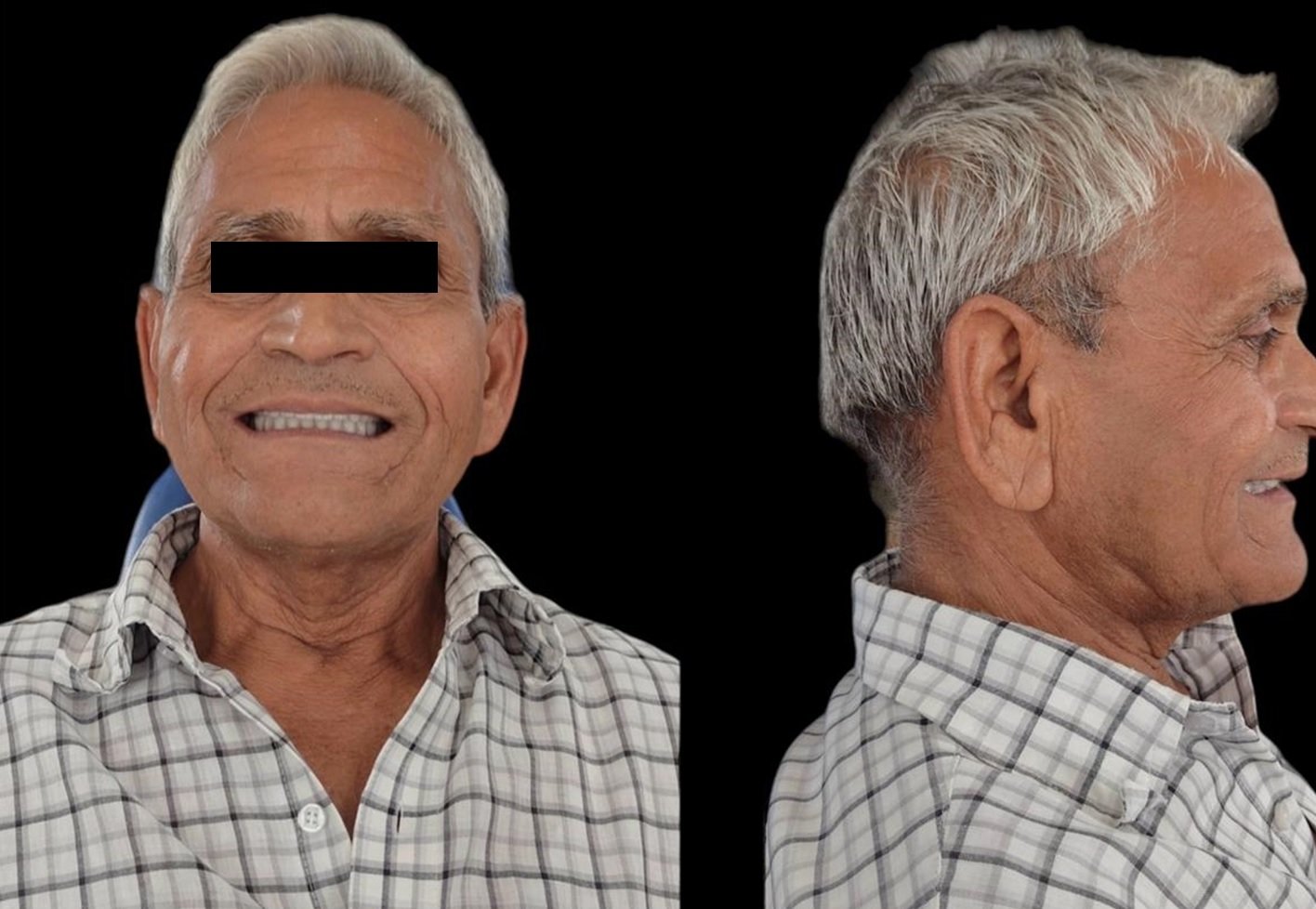
Figure-9
The patient was recalled after 1 week and then after 6 months to maintain a follow up. There was no no complaints reported from the patient. Patient adapted well to the dentures.
DISCUSSION
The long-term success of using two osseointegrated implants to treat edentulous patients is well-documented. Van Steenberghe pioneered this approach in the edentulous mandible, achieving a 98% success rate over 52 months, while Naert reported a 100% success rate after five years across various anchorage systems. This method is cost-effective and uses familiar materials, unlike fixed prostheses, which require more implants. Studies, including one by Li Chen, show that implant-supported overdentures enhance masticatory efficiency compared to conventional dentures and help preserve alveolar bone. For instance, Crum and Rooney found significantly less bone loss in patients with overdentures. The direct technique for connecting implants to the denture is quick and cost-effective. It’s less technique-sensitive and time-consuming, provided the implants are placed parallel. Ball/O-ring attachments are effective, distributing stress optimally to maintain bone and improve denture retention, stability, and chewing ability.
CONCLUSION
Mandibular overdentures supported by two ball attachments on endosseous implants offer better retention for less stable mandibular dentures, especially when the mandibular foundation is deficient. This approach also enhances the oral health-related quality of life for edentulous patients seeking an affordable solution to improve denture retention. Additionally, mandibular overdentures require significantly fewer adjustment visits for post-placement pressure spots compared to conventional mandibular prostheses.
REFERENCES
- Van Steenberghe D, Quirynen M, Callberson L, Demanet M. A prospective evaluation of the fate of 697 consecutive intraoral fixtures ad modum Branemark in the rehabilitation of edentulism. J Head Neck Pathol 1987;6:53-58.
- Naert I, Gizani S, Vuylsteke M, van Steenberghe D. A 5-year randomized clinical trial on the influence of splinted and unsplinted oral implants in mandibular overdenture therapy. Part I: Peri-implant outcome. Clin Oral Implants Res 1998;9: 170-77
- Chen L, Xie Q, Feng H, Lin Y, Li J. The masticatory efficiency of mandibular implant supported overdentures as compared with tooth supported over-dentures and complete dentures. J Oral Implantol 2002;28:238-4
- Crum RJ, Rooney GE. Alveolar bone loss in overdenture: A 5-year study. J Prosthet Dent 1978;6:610-13.
- LoCascio SJ, Salinas TJ. Rehabilitation of an edentulous mandible with an implant supported prosthesis. Pract Periodontics Aesthet Dent 1997;9:357-70.
- Golden WG, Wee AG, Danos TL, Cheng AC. Fabrication of a two piece superstructure for a fixed detachable implant supported mandibular complete denture. J Prosthet Dent 2000;2:205-09
Disclaimer from Guident
The views and opinions expressed in articles published in Guident are solely those of the authors and do not necessarily reflect the views of the editors, the editorial board or the publisher, Ivory India. Guident does not endorse any product, technique or treatment described. Clinical content is intended for qualified dental and medical professionals and is not a substitute for individual clinical judgement. Guident, its editors and the publisher accept no liability for any consequence arising from the use of information published in the journal.
How to cite this article
Dr. Chiranjeev Gogoi, Dr. Yamini Bhushan, Dr. Rahul Nagrath. Rehabilitation of an Edentulous Patient by Using an Implant Supported Overdenture: A Case Report. Guident. 2024 Sep;17(10). Available from: https://ivoryindia.in/articles/prosthodontics/rehabilitation-of-an-edentulous-patient-by-using-an-implant-supported-overdenture-a-case-report.html


