Life Style Factors Affecting Oral Health
Department of Public Health Dentistry, K. D. Dental College and Hospital, Mathura, Uttar Pradesh, India
INTRODUCTION
Lifestyle is associated closely with particular ways of living, promoted through advertising and branding forms. It is a diffuse concept that is often used to denote the way people live, reflecting a whole range of social values, attitude and activities, and it is composed of cultural and behavioural patterns and lifelong personal habits (e.g. physical activity, diet, smoking and alcoholism) that have developed through the process of socialisation and are learnt through social interactions from parents, peer groups, friends and siblings or through school and mass media. It also affects the health, where some of the present-day health problems like coronary heart disease, cancers and drug addiction have been demonstrated in the developing countries and elsewhere, with oral health detrimental behaviours being most common in the subjects of the lower socio-demographic status.1 It may be noted that not all lifestyle factors are harmful. There are many that can actually promote health. Examples include adequate nutrition, enough sleep, sufficient physical activity, etc. Health is both a consequence of an individual's lifestyle and a factor in determining it. Behaviors such as smoking, physical exercise, activity in everyday life, alcohol consumption, diet, self care practices, social contacts, and work-style are important contributing factors to population health status and variations in ill health with age.2
The term "oral health" describes the condition of having a sound mind. Oral health behavior refers to the influence of characteristics like dietary choices, dental care utilization patterns, and oral health hygiene on overall health. Food with proper nutrition value should be taken like food rich in vitamin E, C, calcium and drink an adequate amount of water. Food which includes certain colors, chemicals and high in caffeine also affect teeth. Proper oral health comes from meals that have nutrients that are good for teeth. Utilization of dental services, particularly dental treatments, intends to support the promotion of good dental health since it keeps a check on dental hygiene.3
Thus, in the socio behavioural context of oral health, lifestyle serves as an important modifying factor for the oral health outcomes. Lifestyle is closely related with social network, socio demography and socio economy. So, there is need of more comprehensive approach incorporating all the social, economical, physical and biological variables associated with the lifestyle that can have significant effect on oral health.
DEFINITION OF LIFE STYLE
“Lifestyle is a way of living based on identifiable patterns of behaviour, which are determined by the interplay between an individual’s personal characteristics, social interactions, and socioeconomic and environmental living conditions”.4
WHO Health Promotion Glossary, 1998
“A lifestyle is a pattern of repeated acts that are both dynamic and to some degree hidden to the individual, and they involve the use of artefacts. This lifestyle is founded on beliefs about the world, and its constancy over time is led by intentions to attain goals or sub-goals that are desired. In other words, a lifestyle is a set of habits that are directed by the same main goal.”5
Jensen (2009)
LIFESTYLE FACTORS AFFECTING ORAL HEALTH
Lifestyle is a behavior associated with an individual or group. Lifestyle is a general way of living, which is based on the interplay between living conditions, and individual patterns of behavior as determined by socio-cultural factors, and personal characteristics. The most important risk factors for non-communicable diseases include high blood pressure; high blood cholesterol, inadequate fruit and vegetable intake, overweight and obesity, physical inactivity tobacco use, unhealthy diet, harmful alcohol use, and poor oral hygiene are all considered as risk factors for oral diseases.6
Oral health can be affected by several diseases, particularly caries, periodontal disease, and oral cancer. These diseases are multifactorial, meaning several interacting factors may be responsible. Factors possibly contributing to these diseases, directly or indirectly, include health status, diet, physical activity, smoking, microbiome, oral hygiene, and other dental and medical conditions.7
Oral diseases are closely linked to lifestyle. Dental health encompasses the likelihood of making healthy choices in relation to diet, smoking, tobacco, oral hygiene and utilization of dental health services. A rise in the use of sugary diet, especially bakery products and carbonated drinks increase prevalence of dental caries. This unhealthy diet pattern is more common in children and adolescents that is why dental caries is considered a disease of childhood. Lack of oral hygiene from early to adult age results in accumulation of plaque and calculus, the major etiological factors for Gingivitis (Inflammation of gums) and Periodontitis (inflammation of supporting tissues of teeth).8
The concept of lifestyle highlights the personal characteristics of an individual and allows to study behavior in a broader sense. However, there is no uniform concept as to what composes a “lifestyle.” Breslow had recommended seven habits that can be considered for overall healthy lifestyle such as adequate sleep, no habit of smoking, occasional drinking of alcohol, keeping good weight, routine exercise, having daily breakfast, and reduced eating in between meals.9
There are many factors that affect the life style:
A) DIET-
One can eat different kinds of food such as dal, chapatti, bread, rice, vegetables, milk, lassi, etc. All these different kinds of food provide us with nutrients to keep us healthy and active. It is important to know what food to eat in order to stay healthy.
The science of food and nutrients and their action on our health is called Nutrition.
Nutrition and health, in fact, are two sides of the same coin. They are, therefore, inseparable. Health depends to a large extent on nutrition, and nutrition depends on the food intake. So food, is the most important single factor for health and fitness.
• Food can be defined as anything solid or liquid which when swallowed, digested and assimilated in the body provides it with essential substances called nutrients and keeps it well. It is the basic necessity of life. Food supplies energy, enables growth and repair of tissues and organs. It also protects the body from disease and regulates body functions.
• Nutrition is defined as the science of foods, nutrients and other substances they contain; and of their actions within the body including ingestion, digestion, absorption, metabolism and excretion. While this summarises the physiological dimensions, nutrition has social, psychological and economic dimensions too.10
Unhealthy diet affects oral diseases such as-
i) Dental caries- Dental caries is a complex multifactorial disease characterized by demineralisation of dental hard tissue (enamel, dentine, and cementum) in deciduous and permanent teeth. Four elements are necessary for the development of dental caries. These elements are bacterial biofilm (plaque), fermentable carbohydrates, dental hard tissue, and time.11
The effect of diet on dental caries essentially refers to the local effect of carbohydrates on dental tissue or metabolised by cariogenic microorganisms in the oral cavity. Carbohydrates involve a broad group of foods and those that are more easily fermented by bacterial species are monosaccharides (glucose and fructose) and disaccharides (sucrose, lactose and maltose), which have a low molecular mass and are designated sugars. Starch is a polysaccharide with a complex, voluminous molecule that hinders its diffusion in dental biofilm and its use in bacterial metabolism. The consumption of sucrose enables cariogenic microorganisms to use sugar as a primary energy source and promotes biochemical events through extracellular and intracellular mechanisms.12
ii) Obesity- Obesity and its attendant conditions have become major health problems worldwide, and obesity is currently ranked as the fifth most common leading cause of death globally. The World Health Organization (WHO) defines obesity as an “abnormal or excessive fat accumulation that may impair health,” further clarifying that “the fundamental cause of obesity and overweight is an energy imbalance between calories consumed and calories expended” The unit of “Body Mass Index” (BMI), which is measured by calculating [(weight in kg)/(height in m2)].
BMI classification of adult weights based on WHO scheme (BMI = weight in kg/ height in meters2).
Classification |
BMI (kg/ m2) |
Risk of co-morbidities |
|
Underweight |
<18.5 |
Low (but risk of other clinical problems increased) |
|
Normal weight |
18.5–24.9 |
Average |
|
Overweight |
25.0–29.9 |
Mild increased |
|
Obese Obese I Obese II Obese III |
≥30 30.0–34.9 35.0–39.9 ≥40 |
Moderate Severe Very severe.13 |
B) HABITS –
Lifestyle is the way of people live, reflecting a whole range of social values, attitudes and activities, and it is composed of cultural and behavioral patterns and lifelong personal habits (e.g. physical activity, diet smoking and alcoholism) that have developed through process of socialization and were learnt through social interactions from parents, peer groups, friends, social media and through school.6 Tremendous changes in lifestyle, which includes reduction in the physical activity and unhealthy eating habits negatively, affect the general and oral health of the society. Lifestyle modification and changes in health related behavior would reduce the unhealthy behavior.
- Alcohol–
Alcoholism is a chronic and progressive psychiatric illness described as an unsanctioned, maladaptive, repeated pattern of alcohol ingestion, irrespective of its adverse physical, psychological and social consequences. Alcohol is consumed by drinking. It may thus inevitably affect the oral cavity, oral mucosa, and teeth of the consumer. Oral side effects of alcohol depend on the nature and contents of the drink, its alcohol concentration, and the frequency and amount of consumption. Alcohol is among the most important risk factors for oral cancer. Alcohol causes a change in the rate of penetration of substances from the oral environment across the mucosa and this alteration of mucosal permeability may have a role to play in carcinogenesis. Increased alcohol consumption has also been associated with an increased risk of oral premalignant lesions.14
ii) Tobacco-
Tobacco use has detrimental effects on health, including oral health. The emergence and increasing popularity of newer tobacco and nicotine products make tobacco use one of the major public health problems. Tobacco use increases the risk of oral diseases such as oral cancer, oral mucosal lesions, periodontal disease, and dental caries, among many other oral diseases and conditions.30 The World Health Organization reported that 23.6% of the global adult population (aged ≥15 years) were current tobacco users in 2018, down from 33.3% in 2000 and projected to decline further to 20.9% by 2025.29 Cigarette smoking is the most popular method of using tobacco. While each cigarette contains 10–14 mg of nicotine, 1–1.5 mg is absorbed into the body when smoked. Tobacco addiction is driven by nicotine, which is the primary reinforcing component of tobacco. Nicotine is generally delivered through the skin, lungs, and mucous membranes.15
C) SEDENTARY LIFE STYLE
Sedentary lifestyle is described as the origin of multiple diseases at a systematic level, as well as cerebrovascular accidents also known as strokes or ictus, which has generated a remarkable development in recent years positioning itself as a worldwide problem given the degree of mortality associated with this pathology, especially in older adults, which can generate physical and mental disabilities.
Sedentary lifestyle is defined as distinct class of behaviours is characterized by little or no physical movement and low energy expenditure less than 1.5 METs (Metabolic Equivalent Task) MET is used to assess the energy expenditure during activities.16
D) STRESS
According to WHO- Stress can be defined as a state of worry or mental tension caused by a difficult situation. Stress is a natural human response that prompts us to address challenges and threats in our lives. Everyone experiences stress to some degree. The way we respond to stress, however, makes a big difference to our overall well-being.
Cause of stress
- Environment - The environment presents a barrage of competing demands that need to be adjusted. Weather, noise, crowding, pollution, traffic, dangerous and poor housing, and crime are all examples of environmental stressors.
- Social Stressors - The pressures of the various social positions such as parent, spouse, caregiver, and employee, might be cause of several stressors. Deadlines, financial troubles, job interviews, presentations, conflicts, demands time and attention, loss of a loved one, divorce, and co-parenting are all instances of social stressors.
- Physiological - Physiological stresses are situations and conditions that have an impact on bodies. Adolescent rapid development, menopause, disease, ageing, giving birth, accidents, lack of exercise, poor nutrition, and sleep disorders are all examples of physiological stressors.
- Thoughts – Brain interprets and sees situations as stressful, challenging, painful, or enjoyable. Some life situations are stressful, but it is the perception of them that determines whether or not they are a problem forus.17
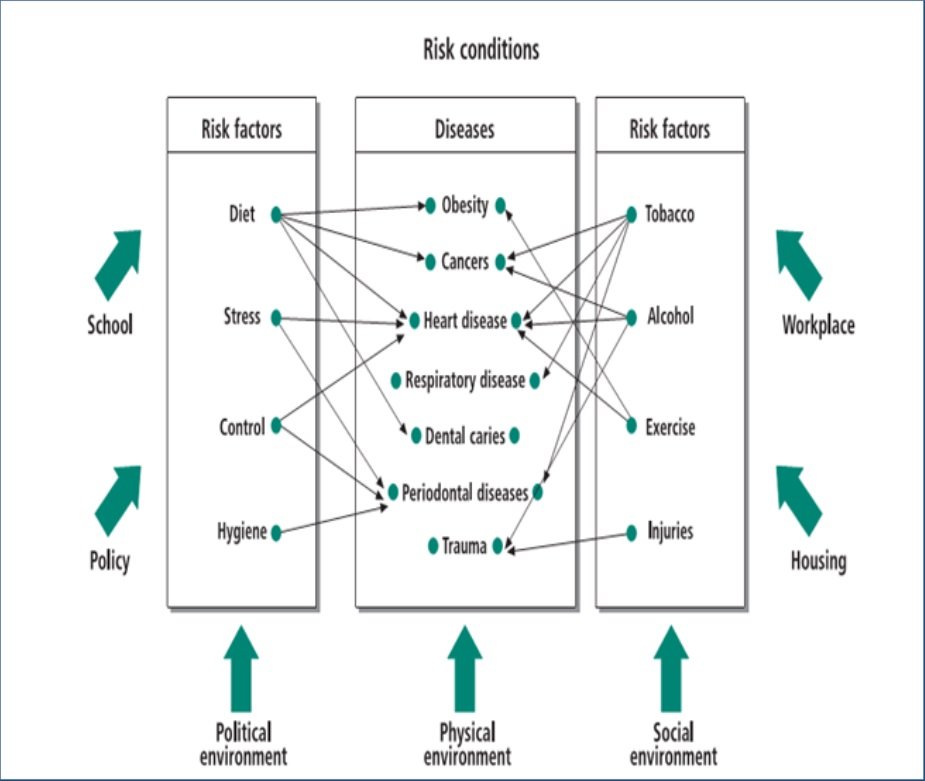
COMMON RISK FACTOR APPROACH IN DENTAL PUBLIC HEALTH
The Common Risk Factor Approach (CRFA) is a method used to create cross-disciplinary health promotion programs sharing common risk factors for disease. Many of the behavioral risk factors negatively impacting oral health also have a detrimental effect on overall health. Common Risk Factors Approach has been highly influential in integrating oral health into general health improvement strategies; it can be adapted to major public health initiatives to tackle the Non-communicable disease [NCD] burden. Taking this combined approach, the dental health professionals can effectively reduce the morbidity and mortality from chronic diseases and decrease the incidence of oral diseases, by working within and between their professional organizations to find enduring solutions.18 The key concept underlying the integrated CRFA is that promoting general health by controlling a small no. of risk factors may have a major impact on a large number of diseases at a lower cost, greater efficiency and effectiveness than disease specific approaches.19
Common Risk Factor Approach (Sheiham and Watt 2000)
CONCLUSION
A healthy mouth is a premise of overall health. The oral cavity can be a mirror image of other areas of the body and many systemic illnesses are manifested in the soft tissues of oral mucosa of the mouth. When oral health is compromised, overall health can be affected. Maintaining a healthy lifestyle could be simply by inheriting healthy behaviors in ones lives. Patients’ involvement in self-care by promoting healthy behaviors such as brushing twice a day, visiting dentist regularly, negating orally abusive substance addiction, having breakfast every day, eating a balanced diet, and reducing stress leads to an overall good lifestyle. These factors along with sleeping a minimum of 7–8 h per night and working for 8–9 h/day and ample daily exercise may help patients improve or protect their oral health for years to come. The public health programs emphasizing on individual lifestyle as a determinant of health are needed.
REFERENCES
- Dariush D. Farhud. Impact of Lifestyle on Health. a systemic review. Iran J Public Health, 2015; 44(11): 1442-1444.
- Bharathi Purohit, Abhinav Singh. Life style and oral health. Advances in Life Science and Technology, 2012; 3(8): 35-43.
- Satyaranjan Mishra, Ayesh Das. Effect of lifestyle in oral health pattern.a systemic review. International Journal of Community Dentistry, 2022; 10(2): 103-108.
- Francesco Bagordo, Antonella De Donno, Tiziana Grassi, Marcello Guido, Gabriele Devoti, Elisabetta Ceretti, Claudia Zani, Donatella Feretti, Milena Villarini, Massimo Moretti. Lifestyles and socio-cultural factors among children aged 6–8 years. BMC Public Health, (2017); 233 (17): 2-12.
- A.J .Veal. The concept of lifestyle: a review. Leisure Studies, 1993; 12(4) :233-252.
- Jagan Kumar Baskaradoss, Amrita Geevarghese, Abeer Al-Mthen, Hanan Al-Ghamdi, Ruba Al-Haudayris, Sarah Al-Obaidy, Waad Al-Saadi. Influence of lifestyle on dental health behavior. Journal of Lifestyle Medicine, July 2019; 9(2): 119-124.
- Daniela Carmagnola, Gaia Pellegrini, Matteo Malvezzi, Elena Canciani, Dolaji Henin and Claudia Dellavia. Impact of lifestyle variables on oral diseases and Oral Health-Related Quality of Life. Int. J. Environ. Res. Public Health, 2020; 17(6): 1-16.
- S. Akhtar Hussain Bokhari. Life style impact on oral health. a short communication. Journal of Medical Sciences, 2005; 22(3); 1-2.
- Nishu Singla, Shashidhar Acharya, Ritesh Singla, Prajna Nayak. The Impact of lifestyles on dental caries of adult patients in Udupi district: across-sectional study. J Int Soc Prevent Community Dent, 2020;10: 189-195.
- S. Akhtar Hussain Bokhari. Life style impact on oral health. a short communication. Journal of Medical Sciences, 2005; 22(3); 1-2.
- Abdulhadi Warreth. Dental caries and its management. International Journal of Dentistry,2023;1(1): 1-15.
- Khushbu Yadavand Satyam Prakash. dental caries: a review. Asian Journal of Biomedical and Pharmaceutical Sciences,2016; 6(53): 01-07.
- Xihua Lin and Hong Li. Obesity: Epidemiology, Pathophysiology, and Therapeutics. Frontiers in Endocrinology 2021;12(706978): 1-9.
- Kakarla Priyanka, Kudlur Maheswarappa Sudhir, V. chandra sekhara reddy, RVS. Krishna Kumar, G. Srinivasulu. Impact of alcohol dependency on oral health – a cross-sectional comparative study. Journal of Clinical and Diagnostic Research, 2017; 11(6): 43-46.
- K.H. Awan. Effects of tobacco use on oral health – a review article. Annal Dent Univ Malaya, 2011; 18(4): 18–23.
- Jung Ha Park, Ji Hyun Moon, Hyeon Ju Kim, Mi Hee Kong, Yun Hwan Oh. Sedentary lifestyle: overview of updated evidence of potential health risks. Korean J Fam Med 2020;41(7):365-373.
- Sujaritha, Deepa, Nandhini, Vandhana and Mahalakshmi. Stress and stress management: A review. Indian journal of natural science, 2022; 13(73): 58-71.
- C. Santhosh Kumar, Shweta Somasundara. Common risk factor approach: finding common ground for better health outcomes. International Journal of Contemporary Medical Research, 2017; 4(6): 67-70.
- Sreekanth Bose. Common risk factor approaches for oral diseases- a SWOT analysis. Acta Scientific Dental Sciences, 2019; 3(9): 1-3.
Disclaimer from Guident
The views and opinions expressed in articles published in Guident are solely those of the authors and do not necessarily reflect the views of the editors, the editorial board or the publisher, Ivory India. Guident does not endorse any product, technique or treatment described. Clinical content is intended for qualified dental and medical professionals and is not a substitute for individual clinical judgement. Guident, its editors and the publisher accept no liability for any consequence arising from the use of information published in the journal.
How to cite this article
Dr. Saurabh Agarwal, Dr. Navpreet Kaur, Dr. Manish Bhalla. Life Style Factors Affecting Oral Health. Guident. 2025 Jan;18(2). Available from: https://ivoryindia.in/articles/general/life-style-factors-affecting-oral-health.html