Probiotics and its Role in Prevention of Dental Caries-a Review
Department of Pedodontics and Preventive Dentistry, K.D. Dental College & Hospital, Mathura, UP
ABSTRACT
The current oral health crisis, whose causes are varied and complex, necessitates timely oral evaluation and early detection and treatment of oral health problems. Dramatic changes in eating habits and lifestyles are associated with the recent decline in oral health.
Traditionally, probiotics have been associated with gut health, and most clinical interest has been focused on their use for prevention or treatment of gastrointestinal infections and diseases; however, during the last decade several investigators have also suggested the use of probiotics for oral health purposes such as dental caries. The aim of this review is to present an update on role of probiotics in prevention of dental caries.
Keywords-Probiotics, Dental caries, Streptococcus mutans.
WHAT ARE PROBIOTICS
The concept of traditional probiotics was initially based on the observations of Elie Metchnikoff in 1907. He thus suggested that the regular consumption of fermented dairy products with lactic acid bacteria (LAB), such as yogurt, was associated with enhanced health and longevity in people. Since then, the term probiotic has been always linked to beneficial bacteria for the host health, although its precise definition has evolved over the time.
Probiotic definition has evolved since its creation and has been carefully analyzed by several experts. Nowadays, the most accepted definition by the scientific community is the one proposed by the expert panel convened by the International Scientific Association of Probiotics and Prebiotics (ISAPP) in 2014. It defines probiotics as “live microorganisms that, when administered in adequate amounts, confer a health benefit on the host” and proposed only a slight grammatical modification of the definition already proposed by the FAO/WHO in 2001.
This definition itself differentiates commercial starter-cultures (administered as food processing elements) and commensal microorganisms (not administered but already present within the host) from probiotic bacteria that are administered to promote their health effects. Furthermore, it highlights the requirement to ingest live microorganisms.1
There has been a paradigm shift towards an ecological and microbial community-based approach to understanding oral diseases.2
Dental caries is one of the most common preventable childhood diseases; people are susceptible to this ailment throughout their lifetime. Various approaches including Chemotherapeutic agents, Antibiotics, Sugar Substitutes, Fluorides, Restorative materials have been in use, however the anti-caries effects of these approaches are still limited. Hence the main aim of this review is to brief the role of probiotics in prevention of dental caries.
MICRO-ORGANISIMS COMMONLY USED AS PROBIOTIC 3

MECHANISM OF PROBIOTICS
Probiotics can help prevent and treat oral diseases through several mechanisms that includes-
1. Direct interaction – causing enmeshing in securing of oral microorganism to proteins, inhibition of pathogen adhesion, colonization and biofilm formation, induction of cyto-protective proteins expression on host cell surfaces, inhibition of collagenases.
2. Competitive exclusion – agility on plaque evolution and on its complex ecosystem by competing and intervening with bacterial attachments and engaging in metabolism of substrate and yielding of chemicals like organic acids, hydrogen peroxide and bacteriocins that inhibit oral bacteria.
3. Indirect actions – modulating systemic immune function, effect on local immunity, eventuality on non-immunologic defense mechanisms, modulation of cell proliferation and cytokine induced apoptosis, regulation of mucosal permeability, as antioxidants and hamper plaque induction by neutralizing the free electrons.4-6
IDEAL PROPERTIES OF PROBIOTICS 7
An effective probiotic should:
1. Exert a beneficial effect on the host
2. Be non-pathogenic and non-toxic
3. Contain a large number of viable cells
4. Be capable of surviving and metabolizing in the gut
5. Remain viable during storage and use
6. Have good sensory properties
7. Be isolated from the same species as its intended host.
ROLE OF PROBIOTICS IN PREVENTION OF DENTAL CARIES 8
Streptococcus mutans is the main causative organism in caries development due to its ability to produce highly branched, water-insoluble glucan, mutan.
The main characteristics of virulence Streptococcus mutans are their acidogenicity, ability to survival in acidic environments, the ability of biofilm formation and adherence to the tooth.
Various hypotheses have been proposed regarding the mechanism of action of probiotics, including the production of antimicrobial substances, in antagonism with the pathogenic agents, preventing cell adhesion, invasion, and the modulation of both local and systemic immune actions.9
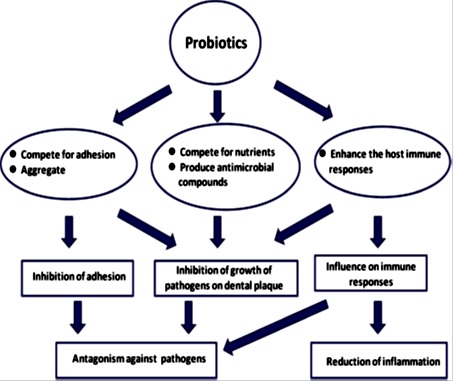
Fig 1:Effect of probiotic bacteria on oral health. Several mechanisms have been postulated regarding the action of probiotics in the oral cavity. Probiotics exert beneficial effects by improving gut health (normalization of intestinal microbiota), antagonizing pathogens through production of anti-microbial compounds (organic acids, hydrogen peroxide, and bacteriocins), competing for pathogen-binding sites and available nutrients and growth factors, and modulating the immune response and metabolic effects. The mechanism of probiotic action in the oral cavity could be analogous to that in the intestine.10
Strains of Lactobacillus rhamnosus, L. casei, L. reuteri and Bifidobacterium spp. have all demonstrated the potential to alter colonisation of cariogenic bacteria and thus prevent dental caries.11
An in-vitro study was the first to state that Lactobacillus acidophilus could inhibit growth of other bacteria. Lactobacillus species strain GG could produce different antimicrobial components such as organic acids, hydrogen peroxide, carbon peroxide, diacetyl, low molecular weight antimicrobial substances, bacteriocins, and adhesion inhibitors against Streptococcus, hence could be used as a potent probiotic.12-13 Caglar et al have estimated the effectiveness of the Xylitol based chewing gums and probiotics on the Streptococcus mutans and Lactobacilli counts, stating that probiotic microorganisms could reduce the salivary concentration of Streptococcus mutans in a meaningful way.14 Nase et al and Wu et al (2014-follow-up to six months) have studied the effect of the probiotic Lactobacillus rhamnosus GG on the risk of tooth decay and have demonstrated a reduction in caries and reduced levels of Streptococcus mutans in patients taking the probiotics of Lactobacillus group.15-16
Cildir et al demonstrated that daily consumption of fruit yogurt with Bifidobacterium animalis subsp. Lactis DN-173010 could reduce the salivary levels of mutans streptococci in orthodontic patients with fixed appliances.17 Tehrani et al reported that consumption of L. acidophilus containing probiotic curd (1010 to 1011 cfu/ ml) for 7 days resulted in marked reduction in salivary S. mutans count due to significant increase in oral pH. Combination of L. rhamnosus LB21 with fluoride was shown to be very effective in reducing caries occurrence in school children and also remineralization of dental enamel, in older adults.18-19
The studies quoted above gives a promising result of probiotics in dental caries prevention.
NATURALLY AVAILABLE PROBIOTICS 20

COMMERCIALLY AVAILABLE PROBIOTICS 21

PROBIOTIC STATUS IN INDIA
Food industry of India is one of the hot spots for investors. Since the awareness about the probiotic and its health benefits has grown tremendously among Indian population, demand for probiotic foods has gained much popularity. Indian and multinational companies are coming in to the picture since they entered the Indian food industry in 2007. Indian probiotic market was valued at $2 million as per 2010 estimates. According to figures released by US-based research firm, Frost and Sullivan, in August 2012, probiotic products in India generated revenue of US $522.8 million in 2018.22
Functional dairy products with probiotics are promising in the Indian market, as major players engaged in offering probiotic food products in the Indian market includes Mother Dairy, Amul, Danone Yakult, Nestle, Tablets India, Dr Reddy Laboratories, Unique Biotech, Zeus Biotech, etc.
Major pharmaceuticals companies have become active and are trying to formulate newer drugs and products, and packaged products like probiotic-based nutritional supplements with special needs such as lactation, pregnancy, immunodeficiency etc and products especially for pediatric and geriatric patients. In this aspect, some probiotic based pharmaceutical formulations are Sporolac, ViBact, Darolac, Biglac, Bifilac etc.
The latest and recent addition to the list of probiotics in India is ViBact (which is made up of genetically modified Bacillus mesentricus), which acts as an alternate to B-complex capsules. A formulation of approximately 108 probiotic bacteria per gram or mililitre (108/ml) with a daily intake of 1.5-2 dl per day is recommended dose.23
Probiotic products are gaining acceptance mostly in metros and in some Tier 1 cities. The Indian market is big, but difficult to reach since cold storage and cold distribution chain are underdeveloped in India, especially in the rural areas. Realizing these drawbacks, yakult has taken an initiative in this direction, and has already announced to target tier II cities in their next phase. The strongest sale of Yakult is recorded from Delhi/ NCR. In the future, it is important to increase the awareness of the country people and to educate them about the probiotics' benefits.24
FUTURE ASPECTS
Novel probiotic solutions, targeting oral health, constitute a new class of products that are a great leap beyond the conventional over the counter solutions. With the changing lifestyle and feeding habits, globally, it is anticipated that rise in oral diseases will be proportional to other lifestyle diseases. Identification of strains from indigenous fermented products such as kefir, curd, etc. followed by rigorous preclinical and clinical trials can help generate novel probiotic with desired effects.25
Early mucosal colonization with E. coli bacteria in new-born stimulates mucosal immune system to produce specific antibodies as well nonspecific secretory immunoglobulins. Research is directed at the reduction of severity and occurrence of mucosal lesions, specifically apthous ulcers.26
New tools allowing real-time studies in humans and following a microbe as it integrates into an existing microbiota, as well as systems that can quantify levels of health, will drive this field forward. Read-outs on what microbes are present, their interaction with the host and the influence of environmental factors (e.g., drugs, nutrients) will become standard when going for a physical examination in the future.27
Various processing advances, such as microencapsulation and bacterial coating and addition of prebiotic compounds used as growth factors for probiotic organisms, will provide a means to optimize the delivery and survival of strains at the site of action.28
The Given Imaging’s PillCam is a good example of engineering technology in medicine. This tiny capsule is swallowed, and, as it passes through the host, it takes photographs of the mucosal tissues. In time, such devices will be controlled remotely, will have sensors and sampling devices, and will deliver payloads at the desired site. Such science fiction will become reality within 10 years. Thus, molecular, nano, biochemical, microbiological, immunological, and engineering sciences hold the key to future advances in the clinical application of probiotic and prebiotic products.29
However, all the products effective in oral health care are required to be administered daily, so a possible way of administration could be to incorporate probiotics in toothpaste, mouthwash, chewing gums, sugar-less candy for kids etc. Some of these products are already available over-the-counter in western countries and are fast gaining popularity in others. Tapping the commercial potential of the emerging oral-probiotic market by the industry can turn out to be a win–win situation for all.
CONCLUSION
The practical application of probiotic strain could be proposed in the future as a new tool in preventing caries along with the already available strategies, particularly among high‑risk population. Probiotics have got immense potential in dealing with dental caries as revealed by the studies mentioned above. It is well accepted globally that consumption of probiotics helps in leading a healthy life. In India too, with the growing interest in self-care and optimum health at all ages’ recognition of a link between diet and health has never been stronger. Guidelines governing the labelling of probiotics, such as indicating the species, strain and the number of bacteria present are required from regulatory authorities in India. Like an old quote by Hippocrates goes, “Let food be thy medicine and medicine be thy food”. Today more and more people are becoming increasingly aware that the key to a healthy life lies in the gut and there is a greater focus on eating right and healthy.
REFRENCES
- Martín R and Langella P (2019) Emerging Health Concepts in the Probiotics Field: Streamlining the Definitions. Front. Microbiol. 10:1047. doi: 10.3389/fmicb.2019.01047.
- Devine AD, Marsh PD. Prospects for the development of probiotics and prebiotics for oral applications. J Oral Microbiol. 2009; 1:10.
- Brown M. Modes of action of probiotics: Recent developments. Journal of animal and veterinary advances 2011;10(14):1895-900.
- Waghmode V, Joshi V, Patil K, Shep T, Shah Y, Rathod A. Probiotics: A review. I J Pre Clin Dent Res. 2015;2(4):45-8
- Bhushan J, Chachra S. Probiotics – Their role in prevention of dental caries. JOHCD. 2010;4(3):78-82.
- Lawande S. Probiotics for management of periodontal disease: A novel therapeutic strategy?IOSRPHR. 2012;2(4):41-6.
- M David Collins, Glenn R Gibson. Probiotics, prebiotics, and synbiotics: approaches for modulating the microbial ecology of the gut. Am J Clin Nutr 1999; 69(spl): 1052Sâ€ÂÂ7S.
- KrzyÅ›ciak, W., Jurczak, A., KoÅ›cielniak, D., Bystrowska, B., & Skalniak, A. (2014). The virulence of Streptococcus mutans and the ability to form biofilms. European Journal of Clinical Microbiology & Infectious Diseases: Official Publication of the European Society of Clinical Microbiology, 33(4), 499–515.
- Bibb ò S, Ianiro G, Giorgio V, Scaldaferri F, Masucci L, Gasbarrini A, Cammarota G. The role of diet on gut microbiota composition. Eur Rev Med Pharmacol Sci 2016; 20: 4742-4749.
- Rastogi P, Saini H, Dixit J, Singhal R (2011) Probiotics and oral health. Natl J Maxillofac Surg 2(1):6–9.
- Meurman JH, Stamatova I. Probiotics: contributions to oral health. Oral Dis. 2007; 13:443–51.
- Polonskaia MS. Antibiotic substances in acidophil bacteria. Mikrobiologiia.1952; 21:303-310.
- Silva M, Jacobus NV, Deneke C, Gorbach SL. Antimicrobial substance from a human Lactobacillus strain. Antimicrob Agents Chemother. 1987; 31:1231-1233.
- Caglar E, Kuscu OO, Sandalli N, Ari I. Prevalence of dental caries and tooth wear in a Byzantine population (13th c. A.D.) from northwest Turkey. Arch Oral Biol 2007; 52: 1136-1145.
- Näse L, Hatakka K, Savilahti E, Saxelin M, Pönkä A, Pouss a T, Korpela R, Meurman JH.Effect of long-term consumption of a probiotic bacterium, Lactobacillus rhamnosus GG, in milk on dental caries and caries risk in children. Caries Res 2001; 35: 412-420.
- Wu A, Switzer-Nadasd i R. The role of health behavior in preventing dental caries in resource-poor adults: a pilot intervention. J Tenn Dent Assoc 2014; 94: 17-21.
- Cildir SK et al. Reduction of salivary mutans streptococci in orthodontic patients during daily consumption of yoghurt containing probiotic bacteria. Eur J Orthod. 2009 Aug; 31(4):407- 11.
- Tehrani, M. H., Akhlaghi, N., Talebian, L., Emami, J., & Keyhani, S. E. (2016). Effects of probiotic drop containing Lactobacillus rhamnosus, Bifidobacterium infantis, and Lactobacillus reuteri on salivary Streptococcus mutans and Lactobacillus levels. Contemporary Clinical Dentistry, 7(4), 469–474.
- Petersson, L. G., Magnusson, K., Hakestam, U., Baigi, A., & Twetman, S. (2011). Reversal of primary root caries lesions after daily intake of milk supplemented with fluoride and probiotic lactobacilli in older adults. Acta Odontologica Scandinavica, 69: 6, 321–327.
- Sornplang P, Piyadeatsoontorn S. Probiotic isolates from unconventional sources: a review Journal of Animal Science and Technology 2016; 58:26
- Kesavelu D, Rohit A, Karunasagar I, et al. (November 05, 2020) Composition and Laboratory Correlation of Commercial Probiotics in India. Cureus 12(11):11334.
- Balaji RR, Kantha DA. Market potential for probiotic nutritional supplements in India. Afri J Busi Manag 2011; 5: 5418-23.
- Suvarna VC, Boby VU. Probiotics in human health: A current assessment. Curr. Sci. 2005;88(11):1744-48.
- Shailendra Raghuwanshi, Swati Misra, Rohit Sharma and P.S. Bisen Indian perspective for probiotics: A review Indian J. Dairy Sci. 68(3), 2015
- P. Chugh, et al. Journal of Functional Foods 70 (2020) 103985
- Saraf K, Shashikanth MC, Tulasi P, Nishant S, Nallan C. Probiotics – Do they have a role in Medicine and Dentistry?JAPI. 2010; 58:1-6.
- Spacova et al. Future of Probiotics and Prebiotics the Implications for Early Career Researchers Food Microbiology, a section of the journal Frontiers in Microbiology June 2020.
- Reddy SR, Swapna LA, Ramesh T, Singh TR, Vijayalaxmi N, Lavanya R. Bacteria in oral health – Probiotics and prebiotics A review. Int J Bio Med Res. 2011;2(4):1226-33.
- Reid G. How science will help shape future clinical applications of probiotics.CID,2008;46:62- 66.
Disclaimer from Guident
The views and opinions expressed in articles published in Guident are solely those of the authors and do not necessarily reflect the views of the editors, the editorial board or the publisher, Ivory India. Guident does not endorse any product, technique or treatment described. Clinical content is intended for qualified dental and medical professionals and is not a substitute for individual clinical judgement. Guident, its editors and the publisher accept no liability for any consequence arising from the use of information published in the journal.
How to cite this article
Dr. Rupali Shrivastava, Dr. Sonal Gupta. Probiotics and its Role in Prevention of Dental Caries-a Review. Guident. 2021 Feb;14(3). Available from: https://ivoryindia.in/articles/general/probiotics-and-its-role-in-prevention-of-dental-caries-a-review.html