Cortico -Basal Implantology-Biological Blessing
V.K Dental, Bangalore, KAR India
DENTAL IMPLANTOLOGY TODAY
Many options exist to replace missing teeth but dental implants have become one of the most used biomaterials to replace one (or more) missing tooth over the last decades. Therefore, the use of dental implants is also a common practice. Implantology is undergoing revolution, and the speed of revolution is similar to what we see in the electronic and phone technology.
- Fast forward from 1967. The origin of concepts of osseointegration till today, implants have proved to be very successful, But lot has changed from patients side and also from the clinicians side ,patients expect shorter treatment time and much less complex way, which they witness in Medical and surgical field. They have moved from open surgery to laparoscope, Endoscopy to Robotic surgeries to reduce the time and also more predictable out come,Cortico Basal Implantology is next step in dental implantology and we have moved from minimal invasive to micro invasive procedure
Basal Implantology also termed bi-cortical implantology, cortical implantology, and Cortico-Basal Implantology, is a modern innovative implantology system which utilizes the basal cortical portion of the jaw bones for retention of the dental implants, which are less prone to resorption and are infection free and ready to bear the load in immediate load protocol. Basal bone is defined as the osseous tissue of the mandible and maxilla other than the alveolar processes. It acts as the basic framework of the maxilla and mandible. The basal bone is always present throughout life; it is very strong and forms the stressPre-bearing part of our skeleton. Utilizing the basal bone, implantologists can now place implants in regions where traditional implants would not be possible. Many limitations on traditional implantology are now easily solved with the utilisation of basal implantology technique.
KEY FEATURES OF CORTICO BASAL IMPLANTOLOGY
- Utilisation of patients Native Bone- dense, stable cortical bone Treatment concept is Multimodal. Multitype, Multiple implants concepts
- Always Immediate loading with Rigid Stabilization
- Load bearing Threads have to be in Stable cortical bone
- Presence or Absence of Cancellous bone has no Influence on Treatment out come
- Non-Invasive, flap less, Graft less, Key hole Procedure Treatment Differs from Conventional / Alveolar / Axial Approach In Implantology.
- Implants belonging to this system are anchored cortical or Basal bone, and the process of creating this anchorage has been denominated as “Cortical -fixation”.
- Their Load Transmitting Threads Are Anchored In Native, Residual, Cortical Bone Areas, Often Far From The Actual Clinical Tooth
- The success of this treatment is the primary stability which is Macro Mechanical Anchorage (Cortical fixation) in 1st,2nd,3rd, cortical fixation.
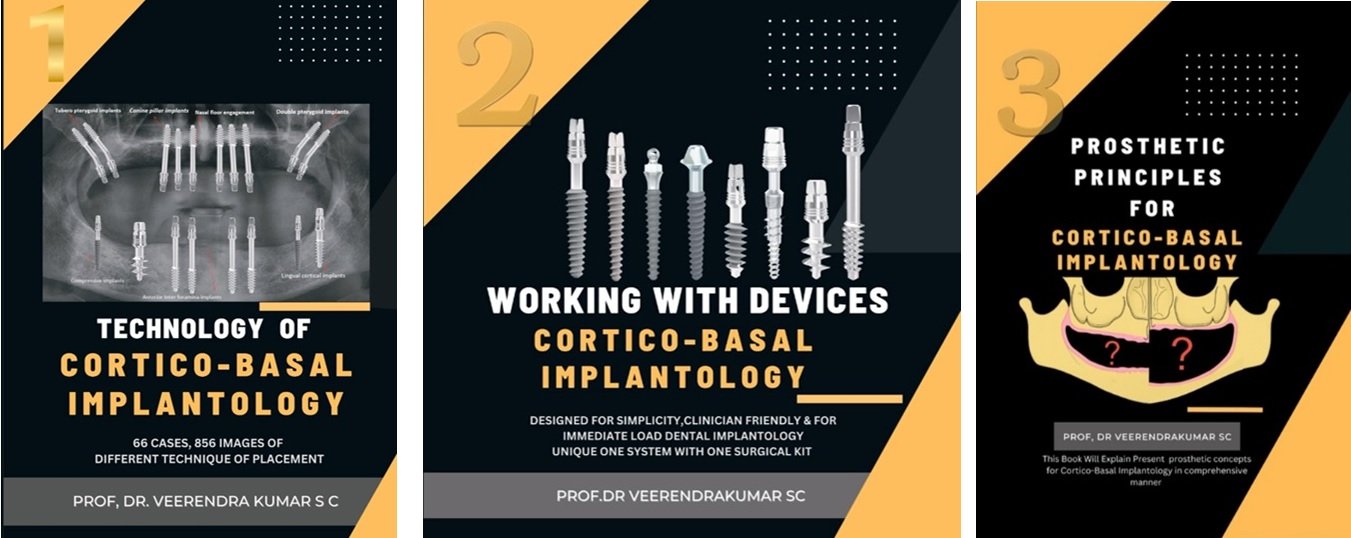
More Details and reading can be found in the educational series:
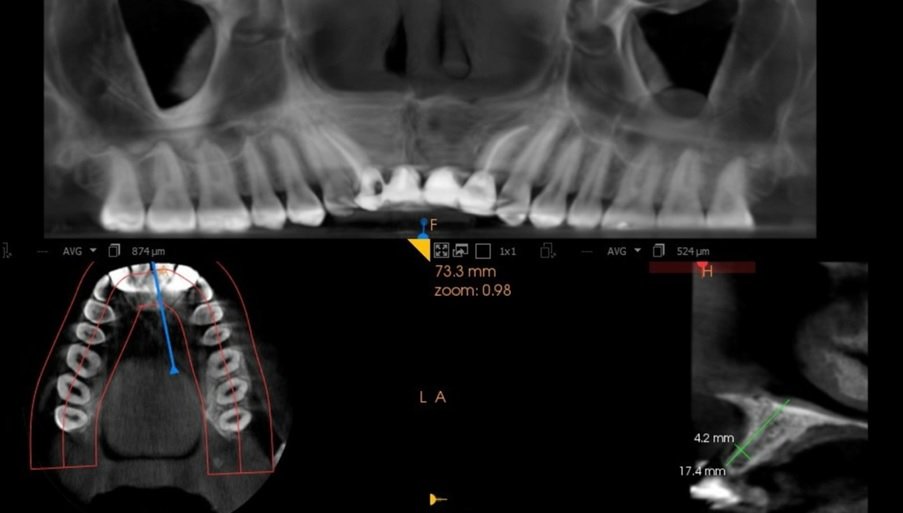
PRESENTING A COMPLEX CASE TREATED IN ONE STAGE UTILISING THE TECHNOLOGY OF CORTICO BASAL IMPLANTOLOGY

Patient presets with cyst in relation to anterior maxillary incisors, extraction and cyst Enucleation done in one stage and implants are inserted in the same time and impression were taken.


Immediate in 24 hours Prosthesis inserted PFM

One year later bone formation is evident

In 2019 clinical picture shows soft tissue stability

After 7 years post implantation both soft tissue and hard tissue stability is seen and can be well appreciated


Implants used-Monoimplants(monoimplants.com)
CONCLUSION
Out of the variety of implant treatment options that can be used, the minimally invasive implant treatment alternatives may be more appropriate especially for the aged edentulous patients, considering their oral and systemic status, needs, expectations and barriers.
Usage of fewer and less invasive surgical procedures (e.g., avoiding bone grafting; using flapless technique for implant placement; using a number of implants) is beneficial due to a shorter healing period and a decreased patient discomfort, represented by either pain or stress.
Additionally, the possibility of immediate implant loading provides functionality, comfort, psychological confidence, speech, the decreased clinical time, needed for their execution.
Disclaimer from Guident
The views and opinions expressed in articles published in Guident are solely those of the authors and do not necessarily reflect the views of the editors, the editorial board or the publisher, Ivory India. Guident does not endorse any product, technique or treatment described. Clinical content is intended for qualified dental and medical professionals and is not a substitute for individual clinical judgement. Guident, its editors and the publisher accept no liability for any consequence arising from the use of information published in the journal.
How to cite this article
Dr. Veerendrakumar SC.. Cortico -Basal Implantology-Biological Blessing. Guident. 2023 Dec;17(1). Available from: https://ivoryindia.in/articles/implantology/cortico-basal-implantology-biological-blessing.html