
Chickenpox: Intra Oral Manifestations
Department of Oral Medicine & Radiology, Department of Oral Maxillofacial Surgery, Department of Oral Medicine & Radiology, Panineeya Institute of Dental Sciences & Research Centre Hyderabad, India
ABSTRACT
Chickenpox is a highly contagious disease caused by varicella zoster virus, although it’s a skin lesion, could be associated with oral lesions. Dentist could diagnose the disease even before the cutaneous manifestations appear. We report a case of chicken pox with oral and cutaneous manifestations.
KEYWORDS: Chicken pox, varicella zoster, oral manifestations.
INTRODUCTION
Chickenpox is a highly contagious illness caused by primary infection with varicella zoster virus (VZV). It is an air borne disease which spreads easily through, coughing or sneezing of ill individuals or through direct contact with secretions from the rash. Oral lesions can occur.1, 2
CASE REPORT
A 9 year old boy came to Department of Oral Medicine And Radiology with his parents. They complained of ulcers in the mouth. On external examination, few lesions were vesicles which were intact and few were ruptured leading to ulcers on the skin (Fig 1). On intraoral examination, there was a deep ulcer in the upper left molar region on gingiva measuring 1x1cm in size. The lesion was surrounded by erythema. The base was necrotic and rested on bone (Fig 2). He also had an ulcer that was a ruptured vesicle in left buccal mucosa measuring approximately 0.5x0.5 cm surrounded by erythema. The dental eruption status was normal for his age. Complete haemogram revealed raised ESR and neutropenia. Smear from the base of the ulcer was positive for Tzanck test.
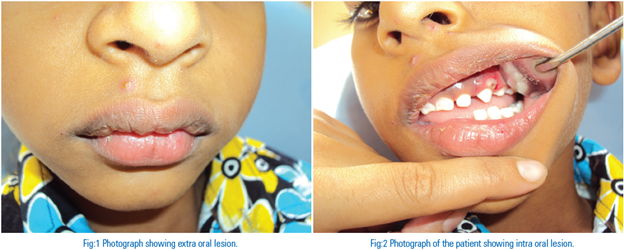
FIG 1: CLINICAL PRESENTATION
DISCUSSION
Chickenpox or Varicella is a contagious exanthematous fever (eruptions) caused by varicella zoster virus. It is similar to Herpes simplex in various aspects. It represents the primary infection with VZV; latency ensues, and recurrence is possible as Herpes zoster. The incubation period is 10 – 21 days with the average of 15 days. The symptomatic phase usually begins with malaise, pharyngitis, fever, epiphora and rhinitis. In older children and young adults, additional symptoms (e.g., headache, myalgia, nausea, anorexia and vomiting) occasionally seen. This is followed by a characteristic, intensely pruritic exanthem.1, 2
The rash begins on the trunk later, face followed by involvement of extremities. Each lesion progresses through stages of erythema, vesicle and hardened crust. There might be pustules if secondarily infected. The early vesicular stage is the classic presentation.3 The centrally located vesicle is surrounded by a zone of erythema and has been described as “a dew drop on a rose petal”. In contrast to herpes simplex the lesions typically continue to erupt for 4 days; in some cases the exanthema’s arrival might extend to 7 or more days.3, 4 There will be lymphadenopathy. Old crusted lesions intermixed with newly formed and intact vesicles have common place.1, 2
Affected individuals are contagious from 2 days before the exanthema until all the lesions crust and exfoliate. It is highly contagious in exfoliation stage. The severity of the cutaneous involvement is variable. Oral lesions are present in about 1/3rd of affected individuals. The lesions are usually painless. The lesions begin as 3-4 mm white opaque vesicles that rupture to form 1-3 mm ulcerations on tongue, buccal mucosa and gingival commonly. Prevalence and number of oral lesions correlate with severity of extraoral infection.1, 2
Possible complications include secondary infections, encephalitis, pneumonia, cerebellar ataxia, gastrointestinal disturbances (e.g., vomiting, diarrhea, dehydration) and hematologic events i.e., thrombocytopenia, pancytopenia, hemolytic anaemia and sickle cell crisis.1
The histological features include acantholysis, with formation of numerous free floating Tzanck cells, which exhibit nuclear margination of chromatin and occasional multinucleation. Diagnosis of chicken pox usually can be made from history of exposure to VZV within last 3 weeks and presence of typically exanthema.5 Smear from vesicular fluid demonstrate Tzanck cells identical to HSV. Viral isolation in cell culture or rapid diagnosis from fluoresceinconjugated VZV monoclonal antibodies.1, 2, 5 Serum samples can be obtained during acute stage and 14-28 days later. The later sample should demonstrate 4 fold increase in antibody titres to VZV.1, 2, 6
Treatment include symptomatic treatment. Warm baths with soap/ baking soda, application of calamine lotion and systemic/local diphenhydramine which are used to relieve pruritus. Lesions should not be scratched due to pruritis because of danger of secondary infection. VZV has a lipid envelope destroyed by soap and other detergents.7, 8, 9, 10 Antipyretics other than aspirin should be given to reduce fever because of fear of Reye’s syndrome in children below 6 years. Use of peroral antiviral medications such as acyclovir in the dosage of 400mgs tid for 7 days or valacyclovir/famciclovir have been shown to reduce duration and severity of the infection if it is administered with the first 24 hours of appearance of rash. Routine use of these antiviral medications is not recommended in immunocompetent children with uncomplicated chicken pox.1, 2
In immunosuppressed individuals/complicated chicken pox, purified Varicella Zoster immunoglobulin can be given to modify the clinical manifestations of the infection. Use of combined measles, mumps, rubella and Varicella (MMRV) vaccine has demonstrated comparable effectiveness and safety.3
REFERENCES
- B Sivapathasundaram, N Gururaj and K Ranganathan. Viral infections of oral cavity. Shafer’s Textbook of oral pathology, Saunders Elsevier Publications, 6th edition page 344-346, 2009.
- Neville, Damm, Allen and Bouquot. Viral infections Oral and Maxillofacial Pathology, Elsevier – 3rd edition, page 248-250, 2009.
- Chickenpox Wikipedia, The free Encyclopedia.
- Pub Med Health. A service of the national library of medicine, National Institutes of Health A.D.A.M. Medical Encyclopedia, Atlanta (GA), 2011.
- MG Myers, JF Seward, PS Larussal’s Varicella zoster virus in Klieghan RM, Behrman RE, Janson HB, Stanton BF eds Nelson. Textbook of Pediatrics, Philadelphia PA Saunders Elsevier, 18th edition, Chapter 250.
- American Academy of Pediatrics Committee on Infectious diseases. Recommended Immunization Schedules for Children and Adolescents- United States, 2008, Pediatrics 2008; 121: 219-220.
- Sol. Silverman, L Roy Eversole, Herpes Viruses and Enteroviruses. Essentials of Oral Medicine by Silverman, Eversole and True Love, Brain C. Decker Publisher, 2002. Page 117.
- RA Cawson’s and EW Odell Cawson’s essentials of oral medicine, Churchill Livingstone – Elsevier, 8th edition page no:209.
- J A Regezi, JJ Sciubba and R CK Jordan. Oral Pathology: Clinico pathologic correlations, Saunders Elsevier 5th edition.
Disclaimer from Guident
The views and opinions expressed in articles published in Guident are solely those of the authors and do not necessarily reflect the views of the editors, the editorial board or the publisher, Ivory India. Guident does not endorse any product, technique or treatment described. Clinical content is intended for qualified dental and medical professionals and is not a substitute for individual clinical judgement. Guident, its editors and the publisher accept no liability for any consequence arising from the use of information published in the journal.
How to cite this article
Dr. C. Sunanda, Dr. NVS Sekhar Reddy, Dr. G. Komali. Chickenpox: Intra Oral Manifestations. Guident. 2013 Jan;6(3). Available from: https://ivoryindia.in/articles/oral-medicine/chickenpox-intra-oral-manifestations.html


