Nosocomial Infections: Threat to Life
Department of Oral and Maxillofacial Surgery, Jodhpur Dental College, Jodhpur National University Boranada, Jodhpur
Abstract
Nosocomial infections are associated with a great deal of morbidity, mortality and increased financial burden. Intensive care is a risk factor for the emergence of antibiotic resistant bacteria. The increase in resistance among gram-positive and gram-negative pathogens that cause infection in the hospital and in the community is an major problem.
DEFINITIONS
A nosocomial infection is one for which there is no evidence that the infection was present or incubating at the time of hospital admission. To be classified as an infection, the condition must be manifested as a clinical disease and not a colonization, which means that microorganisms are present but have no adverse effect on the host. However, an asymptomatic patient may be considered infected if pathogenic microorganisms are found in a body fluid or at a body site that is normally sterile, such as the cerebrospinal fluid or blood.1
An infection occurring in a patient in a hospital or other health care facility in whom the infection was not present or incubating at the time of admission. This includes infections acquired in the hospital but appearing after discharge, and also occupational infections among staff of the facility2
An infection acquired in hospital by a patient who was admitted for a reason other than that infection3
FACTORS THAT PREDISPOSE TO NOSOCOMIAL INFECTION4
1.Related to underlying health status
Advanced age
Malnutrition
Alcoholism
Heavy smoking
Chronic lung disease
Diabetes
2. Related to acute disease process
Surgery
Trauma
Burns
3. Related to invasive procedures
Endotracheal or nasal intubation
Central venous catheterisation
Extracorporeal renal support
Surgical drains
Nasogastric tube
Tracheostomy
Urinary catheter
4. Related to treatment
Blood transfusion
Recent antimicrobial therapy
Immunosuppressive treatments
Stress-ulcer prophylaxis
Recumbent position
Parenteral nutrition
Length of stay
TRANSMISSION OF NOSOCOMIAL INFECTIONS5
There are four major modes of transmission of infectious pathogens. The most common is contact transmission, which results from direct (between patients or between patients and health care workers) or indirect (between persons and contaminate inanimate object) contact. The second most common mode of transmission is via common sources such as contaminated medications, food, devices or blood products. The third most common cause is air borne transmission of infectious agents; Mycobacterium tuberculosis, Legionella sp., influenza and varicella virus are among the agents transmitted this way. Finally vector borne transmission is rare.
Both intrinsic and extrinsic risk factors predispose patients to nosocomial infections. Intrinsic factors include patient characteristics such as age, sex, underlying disease, severity of illness and immune status. Knowledge of these factors is useful in identifying high risk patients for which special precautions may be provided. Extrinsic factors include surgical or other invasive procedure, diagnostic or therapeutic interventions and personnel exposure.5
NOSOCOMIAL PATHOGENS
Although the pathogens associated with hospital-acquired infections are similar worldwide, the rate of antimicrobial resistance among nosocomial pathogens is increasing for nearly all antimicrobial-pathogen combinations.
An increase in incidence of resistant members of the family Enterobacteriaceae involved in nosocomial infections followed by the therapeutic introduction of newer broadspectrum antibiotics in hospitals and a subsequent increase in the importance of strictly aerobic gram-negative bacilli, including Pseudomonas aeruginosa, Stenotrophomonas (Xanthomonas) maltophilia, and Acinetobacter spp.6
Gram-negative, nonfermentative bacteria currently recognized as belonging to the genus Acinetobacter have been classiï¬ed previously under at least 15 different ‘‘generic’’ names, the best known of which are Bacterium anitratum7; Herellea vaginicola and Mima polymorpha8; Achromobacter, Alcaligenes, Micrococcus calcoaceticus, and ‘‘B5W’’9
Rice10 recently reported the “ESKAPE” pathogens Enterococcus faecium,Staphylococcus aureus, Klebsiella pneumoniae, Acinetobacter baumanii, Pseudomonas aeruginosa, and Enterobacter species) to emphasize that they currently cause the majority of US hospital infections and effectively “escape” the effects of antibacterial drugs. Data from the Centers for Disease Control and Prevention (CDC) show rapidly increasing rates of infection due to methicillin-resistant S. aureus (MRSA), vancomycin-resistant E. faecium(VRE), and fluoroquinolone-resistant P. aeruginosa 11
The most recent reports of superbugs in the professional and lay literature discuss NDM-1, which stands for New Delhi metallo-beta-lactamase 1 and actually refers not to a single bacterial species but to a transmissible genetic element encoding multiple resistance genes that was initially isolated from a strain of klebsiella obtained from a patient who acquired the organism in New Delhi, India.12
STERLIZATION
STANDARD METHODS13

New methods in disinfection and sterilization14

Comparison of new and standard disinfection and sterilization technologies14

PREVENTION
Prevention of nosocomial infections requires an integrated, monitored, programme which includes the following key components:15
- Limiting transmission of organisms between patients in direct patient care through adequate handwashing and glove use, and appropriate aseptic practice , isolation strategies, sterilization and disinfection practices, and laundry.
- Controlling environmental risks for infection.
- Protecting patients with appropriate use of prophylactic antimicrobials, nutrition, and vaccinations.
- Limiting the risk of endogenous infections by minimizing invasive procedures , and promoting optimal antimicrobial use.
- surveillance of infections, identifying and controlling outbreaks.
- prevention of infection in staff members.
- Enhancing staff patient care practices, and continuing staff education.
Differential nosocomial infection risk by patient and interventions15

* Biological fluids include blood, urine, faeces, CSF, fluid from body cavities
Aseptic measures appropriate for different levels of risk of infection15

* All devices entering sterile body cavities must be sterile.
The guidelines for handwashing practice of the Association for Professionals in Infection Control and Epidemiology recommend use of 3 to 5 mL of soap, chlorhexidine gluconate, or the waterless alcohol-based solution for at least 10 to 15 seconds.16
Antimicrobial Spectrum and Characteristics of Hand-Hygiene Antiseptic Agents17
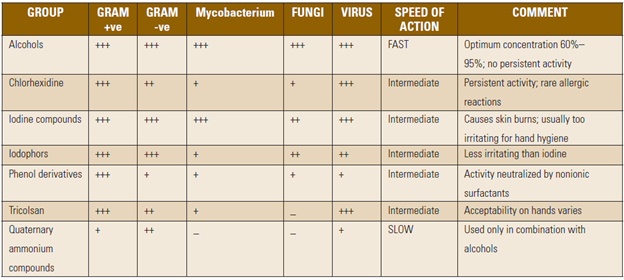
Note: +++ = excellent; ++ = good, but does not include the entire bacterial spectrum; + = fair; — = no activity or not sufficient.
* Hexachlorophene is not included because it is no longer an accepted ingredient of hand disinfectants.
prevention of patient-to-patient spread through infection control measures are believed to be potent interventions to control nosocomial infections.
CONCLUSION
The attributable mortality from nosocomial infection is high in critically ill patients. Early identification of patients and subsequent prevention of patient-to-patient spread through infection control measures are believed to be potent interventions to control nosocomial infections.
REFERENCES
- An Overview of Nosocomial Infections, Including the Role of the Microbiology Laboratory T. Grace Emori and Robert P. Gaynes CLINICAL MICROBIOLOGY REVIEWS, Oct. 1993, p. 428-442 Vol. 6, No. 4
- Benenson AS. Control of communicable diseases manual, 16th edition Washington ,American Public Health Association, 1995
- Ducel G et al. Guide pratique pour la lutte contre l’infection hospitalière. WHO/BAC/79.1.
- Nosocomial infections. Ken Inweregbu, Jayshree Dave & Alison Pittard . Contin Educ Anaesth Crit Care Pain(2005) 5 (1):
- Clinical Infectious Diseases : A Practical Approach: Richard K. Root Chief, Department of Medicine Page 61. Editors Francis W., Lawrence C.,and Walter S. Oxford University Press
- Acinetobacter spp. as Nosocomial Pathogens: Microbiological, Clinical, and Epidemiological Features. E. BERGOGNE-BEREZIN AND K. J. TOWNER. CLINICAL MICROBIOLOGY REVIEWS, Apr. 1996, p. 148–165
- Schaub, I. G., and F. D. Hauber. 1948. A biochemical and serological study of a group of identical unidentiï¬able gram-negative bacilli in human sources. J. Bacteriol. 56:379–385.
- De Bord, G. G. 1939. Organisms invalidating the diagnosis of gonorrhea by the smear method. J. Bacteriol. 38:119.
- Juni, E. 1978. Genetics and physiology of Acinetobacter. Annu. Rev. Microbiol. 32:349–371
- Rice LB . Federal funding for the study of antimicrobial resistance in nosocomial pathogens: no ESKAPE. J Infect Dis 2009;197:1079-81
- National Nosocomial Infections Surveillance System Report, data summary from January 1992 through June 2004, issued October 2004. Am J Infect Control2004;32:470-85.
- NDM-1 — A Cause for Worldwide Concern Robert C. Moellering, Jr., M.D. N Engl J Med 2010; 363:2377-2379
- Disinfection and Sterilization in Health Care Facilities: What Clinicians Need to Know. William A. Rutala and David J. Weber. Clin Infect Dis. (2004) 39 (5):702-709
- New Disinfection and Sterilization Method. William A. Rutala and David J. Weber. Emerging Infectious Diseases. Vol. 7, No. 2, March–April 2001
- Prevention of hospital-acquired infections A practical guide 2nd edition. Editors G. Ducel, J. Fabry, L. Nicolle, WHO/CSR Web site page 30-31.
- Association for Professionals in Infection Control and Epidemiology Guidelines for Infection Control Pratice, APIC guidelines for handwashing and hand antisepsis in health care settings. Am J Infect Control. 1995;23251- 269
- Guideline for Hand Hygiene in Health-Care Settings Recommendations of the Healthcare Infection Control Practices Advisory Committee and the HICPAC/SHEA/APIC/IDSA Hand Hygiene Task Force. MMWR October 25, 2002 Vol. 51 /RR-16
Disclaimer from Guident
The views and opinions expressed in articles published in Guident are solely those of the authors and do not necessarily reflect the views of the editors, the editorial board or the publisher, Ivory India. Guident does not endorse any product, technique or treatment described. Clinical content is intended for qualified dental and medical professionals and is not a substitute for individual clinical judgement. Guident, its editors and the publisher accept no liability for any consequence arising from the use of information published in the journal.
How to cite this article
Dr Ashish Vyas. Nosocomial Infections: Threat to Life. Guident. 2014 Apr;7(5). Available from: https://ivoryindia.in/articles/oral-surgery/nosocomial-infections-threat-to-life.html