Pleomorphic Adenoma of Lower Lip: A Rare Anomaly
Dental Director at MyDentist Mumbai, Maharashtra
Abstract
The majority of minor salivary glands tumors are malignant. Among benign tumors of the minor salivary glands Pleomorphic adenoma is the commonest, found most often in the oral cavity. The lower lips a very rare site for this tumor, followed by parapharyngeal space.5,6
This case of unusual location of the benign mucosal lump on the lower left lip cheek mucosa report is review of articles and literature of rarest location of Pleomorphic adenoma.
CASE REPORT:
A 35 year old female came to Mydentist (private clinic ) with chief complaint of slow growing painless swelling on the left lower lip region between two premolars (34, 35) for more than 2 years . Patient presented with history of small growth over lower lip, which increased to present size due to recurrent trauma. No history of ant medication or medical history, no history of pain of dental origin. No history of fever or radiating pain.
ON EXAMINATION:
Extra oral: no major deformities on the lower left jaw, no signs of inflammation/ induration/edema/local rise in temperature/lymphadenopathy .no extra oral growth or fistula tract. Intra oral examination: a 1.2 cm x 1 cm oval shaped multiple nodular swelling. No signs of mucosa inflammation. On palpation it was not tender, no pus discharge, fluctuant and soft in consistency. 34.35 Clinically sound, and asymptomatic.
INVESTIGATION:
Aspiration cytology: feature suggestive of an “Inflammation within the Lesion”. Aspirate shows numerous cholesterol crystals on a background of RBC’s
ULTRA SONOGRAPHY:
Small solid lump present on the left cheek mucous membrane superficially appears to be benign lump. No evidence of cervical lymphadenopathy on other side.
No cystic or necrotic areas seen in the lump, no calcification seen in the lump Differential diagnosis: Mucocele/Tumor of Minor Salivary Glands
TREATMENT
Plan: Excision Biopsy Of The Lesion Under Local Anesthesia
Consent taken
Under aseptic preparation, local anesthesia at concentration of 2 percent lignocaine hydrochloride with adrenaline injected using local infiltration technique and mental nerve block technique. Using 15no. blade, elliptical incision placed. Lesion skeletonised, mucosal attachment dissected. Traction sutures placed, the capsulated lesion dissected from mucosal attachment along with minor salivary glands of lower lip.
Lesion excised and sent for biopsy. The wound area thoroughly irrigated and closed in layers with non resorbable sutures
Patient reviewed at consecutively visit (1st week, 3 weeks and 2 month) wound healing satisfactory and showed no signs of recurrence.

BIOPSY:
cuboidal cells with dense to vacuolar nuclei, arrange in sheets amidst a connective tissue stroma showing pulp fibroblast, island of metastatic squamous cells noted throughout the section. Numerous ducts like space and foci of chondromyxoid degeneration can be appreciated. The surrounding capsule shows bundles of collagen fibres with mild sprinkling of chronic inflammatory infiltrate. Mixed salivary acini with excretory duct, adipose and skeletal muscle fibres are noted.

Final diagnosis: PLEOMORPHIC ADENOMA OF LOWER LIP
DISCUSSION:
Salivary glands tumors: All the salivary glands may be involved by tumors arising from salivary acinar or ductal cells.These tumors form a Fascinating and heterogeneousgroups.1
MINOR SALIVARY GLANDS TUMORS
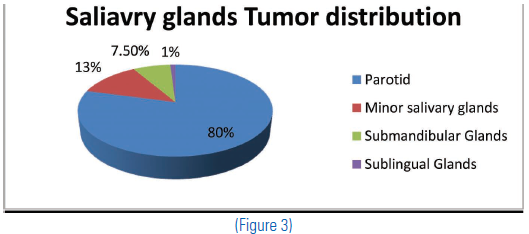
Approximately 750 minor salivary glands are found in the oral cavity, nasal cavity, paranasal sinus and pharynx. Majority of tumors of salivary glands are malignant with only 18% benign. Of the benign tumors Pleomorphic adenoma is commonest. The most common site of Pleomorphic adenoma of the minor salivary glands is the palate followed by lip, buccal mucosa, floor of mouth, tongue, tonsil, pharynx, retro-molar area and nasal cavity. The upper lip shows higher frequency of involvement compare to lower lip (5%).1, 2.

PLEOMORPHIC ADENOMA
Pleomorphic adenoma is a commonest benign salivary glands neoplasm characterized by neoplastic proliferation of parenchymatous glandular cells along with myoepithelial component, having a malignant potential.It consists of mixed epithelial and mesenchymal cell component, exhibit myxofibrous appearance and shows chondromatous differentiation.(Epithelial and Myoepithelial elements).1
EPIDEMIOLOGY
4th & 6th decades of life. Higher predilection for women (Toida et al 2004) .Male female ration – 1:3.2
PATHOPHYSIOLOGY
Pleomorphic adenoma most frequently develops with a ratio of 6:1, when compared to the upper lip.
The probable reason for their ratio is due to the different embryological development and different trauma risk of both lips it has been considered that potential tumors cells are destroyed by continuous presence of inflammatory cells in the lower lip due to their higher incidence of trauma.2
CLINICAL PRESENTATION
- Slow growing, painless, firm /mobile single nodular mass. Isolated nodules are generally outgrowth of the main nodule rather than a multinodular presentation.
- Range of duration of symptoms: mean time of 45 month which coincides with our history of painless swelling for more than 2 year.
- Less common clinical signs and symptoms includes ulceration and ill fitting dentures, change in sensation and difficulty in speech..
- Though it is classified as benign tumor, Pleomorphic adenoma may undergo malignant transformation, to form carcinoma ex Pleomorphic adenoma.
- Tumor is aneuploid, can reoccur after resection, distant metastases have been reported after 10 years.1
Investigation

TREATMENT
- Surgical resection of tumor with negative margin (0.5 to 1cm) – gold standard.3,4,5
- Application of fine needle aspiration or incisional biopsy before definitive treatment is advisable. In our procedure we performed aspiration cytology to rule out malignancy, as minor salivary glands tumors tends to undergoes malignant transformation.1,2
- Dongre et al propounded that simple excision is only treatment.
- We followed similar procedure of excision of the lesion along with minor salivary gland, with negative margin to minimize risk of malignant transformation. Precaution must be taken to avoid damages to esthetic areas like lip.
- Enucleation will lead to recurrence.
- Bony excision is usually not required, as Pleomorphic adenoma doesn’t not invade bone
RECURRENCE
- 2-44% recurrence
- Spiro – 7% recurrence in patient with minor salivary glands neoplasm
Cause-
- deficiency of encapsulation allowing the rupture and seeding of tumor
- kroll et al “ inefficient first surgical intervention “
CONCLUSION
Pleomorphic adenoma of lower lip is rare anomaly, however due to high predilection of recurrence and malignant transformation, it should be diagnose before surgical excision of the gland. Care must be taken to avoid rupture of capsule to prevent recurrence and need a long term follow up of the patient.
REFERENCES
- Oral And Maxillofacial Surgery , Volume No 5 Surgical Pathology- Raymond Fonseca
- Lip Pleomorphic Adenoma , Revista Odontologica Mexicana – Volume 16 No.2 April June 2012: Erick Carillo Teran et al.
- Krolls SO , Hicks JL Mixed Tumors of the lip . Oral Surg 1973 ; 35:212.
- Neville BW et al . Oral And Maxillofacial pathology . 2nd edition. Ed Saunders USA 2002: 410-413.
- Pleomorphic Adenoma of lower lip : a review , Ilker Sengul MD et al
- Pleomorphic Adenoma of minor salivary gland in parapharyngeal space ; Bipin T Varghese et al.
Disclaimer from Guident
The views and opinions expressed in articles published in Guident are solely those of the authors and do not necessarily reflect the views of the editors, the editorial board or the publisher, Ivory India. Guident does not endorse any product, technique or treatment described. Clinical content is intended for qualified dental and medical professionals and is not a substitute for individual clinical judgement. Guident, its editors and the publisher accept no liability for any consequence arising from the use of information published in the journal.
How to cite this article
Dr.Prit Shah, Dr. Ankita Gada. Pleomorphic Adenoma of Lower Lip: A Rare Anomaly. Guident. 2014 Mar;7(4). Available from: https://ivoryindia.in/articles/oral-surgery/pleomorphic-adenoma-of-lower-lip-a-rare-anomaly.html