Nonsurgical Orthopaedic Management of an Adolescent Class III Patient
Rohtak, India
Abstract
This case report successful management of an adolescent Class III female patient with combination Class III therapy using orthopaedic facemask with RME followed by fixed mechanotherapy. Treatment was completed in 17 months and proved to be an effective modality in such cases.
INTRODUCTION
Class III malocclusions are considered one of the most complex and difficult orthodontic problems to diagnose and treat. The skeletal Class III malocclusion is characterized by mandibular prognathism,maxillary deficiency or both.1,2 Clinically, these patients exhibit a concave facial profile, a retrusive nasomaxillary area and a prominent lower third of the face. The lower lip is of tenprotruded relative to the upper lip, the upper arch is usually narrower than the lower, and the overjet and overbite can range from reduced to reverse.3 The effect of environmental factors and oral function on the etiological factors of a Class III malocclusion is not completely understood. However, there isa definite familial and racial tendency to mandibular prognathism.4,5 This case report discusses treatment of an adolescent Class III female using RME and Facemask.
CASE HISTORY
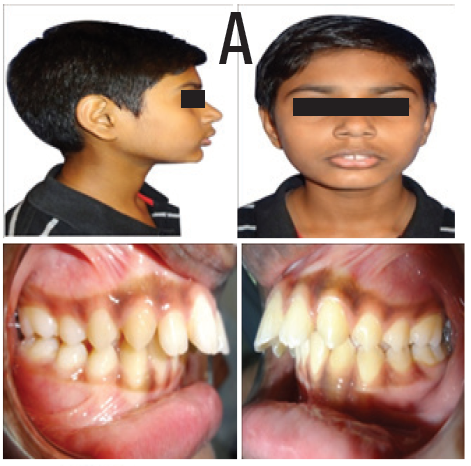
A 13 year old female reported to the department of orthodontics and dentofacial orthopaedics with chief complaint of irregularly placed upper front teeth. On extraoral examination, it was observed that the patient had mesoprosopic face, with depressed and retrusive nasomaxillary area, anterior divergent concave facial profile and competent lips. Intraoral examination revealed anterior and posterior cross bite, with negative overjet of -3mm, overbite of 66.6%, severe crowding wrt upper anteriors.(Figure 1t)
Cephalometric findings revealed retrusive maxilla (SNA 76°), Protrusive mandible (SNB 87°) depicting Class III jaw bases, horizontal growth pattern (FMA 20°), proclined upper incisors (upper incisor to NA 44° & 11mm) and upright lower incisors (IMPA 86°). (Figure 2)
Treatment objectives: The treatment objectives were to correct the concave facial profile, achieve Class I canine and molar relation, normal overjet & overbite.
 |
 |
TREATMENT OPTIONS
Extraction of upper first premolars is needed while considering the upper incisor inclination and space requirements for correction of crowding, this process will increase negative overjet and necessitate orthognathic surgery but orthognathic surgery is preferred only after completion of growth. However early orthognathic surgery cases have been reported but in most of class iii cases a repeat orthognathic surgery is needed after completion of growth. Considering the potential remaining growth of the patient which may delay treatment with orthognathic surgery further for 4-5 years, we choose RME and facemask therapy for the patient. Constricted arches, made expansion using RME a possibility giving necessary space for alignment. Facemask helped in correction of negative overjet and controlling forward growth of mandible.
TREATMENT PROGRESS
Patient was given a bonded rapid maxillary expansion appliance (Hyrax). Activation Protocol was two turns each day for the first 4 to 5 days, one turn each day for the remainder of RME treatment. Expansion was stopped when the maxillary palatal cusps are level with the buccal cusps of the mandibular teeth. RME “disarticulates” the maxilla and initiates cellular response in the sutures, allowing a more positive reaction to protraction forces. Petit face mask was adjusted to rest on the forehead and the chin of the patient. Elastics (5/16 inch by 14 ounces) were worn from hooks located 2-3 cm in front of the lips to the intraoral attachments located on the expansion appliance, distal to the canine.(Figure 3) The force generated by the elastics was 600-800 g bilaterally. After duration of 9 months of orthopedic correction, pre-adjusted edgewise appliance (MBT 022) was fixed. Leveling and alignment was done using sequential arch wires (014 NiTi, 016 NiTi, 017 x 025 NiTi, 019 x 025 NiTi, 019 x 025 SS). Fixed mechano therapy was completed in 8 months. Total treatment time was 1 year 7 months.
 |
TREATMENT RESULTS:
Normal Overjet and overbite with Class I molar and canine relationship was achieved with a significant improvement in the facial profile. (Table 1) (Figure 4, 5)
Table 1: Cephalometric values
|
Cephalometric Values |
Pre Treatment |
Post Treatment |
|
SNA |
76o |
83 o |
|
SNB |
87 o |
87 o |
|
WITS |
-9mm |
-3mm |
|
Upper Incisor to NA |
44 o & 11mm |
55 o & 10mm |
|
Lower Incisor to NB |
16 o & 3mm |
21 o & 3mm |
|
Lower incisor to Mand. plane |
86 o |
90 o |
|
Nasolabial Angle |
81 o |
84 o |
|
Upper lip to E line |
-4.5mm |
-4mm |
|
Lower lip to E line |
+1mm |
-2mm |
 |
 |
Discussion
This case report showed the result of the treatment of an adolescent patient with class III malocclusion with an efficient orthodontic therapy of RME plus maxillary protraction.
Class III combination therapy is a comprehensive non-surgical treatment strategy designed for developing skeletal class III malocclusions by incorporating orthodontic and orthopedic mechanics to effectively improve the patient’s occlusion and profile.
CONCLUSION
In properly selected cases, this modality of treatment can be a successful alternative that satisfies a patient’s request to avoid surgery or premolar extraction.
REFERENCES
- Sanborn RT. Differences between the facial skeletal patterns of Class III malocclusion and normalocclusion. Angle Orthod 1955;25:208-22.
- Williams S, Andersen CE. The morphology of the potential Class III skeletal pattern in the growing child.Am J Orthod Dentoface Orthod 1986;89:302-11.
- Ngan P, Hagg U, YiuC , et al. Soft tissue and dentoskeletal profile changes associated with maxillary expansion and protraction headgear treatment. Am J orthod dentofac Orthop 1996;109:38-49.
- Litton SF, Ackerman LV, Isaacson RJ, et al. A genetic study of Class III malocclusion. Am J Orthod 1970;58:565-77.
- Mossey PA. The heritability of malocclusion: Part 2. The influence of genetics in malocclusion. Br J Orthod 1999;26:195-203.
Disclaimer from Guident
The views and opinions expressed in articles published in Guident are solely those of the authors and do not necessarily reflect the views of the editors, the editorial board or the publisher, Ivory India. Guident does not endorse any product, technique or treatment described. Clinical content is intended for qualified dental and medical professionals and is not a substitute for individual clinical judgement. Guident, its editors and the publisher accept no liability for any consequence arising from the use of information published in the journal.
How to cite this article
Dr. Shweta Airan, Dr. Manisha Kamal Kukereja, Dr. Manish Airan Department of Orthodontics PGDIS. Nonsurgical Orthopaedic Management of an Adolescent Class III Patient. Guident. 2017 Aug;10(9). Available from: https://ivoryindia.in/articles/orthodontics/nonsurgical-orthopaedic-management-of-an-adolescent-class-iii-patient.html