He Survived a 40-Foot Fall to Play Again!
Department of Pedodontics & Preventive Dentistry, Narayana Dental College, Nellore, India
INTRODUCTION
Traumatic injuries to the oral and maxillofacial structures in children constitute an emergency situation with deep rooted psychological implications. In addition to the physical trauma, the effects of possible disfigurement and/ or scarring can often leave the child with a dented psyche. The management of the same therefore focuses utmost on restoration of function, disability limitation with esthetic outcome and psychological counselling.
Fracture of the mandible in the symphyseal, para-symphyseal and corpus regions are common and they can lead to complications such as deranged occlusion, disfigurement and impaired function. Timely management of such injuries can ensure optimal treatment outcome. The Cap splint is a simple, time tested device that has been successfully used for the past several decades in managing the fractures of the mandible.
CASE REPORT
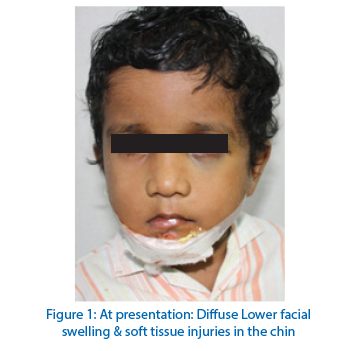
A 4 year old boy reported to the clinic with lacerations and extensive soft tissue injuries to the maxillofacial structures. His parents reported that boy had fallen from the roof of a two storied building three days ago following which he was immediately rushed to a trauma center for complete neurophysical examination. The trauma center cleared him of any neurological damage and his motor and sensory nerve functions were reportedly normal. MRI ruled out brain damage and internal injuries were ruled out as well. He was given symptomatic treatment and soft-tissue injuries were attended to while he was under observation for 24 hours following which he was discharged with a referral to a dentist.
The patient reported to the Dept of Pedodontics & Preventive Dentistry, Narayana Dental College & Hospital, with pain and diffuse swelling in the lower facial region. Mouth opening was restricted and infra-orbital ecchymosis on the patient’s left eye. Intra-orally, maxillary primary incisors were lost to trauma, maxillary canines were intruded and the pre-maxilla, collapsed. Except the maxillary primary incisors, all the primary teeth were intact. The mandibular fracture line in the right para-symphyseal region resulted in a step deformity and loss of arch integrity. There was extensive laceration and contusion of the intra-oral soft-tissues.
The Orthopantomogram showed a discontinuity in the lower border of the corpus in the right para-symphyseal region suggestive of distinct fracture line. Zygomatic area appeared hazy and was indistinctive and so a Computed Tomography was requested to rule out fractures of other areas of the maxillofacial skeleton. Tomography revealed an undisplaced fracture of the left zygomatic arch and hairline fractures in the facial skeleton.
 |
 |
With the investigations corroborating the findings of the clinical examination a diagnosis of simple fracture of the right mandibular para-symphysis with labial displacement of the fractured fragment was arrived at and a treatment plan was formulated in conjunction with the Dept of Oral & Maxillofacial Surgery. The basic treatment plan was to reduce the fracture and achieve fixation to favour optimal healing. Treatment plan also included space maintenance for the missing maxillary incisors, monitoring the status of the maxillary canines, diet counselling and oral hygiene care during the healing period to prevent caries. Considering the age of the child, the fracture reduction was planned under general anesthesia. An acrylic cap splint was planned as a fixation device following reduction of the fragments.
 |
CONSTRUCTION OF THE CAP SPLINT
Impressions were recorded in alginate and casts were made in dental stone. The fracture line where the ‘step’ deformity existed in the mandibular arch was cut using a prosthetic saw. The lower cast is then re-aligned using the opposing posterior teeth as a guide and the cut pieces of the cast are reattached and a base is poured to prepare a ‘modified’ cast with the arch alignment as close as possible to that prior to trauma. An acrylic splint is fabricated on the modified cast using auto-polymerizing resin and this is finished and polished after incorporating two furrows across the parasymphyseal area which will prevent the circum-mandibular wire from slipping.
 |
 |
Reduction and Fixation of the Fracture: The reduction of the fracture was done under general anesthesia and the Cap Splint was used along with circum-mandibular wiring for fixation. The soft tissue injuries were managed with appropriate sutures where required.
 |
 |
Further treatment plan involves aesthetic restoration of missing maxillary incisors using an anterior space maintainer.
POST- OPERATIVE REVIEW
Further recall appointments will focus on prosthetic and aesthetic management following healing of soft tissues; assessment of maxillary canines for vitality and consideration of the need space maintenance. In addition, diet planning & oral hygiene protocols will help prevent caries.
Follow up review is awaited.
Immediate management of mandibular fractures with simple fixation options like the cap splint can give optimal results and restore the functional harmony of the stomatognathic system.
REFERENCES:
- Cap Splints. In: Maxillofacial Injuries–Volume one; N L Rowe & J L Williams. Pg: 255 – 267, Elsevier Science – 1985
- Mandibular Fractures: In: Pediatric Oral and Maxillofacial Surgery. L B Kaban and M J Troulis. Pg - 445 – 456. Elsevier Science 2004.
- Acrylic Resin Cap Splints. British Journal of Oral Surgery, Robertson J H; 2: 171, 1965.
- Traumatic Dental Injuries: A Manual. Andreasen J O, Andreasen F M, Bakland L K, Flores M T. Munksgaard, Coppenhagen. 1999.
- Mandibular Fractures. In: Contemporary Oral and Maxillofacial Surgery. J R Hupp, E Ellis III, M R Tucker. Pg: 502 – 507; 5th Edition. Elsevier Science. 2008
Disclaimer from Guident
The views and opinions expressed in articles published in Guident are solely those of the authors and do not necessarily reflect the views of the editors, the editorial board or the publisher, Ivory India. Guident does not endorse any product, technique or treatment described. Clinical content is intended for qualified dental and medical professionals and is not a substitute for individual clinical judgement. Guident, its editors and the publisher accept no liability for any consequence arising from the use of information published in the journal.
How to cite this article
Dr. Tejas Harsha Melkote, Dr. Sivakumar Nuvvula, Dr. Nirmala S V S G. He Survived a 40-Foot Fall to Play Again!. Guident. 2017 Aug;10(9). Available from: https://ivoryindia.in/articles/pedodontics/he-survived-a-40-foot-fall-to-play-again.html