The Role of Vitamin D in Periodontal and Peri-Implant Health-a Brief Review
Department of Periodontology, K. D. Dental College and Hospital, Mathura, Uttar Pradesh, India
Abstract
Osteoporosis and periodontal diseases are common problems among the elderly population. Vitamin D is a secosteroid hormone that is either synthesized by human skin cells under the effect of UV radiation or consumed through diet. Deficiency in vitamin D leads to reduced bone mineral density, osteoporosis, the progression of periodontal diseases and causes resorption to occur in the jawbone. Sufficient intake of vitamin D can decrease the risk of gingivitis and chronic periodontitis, as it has been shown to have immunomodulatory, anti-inflammatory, antiproliferative effects and initiates cell apoptosis. In addition, vitamin D is also important for bone metabolism, alveolar bone resorption and preventing tooth loss. It increases antibacterial defense of gingival epithelial cells and decrease gingival inflammation, improves postoperative wound healing after periodontal surgery and is an important supplement used as prophylaxis in periodontology. This publication aims to update the recent advances, stress the clinical importance, and evaluate vitamin D in the prevention of periodontal diseases to reach a successful outcome of conservative and surgical treatment. An analysis of the literature shows that vitamin D plays a significant role in maintaining healthy periodontal and jaw bone tissues, alleviating inflammation processes, stimulating post-operative healing of periodontal tissues and the recovery of clinical parameters. However, further research is needed to clarify the required vitamin D concentration in plasma before starting periodontal treatment to achieve the best outcome.
Keywords- Periodontitis, Vitamin D, immune response, Peri-implant health
INTRODUCTION
Periodontitis is a chronic infectious disease caused by microorganisms in dental plaque, which can lead to inflammation and the progressive destruction of the periodontal support tissues [1, 2]. A guide issued by the World Health Organization (WHO) in 2021 showed that more than 3.5 billion people suffered from oral disease in 2017, and severe periodontal disease, which is estimated to be detrimental to 796 million people, especially the elderly, has emerged as the leading cause of tooth loss [3, 4]. The reason is that bacteria in periodontal pockets can induce an immune response that leads to gingival inflammation, periodontal pocket formation, attachment loss, and alveolar bone resorption, ultimately resulting in tooth loss and oral dysfunction [5, 6]. In addition, evidence has shown that the potential risk factors for periodontitis include certain systemic factors, such as hormones, diabetes, stress, genetic susceptibility, tobacco use, alcohol consumption, dietary patterns, and reduced intake of certain nutrients apart from
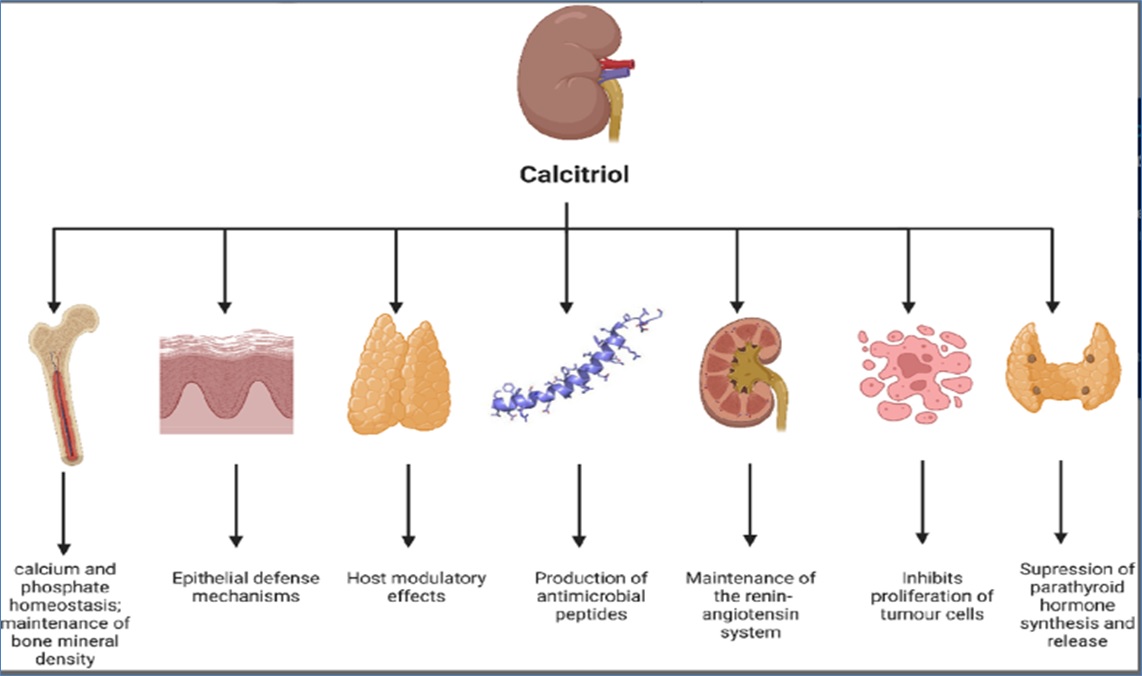
Vitamin D is an essential nutrient and precursor hormone that plays an important role in numerous biochemical functions in the body [9]. It is a lipid-soluble vitamin that is mainly ingested in the form of vitamin D2 and D3 via dietary intake and exposure to sunlight. Both forms of vitamin D are metabolized and activated to 25-hydroxyvitamin D (25(OH)D) in the liver, and subsequently converted to the active form of vitamin D, 1, 25-dihydroxyvitamin D3 (1,25(OH)2D3), in the kidney. As the main circulating metabolite in the blood, 25(OH) D is the most representative indicator of vitamin D storage in the human body [10, 11] Calcitriol has wide-ranging molecular effects which include maintenance of bone density, modulation of the innate and adaptive immune responses, regulation of the rein–angiotensin system, suppression of parathyroid hormone (PTH) synthesis and release, and inhibition of proliferation and differentiation of cancer cells15 (Figure 1)
Vitamin D deficiency has become a significant public health issue worldwide [12]. Studies have found that low levels of vitamin D can lead to an increased risk of periodontitis [13]. This may be due to vitamin D playing an important role in maintaining calcium and bone homeostasis as well as immune function, it is inferred that vitamin D may affect the development of periodontitis by the regulation of bone metabolism and immunological reaction [14].
SIGNIFICANCE OF VITAMIN D IN IMMUNE RESPONSE OF PERIODONTIUM
Liu et al. discovered that, during an inflammatory process, dental pulp fibroblasts and periodontal cells produce 25-hydroxylase, which stimulates the production of 25(OH)D3 . As pathological microorganisms affect the cell membrane receptors, 1α-hydroxylase synthesis is activated, during which 1,25(OH)D3 is formed from 25(OH)D3 . The resulting molecule binds with the VDR in the immune and epithelial cells and participates in the epithelium defense mechanism against the pathogen . 1,25(OH)D3 activates the synthesis of proteins which are required in the tight, gap and desmosome junctions of epithelial cells . [15-16]The junctional epithelium connects to the tooth through loose junctions, thus, creating favorable conditions for a bacterial invasion from dental plaque, which initially causes inflammation of the periodontal tissue (PT), and, as the process advances, resorption and tooth loss occurs [17]. 1,25(OH)D3 regulates the non-specific immune response, activates hydrogen peroxide secretion in monocytes, stimulates the synthesis of antimicrobial peptides, e.g., β-defensin and cathelicidin LL-37. Cathelicidin LL-37 plays a role in chemotaxis, production of cytokines and chemokines, cellular reproduction, vascular permeability, wound healing, and neutralization of bacterial endotoxins [15]. McMahon et at. studied human gingival cell cultures and the effect of vitamin D on the expression of non-specific immune system of these cells. After affecting gingival cell cultures with 1,25(OH)D3, cathelicidin, LL-37 secretion increased, and its antimicrobial effect against Actinobacillus actinomycetemcomitans lasted for 24 h [9]. 1,25(OH)D3 takes place in specific immune system by affecting B-lymphocytes and T-lymphocytes [18]. These cells emit cytokines and immunoglobulins, and they specifically destroy bacterial pathogens which are transferred by macrophages and dendritic cells. Such immune processes harm the PT and aggravate the course of PD. Vitamin D suppresses the proliferation of T-lymphocytes, secretion of immunoglobulins, transformation of B-lymphocytes into plasma cells, it inhibits the unwanted process, and protects the organism from excessive specific immune response by decreasing the secretion of IL-1, IL-6, IL-8, IL-12, TNFα cytokines [19]]. These cytokines are released in PD pathogenesis during a bacterial invasion. They cause lymphocyte infiltration, bone resorption, deterioration of extracellular matrix. Tang et al. studied the human periodontal tissue cell cultures trying to discern the anti-inflammatory effect of vitamin D on the cells. Less IL-8 was discovered in the cell cultures affected by Porphyromonas gingivalis and 1,25(OH)D3 than in cell cultures affected only by Porphyromonas gingivalis. Thus, the hypothesis that vitamin D is effective in PD prophylaxis and treatment was confirmed [20]. Teles et al. confirmed anti-inflammatory properties of vitamin D by determining that higher concentrations of vitamin D in blood serum contain less IL-6 and leptin and more adiponectin, which regulates the immune response. An increase in leptin signifies the presence of an infectious process and inflammation (proliferation and activation of T-lymphocytes, production of cytokines), adiponectin suppresses the production and activity of cytokines [21].
CONCENTRATION OF 25-HYDROXYVITAMIN D IN PLASMA AND PERIODONTAL DISEASE
The quantity of vitamin D in a human organism is determined by the concentration of its metabolite 25(OH)D3 in plasma; it normally fluctuates from 25 to 138 nmol/L. A concentration lower than 37.5 nmol/L shows vitamin D deficiency. A concentration higher than 200 nmol/L signifies hypervitaminosis [12]. To have an effect on periodontium, the plasma concentration should reach 90–100 nmol/L [3]. During acute periodontal inflammation, 25(OH)D3 concentration increases due to increased 25-hydroxylase activity of periodontal cells. During a chronic inflammation, it decreases [22]. Due to the production of this enzyme in aggressive periodontitis, 25(OH)D3 concentration in periodontal pockets is 300 times greater than in blood plasma [7]. Zhang et al. argue that, in the case of aggressive periodontitis, an increase in IL-6 and 25(OH)D3 concentration, leukocytes and neutrophils is observed [23]. Low concentration of 25(OH)D3 in blood plasma indicates vitamin D deficiency, unbalanced immune reactions in the organism, and the progression of periodontal disease .
PERI-IMPLANT DISEASE AND VITAMIN D
The success of implant-based restorations depends primarily on osseointegration, which is can beaffected by multiple factors. While external factors linked to the surgical protocol and implant design have received a lot of focus, host factors such as vitamin D deficiency can possibly contribute to implant failure [24]. The impact of vitamin D status on peri-implant tissues has been less explored in relation to its effect on periodontal tissues. In vitamin D3 deficient rats subjected to miniature dental implants placed in the femur, lower BIC and lower push-in test values were reported in comparison to vitamin D sufficient rats [25]. As a supplement, results from other animal studies on vitamin D3 provide overall positive results, with increased BIC, bone volume, and improved osseointegration reported by the majority [26-28]. Two studies show a lack of effect of supplementationThe impact of coating dental implant abutments with a vitamin D precursor (7-dehydrocholesterol), vitamin E, and ultraviolet-irradiation was investigated by Satue, et al. [29]. The authors reported a positive effect on soft tissue integration. Naito, et al. [30] reported a lack of difference in the osseointegration of titanium implants with and without a Vitamin D3 coating. On the contrary, Cho, et al. [31] reported a beneficial effect of vitamin D3 coating on bone formation around dental implants placed in rabbits’ tibia. When comparing the cellular behavior around different abutment surface modifications in a systematic review, Corvino, et al. [32] concluded that the use of vitamin D precursor coating led to worse results than machined titanium in terms of fibroblast behavior.
Very few clinical studies have been conducted to evaluate the possible effects of vitamin D deficiency in peri-implant diseases. Two case reports provide information on early implant failure in three patients who were vitamin D deficient [33,34]. In one of the reports, supplementation with vitamin D after implant failure resulted in the successful osseointegration of new implants [34]. In two retrospective studies, Mangano, et al. [35] evaluated early implant loss and vitamin D levels in over 800 patients. Despite a trend for reduced vitamin D levels in patients who lost dental implants in one study, there was no statistically significant association between vitamin D levels and implant failure [36,37]. In a crosssectional study including 53 participants, mean vitamin D3 GCF levels were lower in peri-implantitis sites as compared to peri-implant mucositis and healthy peri-implant sites. Low vitamin D3 levels were associated with worse peri-implant status, measured as clinical attachment level, pocket depth, gingival bleeding, and plaque index [38]. Higher vitamin D levels on the dental implant surgery day were associated with lower marginal bone loss after 6 and 12 months in the RCT from Kwiatek and co-workers [39]. Accordingly, on a prospective clinical trial, there was a tendency for less peri-implant bone loss in patients taking vitamin D3 supplements [40]. Despite the limited number of studies, clinical findings support a potential role for supplementation in vitamin D deficient patients subjected to implant-based tooth replacement.
VITAMIN D IN PROPHYLAXIS AND TREATMENT OF PERIODONTAL DISEASES
In case of vitamin D hypovitaminosis, getting less than 400 IU of vitamin D daily may cause adecrease of calcium concentration in blood plasma, an increase of parathyroid hormone secretion,disruption of bone tissue remodeling, and may develop a secondary hyperparathyroidism [41]. The recommended daily dosage of vitamin D for people under 70 years old is 600 IU; for people older than 70 years—800 IU [22]. During vitamin D deficiency treatment, daily dosage may be increased to 2000 IU, without tracking 25(OH)D3 concentration in blood plasma. If the daily dosage of vitamin D reaches 40,000 IU, vitamin D hypervitaminosis may occur in healthy individuals. This quantity of vitamin D taken daily for extended periods of time disrupts calcium metabolism, causes parathyroid gland hyperfunction [42], and forms conditions for the development of nephrolithiasis .
Approximately only 90 IU of vitamin D may be absorbed from food every day without consumption of supplements. Human body synthesizes approximately 10,000 IU of vitamin D from tanning under Medicina 2018, 54, 45 6 of 8 natural sunlight until light redness of the skin. The recommended dosage of vitamin D may be absorbed by exposing the face, hands, and palms to natural sunlight 2–3 times a week without reaching light redness of the skin [43]. Hildebolt investigated the correlation between the daily intake of vitamin D supplements and the increase in 25(OH)D3 concentration in blood plasma. According to Hildebolt, consuming 200 IU of vitamin D supplements per day increases the concentration of 25(OH)D3 in blood plasma by 10 nmol/L, whereas consuming 1000–2000 IU increases it by 47 nmol/L [23]. Bashutski et al. published the results of a long-term clinical study where the correlation between the quantity of vitamin D in blood plasma and periodontal surgeries was studied. Researchers determined that research subjects with a vitamin D deficiency in blood plasma showed less effective results (lower tissue attachment level and probing depth change) after periodontal surgery. The authors argue that to improve post-surgery results, it is advised to examine vitamin D level in the patients’ blood prior to the treatment and avoid vitamin D deficiency by taking supplements [44].
Alshouibi et al. studied the correlation between the quantity of vitamin D and state of periodontium in 562 older men. Study results showed that subjects who received more than 800 IU of vitamin D daily had a lower risk of having a more severe form of chronic periodontitis (results were based on probing depth, attachment level, loss of alveolar bone), whereas those receiving less than 400 IU of vitamin D suffered from a more advanced level of alveolar bone resorption [45].
Hiremath et al. conducted a random sampling of clinical research to prove the anti-inflammatory effect of vitamin D on gingiva. Results showed that a 500–2000 IU dosage of vitamin D is safe and effective in gingival inflammation treatment. Notable results were shown after three months. Results were observed after one month where subjects took a dose of 2000 IU of vitamin D or higher. Consumption of higher doses led to a change in 25(OH)D3 concentration in blood plasma. While not consuming vitamin D, the concentration increased by 0.87 nmol/L. During consumption of 500 IU, the concentration increased by 32.03 nmol/L. During consumption of 1000 IU, the concentration increased by 42.12 nmol/L. During consumption of 2000 IU, the concentration increased by 74.22 nmol/L [45]. This randomized clinical trial demonstrates the effect of vitamin D on gingival inflammation and the required vitamin D dosage to reach this effect.
CONCLUSION
In conclusion, vitamin D is significant in periodontology as it takes part in the synthesis of proteins that are needed in formation of mucous membrane. This creates a physical barrier and, thus, hinders the transfer of pathogens further into deeper tissues. The antimicrobial protein synthesis by immune and epithelial cells as well as non-specific immune responses is activated. Vitamin D also takes part in specific immune response by suppressing the destructive effect of chronic periodontitis. Moreover, it maintains systemic and jawbone density homeostasis. In order to prescribe vitamin D for treatment of periodontal diseases, further research is needed
REFERENCES
- Frencken JE, Sharma P, Stenhouse L, Green D, Laverty D, Dietrich T. Global epidemiology of dental caries and severe periodontitis - a comprehensive review. J Clin Periodontol. 2017;44(Suppl 18):S94-s10
- Yang H, Xiao L, Zhang L, Deepal S, Ye G, Zhang X. Epidemic trend of periodontal disease in elderly Chinese population, 1987–2015: a systematic review and meta-analysis. Sci Rep. 2017;7:45000.
- Bernabe E, Marcenes W, Hernandez CR, et al. Global, Regional, and national levels and trends in burden of oral conditions from 1990 to 2017: a systematic Analysis for the Global Burden of Disease 2017 Study. J Dent Res. 2020;99(4):362–73.
- World Health O, International Telecommunication U. Mobile technologies for oral health: an implementation guide. Geneva: World Health Organization; 2021.
- Aral K, Milward MR, Kapila Y, Berdeli A, Cooper PR. Inflammasomes and their regulation in periodontal disease: a review. J Periodontal Res. 2020;55(4):473–87.
- Graves DT, Li J, Cochran DL. Inflammation and uncoupling as mechanisms of periodontal bone loss. J Dent Res. 2011;90(2):143–53.
- Adegboye AR, Boucher BJ, Kongstad J, Fiehn NE, Christensen LB, Heitmann BL. Calcium, vitamin D, casein and whey protein intakes and periodontitis among Danish adults. Public Health Nutr. 2016;19(3):50
- Zhang JC. Consideration for impacts of periodontitis on systemic health. Zhonghua Kou Qiang Yi Xue Za Zhi. 2021;56(6):507–9.
- Sassi F, Tamone C, D’Amelio P. Vitamin D: Nutrient, Hormone, and Immunomodulator. Nutrients. 2018;10(11):1656.
- Garand M, Toufiq M, Singh P, et al. Immunomodulatory effects of Vitamin D supplementation in a deficient population. Int J Mol Sci. 2021;22(9):5041.
- Trimboli F, Rotundo S, Armili S, et al. Serum 25-hydroxyvitamin D measurement: comparative evaluation of three automated immunoassays. Pract Lab Med. 2021;26: e00251.
- Fernández-Lázaro D, Hernández JLG, Lumbreras E, Mielgo-Ayuso J, Seco-Calvo J. 25-Hydroxyvitamin D serum levels linked to Single Nucleotide Polymorphisms (SNPs) (rs2228570, rs2282679, rs10741657) in skeletal muscle aging in institutionalized elderly men not supplemented with Vitamin D. Int J Mol Sci. 2022;23(19):11846.
- Jimenez M, Giovannucci E, Krall Kaye E, Joshipura KJ, Dietrich T. Predicted vitamin D status and incidence of tooth loss and periodontitis. Public Health Nutr. 2014;17(4):844–52.
- Khammissa RAG, Ballyram R, Jadwat Y, Fourie J, Lemmer J, Feller L. Vitamin D deficiency as it relates to oral immunity and chronic periodontitis. Int J Dent. 2018;2018:7315797.
- Van der Velden, U.; Kuzmanova, D.; Chapple, I.L. Micronutritional approaches to periodontal therapy. J. Clin.Periodontol. 2011, 38 (Suppl. 11), 142–158. [CrossRef] [PubMed]
- Schwalfenberg, G.K. A review of the critical role of vitamin D in the functioning of the immune system and the clinical implications of vitamin D deficiency. Mol. Nutr. Food Res. 2011, 55, 96–108. [CrossRef] [PubMed]
- Liu, K.; Meng, H.; Hou, J. Activity of 25-hydroxylase in human gingival fibroblasts and periodontal ligament cells. PLoS ONE 2012, 7, e52053. [CrossRef] [PubMed]
- Bikle, D.D. Vitamin D and the immune system: Role in protection against bacterial infection. Curr. Opin.Nephrol. Hypertens. 2008, 17, 348–352. [CrossRef] [PubMed]
- McMahon, L.; Schwartz, K.; Yilmaz, O.; Brown, E.; Ryan, L.K.; Diamond, G. Vitamin D-mediated induction of innate immunity in gingival epithelial cells. Infect. Immun. 2011, 79, 2250–2256. [CrossRef] [PubMed]
- Tang, X.; Pan, Y.; Zhao, Y. Vitamin D inhibits the expression of interleukin-8 in human periodontal ligament cells stimulated with Porphyromonas gingivalis. Arch. Oral Biol. 2013, 58, 397–407. [CrossRef] [PubMed]
- Teles, F.R.; Teles, R.P.; Martin, L.; Socransky, S.S.; Haffajee, A.D. Relationships among interleukin-6, tumor necrosis factor-α, adipokines, vitamin D, and chronic periodontitis. J. Periodontol. 2012, 83, 1183–1191.
- Millen, A.E.; Hovey, K.M.; LaMonte, M.J.; Swanson, M.; Andrews, C.A.; Kluczynski, M.A.;Genco, R.J.; Wactawski-Wende, J. Plasma 25-hydroxyvitamin D concentrations and periodontal disease in postmenopausal women. J. Periodontol. 2013, 84, 1243–1256. [CrossRef] [PubMed]
- Zhang, X.; Meng, H.; Sun, X.; Xu, L.; Zhang, L.; Shi, D.; Feng, X.; Lu, R.; Chen, Z. Elevation of vitamin D-binding protein levels in the plasma of patients with generalized aggressive periodontitis. J. Periodontal Res. 2013, 48, 74–79. [CrossRef] [PubMed]
- Javed F, Malmstrom H, Kellesarian SV, Al-Kheraif AA, Vohra F, et al. (2016) Efficacy of vitamin D3 supplementation on osseointegration of implants. Implant Dent. 25(2):281-7.
- Kelly J, Lin A, Wang CJ, Park S, Nishimura I. (2009) Vitamin D and Bone Physiology: Demonstration of Vitamin D Deficiency in an Implant Osseointegration Rat Model. J Prosthodont. 18(6):473-8.
- Zhang HY, Feng L, Wu H, Xie XD. (2014) The association of IL-6 and IL-6R gene polymorphisms with chronic periodontitis in a Chinese population. Oral Dis. 20(1):69-75.
- Dvorak G, Fügl A, Watzek G, Tangl S, Pokorny P, et al. (2012) Impact of dietary vitamin D on osseointegration in the ovariectomized rat. Clin Oral Implants Res. 23(11):1308-13.
- Zhou C, Li Y, Wang X, Shui X, Hu J. (2012) 1, 25Dihydroxy vitamin D3 improves titanium implant osseointegration in osteoporotic rats. Oral Surg Oral Med Oral Pathol Oral Radiol. 114(5):S174-8.
- Liu W, Zhang S, Zhao D, Zou H, Sun N, et al. (2014) Vitamin D supplementation enhances the fixation of titanium implants in chronic kidney disease mice. PLoS One. 9(4):e95689.
- Naito Y, Jimbo R, Bryington MS, Vandeweghe S, Chrcanovic BR, et al. (2014) The influence of 1α.25-dihydroxyvitamin d3 coating on implant osseointegration in the rabbit tibia. J Oral Maxillofac Res. 5(3).
- Pimentel SP, Casarin RC, Ribeiro FV, Cirano FR, Rovaris K, et al. (2016) Impact of micronutrients supplementation on bone repair around implants: MicroCT and counter-torque analysis in rats. J Appl Oral Sci. 24:45-1.
- Satue M, Gómez?Florit M, Monjo M, Ramis JM. (2016) Improved human gingival fibroblast response to titanium implants coated with ultraviolet-irradiated vitamin D precursor and vitamin E. J Periodontal Res.51(3):342-9.
- Cho YJ, Heo SJ, Koak JY, Kim SK, Lee SJ, et al. (2011) Promotion of osseointegration of anodized titanium implants with a 1α, 25-dihydroxyvitamin D3 submicron particle coating. Int J Oral Maxillofac Implants.26(6)..
- Pesce P, Menini M, Tommasato G, Patini R, Canullo L. (2020) Influence of Modified Titanium Abutment Surface on Peri-implant Soft Tissue Behavior: A Systematic Review of In Vitro Studies. Int J Oral Maxillofac Implants. 12(4):419-29.
- Bryce G, MacBeth N. (2014) Vitamin D deficiency as a suspected causative factor in the failure of an immediately placed dental implant: a case report. J R Nav Med Serv . 100:326-32.
- Fretwurst T, Grunert S, Woelber JP, Nelson K, Semper-Hogg W. (2016) Vitamin D deficiency in early implant failure: two case reports. Int J Implant Dent. 2(1):1-6.
- Mangano FG, Oskouei SG, Paz A, Mangano N, Mangano C. (2018) Low serum vitamin D and early dentai implant failure: Is there a connection? A retrospective clinical study on 1740 implants placed in 885 patients. J Dent Res Dent Clin Dent Prospects. 12(3):174.
- Mangano F, Mortellaro C, Mangano N, Mangano C. (2016) Is Low Serum Vitamin D Associated with Early Dental Implant Failure? A Retrospective Evaluation on 1625 Implants Placed in 822 Patients. Mediator Inflamm. 2016.
- Acipinar S, Karsiyaka Hendek M, Olgun E, Kisa U. (2019) Evaluation of FGF-23 and 25(OH)D 3 levels in peri-17 Research Article | Molayem S, et al. J Oral Med and Dent Res. 2021, 2(2)-20.implant sulcus fluid in peri-implant health and diseases. Clin Implant Dent Relat Res. 21(5):1106-12.
- Kwiatek J, Jaro? A, Trybek G. (2021) Impact of the 25-Hydroxycholecalciferol Concentration and Vitamin D Deficiency Treatment on Changes in the Bone Level at the Implant Site during the Process of Osseointegration: A Prospective, Randomized, Controlled Clinical Trial. J Clin Med. 10(3):526.
- Ross, A.C.; Taylor, C.L.; Yaktine, A.L.; Del Valle, H.B. Institute of Medicine (US) Committee to Review Dietary Reference Intakes for Vitamin D and Calcium; National Academies Press: Washington, DC, USA, 2011.Medicina 2018, 54, 45 8 of 8
- Glade, M.J. Vitamin D: Health panacea or false prophet? Nutrition 2013, 29, 37–41. [CrossRef] [PubMed]
- Bashutski, J.D.; Eber, R.M.; Kinney, J.S.; Benavides, E.; Maitra, S.; Braun, T.M.; Giannobile, W.V.; McCauley, L.K.The impact of vitamin D status on periodontal surgery outcomes. J. Dent. Res. 2011, 90, 1007–1012. [CrossRef] [PubMed]
- Alshouibi, E.N.; Kaye, E.K.; Cabral, H.J.; Leone, C.W.; Garcia, R.I. Vitamin D and periodontal health in oldermen. J. Dent. Res. 2013, 92, 689–693. [CrossRef] [PubMed]
- Hiremath, V.P.; Rao, C.B.; Naiak, V.; Prasad, K.V. Anti-inflammatory effect of vitamin D on gingivitis: A dose response randomized controlled trial. Indian J. Public Health 2013, 57, 29–32. [CrossRef] [PubMed]
Disclaimer from Guident
The views and opinions expressed in articles published in Guident are solely those of the authors and do not necessarily reflect the views of the editors, the editorial board or the publisher, Ivory India. Guident does not endorse any product, technique or treatment described. Clinical content is intended for qualified dental and medical professionals and is not a substitute for individual clinical judgement. Guident, its editors and the publisher accept no liability for any consequence arising from the use of information published in the journal.
How to cite this article
Dr. Ankita Sharma, Dr. Shailendra S. Chauhan, Dr. Radha Kumari. The Role of Vitamin D in Periodontal and Peri-Implant Health-a Brief Review. Guident. 2024 Mar;17(4). Available from: https://ivoryindia.in/articles/periodontics/the-role-of-vitamin-d-in-periodontal-and-peri-implant-health-a-brief-review.html