Prosthodontic Management of Flabby Tissue Using Two Tray Palatal Splinting Impression Technique: A Case Report
Department of Prosthodontics and Crown & Bridge, K.D. Dental College & Hospital, Mathura, UP, India.
INTRODUCTION
According to "The Glossary of Prosthodontics Terms," flabby tissue refers to excessive, movable tissue, often posing challenges in prosthodontic treatment, particularly in completely edentulous patients with prolonged denture wear. This condition, whether physiological or pathological, raises concerns, especially in dentures supported solely by soft tissue or a combination of soft and hard tissues. Although the primary support for any dental prosthesis is the underlying compact bone, achieving optimal adaptation of the denture base to this bone is critical for stability and function.
Studies suggest that flabby or displaceable ridges are more common in the maxillary arch compared to the mandibular arch. While classifications based on tissue characteristics and mobility exist, clinical focus has shifted towards effectively managing flabby tissue. Surgical and implant treatments may not be feasible for many patients, leading to a preference for non-surgical approaches in conventional prosthodontics.
Customized treatment strategies are essential for addressing flabby ridges, with modifications in impression techniques and materials being integral to conservative management. Various approaches, such as mucostatic versus selective impressions, modified techniques, and the use of different materials, have been explored. Elastomeric impression materials have garnered attention for their ability to alleviate traumatized tissues, with recent advancements enabling their application in managing flabby ridges.
As a result, conventional prosthodontic methods, including special impression techniques and the distribution of occlusal loads, are commonly utilized in treating flabby ridges.
This article presents a case report detailing the prosthodontic rehabilitation of a patient with a flabby ridge using the two tray palatal splinting impression technique.
CASE REPORT
A 70-year-old male presented to the Outpatient Department (OPD) of the Department of Prosthodontics seeking replacement of missing teeth in both the upper and lower jaws.

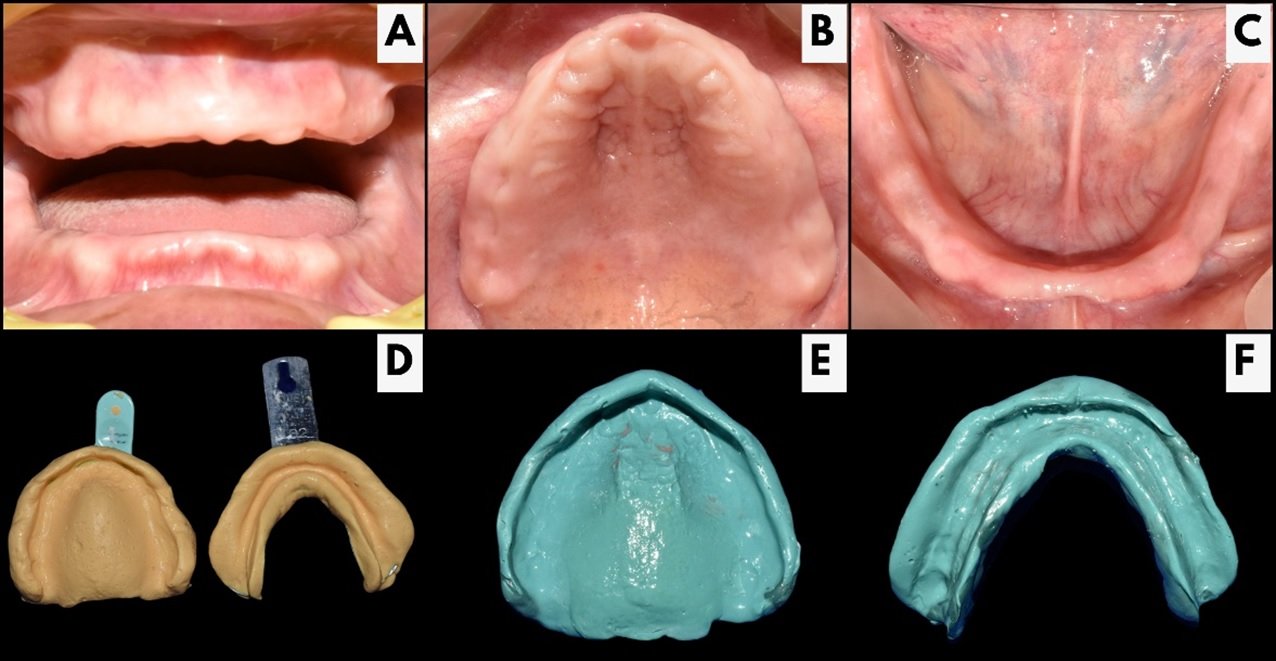
He had been wearing dentures for the past decade and complained that they were now ill-fitting. Clinical examination revealed complete edentulism in both the upper and lower jaws. In the maxilla, the anterior region between the canines exhibited flabbiness.

The patient was provided with various treatment alternatives. Nevertheless, given the patient's apprehension towards surgical interventions, it was mutually decided to proceed with the construction of complete dentures for both the upper and lower arches. The palatal splinting impression technique was chosen for this purpose.
TECHNIQUE
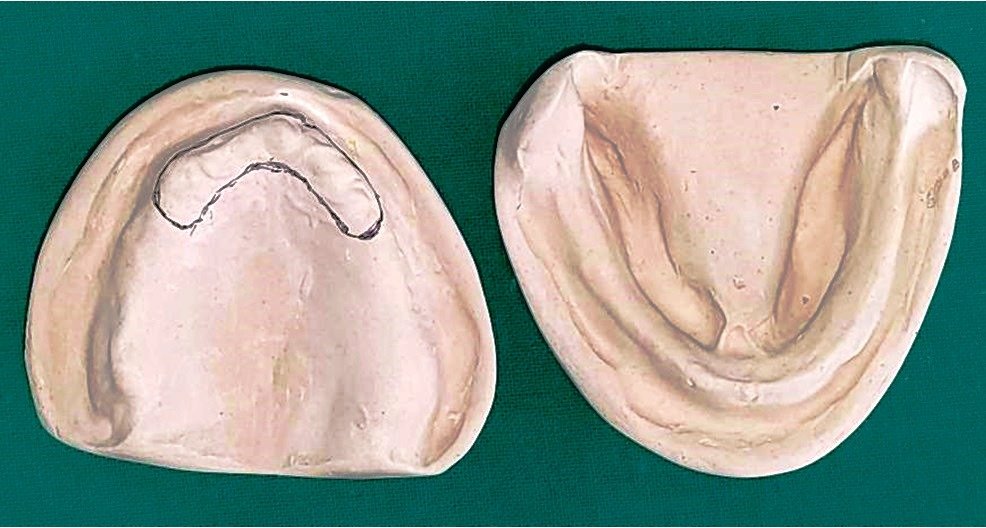
- The upper and lower arches' primary impression was made using alginate impression material (irreversible hydrocolloid impression material) within perforated edentulous stock trays. Subsequently, the impressions were filled with dental plaster, the cast was marked to exclude the flabby area and a special tray was fabricated on it.
- The flabby area on the cast was initially outlined and relieved with modeling wax. Following this, a "T spacer" was fabricated in the maxillary arch.
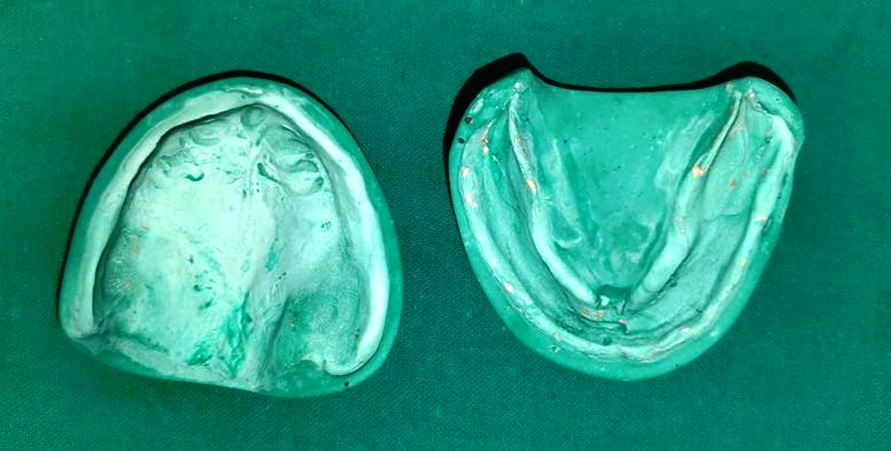
- Within this relief area, the self-cure acrylic resin tray was adapted, and then a stainless steel pin, angled anteriorly and superiorly, was attached to this part of the tray. This formed the first part of the tray, known as the palatal tray. Subsequently, a full-arch special tray was fabricated using the same material, with a separating medium applied over the first part. The alignment of the two parts of the tray was facilitated by the stainless steel pin.
- The tray was removed from the cast to check for any errors at the connection point between the two tray sections. Borders were then trimmed to be 2 mm shorter for border molding.
- The next step involved performing border molding of the special tray using a green stick during the clinical impression-making process, followed by verifying the fit of the palatal section.
- The secondary impression process was conducted in two stages. Initially, an impression of the flabby area was made using light body VPS elastomeric impression material. This was followed by creating an impression of the remaining maxillary arch using zinc oxide eugenol impression paste.
- A master cast was poured from the secondary impression using the beading and boxing technique, and a record base was constructed using self-cure acrylic resin to record the maxillomandibular relationship.
- After try-in and processing, the denture was inserted intraorally, and the patient was given instructions for the use and home care of the prosthesis.
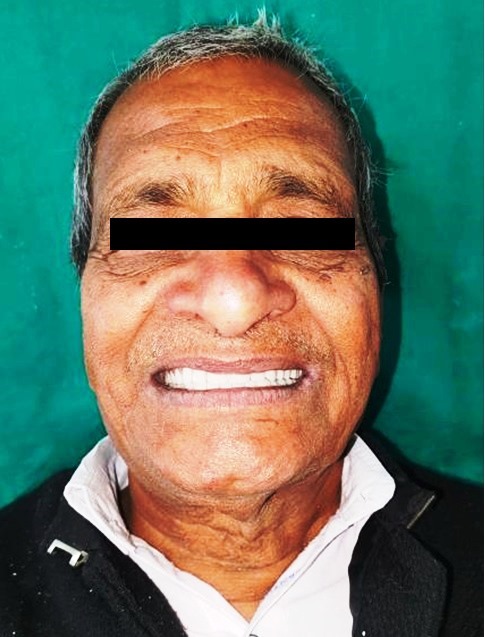
- Follow-up was done at 2 months. The patient expressed satisfaction with the denture, especially when compared to previous maxillary dentures fabricated using conventional impression techniques. He feels that this maxillary single denture is more comfortable. Clinical examination revealed that the denture, constructed using the palatal splinting impression technique with a custom tray, was stable and retentive.


DISCUSSION
This approach, introduced by Osborne, emphasizes the use of two separate impressions taken in individual trays, both belonging to a single unit. Initially, a separate impression of the palatal area is taken using zinc oxide eugenol impression paste. If the amount of flabby tissue is minimal and easily displaced, the consistency of the zinc oxide eugenol is not a significant factor. However, when dealing with a larger quantity of flabby tissue that is highly displaceable, using zinc oxide eugenol for the palatal tray impression, even with large perforations, may still compress the flabby tissue within the tray. The degree of relief provided in this technique is subjective and thus prone to arbitrary adjustments, leading to potential errors that may not be readily detectable.
Secondly, the presence of material within the tray complicates the alignment of the palatal tray, making it a technique-sensitive process. Thirdly, the purpose of the perforations is primarily for aligning the two tray components rather than providing relief to the flabby tissue from pressure. The clinical consistency of both impression materials is crucial. This technique does not allow for the recorded flabby tissue to rebound, which is a primary advantage of this technique.
Alternatively, this technique may better serve the principles of recording flabby tissue if the flabby tissue is recorded either with impression plaster or light-body elastomer, while the remaining impression is made with either of these two compatible materials.
CONCLUSION
In summary, Osborne's technique presents a novel approach to addressing flabby tissue through separate impressions in trays belonging to a single unit. While effective, its success depends on factors like the quantity and displaceability of the tissue. Challenges include subjective relief provision and limitations in facilitating tissue rebound. Alternative materials like impression plaster or light body elastomer may enhance its effectiveness. Continued exploration and refinement of impression techniques are necessary to better manage flabby tissue in prosthodontic practice.
REFERENCES
- The Glossary of Prosthodontic Terms 2023, Tenth Edition.
- Osborne J. Two impression methods for mobile fibrous ridges. Br Dent J. 1964;117(6):392-4.
- Boucher CO. Complete denture prosthodontics—The state of the art. Journal of Prosthetic Dentistry. 2004 Oct 1;92(4):309-15.
- Zarb GA, Hobkirk J, Eckert S, Jacob R. Prosthodontic treatment for edentulous patients: complete dentures and implant-supported prostheses. Elsevier Health Sciences; 2012 Mar 15.
- Souza RD. Prosthodontic management of flabby ridge using palatal split tray technique-A case report. Clinical Dentistry (0974-3979). 2013 Jul 1;7(7).
- Labban N. Management of the flabby ridge using a modified window technique and polyvinylsiloxane impression material. The Saudi Dental Journal. 2018 Jan 1;30(1):89-93.
- Haseeba SA, Vinaya KC, Naveen YG, Kttimani PT, Nair RV. Modified Impression Techniques for Management of Flabby Ridges–A Series of Case Reports. Journal Of Applied Dental and Medical Sciences. 2019;5:1.
- Mattoo KA, Goswami R, Yunus N, Gaba N. Prosthetic Management of Flabby Hyperplastic Edentulous Ridge Tissue Using Different Clinical Impression Techniques–A Critique Case Series.(2022)
- Singh RK, Patil N, Datta A, Pattedar A, Billesh NK. Impression techniques for management of flabby ridges in complete denture patients: A review of literature. Int J Appl Dent Sci. 2022;8(1):31-6.
Disclaimer from Guident
The views and opinions expressed in articles published in Guident are solely those of the authors and do not necessarily reflect the views of the editors, the editorial board or the publisher, Ivory India. Guident does not endorse any product, technique or treatment described. Clinical content is intended for qualified dental and medical professionals and is not a substitute for individual clinical judgement. Guident, its editors and the publisher accept no liability for any consequence arising from the use of information published in the journal.
How to cite this article
Dr. Shikha Shahi, Dr. Srishti Mishra, Dr. Manesh Lahori. Prosthodontic Management of Flabby Tissue Using Two Tray Palatal Splinting Impression Technique: A Case Report. Guident. 2024 Mar;17(4). Available from: https://ivoryindia.in/articles/prosthodontics/prosthodontic-management-of-flabby-tissue-using-two-tray-palatal-splinting-impression-technique-a-case-report.html