Changing Trends in Maxillofacial Prosthodontics a Review
Department of Prosthodontics & Implantology, K.D. Dental College & Hospital, Mathura, UP
ABSTRACT
Face restoration with conventional method of Prosthesis fabrication requires high level of artistic skills and time. From the use of Vulcanite in 19th century, thermoplastic materials based on wax reinforced with resin, polymethylmethacrylate, silicone polymers (Fernanda Pereira de Caxias, 2019), to the recent 3D printing-RAPID PROTOTYPING fabricated prosthesis, there has been an advancement to manifolds. Advent of RP has unmasked new outlook for design and production in Maxillofacial Prosthodontics. Rapid Prototyping is fast fabrication of model using 3D computer aided design, done mostly using Additive manufacturing allowing production of complex shapes with internal details and undercut areas, replicates contralateral vital structures reducing the discrepancies incorporated by hand crafting.
Key Words: Maxillofacial defects, Rehabilitation,History, Silicones, Acylic resins, 3D Printing, CAD-CAM
INTRODUCTION
Maxillofacial prosthodontics is a speciality of dentistry which deals with acquired and congenital defects of both of stomatognathic and associated facial structures, using artificial substitutes that may or may not be removed. It serves as a life changing milestone for patients loosing an eye, ear, or nose or sustained damage to intraoral structures.
Malformations from necrotizing diseases, head and neck cancer produces obvious disfigurement and dysfunction. This may be only partially compensated for, by prostheses and rehabilitation. The diagnosis, treatment and long-term adjustment to head and neck cancer presents both physical and psychological challenges to an individual that cannot be summarized by or equated with statistics on treatment response, disease progression, and survival.1 These deformities not only produces disconcertment in patients but also negatively affect their psychiatric, familial, and social status. Hence, it is particularly important to address not only the physical and functional deficiencies but also the psychological effects caused by these deformities.2
Maxillofacial prostheses have an important impact on the patient’s quality of life and self-esteem, as they can immediately correct the defects that occur after surgical procedures.3 The prostheses allow individuals to reintegrate into their social and familial environments, making them happier and more confident. In order to achieve success, it is necessary to integrate different health professionals, such as doctors, nurses, psychologists, physiotherapist, speech therapists, and dentists for prosthetic rehabilitation. Maxillofacial prostheses are primarily contrived using acrylic resin and/or silicone4, according to the facial structure of the patient. Generally, maxillofacial prostheses can be classified as restorative or complementary. Restorative prostheses substitute for bone loss or repair deformities of facial contour. They can be located internally within the tissue or externally as oral, ocular, or facial prostheses. Complementary prostheses help with plastic surgery, in the pre-, trans-, or postoperative period, or in radiotherapy sessions3 (Figure 1).
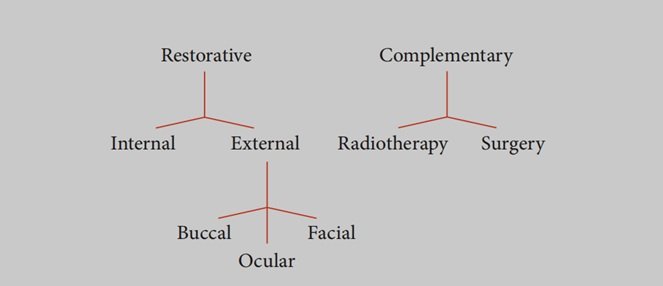
FIGURE 1: Classification of Maxillofacial Prosthesis, TAKEN FROM: Classification, History, and Future Prospects of Maxillofacial Prosthesis Fernanda Pereira de Caxias,1 Daniela Micheline dos Santos, Lisiane Cristina Bannwart, Clovis Lamartine de Moraes Melo Neto,1 and Marcelo Coelho Goiato International Journal of Dentistry Volume 2019, Article ID 8657619, 7 pages https://doi.org/10.1155/2019/8657619
These prosthesis are retained by several methods. Methods of Retention used for maxillofacial prostheses includes:5
- Anatomical, in which the retentive contours existing at the site of deformity are used to retain the prosthesis. e.g. extra-oral and intra-oral .
- Chemical, in which adhesive materials are used to retain the prosthesis. e.g. Adhesive, Silicon adhesive, Pressure sensitive tapes, Rubber based liquid, Combination of Adhesive.
- Mechanical, e.g. Eye glasses and frame, Extensive from denture, Precision attachment. Elastic and non elastic strayes, Magnets.
- Surgical anchorage e.g. using surgically created retention Elements.
- Implant, in which implant fixtures anchored into the bone are used to retain the facial prosthesis.
Diverse materials, methods, and clinical approaches have been used for maxillofacial prostheses. This review presents the trends in Maxillofacial prosthesis starting from the conventional techniques and materials like vulcanite, leather, wood, silver to the most commonly used acrylic resins, silicone and the recent one being the prosthesis fabricated by using 3D-PRINTING technology. It is a type of CAM technology capable of making physical objects directly from 3D computer data by adding layer upon layer- additive manufacturing, which is most widely used.
Use of Rapid Prototyping technology in Maxillofacial Prosthesis fabrication has a considerable impact in rehabilitation of patients with orofacial defects. Its future holds a plethora of opportunity. It reduces treatment time, replicates patient characteristics, eliminates making facial impressions, reduces complexity of wax pattern sculpting. Although it comes with limitations like complicated, expensive equipment and reliance on expertise to run, but it might become the mainstream technology in Digital Prosthodontics and revolutionize the entire workflow related to Maxillofacial Prosthodontics by providing patients with sense of security regarding comfort, function, aesthetics.
PAST:
The beginning of maxillofacial prostheses is doubtful.3 According to Conroy, the first application of engineering principles to restore orofacial appearance and dental occlusion may be attributed to Hippocrates . The Etruscans society had used their art of intraoral prosthesis with remains of prosthetic structures found in their ancient burial sites.3 ’Egyptians Mummies’ were discovered with enamel-covered, silver eyes with bronze lids8 and nasal and auricular structures. Evidence was found of in vivo use of intraoral eyes by Romans. This tradition was followed by ancient Greeks to fabricate artificial eyes with silver for their statues.8 Indians and Chinese had used the artifial eyes in ancient times as cited by Bulbulian.3 Confirmation of oculofacial prostheses in China (year 200 AD) suggests that their designs were based on a metal framework externally coated with a layer of lacquer to increase facial skin tones.7 The idea for the use of these prostheses in Indians, Roman, and Egyptian, societies could possibly be the amputation of ears, noses, and hands as a punishment for crimes.3,7 The cited case of maxillofacial reconstruction between 200 AD and 1000 AD is related to the Byzantine Emperor Justinian II who had a golden nose manufactured while he was in prison.3 Ambroise Pare gave the first cited use of ÌÂmaxillofacial prostheses during the 16th century3,7, French surgeon mentioned the use of the artificial ocular3,8, auricular, and nasal prosthesis and described the manufacturing of an obturator prosthesis.3 The prostheses proposed by Pare were made with different materials like paper-Mache, ÌÂleather, ivory, gold, and silver.7 Nasal prostheses was retained by sticky substances or by three linen strips wrapped around the patient’s head. Ear prostheses were retained by a metal band that was placed over the patient’s head. The ocular prostheses was retained internally in the orbit or externally retained similar to the ear prostheses.3,7 Regarding the obturator prostheses, a dry sponge was attached to the upper surface of the prosthesis (obturator region) so that when the dry sponge entered the palatine cavity and was moistened, it expanded and stabilized prosthesis in position.3 Glass and wood were a more common in Europe during the 16th century as maxillofacial prosthesis. Later, during the 17th century, Pierre Fauchaud recognized that maxillofacial prostheses improve mastication and reorganizes palatal defects and improve aesthetics.3 Fauchaud designed a wing palatal obturator where the wings were folded together during insertion into the palatal defect. Once placed, the wings spread out to hold the prosthesis in position.3
Fauchaud invented the aesthetics of artificial teeth. The ivory artificial teeth were covered with a thin metal layer, and again this metal layer was covered with enamel.3 In 1681, artificial eyes were made of enamel aiming to ‘realistic look’. Some prostheses were made of nitrated cellulose. However, for smokers, nitrated cellulose produced unsatisfactory results, as it turned brown and caught fire. Later, in France, Celluloid was also used for cranioplasty.7 At the end of the 19th century, vulcanite was dicovered for the fabrication of maxillofacial prosthesis.3 This material replaced the cellulose, metals, ceramics, and other materials used for the manufacture of prostheses at that time period. Additionally, vulcanite was often used during World War I (1914–1918) to manufacture maxillofacial prostheses.3 Some professionals used other materials, such as thermoplastic material based on wax reinforced with resin and a material based on gelatin and glycerin.9But the gelatin and glycerin prostheses only lasted few days or, at most, a week.3 In spite ocular prostheses demand during World War I, when more than 600,000 soldiers had head and facial in-juries, government regulations hampered the manufacture of glass ocular prostheses.7,8
Maxillofacial prosthetics had an important role in the quality and purpose of life for recuperating soldiers since they were able to engage in social activities and go out in public.7 Between World Wars I and II, researchers tried to develop new materials for the fabrication of maxillofacial prostheses, such as prevulcanized latex.7

FIGURE: Timeline of various materials used for restoring Maxillofacial defects TAKEN FROM: https://www.frontiersin.org/article/10.3389/fbioe.2020.00121
CURRENT:
Presently, the materials used to fabricate maxillofacial prostheses include vinyl plastisol, acrylic resins based on polymethyl methacrylate (PMMA), polyurethanes, latex, and silicone polymers. Silicones and acrylic resins are the highly used materials for maxillofacial reconstruction. The most rated material for fabrication of facial prostheses are silicone polymers that are classifified as one of two types: high-temperature vulcanizing silicone and room temperature vulcanizing silicone.5 Silicone, also known as polydimethyl siloxane is the most successful maxillofacial prosthetic material till now and the new advances are being made to this material to overcome their weaknesses. These became more popular over other materials as they have a good range of physical properties that include chemical inertness, strength, durability, and ease of manipulation.6 Two major drawbacks of silicone polymers are color degradation and instability, caused by exposure to ultraviolet rays, air pollution, temperature variation, and humidity. Silicones are classicaly used but still need upgradation because they last for transient periods, such as 6 months, and need frequent replacement.

FIGURE: Auricular silicone prosthesis TAKEN FROM: https://www.medicalartprosthetics.com/prosthetics/ear/
The acrylic resins have been used to fabricate intraoral prostheses, such as obturators and ocular prostheses. It can be thermopolymerized (by water bath or microwave energy) or autopolymerized . Da Silva tested the biocompatibility of difffferent polymerization methods on a human conjunctival cell line and concluded that heat polymerization using a water bath was the most appropriated method to fabricate ocular prostheses. With the latest acrylic resins, ocular prostheses have become much more versatile, resistant, and comfortable to use. They can be easily shaped and conformed to irregularities in the anophthalmic cavity producing a more accurate, safer (the materials are inert and nontoxic), and practical final cosmetic result . Moreover, orbital implants (i.e., hydroxyapatite, polyethylene, aluminum oxide, and silicone) can also be used to restore orbital volume and some mobility for the prosthesis. Its advantages includes its availability, colour stability, ease of being relined and repaired, good strength, can be fabricated with feather margin and a good shelf life of about two years.6

FIGURE: Acrylic resin ocular Prosthesis TAKEN FROM: https://ocularpro.com/the-difference-between-a-stock-and-custom-prosthetic-eye
However, they are rigid, have water absorption and duplication is not feasible. Acrylic copolymers with elastic properties have drawbacks like poor edge strength, poor durability and degradation when exposed to sunlight. The restoration often becomes tacky and predisposes to dust collection and staining.Latest generation of acrylic monomers, oligomers and macromeres are thermal, chemical and photo initiated and can eliminate the short comings of traditional acrylic co-polymers.7
Three-dimensional (3D) printing is a new, evolving technology that has the potential to revolutionize medical education and maxillofacial reconstruction . It allows the creation of customized, patient-specific models to optimize facial reconstruction by providing anatomical precision and individualized solutions for facial reconstruction. 3D printing can make prosthetic treatments more accurate, faster, and less expensive. Silicone rubber can also be infused with colored pigments in order to print prostheses that match the patient’s skin color.5

FIGURE: 3D image reproduction protocol TAKEN FROM: https://www.intechopen.com/books/new-trends-in-3d-printing/colour-image-reproduction-for-3d-printing-facial-prostheses
FUTURE:
A large number of studies point to the development of new materials and techniques to optimize the treatment of congenital and acquired orofacial defects. New studies identified several areas for further investigation when evaluating different properties of maxillofacial prostheses and their management, such as biocompatibility , cleaning protocols,9 pigment incorporation,10 and material bonding efficiency. Ferreira predicted the development of new prostheses that substitute for bone tissue without requiring bone grafts, thus reducing the morbidity and the recovering time, as a possible new approach in maxillofacial reconstruction. According to Ferreira , these new prostheses should be developed using engineering, computer-aided design and manufacturing (CAD-CAM), and surgical guides. Several steps in the fabrication of maxillofacial prostheses are still relating, requiring time and skill.10 Modern techniques for ocular prosthesis fabrication, such as 3D printing and digital imaging, are able to reduce the treatment time, better replicate the patient characteristics10, eliminate taking facial impressions, and reduce the complexity of wax pattern sculpting. However, modern techniques will need improvements, along with reduced cost and wider availability, to lead to a promising future for maxillofacial reconstructions. In addition to technical advances, the expectations related to the future for maxillofacial prostheses will be obtained by the needs of patients.Rapid prototyping is a technique highly in demand, but again cost effectiveness is an issue with it. Computers can now be used to create accurately detailed projects that can be assessed from different perspectives in a process known as computer aided design (CAD). To materialize virtual objects using CAD, a computer aided manufacture (CAM) process has been developed. To transform a virtual file into a real object, CAM operates using a machine connected to a computer, similar to a printer or peripheral device. Rapid prototyping procedure is explained briefly in the following flow chart:

CONCLUSION
Maxillofacial prostheses restore orofacial defects as well as improve the patient’s quality and ethnicity of life. This is an ancient treatment modality that has grown over centuries. The current situation is worthy, and there is positive hope for the future. The need of the hour is to have a good knowledge of all the new aids in market, keeping in mind the advantages and disadvantages. Pocket friendliness is another aspect to be seen in this big story. A brief documented matter is presented below.

REFERENCES
- Maxillofacial Rehabilitation: Prosthodontic and Surgical Management of Cancer-related, Acquired, And congenital defects of the head and neck-John Beumer
- Emrah Ayna, Emine Göncü BaÅŸaran, Köksal Beydemir, "Prosthodontic Rehabilitation Alternative of Patients with Cleft Lip and Palate (CLP): Two Cases Report", International Journal of Dentistry, vol. 2009, Article ID 515790, 4 pages, 2009. https://doi.org/10.1155/2009/515790
- A. J. Ackerman, “Maxillofacial prosthesis,” Oral Surgery, Oral Medicine, Oral Pathology, vol. 6, no. 1, pp. 176–200, 1953.
- M. C. Goiato, B. C. Zucolotti, D. N. Mancuso, D. M. dos Santos, E. P. Pellizzer, and F. R. Verri, “Care and cleaning of maxillofacial prostheses,” Journal of Craniofacial Surgery, vol. 21, no. 4, pp. 1270–1273, 2010.
- Mckinstry RE. Retention and facial prostheses. In:Mckinstry RE. Fundamental of facial prosthetics. Arlington (USA): ABI Professional Publications; 1995. p. 19–30.
- Aparajita Mitra , Sunita Choudhary , Hemlata Garg , Jagadeesh.H.G, Maxillofacial Prosthetic Materials An Inclination Towards Silicones, ‘’Journal of Clinical and Diagnostic Research. 2014 Dec, Vol-8(12)’’
- B. Conroy, “A brief sortie into the history of cranio-oculofacial prosthetics,” Facial Plastic Surgery, vol. 9, no. 02,pp. 89–115, 1993.
- F. Roman, “-e history of artificial eyes,” British Journal of Ophthalmology, vol. 78, no. 3, p. 222, 1994.
- A. M. Guiotti, B. G. Cunha, M. B. Paulini et al., “Antimicrobial activity of conventional and plant-extract disinfectant solutions on microbial biofilms on a maxillofacial polymer surface,” Journal of Prosthetic Dentistry, vol. 116, no. 1,pp. 136–143, 2016.
- A. M. Guiotti, M. C. Goiato, D. M. Dos Santos et al., “Comparison of conventional and plant-extract disinfectant solutions on the hardness and color stability of a maxillofacial elastomer after artificial aging,” Journal of Prosthetic Dentistry, vol. 115, no. 4, pp. 501–508, 2016.
Disclaimer from Guident
The views and opinions expressed in articles published in Guident are solely those of the authors and do not necessarily reflect the views of the editors, the editorial board or the publisher, Ivory India. Guident does not endorse any product, technique or treatment described. Clinical content is intended for qualified dental and medical professionals and is not a substitute for individual clinical judgement. Guident, its editors and the publisher accept no liability for any consequence arising from the use of information published in the journal.
How to cite this article
Dr. Tanya Singh, Dr. Vishal Paul, Dr. Rahul Nagrath. Changing Trends in Maxillofacial Prosthodontics a Review. Guident. 2020 Dec;14(1). Available from: https://ivoryindia.in/articles/prosthodontics/changing-trends-in-maxillofacial-prosthodontics-a-review.html