Enhancing Stability in Complete Dentures with Monoplane Occlusion
AME, s Dental College & Hospital, Raichur, Karnataka, Maharashtra
ABSTRACT
The most common problem associated with long term denture wearers is lack of stability of their mandibular complete dentures because of high resorption of lower edentulous ridge,because of which these patients suffer ongoing diminution of the denture foundation. It is the duty of a prosthodontist to rehabilitate those patients to near normal function, irrespective of the clinical picture.Physiologically optimal denture contours and appropriatedenture tooth arrangement should be achieved to maximize prosthesis stability, comfort, and function for patients.
KEYWORDS: Atrophic residual ridges, Mandibular complete denture, stability.
INTRODUCTION
Incorrect tooth placement and arbitrary shaping of thepolished surfaces may have an adverse effect on the success of the prosthesis. This is particularly true for patients with reduced mandibular residual ridges, yielding flat or concave foundations due to severe bone resorption. The unstable lower complete denture is a continuing problem for our profession. Many edentulous people can experience difficulty in carrying out functional activitieswhen wearing complete dentures. This maybe due to a number of factors, one ofwhich is the ability to control the dentures effectively during mastication and speech.For this reason, it is critical whenconstructing complete dentures toincorporate features in their design whichwill aid stability in function.1
Successful treatment of patients withcomplete dentures depends mainly uponthe proper positioning of the teeth on thedenture foundation. Along with verticalheight changes, resorption of bone bringsabout changes in bucco-lingual direction,of residual alveolar ridge.2
The most commonly encountered difficulty is fabrication of lower denture inresorbed mandible,and it is also difficult to achieveretention and stability in mandibular dentures as compared to the maxillary ones.3
Many types of occlusal forms and posterior tooth arrangements have been used in complete dentures foralmost 200 years. The three major groups of occlusal forms available are (1) anatomic: 33- or 30-degree cusps; (2) semianatomic: 20-degree cusps; and (3) nonanatomic or cuspless:O-degree cusps.4
There has been search for the ideal denture occlusion in an effort to find out the tooth forms which provides esthetic, stability, and masticatory efficiency without compromising the health of underlying hard and soft tissues of the edentulous arch. The main aim of clinician is to fulfill theseobjectives, regardless of posterior tooth form selected.5,6
Numerous concepts, techniques and philosophies have been documented concerning about complete denture occlusal schemes. There are several schools of thoughts on occlusal schemes in complete denture and some clinician believe there should be cusps on the teeth and must be in complete harmony with the stomatognathic system. Some believe that cusplessteeth create minimum horizontal force to unseat denture.7
Sear introduced monoplane occlusion with balancing ramps or tooth at the distal part of the mandibular arch which comes in contact only in eccentric excursions. De Van has used the same principle without the balancingramp .According to this concept teeth which are flat mesiodistallyand buccolingually are used, oriented as close as possible parallel to the maxillary and mandibular mean foundation plane.
Indication
- Abnormal closure imbalance, pathosis, trauma, neuromuscular disturbances.
- Posterior displaceable mucosa.
- Multilated, tortuous ridges with an excessive denture space.
- Ridges are flat or knife edge, rendering dentures more suspectible to horizontal force.
- When chewing pattern is milling type with broad excursions.
- Maximum of vertical force and a minimum of horizontal stress is desired.
Advantages
- They are more adaptable to the unusual jaw relation such as class II and class III relations, used easily in cases of variations in the width of maxillary and mandibular jaws, cross bite.
- These impart a sense of freedom to the patients, do not lock mandible in one position.
- They eliminate horizontal forces, which are more damaging than vertical forces.
- Because the monoplane teeth occlude in more than one relationship, so centric relation developed to an area instead of a point.
- Monoplane teeth permit the use of a simplified and less time consuming technique and offer greater comfort and efficiency for a longer period.
- They accommodate better to the negative changes in the ridge height that occur with aging.8
Disadvantages
- No vertical component to aid in shearing during mastication.
- Patients may complain of lack of positive intercuspation position.
- Esthetically limited.
- Occlude only in two dimensions, but the mandible has a 3D movement due to its condylar behaviour
CASE REPORT
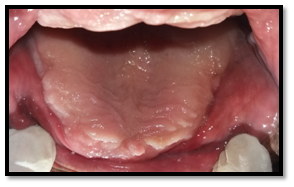
A 65 year old male patient reported with the chief complaint of missing teeth since past 5 years and desired to get them replaced. Intra-oral examination revealed completely edentulous and severely resorbed both upper and lower arches (Figure 1). The patient did not give any previous history of wearing denture and had reported for replacement of his teeth. Hence, fabrication of complete dentures with monoplane teeth was planned for the patient, and he was was explained about the same.
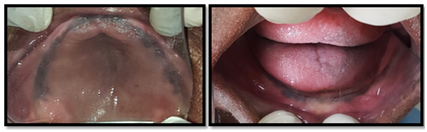
Fig 1: Resorbed maxillary and mandibular arches
Primary impressions of the upper and lower jaw were made with impression compound using metal stock trays and the model was poured in dental plaster. Following which upper and lower custom trays were fabricated using self-cure acrylic resin. The extensions of the custom trays were evaluated intra-orally,border moulding was done with the help of green stick compound and secondary impressions were recorded using zinc-oxide eugenol impression paste(Figure 2). Following which the master casts were poured in dental stone. After obtaining the master cast, upper and lower base plates were fabricated using acrylic resin. The base plates were trimmed and checked for extensions, retention and stability in the patient’s mouth. Wax occlusal rims were made over upper and lower base plates and occlusal registration was recorded in a conventional manner. The height of the wax rims were adjusted intraorally to permit an acceptable occlusal vertical dimension (OVD) and a freeway space of 2mm.Centric relation was recorded and articulation was done(Figure 3).

Figure 2:Secondary Impression

Figure 3: Jaw Relation recorded
Anterior maxillary teeth arrangement was done in a conventional manner, whereas for the posteriors teeth arrangement was done with non-anatomic or 0â—¦ cuspless teeth, which were oriented as close as possible parallel to the occlusal plane. The teeth were arranged such that the entire occlusal surface of all maxillary posteriors touched the glass plate and the mandibular posteriors were arranged according to themaxillary posteriors.
The waxed up dentures were checked in the patient’s mouth for esthetics, phonetics and occlusion (Figure 4). Once the try in was found satisfactory, the dentures were processed, finished and inserted(Figure 5).

Figure 4: Try -in done
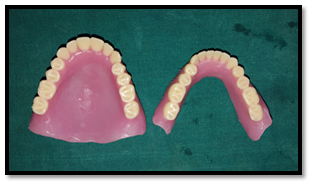
Figure 5: Final Denture
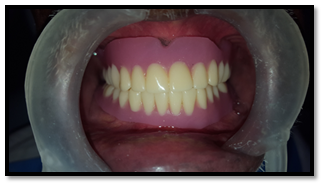
Figure 6: Denture Insertion
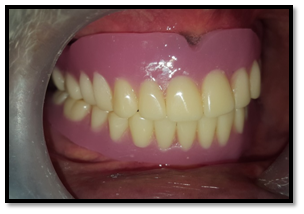
Figure 7: Right Side Occlusion

Figure 8: Left Side Occlusion

DISCUSSION
The present case report focusses on rehabilitation of completetly edentulous patients with resorbed ridges and having poor neuromuscular co-ordination. For such patients using monoplane or cuspless teeth provides them with an opportunity to easily adapt to the occlusion as it does not cause any interlocking of mandible during lateral excursive movements as in case of using an anatomic teeth. The non-anatomic teeth also reduce the horizontal forces acting on the denture thereby reducing denture instability.
CONCLUSION
Monoplane occlusal scheme are moreadaptable to the unusual jaw relation such as class II and class III malocclusions and cross bite cases.
A practical approach to rehabilitate the edentulous patients to optimal occlusion is not an easy task. Complete denture prosthesis when compared to natural teeth have relatively unstable bases and have no proprioception comparable to the periodontal ligament of the natural tooth and acts as the single unit instead of an individual tooth. Poor oral awareness makes it more difficult for a patient to adapt to the function with the prosthesis especially one with a complicated occlusal scheme.
REFERENCES
- Scott BJ, Hunter RV. Creating complete dentures that are stable in function. Dent Update 2008;35(4):259-62,265-67.
- Pawah S, Gupta A, Madan B. The relation of the Neutral zone to the crest of the residual alveolar ridge in completely edentulous subjects-A clinico-Radiological study. Journal of Oral Health and Community. 2011;5:90-3.
- Lynch CD, Allen PF. Overcoming the unstable mandibular complete denture: the neutral zone impression technique. Dental update. 2006 Jan 2;33(1):21-6.
- Clough HE, Knodle JM, Leeper SH, Pudwill ML, Taylor DT. A comparison of lingualized occlusion and monoplane occlusion in complete dentures. The Journal of prosthetic dentistry. 1983 Aug 1;50(2):176-9.
- Becker CM ,Swoope CC, Guckes AD .Lingualized occlusion for removable prosthodontics. J Prosthet Dent 1977;38:601-608.
- Boucher CO, Hickey JC, Zarb GA .Prosthodontic Treatment For Edentulous Patients, ed 10.St Louis.CV Mosby,1990.
- Krishna Prasad D, Rajendra Prasad B, Anshul B, Anupama Prasad D. Enhancing stability: a review of various occlusal schemes in complete denture prosthesis. NUJHS. 2013;3:105-12.
- Levin B. Monoplane teeth. The Journal of the American Dental Association. 1972 Oct 1;85(4):783.
- Harold R Ortman, Complete Denture Occlusion In: Sheldon Winkler d Essentials of Complete Denture Prosthodontics .2 ed.India:A.I.T.B.S.Publishers2009 : 217-249.
- Sears VH. Specifications for Artificial Posterior Teeth, J Prosthet Dent.2: 353-361, 1952.
- Porter CG. The Cuspless Centralized Occlusal Pattern, J Prosthet Dent.5: 313-318, 1955.
Disclaimer from Guident
The views and opinions expressed in articles published in Guident are solely those of the authors and do not necessarily reflect the views of the editors, the editorial board or the publisher, Ivory India. Guident does not endorse any product, technique or treatment described. Clinical content is intended for qualified dental and medical professionals and is not a substitute for individual clinical judgement. Guident, its editors and the publisher accept no liability for any consequence arising from the use of information published in the journal.
How to cite this article
DR. Ayesha Razzaque Dr. Sunil Dhaded Dr. Chandrashekar Sajjan Department of Prosthodontics. Enhancing Stability in Complete Dentures with Monoplane Occlusion. Guident. 2017 Dec;11(1). Available from: https://ivoryindia.in/articles/prosthodontics/enhancing-stability-in-complete-dentures-with-monoplane-occlusion.html