Research Methodology Made Easy in Prosthodontics
Department of Prosthodontics & Implantology, K.D. Dental College & Hospital, Mathura (U.P) India
INTRODUCTION
Research in common parlance refers to a search for knowledge. One can also define research as a scientific and systematic search for pertinent information on a specific topic.Redman and Mory define research as a “systematized effort to gain new knowledge.
According to Clifford Woody research comprises defining and redefining problems, formulating hypothesis or suggested solutions; collecting, organising and evaluating data; making deductions and reaching conclusions; and at last carefully testing the conclusions to determine whether they fit the formulated hypothesis.
Slesinger and Stephenson in the Encyclopaedia of Social Sciences define research as “the manipulation of things, concepts or symbols for the purpose of generalising to extend, correct or verify knowledge, whether that knowledge aids in construction of theory or in the practice of an art.”
In short, the search for knowledge through objective and systematic method of finding solution to a problem is research.
OBJECTIVES OF RESEARCH
The purpose of research is to discover answers to questions through the application of scientific procedures.The main aim of research is to:
- Find out the truth which is hidden and which has not been discovered as yet
- Exploratory or Formulative: To gain familiarity with a phenomenon or to achieve new insights into it .
- Descriptive: To portray accurately the characteristics of a particular individual, situation or a group
- Diagnostic research studies: To determine the frequency with which something occurs or with which it is associated with something else .
- Hypothesis-testing: To test a hypothesis of a causal relationship between variables.
MOTIVATION IN RESEARCH
The motivation while doing research lies in the intellectual happiness that you get while doing any creative work, the challenge to get answers to unsolved puzzles as well as its numerous consequential benefits that the society is going to get from research service .Research inculcate scientific and inductive thinking and it promotes the development of logical habits of thinking and organisation.
TYPES OF RESEARCH
- Descriptive: Their main aim is fact finding investigation and present state of affairs . such type of research studies have no control over the variables. They attempts to determine, describe, or identify what is.
- Analytical: attempts to establish why it is that way or how it came to be. They are based on testing hypothesis.
- Applied Research is a methodology used to solve a specific, practical issue affecting an individual or group. They are meant to find solution to a real life problem eg finding medicines.
- Fundamental Research: also known as basic research or pure research does not usually generate findings that have immediate applications in a practical level. Fundamental research is driven by intellectual curiosity and the desire to expand knowledge in specific research area. They are meant for knowledge sake.
- Quantitative Research: is defined as a systematic investigation of phenomena by gathering quantifiable data and performing statistical, mathematical, or computational techniques to understand the quantity or amount of a particular phenomena.
- Qualitative Research: here in the main aim of researcher is to find the quality of a particular phenomenon and uncover trends in thought and opinions of human beings.
- Conceptual Research: they are related to abstract idea(s) or theory and are used to develop new concepts or to reinterpret existing ones.
- Empirical research: they are data based research/ experimental type of research which aims at coming up with conclusions which are capable of being verified by observation or experiment.

Fig: qualitative v/s quantitative research
SOME OTHER TYPES OF RESEARCH
1. One-time Research – Research confined to a single time period.2. Longitudinal Research – Research carried on over several time periods.
3. Diagnostic Research- are clinical research that find out the cause of the problem and its possible solution.
4. Exploratory/ formulative – they aim at gaining familiarity with the unfamiliar problem and generate new ideas or to make a precise formulation of the problem.
5. Experimental research - to assess the effect of one particular variable keeping the other variables constant
6. Historical research- they aim to find the origin and development of a past phenomenan and anticipate its present and future.
7. Conclusion-oriented research- here researcher are free to pick up a problem , redesign the enquiry and conceptualize as he wishes.
8. Decision-oriented research – there is always the need of a decision maker The researcher in this case is not free to embark upon research according to his own inclination.
CHARACTERISTICS OF GOOD RESEARCH QUESTION

IMPORTANCE OF KNOWING HOW RESEARCH IS DONE
For one who is preparing himself for a career of carrying out research, the importance of knowing research methodology and research techniques is obvious since the same constitute the tools of his trade. Only a good researcher can be able to make intelligent decision concerning problems of the research result in practical life and evaluate them with full reasonable confidence.CONSIDERATIONS TO BE KEPT IN MIND WHILE CONDUCTING RESEARCH
In any research on human beings, each subject must be adequately informed of the aim, methods, anticipated benefits and potential hazards of the study and the discomfort it may entail. An informed consent without and threats or undue pressure should be exercised. In case of any legal incompetence informed consent is obtained from the legal guardian in accordance with the existing legislation. Subject should be informed that they are free to abstain or to withdraw from participation at any time.ETHICS IN RESEARCH
First important code of ethics was the NURENBURG CODE of 1947. “No research could proceed in human subjects without voluntary consent.’’Declaration of Helsinki code of ethics on principles of ethical behaviour was established in HELSINKI-I in 1975. Institutions undertaking clinical trials have to constitute an Institutional Ethics Committee (IEC) or Institutional Review Board (IRB). It is mandatory that each dissertation research proposal (synopsis) involving humans (irrespective of type of study, including questionnaire based surveys) or animals should be accompanied by a clearance letter from IECThe ethical principles to be kept in mind are non-malificence , Benificieance , Veracity or truthfulness, Autonomy, Justice and Confidentiality
RESEARCH PROCESS
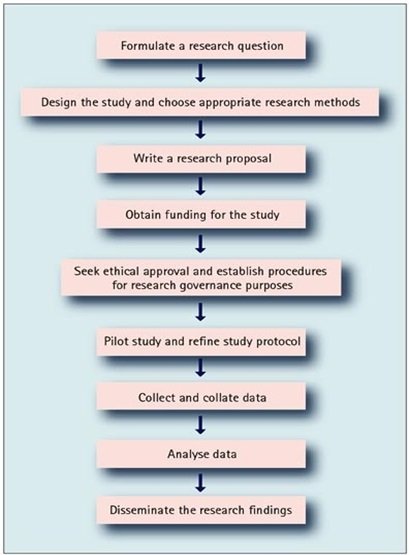

1. PREINVESTIGATION STEPS
2. INVESTIGATION STEPS
3. POST INVESTIGATION STEPS
1. PREINVESTIGATION STEPS
A. Formulating the research problem:The most common research problem is the inability to find their state and their unclear relationship with variables. Importance should be given to thorough understanding of problem from analytical point of view
The best way of understanding the problem is to discuss it with one’s own colleagues or with those having some expertise in the matter. In an academic institution the researcher can seek the help from a guide who has several research problems in mind.
B. Extensive literature survey:
Once the problem is formulated, research worker should write a synopsis of the topic and submit it to the necessary committee or the research board for approval. For this purpose the abstracting and indexing journals and published or unpublished bibliographies are the first place to go to.
Academic journals, conference proceedings, government reports, books etc., must be tapped depending on the nature of the problem. In this process, it should be remembered that one source will lead to another. The earliest studies, if any, which are similar to the study in hand should be carefully studied.
C .Developing the objectives and hypothesis:
After extensive literature survey, researcher should state in clear terms the objectives and working hypothesis. The objective of a research helps to focus on the study and avoid collection of data that are not strictly necessary for understanding or solving the identified problem.. Objectives must be phrased in operational terms that are specific enough to be evaluated.
A hypothesis is tentative assumption made in order to draw out and test its logical or empirical consequences. They also affect the manner in which tests must be conducted and indirectly the quality of data which is required for the analysis.
After development of objectives and hypothesis discussions with colleagues and experts about the problem should be done. Examination of data and records, collection of related similar articles and exploratory personal investigation( original field interviews )with a view to secure greater insight into the practical aspects of the problem is to be done.
D. Preparing the research design:
Researcher has to state the conceptual structure of the research design within which research would be conducted. The preparation of such a design facilitates research to be as efficient as possible yielding maximal information, minimal expenditure of effort, time and money.
The research designing for a particular research problem usually consider the following factors: source of information, availability and skills of the researcher, explanation of the way in which selected means of obtaining information should be organized , the time available for research and the cost factor relating to research, i.e., the finance available for the purpose
E. Determining sample design:
All the items under consideration in any field of inquiry constitute a ‘universe’ or ‘population’. A complete enumeration of all the items in the ‘population’ is known as a census inquiry. It can be presumed that in such an inquiry when all the items are covered no element of chance is left and highest accuracy is obtained. But in practice this may not be true. Hence, quite often we select only a few items from the universe for our study purposes. The items so selected constitute what is technically called a sample.

2. INVESTIGATION STEPS
A. Collecting the data:In dealing with any real life problem it is often found that data at hand are inadequate, and hence, it becomes necessary to collect data that are appropriate. Data can be collected either through experiment or through survey.
If the researcher conducts an experiment, he observes some quantitative measurements, or the data, with the help of which he examines the truth contained in his hypothesis. In this case the researcher should be well trained. But in the case of a survey, data can be collected by any one or more of the ways like: observation, through personal interview, through telephone interviews, mailing of structured questionnaires or through schedules .
The researcher should select one of these methods of collecting the data taking into consideration the nature of investigation, objective and scope of the inquiry, financial resources, available time and the desired degree of accuracy.
B. Execution of the project:
This is one of the most important step in research process. The process of execution of the project should be in systematic manner . If the execution of the project proceeds on correct lines, then only the data that has been collected would be adequate and dependable. The researcher should be given adequate training which explains their job clearly .Occasional field checks should be made to ensure that the interviewers are doing their assigned job efficiently. If data was collected by means of survey then the final data can be readily machine-processed.
POST INVESTIGATION STEPS
A. Analysis of data:The analysis of data requires a number of closely related operations such as establishment of categories, the application of these categories to raw data through coding, tabulation and then drawing statistical inferences. The unwieldy data should necessarily be condensed into a few manageable groups and tables for further analysis. Thus, researcher should classify the raw data into some purposeful and usable categories.
Coding operation is usually done at this stage through which the categories of data are transformed into symbols that may be tabulated and counted. Editing is the procedure that improves the quality of the data for coding. With coding the stage is ready for tabulation.
Tabulation is a part of the technical procedure wherein the classified data are put in the form of tables. The mechanical devices can be made use of at this juncture. A great deal of data, especially in large inquiries, is tabulated by computers. Analysis work after tabulation is generally based on the computation of various percentages, coefficients, etc., by applying various well defined statistical formulae.
In the process of analysis, relationships or differences supporting or conflicting with original or new hypotheses should be subjected to tests of significance to determine with what validity data can be said to indicate any conclusion(s). For instance, if there are two samples of weekly wages, each sample being drawn from factories in different parts of the same city, giving two different mean values, then our problem may be whether the two mean values are significantly different or the difference is just a matter of chance. Through the use of statistical tests we can establish whether such a difference is a real one or is the result of random fluctuations. If the difference happens to be real, the inference will be that the two samples come from different universes and if the difference is due to chance, the conclusion would be that two samples belong to the same universe. In brief, the researcher can analyze the collected data with the help of various statistical measures.
B. Hypothesis testing:
In this validity of data is tested using hypothesis. Different basic hypothesis testing of significance in research methodology are: null hypothesis, ANOVA test, chi square test .
Null hypothesis and alternative hypothesis:
A null hypothesis is a hypothesis that says there is no statistical significance between the two variables in the hypothesis. It is the hypothesis that the researcher is trying to disprove. An alternative hypothesis simply is the inverse, or opposite, of the null hypothesis wherein the researches tries to prove the statistical relevance.
t-Test :
Is a type of inferential statistic used to determine if there is a significant difference between the means of two groups, which may be related in certain features and has normal distribution of observations .
There are two types of t Test: Unpaired t test (student t test) and Paired t test. Unpaired t test applies to unpaired data of observation made on individuals of 2 separate groups to find the significance of difference between 2 means e.g. difference in accuracy in an impression using two different impression materials .whereas, Paired t test is applied to paired data of observation from one sample only e.g. observation done on same individual before and after taking a drug
ANOVA - Analysis Of Variance.
This Investigations may not always be confined to comparison of 2 samples only .e.g. we might like to compare the difference in vertical dimension obtained using various methods eg swallowing , phonetics etc. In such cases where more than 2 samples are used ANOVA can be used .Also when measurements are influenced by several factors playing their role e.g. factors affecting retention of a denture, ANOVA can be used. ANOVA helps to decide which factors are more important.To apply ANOVA test sampling should be at random, data for each group should be independent and normally distributed
ANOVA test can be applied in three ways:
One way ANOVA: Where only one factor will affect the result between 2 groups
Two way ANOVA: Where we have 2 factors that affect the result or outcome
Multi way ANOVA: where three or more factors affect the result or outcomes between groups
Chi square test:
Is a type of non parametric statistical test. It gives us the association between test of proportion and test of association. It measure the probability of association between 2 discrete attributes e.g. smoking and cancer .It determines whether there is a statistically significant relationship between categorical variables.
CONCLUSION
The study of research procedures and methods is very important aspect of all post graduate students and at the same time provide guidelines on which our future research would be based. It also shows us the procedures that need to be followed while undertaking research and also shows us, how the data or findings of our study should be presented for correct interpretation and for publication.REFERENCES
- Health research methodology : a guide for training in research methods - World Health Organization 1992
- Park’s text book of preventive and social medicine. 19th edition. K.Park. Bhanot publishers. 2007
- Essentials of preventive and community dentistry - Soben Peter
- Methods of biostatistics - T Bhaskara Rao Behavioural sciences for dentistry.
- G.Humphris & M.S.Ling. Churchill Livingstone.2000.
- Critical thinking; understanding and evaluating dental research. D.M.Brunette. Quintessence publishing. 1996.
- Dentistry, dental practice and community. 5th edition. B.A. Burt & S.A.Eklund. WB Saunders company.
Disclaimer from Guident
The views and opinions expressed in articles published in Guident are solely those of the authors and do not necessarily reflect the views of the editors, the editorial board or the publisher, Ivory India. Guident does not endorse any product, technique or treatment described. Clinical content is intended for qualified dental and medical professionals and is not a substitute for individual clinical judgement. Guident, its editors and the publisher accept no liability for any consequence arising from the use of information published in the journal.
How to cite this article
Dr. Preeti Sagar, Dr.Sumver Jain, Dr. Abhinav Agarwal. Research Methodology Made Easy in Prosthodontics. Guident. 2020 Sep;13(10). Available from: https://ivoryindia.in/articles/prosthodontics/research-methodology-made-easy-in-prosthodontics.html