Unilateral Palatal Burn Injury-Report of a Case
1, Jain Vihar, Swastik Society, Near Mithibai College, Juhu, Mumbai-400056
ABSTRACT
Immediate consumption of microwave heated food may cause mild to severe injury. The injury may be moderate to severe if there is cheese ingredient present in the food. The authors report a case of an Indian woman who reported to the dental clinic in emergency with palatal thermal injury after ingesting microwaved heated cheese balls.
KEY WORDS: Microwave; Thermal injury; Palate
INTRODUCTION
Home appliances technology has seen advances in past several years. Microwave ovens used in the kitchen of many homes are considered to be one of the several innovative inventions for the benefit of cooking food. As with many benefits with evolution of modern science, there are risks associated which can translate into human injury1-4. One such example is consumption of microwave heated food products either solids or liquids, leading to thermal injuries of the oral mucosa. This article reports a case of an unilateral palatal burn associated with ingestion of microwave heated cheese balls in an Indian woman in her fourth decade of life.CASE REPORT
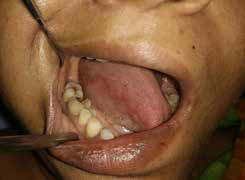
An Indian woman in her fourth decade of life presented to the clinic with pain and burning associated with her palate. A housewife, she gave a history of biting on few vegetarian cheese balls which were consumed immediately after cooking them in a kitchen microwave. The medical and dental history given by her were non significant. She developed acute pain and discomfort the moment she chewed on the centre of the cheeseball. Being extremely hot, the still remaining cheese element in the oral cavity prolonged the pain she experienced. Clinical examination of the oral cavity revealed erosive lesions of the lateral palate. Oval shaped or circular pattern ulcers in isolated clusters and a large ulcer with erthymateous borders surrounding pale mucosa of the palate adjoining to tooth no 22 (palatal ) extending upto 26 (palatal ) area The treatment carried out was prescription of betadine mouthwash gargling ( three to four times a day with dilution in water ), anti inflammatory analgesic like tab. Enzoflam (Serratiopeptidase 15.0mg + Diclofenac sodium 50 mg and paracetamol 500mg, Alkem Laboratories Ltd ) to assist in reduction of pain and transient swelling in the palatal mucosa. Topical application of mucopain gel ( 20 % Benzocaine ICPA health products Ltd ) with clean fingers over the ulcerated palatal area for a week three to four times a day just before intake of solid food. Hiora SG gel (Himalaya drug company) topical application over the localized burn area on the palate with a clean finger (2 to 4 times a day ) for one week and at home care by avoiding tooth brushing over the teeth on the affected side of the palate for a week, to avoid eating spicy, hot, crusty, sharp solid food and avoid intake of tangy, hot liquids and citrus containing juices and carbonated drinks like colas.
Intra oral clinical picture
DISCUSSION
A superficial burn of the oral mucosa is associated with thermal injury. Most burns of the oral mucosa can be classified as erosions. The erosion can be defined as a depressed lesion that results from the partial loss of mucosa. The erosion is a very shallow lesion because there is only incomplete, rather than complete, loss of the outer layer of oral tissue.5 Burns of the oral mucosa can be caused by heat, cold, radiation, electricity and mechanical or chemical stimuli. Acids, alkalis and salts can cause considerable damage to the oral mucosa, membranes and lips. Most damage is found in the oropharynx, besides the pharynx and tonsils, the alveolar mucosa of the tongue and the masticatory mucosa of the palate or gingiva show localized or diffused damage. The clinical appearance depends on the severity of the tissue damage and the destructive properties and mode of application of the causative agent.6 Microwave ovens generate heat deep within food, and this heat is transferred by conduction and convection throughout the food item. Thus cooked food may be cooler on the outside than on the inside. Failure to appreciate the differentially heated property of microwaved food may lead to injuries. Microwave-oven manufacturers advise that food is left to stand for a period of time, usually 2 min, to allow the heat energy to diffuse evenly throughout the item. Particular care must be taken with items that have a liquid centre, since the higher the water content, the more microwave energy is absorbed.7 Cheese is a material which retains the temperature at high levels. In consuming heated cheese pizza for example, the melted cheese can be seen by the person to assess the temperature initially. Whereas in a case described like ours, the cheese balls or cheese pies heated in a microwave the peripheral cooling does not indicate the same for the central portion. Tactile sensation may not be enough to gauge the entire temperature of the solid both from outside and inside. Biting the microwaved food immediately after taking it out from the heater, allows the hot cheese to flow on the mucosa causing areas of erosion and in case described like ours, ulcerations.8 Temperature of the solid to be ingested and duration of contact with the mucosa will determine the type of the thermal injury clinically manifested. Microwaves possibly have the ability to increase the kinetic energy of food contents inconsistently. Also conventional treatment protocol for such thermal injuries has been followed by our team. Over and above, we used a topical ayurvedic gel containing Jasmine known for its anti microbial action and wound healing along with Licorice and Triphala known to heal ulcers and combating micro organisms in oral cavity. Spreading hogweed as another ingredient in the ayurvedic preparation is known to reduce local inflammation of the wound. There have been very few reports in the literature documenting thermal injury to the oral cavity by ingestion of microwave heated solid food or milk and causing ulcerative lesions of the palatal mucosa and treating with a dual approach of conventional protocol and ayurvedic topical gel application. To our knowledge, our case reported is probably one of the only few with palatal ulceration manifested clinically by the thermal injury to the palate of the patient and treated with a combination approach of topical anaesthetic gels, antibacterial mouthwash, anti inflammatory medicine and topical ayurvedic gel preparation. Also there is a possibility of an exaggerated secondary herpes simplex virus (HSV) superinfection on the palate. In our case the patient was not immunocompromised but still manifested unilateral vesicle presentation on the palate. Topical corticosteroids have been used in the treatment for such oral lesions but we preferred to take a symptomatic approach to relieve the symptoms of burning and pain by topical analgesic/local anesthetic gel and antimicrobial therapy to prevent any secondary infection. We need further scientific reports and multi centre studies on management of such thermal injuries of the oral cavity with combination approach protocols.CONCLUSION
There has to be an awareness of difference in temperature of microwave heated food containing cheese by individuals. The management of such thermal injuries which are moderate to severe in nature by combination approach using conventional anaesthetic topical gels, antimicrobial rinses, anti inflammatory medicine and topical ayurvedic gel preparations need further scientific validation.The authors report no conflict of interest commercially with any pharmaceutical companies of the medicines prescribed in this report.
REFERENCES
- Berestizshevsky S, Goldenberg-Cohen N, Friling R, Weinberger D, Snir M: Ocular injury in children from exploding microwaved eggs. Am J Opthalmol 2005, 139:718-719.
- Nahlieli O, Eliav E, Shapira Y, Baruchin AM: Central palatal burns associated with the eating of microwaved pizzas. Burns 1999, 25:465-466.
- Perlman A: Hazards of a microwave oven. New Eng J Med 1980, 302:970-971.
- Dixon JJ, Burd DA, Roberts DG: Severe burns resulting from an exploding teat on a bottle of infant formula milk heated in a microwave oven. Burns 1997, 23:268-269.
- Haring J. I. Case study : RDH;March 2002
- O.Nahlieli, E. Eliav, Y.Shapira,A.M.Baruchin : Burns Vol 25 Issue 5 August 1999 Pgs 465-466.
- Offer, Nanan & Marshall : J of accident and emergency medicine 1995;12 : pgs 216-217
- Kafas & Stravrianos :Cases Journal 2008 :191 Pgs 1- 3
Disclaimer from Guident
The views and opinions expressed in articles published in Guident are solely those of the authors and do not necessarily reflect the views of the editors, the editorial board or the publisher, Ivory India. Guident does not endorse any product, technique or treatment described. Clinical content is intended for qualified dental and medical professionals and is not a substitute for individual clinical judgement. Guident, its editors and the publisher accept no liability for any consequence arising from the use of information published in the journal.
How to cite this article
Dr. Dhaval P. Pandya, Dr. Kanir H. Bhatia, Dr. Kanir Bhatia Dental Clinic. Unilateral Palatal Burn Injury-Report of a Case. Guident. 2020 Sep;13(10). Available from: https://ivoryindia.in/articles/oral-medicine/unilateral-palatal-burn-injury-report-of-a-case.html