Teledentistry in Oral Medicine
Department of Oral Medicine and Radiology, K. D. Dental College and Hospital, Mathura, UP, India
ABSTRACT
Teledentistry is a combination of telecommunications and dentistry, involving the exchange of clinical information and images for dental consultation and treatment planning. This technology served as a boon for the dentists to manage dental emergencies during the lockdown period. The recent spread of severe acute respiratory syndrome coronavirus 2 (SARS-CoV-2) and its associated coronavirus disease (COVID-19) led to community spread pattern of this infection leading to boom in teledentistry practice including its requirement in diagnosis of oral lesions. This overview compiles its significance.
INTRODUCTION
Information-based technologies and communications systems delivering healthcare across geographic distances has become increasingly popular as “Telemedicine”1 It involves electronic information for communicating technologies in provision and support healthcare when distances separate the participants.2 Telemedicine is part of a wider process or chain of care including teledentistry.3 Teledentistry can be generically described as the use of information technology in dental practice, education, research, and management.
Teledentistry was conceptualized as a part of the blueprint for dental informatics, drafted in a 1989 conference funded by the Westinghouse Electronics Systems Group in Baltimore.
With gain in popularity in digital communication, telecommunication, and the internet, an unprecedented opportunity has enabled access to dental care in rural and geographically disadvantaged areas.4
Moreover, clinical support to dentists provide different specialties and improve the health care provided to the population.1,2
Teledentistry is a beneficial tool in reducing health inequalities, promoting access to expert opinion, optimizing time and quality, and reducing waiting lists.1,3 Patients should have faster access to diagnosis and management of their health conditions with the incorporation of teledentistry in oral health services, with more convenience and less traveling to health centres. Moreover, teledentistry provides access to various types of health care (primary, secondary and tertiary), improves quality of life, promotes professional education, improves tele-education programs, and reduces health costs.1,3
COVID-19 AND TELEDENTISTRY
The existing healthcare systems has been challenged by the current pandemic COVID-19 all across the globe. Since it spreads by droplet, fomite and contact transmission, face-to-face interaction involves risk of transmission between healthcare professional and patient. During dental treatment close inspection, examination, diagnosis and therapeutic interventions involving naso-oro-pharyngeal region is a norm. Therefore dental professionals are most susceptible to get infected with coronavirus.1 That is why, during the current pandemic, most of the routine dental procedures everywhere, are currently suspended, and only emergency dental procedures and surgeries are being performed.
However, in current increasing trend of COVID-19 cases, when the pandemic doesn’t seem to end anytime soon and WHO conveyed that this virus may become just another endemic virus in our communities and may never go away, dental practice need to reinvent and reorganize to continue dental practice with minimal risk of cross-contamination.
It has the ability to improve access to oral health care, improve the delivery of oral healthcare and lower its costs.14 It also has the potential to eliminate the disparities in oral healthcare between rural and urban communities.12 Teledentistry may turn out to be the cheapest, as well as the fastest, way to bridge the rural-urban health divide. Taking into account the huge strides in the field of information and communication technology, teledentistry can help to bring specialized healthcare to the remotest corners of the world.16
TELECONSULTATION
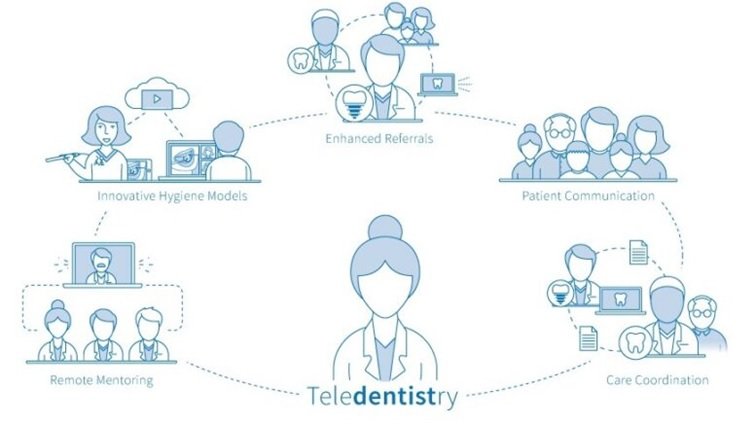
The type of interaction provided by teledentistry classifies it as synchronous or asynchronous. Asynchronous or “Store and Forward Method” of teledentistry, involves the exchange of clinical information and static images collected and stored by the dental practitioner, forwarded later for consultation and treatment planning. In synchronous or “Real-Time Consultation” teledentistry, the interaction is in real time in which dental professionals and their patients, at different locations, may see, hear, and communicate with one another.3
Dentists are able to share patient information, radiographs, graphical representations of hard tissues and peridontium, application of therapies, lab results, tests, remarks, photographs, and other information transportable through multiple providers. This data sharing can be of extreme importance for patients, especially those in need of specialist consultation.7 A third method has also been described, known as “Remote Monitoring Method”, in which patients are monitored at a distance and can either be hospital-based or home-based.15 A “Near-Real-Time” consultation has also been mentioned in the literature, which involves low resolution, low frame rate product that looks like jittery television.11
ROLE IN ORAL MEDICINE AND RADIOLOGY
Bradley M et al. successfully proved the use of teledentistry in oral medicine in a community dental service in Belfast, N. Ireland, using a prototype teledentistry system.30 Torres-Pereira C et al. suggested that distant diagnosis is an effective alternative in the diagnosis of oral lesions using transmission of digital images by email.31 Summerfelt FF reported a teledentistry-assisted, affiliated practice dental hygiene model developed by the Northern Arizona University Dental Hygiene Department, that allowed dental hygienists to provide oral healthcare to underserved populations by digitally linking up with a distant oral health team.32
TELEDIAGNOSIS
Telediagnosis makes use of technology to exchange images and data to make a diagnosis of an oral lesion.12,13 With the use of a telediagnosis program EstomatoNet, patient referral to specialists reduced from 96.9% to 35.1% 14. While the use of smartphones for detection of dental caries is well advocated15,16; it has also served as a reliable adjunct for screening of oral potentially malignant lesions.17 An addition to telediagnosis is telecytology, a system for early detection of oral potentially malignant or malignant lesions.18 Haron et al. developed Mobile Mouth Screening Anywhere (MeMoSA®) to facilitate early detection of oral cancer and found it to be beneficial for patients with limited access to specialists.19 Skandarajah et al. evaluated a tablet-based mobile microscope (CellScope device) as an adjunct for screening of oral cancer.20 During the current COVID-19 pandemic investigators from Brazil recently illustrated the use of WhatsApp and telemedicine in making a differential diagnosis of oral lesions.21 As most of the oral lesion are often directly evident telediagnosis can be made by dental photography thus reducing the need of close clinical examination.22
TELEMONITORING
Monitoring of dental patients require frequent visits of patients to their dentist to monitor the progress of treatment. The use of telemonitoring can replace the frequent physical visits by virtual visits for regular monitoring of treatment outcomes and disease progression.7 In a recent pilot study during this pandemic, telemonitoring appeared to be a promising tool in the remote monitoring of surgical and non-surgical dental patients, especially reducing costs and waiting times.
CHALLENGES IN TELEDENTISTRY USE AND POSSIBLE SOLUTIONS
Challenges Related to Acceptance of Teledentistry by Dentists
The lack of acceptance of teledentistry by the dentists can be attributed to the fact that it is a bit complex and they may resist getting accustomed to new skills.27,28 They may lack knowledge regarding technology at the expense of making inaccurate diagnosis, with concerns such as increased costs and expenses. Constraints like poor internet access, hardware shortage, lack of training, lack of technical support and expertise can also be a boulder. Persistent incompatibility of organizing teledentistry with the healthcare system, insufficient finances, and ambiguous guidelines, poor coordination between remote and core center, and reimbursement charges in setup are also some of the challenges related to its acceptance by dentists.28 Two-dimensional representation of lesions and clinical examination like palpation and auscultation are other limitations.3
These challenges can be overcome if dentists are trained adequately and educated about this technology, thereby increasing the acceptance of teledentistry. In this ongoing Covid-19 pandemic, the dental school curriculum needs update regarding infection control measures.29 It should also be incorporated as a solution for prevention of infection transmission. For successful implementation of teledentistry, appropriate funding and authentication within the healthcare systems is requisite.
Challenges related to acceptance of teledentistry by patients
To make any module a success, it is important for patient to be accepting of it. Lack of face-to-face communication can develop apprehension in patients due to inadequate communication of their problems to their dentists. Such challenges are tackled in time. Acceptance of teledentistry by the patients with increase in parallel acceptance of telemedicine in general, is becoming popular day-by-day. Various surveys reveal that teledentistry is gaining acceptance gradually by both patients as well as healthcare providers.30
TELEDENTISTRY AND ITS ROLE IN POSTGRADUATE EDUCATION AND DENTAL PRACTICE
Teledentistry can serve as a good tool for educating postgraduate students and for providing continuing updates for the practicing dentists. In interactive video-conferencing, the patient information is evaluated first (with or without the patient’s presence), which allows for the interaction and feedback between the educator and the students. The patient cases can be reviewed thoroughly and at the students’ pace.
The cases can be discussed at length after all the clinical data have been collected and transmitted, without the patient being present at the scheduled meeting. This enhances the students’ enthusiasm and provides new learning opportunities for the dental students and the practicing dentists.4
CONCLUSION
Dentistry is an important component of our healthcare system, has severely compromised during this ongoing pandemic of COVID-19. Incorporation of teledentistry into routine dental practice is vital in these times. Although it can’t fully replace, teledentistry can complement the existing compromised dental system in this pandemic.
Acknowledgement
We would like to extend our gratitude to Dr. Gopa Kumar R. Nair, Dr. Anuj Gaur, Dr. Ngurang Anam and Dr. Niharika for their contribution in this review artcle.
REFERENCES
- K. O. Kwok, K. K. Li, H. H. Chan et al., “Community responses during early phase of COVID-19 epidemic, Hong Kong,” Emerging Infectious Diseases, vol. 26, no. 7, pp. 1575–1579, 2020.
- WHO, Director-General’s opening remarks at the media briefing on COVID-19 - 11 March 2020, 2020.
- T. Greenhalgh, J. Wherton, S. Shaw, and C. Morrison, “Video consultations for covid-19,” BMJ, 2020.
- K. H. Stephen and J. Molinari, “Aerosols and splatter in dentistry: a brief review of the literature and infection control implications,” Journal of the American Dental Association, vol. 135, pp. 429–437, 2004.
- M. A. Ahmed, R. Jouhar, N. Ahmed et al., “Fear and practice modifications among dentists to combat novel coronavirus disease (COVID-19) outbreak,” International journal of environmental research and public health, vol. 17, no. 8, p. 2821, 2020.
- J. Matusitz and G.-M. Breen, “Telemedicine: its effects on health communication,” Health Communication, vol. 21, no. 1, pp. 73–83, 2007.
- L. Yoshinaga, “The use of teledentistry for remote learning applications,” Practical Procedures & Aesthetic Dentistry, vol. 13, no. 4, pp. 327-328, 2001.
- J. Fricton and H. Chen, “Using teledentistry to improve access to dental care for the underserved,” Dental Clinics of North America, vol. 53, no. 3, pp. 537–548, 2009.
- R. Currell, C. Urquhart, P. Wainwright, and R. Lewis, “Telemedicine versus face to face patient care: effects on professional practice and healthcare outcomes,” Cochrane Database of Systematic Reviews, vol. 2, article CD002098, 2000.
- J. W. Chen, M. H. Hobdell, K. Dunn, K. A. Johnson, and J. Zhang, “Teledentistry and its use in dental education,” Journal of the American Dental Association (1939), vol. 134, no. 3, pp. 342–346, 2003.
- M. A. Rocca, V. L. Kudryk, J. C. Pajak, and T. Morris, “The evolution of a teledentistry system within the Department of Defense,” pp. 921–924.
- V. R. Subramanyam, “Telepathology: virtually a reality,” Journal of Oral Pathology & Medicine, vol. 1, pp. 1–15, 2002.
- S. U. Chang, D. R. Plotkin, R. Mulligan, J. C. Polido, J. K. Mah, and J. G. Meara, “Teledentistry in rural California: a USC initiative,” Journal of the California Dental Association, vol. 31, no. 8, pp. 601–608, 2003.
- D. T. Golder and K. A. Brennan, “Practicing dentistry in the age of telemedicine,” Journal of the American Dental Association (1939), vol. 131, no. 6, pp. 734–744, 2000.
- K. V. Reddy, “Using teledentistry for providing the specialist access to rural Indians,” Indian Journal of Dental Research, vol. 22, no. 2, p. 189, 2011.
- S. Bagchi, “Telemedicine in rural India,” PLoS Medicine, vol. 3, pp. 297–299, 2006.
- N. Lienert, N. C. Zitzmann, A. Filippi, R. Weiger, and G. Krastl, “Teledental consultations related to trauma in a Swiss telemedical center-a retrospective survey,” Dental Traumatology, vol. 26, no. 3, pp. 223–227, 2010.
- M. Kirshner, “The role of information technology and informatics research in the dentist-patient relationship,” Advances in Dental Research, vol. 17, no. 1, pp. 77–81, 2003.
- A. Bhambal, S. Saxena, and S. V. Balsaraf, “Teledentistry: potentials unexplored,” Journal of International Oral Health, vol. 2, pp. 1–6, 2010.
- S. C. Liu, “Information technology in family dentistry,” Hong Kong Dental Journal, vol. 3, pp. 61–66, 2006.
- J. M. Birnbach, “The future of teledentistry,” Journal of the California Dental Association, vol. 28, no. 2, pp. 141–143, 2000.
- Q. Li, X. Guan, P. Wu et al., “Early transmission dynamics in Wuhan, China, of novel coronavirus–infected pneumonia,” New England Journal of Medicine, vol. 382, no. 13, pp. 1199–1207, 2020.
- Centers for Disease Control and Prevention, Interim infection prevention and control guidance for dental settings during the COVID-19 response, 2019.
- N. Giraudeau, C. Inquimbert, R. Delafoy, P. Tramini, J. Valcarcel, and F. Meroueh, “Teledentistry, new oral care tool for prisoners,” International journal of prisoner health, vol. 13, no. 2, pp. 124–134, 2017.
- P. C. Arora, J. Kaur, J. Kaur, and A. Arora, “Teledentistry: an innovative tool for the underserved population,” Digital Medicine, vol. 5, no. 1, pp. 6–12, 2019.
- V. Luzzi, G. Ierardo, M. Bossù, and A. Polimeni, COVID-19: pediatric oral health during and after the pandemics, 2020.
- C. Torres-Pereira, R. S. Possebon, A. Simoes, M. C. Bortoluzzi, J. C. Leao, and A. F. Giovanini, “Email for distance diagnosis of oral diseases-a preliminary study of teledentistry,” Journal of Telemedicine and Telecare, vol. 14, no. 8, pp. 435–438, 2008.
- H. Guo, Y. Zhou, X. Liu, and J. Tan, “The impact of the COVID-19 epidemic on the utilization of emergency dental services,” Journal of dental sciences, vol. 15, no. 4, pp. 564–567, 2020.
- M. Duka, B. Mihailovic, M. Miladinovic, A. Jankovic, and B. Vujicic, “Evaluation of telemedicine systems for impacted third molars diagnosis,” Vojnosanitetski Pregled, vol. 66, no. 12, pp. 985–991, 2009.
- K. Saad Ahmed and H. Omar, “Teledentistry in practice: literature review,” Telemedicine and e-Health, vol. 19, pp. 565–567, 2013.
Disclaimer from Guident
The views and opinions expressed in articles published in Guident are solely those of the authors and do not necessarily reflect the views of the editors, the editorial board or the publisher, Ivory India. Guident does not endorse any product, technique or treatment described. Clinical content is intended for qualified dental and medical professionals and is not a substitute for individual clinical judgement. Guident, its editors and the publisher accept no liability for any consequence arising from the use of information published in the journal.
How to cite this article
Dr. Binish Khan, Dr. Vinay Mohan, Dr. Balkrishn Gaur. Teledentistry in Oral Medicine. Guident. 2021 Jun;14(7). Available from: https://ivoryindia.in/articles/oral-medicine/teledentistry-in-oral-medicine.html