The Role of Mini Dental Implant in Fixed and Removable Prosthesis- Review
Department of Prosthodontics, Crown, Bridge and Implantology, Triveni Institute of Dental Sciences, Hospital & Research Center, Bodri, Department of Prosthodontics, Crown, Bridge and Implantology, Akola
ABSTRACT
Dental Implants have an incredible impact and have opened new treatment concepts in restorative dentistry. The continuous advancements in material, technique, and implant design make them suitable for every condition. Along with their reduced cost, easy to learn and perform surgery makes it an attractive treatment option which represent a promising treatment modality that has significant potential for growth.
Mini implants are improved implant used in condition with inadequate interdental space, reduced interocclusal space, convergent adjacent roots or close proximity of adjacent tooth & narrow atrophic osseous contour. Growing data suggest mini-implants to be successful in the minimally invasive treatment, retaining the removable prosthesis and supporting fixed prosthesis and complete denture. This article reviews the use of mini dental implant for different treatment option and guidelines associated with their uses.
INTRODUCTION
- MINI DENTAL IMPLANT: “A dental implant that is fabricated with a reduced diameter (less than 3.0 mm) and shorter in length with the same biocompatible material as compared with standard dental implants.” – GPT 9.1
- Syn- temporary implants, provisional implants, orthodontic implants, small diameter implant “
Mini implants were mainly used for interim prosthodontic treatment, but literature have evidence support for their use in definitive prosthetic treatment as an alternative less invasive treatment option compared to conventional implant.
Mini dental implants are a solid, one-piece design that are less than 3mm in diameter, with a special tip end that protrudes from the jaw bone. Because of their smaller size, mini-implants are also called narrow diameter implants or small diameter implants (NDIs and SDIs).2
This narrow-diameter mini dental implants came into use initially as a provisional treatment during healing/integration periods of traditional endosteal root-form implants. However, during this period, while utilizing mini dental implants for provisionalization, it was noted that these immediately loaded mini-implants were often difficult to remove and appeared to have become clinically integrated. This led to an ongoing development of applications and to the current use for long-term restorative cases.3
The significance of this is that they are less invasive than traditional implants and they are associated with immediate stability, minimal osteotomy site preparation, much shorter time for osseointegration, less postoperative discomfort, also easy removal and healing in case of failure. The quantity and quality of bone tissue available in the jaw typically define the characteristics (diameter and length) and the number of implants.
Excellent patient satisfaction was found while evaluating mini-implants in terms of comfort, retention, chewing ability, and speaking ability.4
HISTORY
Reduced diameter implants were first introduced in the literature as the “MINIPLANT” by barber and seckinger in 1994.5 This study was followed by a report by victor i sendax who conceived of the ultra-small 1-piece implant with a diameter of 1.8 mm.6 Dr. Ron Bulard then developed mini dental implants (MDIs) as a way to stabilize removable prosthetics and later marketed by IMTEC Corporation and the final FDA approval for long-term use of its MDI mini-dental implant devices in 2002.7
DESIGN OF MINI IMPLANT
Mini implant has diameter of 1.8mm to 3.3 mm available at Various lengths range from 10-18mm. it has multiple tip, thread, body and head designs are available, Thread designs may vary from thin to thick and thread spacing is also variable among them Square, rectangular, or o-ball heads are common and High-Strength Titanium Alloy are used for construction.8

Figure 1 design of implant
COMPARISON OF STANDARD VS MINI IMPLANT
CRITERIA |
STANDARD IMPLANT |
MINI IMPLANT |
|
Diameter |
3.4 to 5.8 mm |
1.8 to 3.3 mm |
|
Required bone thickness |
1.8 mm cortical thickness |
Require only 1 mm in certain situations |
|
force |
Delivers less force per square mm to the bone |
Delivers more force per square mm to the bone |
|
surgery |
With flap, Bone displacement is higher. |
-Mostly flapless -minimal soft tissue & bone displacement. |
|
Visit |
Multiple visit |
Can be done in single visit |
|
Healing period |
Comparatively more time |
Less healing time |
|
Site |
In adequate interdental space, broad ridge, in anterior and posterior both to bear higher occlusal load |
An inadequate interdental space, reduced interocclusal space, convergent adjacent tooth roots or close proximity of adjacent tooth roots or narrow atrophic osseous contour |
|
Systemic condition |
Standard-diameter implant treatment have systemic contraindications or relative contraindication to implant treatment |
Enable the treatment of patients with Relative contraindications to standard-sized Implant treatment, including geriatric patients and patients with psychological disorders |
INDICATION FOR MINI IMPLANT
Mini implant can be indicated in case of narrow or atrophic alveolar ridge, inadequate interdental space, convergent root and in situation where facial – lingual width of the bone is insufficient. It can also provide immediate stabilisation of a fixed or removable prosthesis and serve as interim abutment for failing fixed or removable prosthesis, in cases where extensive surgery is required for conventional implant placement either due to medical or age constraints, mini-implants can be placed.
ADVANTAGES OF USING MINI IMPLANTS FOR FIXED PROSTHODONTIC TREATMENT
When compared to standard implant it is of low cost and has an ability to be placed in narrow or wide ridges. It is simplified treatment procedures and almost always placed through a flapless surgical procedure. The majority are designed as a 1-piece implant with the ability to Immediately load the prosthesis in a single clinical visit. During healing phases following extraction, graft placement, or conventional implant surgery, mini-implants placed in non-strategic sites are used to support a transitional complete or partial denture.9

Figure 2- Mini implant placed in narrow space to replace a missing
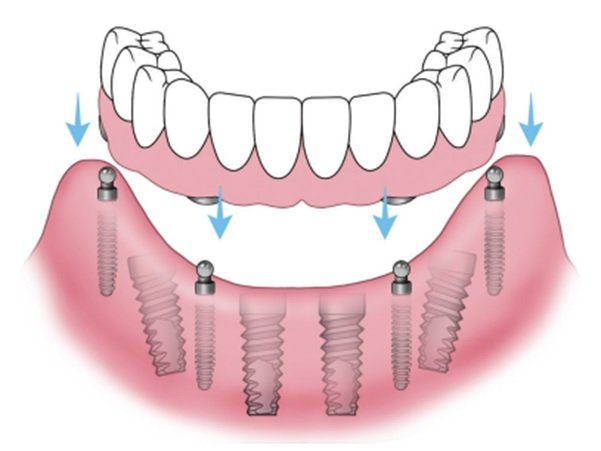
Figure 3- Mini implants used as transitional support
DISADVANTAGES OF MINI-IMPLANTS FOR DEFINITIVE PROSTHODONTIC TREATMENT
Multiple number of implants are required because of the unpredictability and lack of current scientific guidelines and understanding; with limited scientific evidence about long-term survival. The potential for fracture of the implant during placement is higher due its narrow design & the one-piece design of mini-implants makes parallism correction between misaligned placed implant difficult. Occlusal loading of mini-implants is less than standard implant. Other disadvantages attributable to flapless surgery such as lack of bone visibility, inability to irrigate the bone, and contraindications in situations requiring alveoloplasty.
MINI IMPLANT IN REMOVABLE PARTIAL DENTURES
Mini implants can retain maxillary or mandibular removable prosthesis and the supporting bone should be of Misch type I or II for appropriate long-term success, it can also provide an immediate solution for patients with atrophic edentulism ridges.10 When the implants are placed in denser types of bones, they can retain overdenture immediately. The parallelism of mini-implants for overdenture generally should not exceed 20 degrees to avoid non seating of the denture and conversion of axially directed loads to off-axial by the angled position of the implant so a surgical guide may be needed to ensure close parallelism for mini-placement. The minimum number of mini-implants required for appropriate retention of complete removable dentures may be 6 in the maxilla and 4 in the mandible.

Figure 4- mini-implants retained mandibular overdenture
PREVELENCES
The evidence for short-term survival of mini-implants when used exclusively for definitive prosthodontic treatment is encouraging, with a first-year interval survival rate of 94.7%. However, the midterm and long-term studies are not evident.8-10
GUIDELINES FOR MINI IMPLANT USE
Mini dental implants may be appropriate to retain removable prostheses and support fixed complete and partial dentures. Considering Anatomic locations, bone quality, esthetic considerations, and protective occlusal schemes.9
Following is suggested initial guidelines for mini-implant use:8
- Type I and II (Misch) bone sites are most appropriate for mini implants
- Minimum of 1-mm thickness of facial and lingual cortical bone
- Approximately 100 mm occlusal relief for fixed prosthetics
- A rounded minimal occlusal table
- Minimum space of 0.5 mm between tooth and mini implant
- Minimum of 6 mini-implants for removable complete dentures in the maxilla
- Minimum of 4 mini-implants for removable complete dentures in the mandible
- Minimum of 10 mini-implants for splinted fixed complete prosthetics in the maxilla
- Minimum of 8 mini-implants for splinted fixed complete prosthetics in the mandible
- Implant protective type of occlusal scheme should be used for fixed prosthetics
- Esthetic requirements are addressed preoperatively
CONCLUSION
Mini dental implants may be appropriate to retain removable prostheses and support fixed complete and partial dentures, Anatomic locations, bone quality, aesthetic considerations, and protective occlusal schemes are keys to ensure successful treatment outcomes. Even though the studies have minimal support for long-term survival and success, the interest in mini-implants will continue to increase among clinicians and patients for several reasons: as decreased cost, access to care for patients with limited finances, patients with challenging defects, medically compromised patients, and dentists with no or minimal surgical training.
REFERENCES
- The Glossary of Prosthodontic Terms: Ninth Edition. J Prosthet Dent. 2017 May;117(5S):e1-e105
- https://www.sanforddentalexcellence.com/Blog/Post/Pros-and-Cons-of-Mini-Dental-Implants-vs-Traditional-Dental-Implants
- Upendran A, Gupta N, Salisbury HG. Dental Mini-Implants. [Updated 2022 Aug 8]. In: StatPearls [Internet]. Treasure Island (FL): StatPearls Publishing; 2022 Jan-.
- Griffitts TM, Collins CP, Collins PC. Mini dental implants: an adjunct for retention, stability, and comfort for the edentulous patient. Oral Surg Oral Med Oral Pathol Oral Radiol Endod. 2005 Nov;100(5):e81-4.
- Barber HD, Seckinger RJ. The role of the small-diameter dental implant: a preliminary report on the Miniplant system. Compendium 1994;15:1390-2
- Sendax VI. Mini-implants as adjuncts for transitional prostheses. Dent Implantol Update 1996;7:12-5.
- United States Food and Drug Administration. 510(k) Pre-market notification; Indication for use statement of mini dental implants.
- Sendax, V. I. (2013). Sendax Hybrid Mini Dental Implant Applications. Mini Dental Implants, 1–9
- Mini implants for definitive prosthodontic treatment: a systematic review AS Bidra, K Almas - The Journal of prosthetic dentistry, 2013 – Elsevier
- Elkholy, Sahar. (2013). Mini Implants In Prosthetic Dentistry.
- The mini dental implant in fixed and removable prosthetics: a review D Flanagan, A Mascolo - Journal of Oral Implantology, 2011 - joionline.org
- de Souza RF, Ribeiro AB, Della Vecchia MP, Costa L, Cunha TR, Reis AC, Albuquerque RF Jr. Mini vs. Standard Implants for Mandibular Overdentures: A Randomized Trial. J Dent Res. 2015 Oct;94(10):1376-84.
Disclaimer from Guident
The views and opinions expressed in articles published in Guident are solely those of the authors and do not necessarily reflect the views of the editors, the editorial board or the publisher, Ivory India. Guident does not endorse any product, technique or treatment described. Clinical content is intended for qualified dental and medical professionals and is not a substitute for individual clinical judgement. Guident, its editors and the publisher accept no liability for any consequence arising from the use of information published in the journal.
How to cite this article
Dr. Shubham Chelkar, Dr. Shruti D. Pocchi, Dr. Rajesh Ramdasji Kambe Dental College & Hospital. The Role of Mini Dental Implant in Fixed and Removable Prosthesis- Review. Guident. 2023 Jan;16(2). Available from: https://ivoryindia.in/articles/prosthodontics/the-role-of-mini-dental-implant-in-fixed-and-removable-prosthesis-review.html