A Comparative Evaluation of Dimensional Stability and Compression Resistance of Different Interocclusal Recording Materials-an in Vitro Study
Department of Prosthodontics, Sree Sai Dental College And Research Institute, Srikakulam, A.P India
ABSTRACT
BACKGROUND: The fabrication of dental prosthesis requires the transfer of interocclusal records from patient’s mouth to semi adjustable articulators using different kinds of recording media. Interocclusal recording materials are generally used in prosthetic dentistry to register the jaw relationship. Any inaccuracy in these interocclusal records leads to occlusal errors in the final prosthesis. Newer interocclusal materials are chemical modifications, whose comparative properties relevant to clinicians are yet to be studied.
AIM: This study was conducted to compare the linear dimensional change and compression resistance of four commercially available interocclusal recording materials.
METHODS: Each interocclusal recording material was manipulated according to the manufacturer instruction and placed into a metallic cylinder. Each specimen with specific dimensions for each material were made. A total 100 specimens were fabricated. Linear dimensional changes evaluated after 8 and 24 hours of fabrication, using a vertical traveling micrometer microscope. Each specimen was placed in the Universal Testing Machine and values recorded.
RESULTS: There was significant variation between all interocclusal bite registration materials. The mean linear dimensional change minimum for Polyvinly siloxane and Bisacryl Luxabite and maximum for Aluwax. Polyvinyl siloxanes have better resistance to compression followed by Bisacryl Luxabite.
CONCLUSION: Polyvinyl siloxane had better resistance to compression and least for zinc oxide bite material. Maximum linear dimensional change for Aluwax and minimum for Polyvinyl siloxane.
CLINICAL SIGNIFICANCE: Having a stable and accurate bite registration is crucial for the proper examination of a patient's occlusal relationships, which is used for both diagnostic and therapeutic purposes. This process is also useful in the fabrication of indirect restorations based on the desired occlusal scheme.
KEYWORDS: Aluwax. Bite registration materials. Compression resistance. Dimensional change. Luxabite.
INTRODUCTION
Successfully creating a prosthesis requires achieving harmony between the maxillomandibular relationship and the patient’s functional anatomy.1 To accomplish this it is necessary to accurately record the maxillomandibular relationship using materials with appropriate flow properties and transfer the recording to an articulator.2
However, inaccuracies in the cast and interocclusal recording material may lead to incorrect placement of the mandibular cast relative to the maxillary cast on the articulator4 potentially impairing diagnosis and treatment planning.5 To prevent clinical errors, the process of recording and fixing interocclusal relations must be performed with care and understanding.5
On occasion, the articulation of maxillary and mandibular casts may not be done immediately following the clinical procedure, so interocclusal records must be dimensionally stable in these situations.7
There is also the consideration of compressive force resulting from forces exerted on the recording material during the articulation process, which may cause inaccuracies in relating the casts in centric and other excursive positions.7
Each of these interocclusal recording materials exhibits some degree of deformation when under load8 and this deformation should be minimal or negligible and should not affect the accuracy of mounting the maxillary and mandibular casts in the articulator.9
This study was conducted to evaluate the dimensional stability and compression resistance of four commercially available interocclusal recording materials.
MATERIALS AND METHODS
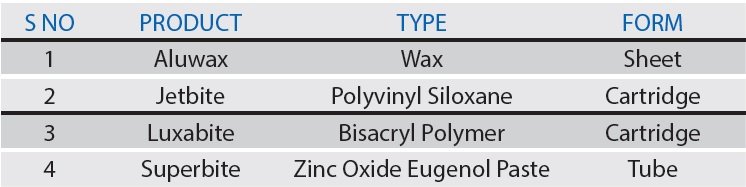
For this study, four commercially available bite registration materials were utilized as mentioned in Table 1.
EQUIPMENTS USED IN THIS STUDY
- Nd – Yag Laser Engraving Machine [Neomark 400, Italy]
- Travelling Microscope with Micrometer [Magnus, India]
- Universal Testing Machine [Instron 8801, UK]
INSTRUMENTS USED IN THIS STUDY
The study’s instruments are outlined in (Figure 1).

Fig.1: Armamentarium used for manipulation of material
- Stainless Steel Die
- Glass Plate
- Polyethylene sheet
- 5ml Glass syringe
- Auto mixing dispensing gun
- Scalpel and Blade
- Spatula and glass slab
- Silicone separating Medium.
- 500g weight.
METHODOLOGY
For the present study 4 stainless steel dies were prepared similar to American Dental Association (ADA) specification no 19. The master die consists of a ruled block with a 5mm height and 20mm width and a mold cylinder (Figure 2) of dimensions outer ring diameter 20 mm, inner ring diameter 15 mm and height 12.5 mm. A 2.5 mm height and 15 ± 0.01 mm diameter step has been made on one side of the die to which the metallic mold cylinder fits. The die was scribed using Nd-Yag laser with 3 horizontal lines A,B,C and 3 vertical lines X,Y,Z on the top of impression surface as in (Figure 3). The three parallel lines X,Y,Z which are spaced equally by 2.5 mm from each other.

Fig.2: Mold cylinder & Fig.3: Ruled block with reference line
FABRICATION OF SAMPLES
The materials were manipulated according to manufacturer’s instructions. Wax was softened in a hot water bath for 5 minutes and placed into the mold using a glass syringe. Materials in auto mixing cartridges, such as Jetbite and Luxabite were dispensed into the mold using an automixing dispensing gun. Superbite paste was mixed on a glass slab and injected into the stainless steel mold. The walls of the metallic cylinders (stainless steel mold) were lubricated with petroleum jelly before placing the interocclusal bite registration materials, such as polyvinylsiloxane, and rigid materials like zinc oxide eugenol paste and aluwax, to facilitate easy removal of the samples.
After mixing the materials thoroughly, they were placed in the die. For the waxes, the process was modified by first softening them in a water bath at 45°C and then filling a 10 ml syringe with the softened wax and injecting it into the mold. The die was then inverted onto a 4X4 inch square glass plate covered with polyethylene sheet and hand pressure was applied for 5seconds to initially express the materials, followed by application of a 500gm weight to further eliminate excess material. All excess material (flash) was trimmed by using a Bard Parker knife. The resulting samples were in the form of a cylinder measuring 10mm in length and 15mm diameter, with 3 parallel horizontal and vertical lines on the surface.
MEASUREMENT OF SAMPLES
The distance between the parallel lines X and Z was measured using a travelling microscope with a magnification of 10x and a micrometer. The distance between the reference lines X and Z was measured at four points, where they intersected with the horizontal lines A and C. These reference points, labeled S-S’ and T-T’, were scribed onto the metallic die and transferred to the samples during their fabrication. The mean of the readings was calculated for each sample, and readings was calculated for each sample, and readings were recorded for all 25 samples of each group at 8 and 48 hours after fabrication. The mean measurement of the distance between X and Z in each sample was compared to the corresponding measurement taken with a micrometer on the standard stainless steel die under the same microscope. After 48 hours, each sample was subjected to a constant compressive force of 25 N by using an Instron universal testing machine.
EVALUATION OF DIMENSIONAL CHANGE
The change in the Dimension is calculated by using the formula

Where, P is the standard measurement (μm) of XZ in the Die. Q is the observed measurement (μm) of XZ in the sample.
EVALUATION OF COMPRESSION RESISTANCE
The distance each specimen was compressed after 60 seconds of loading was compared by means of appropriate statistical analyses.
STATISTICAL ANALYSIS
Statistical analysis was performed using analysis of variance (ANOVA) with repeated measures tests for comparisons among groups and (TUKEY’S HSD) within groups at the 0.05 level of significance.
RESULTS
The following results were obtained from this study which evaluated the dimensional stability and compression resistance of four different types of commercially available interocclusal recording materials. The materials were divided into four Groups as Group A (Aluwax), Group B (Jet Bite), Group C (LuxaBite) and Group D (Superbite). Each Group had 25 samples.
The statistical analysis was done using SPSS software version 26.0 Descriptive data included mean, standard deviation, standard error, coefficient of variation and range values of the groups. Analysis of variance (ANOVA) was done to know the significance within the groups and then Tukey honestly significantly difference (HSD) test for significance among the groups at the p< 0.05 level of significance.
Pairwise comparisons among bite registration materials Group A (Aluwax), Group B (Jet Bite), Group C (LuxaBite) and Group D (Superbite) after 8 hours and 48 hours (TUKEY HSD) as shown in Table 2.

Inference: Multiple comparisons of linear dimension between all the groups did not show any statistical significant difference at 8 hours as there is no much mean differences between the groups. There is a statistical significant difference observed when comparing luxabite with aluwax and superbite as plotted in Figure 4.

Fig.4: Multiple comparisons of linear dimension among bite registration materials
Pairwise comparisons among bite registration materials Group A (Aluwax), Group B (Jet Bite), Group C (LuxaBite) and Group D (Superbite) after 48 hours (TUKEY HSD) as in Table 3.

Inference: Multiple comparisons of compressive resistance between the 4 groups of different bite registration materials Group A (Aluwax), Group B (Jet Bite), Group C (LuxaBite) and Group D (Superbite) after 48 hours shows statistical significant difference, when comparing superbite with aluwax, jetbite and superbite as plotted in Figure 5.

Fig.5: Multiple comparisons of compressive resistance among bite registration materials
DISCUSSION
Accurate transfer of maxillomandibular relations from the mouth to the articulator is crucial in prosthetic rehabilitation. The face bow transfer and centric and eccentric jaw relation records, along with simulating mandibular function on the articulator, are essential in this process.28 However, the degree of correlation between the patient and the articulator depends on various factors, such as biologic considerations and the properties of the materials used during the transfer process.12
Articulators simulate the patient’s maxillomandibular relation and movements, allowing the dentist and technician to study the dentition in function and construct the restoration.12 Using interocclusal records in the most widely accepted method for transferring maxillomandibular relations from the mouth to the articulator.3
According to Freilich and Walls et al, when there are both adequately spaced contacts and good tooth intercuspation present, the maximum intercuspation of the teeth with their opposing teeth is enough to establish an accurate relationship without the need for an interocclusal record.22,24 Therefore, when a minimum number of teeth are being restored and full-arch impressions of a largely intact dentition are made, using an interocclusal record is unnecessary, saving time and reducing the potential for error. On the other hand, if opposing contacts that can ensure an accurate relationship of the maxillary and mandibular casts are absent, it is important to consider using an inter occlusal record to transfer the relationship.22,24
Ideal interocclusal records should have certain requirements, such as dimensional stability after setting and resistance to compression have been evaluated in this study, of the several ideal properties of interocclusal materials, as stated by Malone et al.35
If the selected material is dimensionally unstable, it can cause inaccuracies in reproducing the correct maxillomandibular relationship on the articulator as shown by Balthazar et al, although this was not evident in the present study.12 If a material is compressible, it can be distorted by operator error or by the weight of the cast to be mounted, as reported by Mullick et al and Konstantinos et al.6,9
Therefore, the present in vitro study aimed to evaluate and compare the dimensional stability at 8 and 48 hours and compressive resistance of four types of commercially available interocclusal recording materials, following similar studies by Konstantinos et al and Dua et al.6,8
In this study, the samples were not stored in water and were left to air cool, as Millstein et al found that water storage had inconsistent effects and caused the greatest change, while air cooling produced the least effect.11 No changes in setting times were observed in the study without the use of an incubator, in contrast to Millstein’s findings that the setting times of interocclusal recording media may have changed when an incubator was used.13
The present study used the method of scribing reference lines on a die similar to the original ADA specification19 and used by Konstantinos et al to evaluate linear shrinkage, but with different dimensions and groove depth of the die.6
Hand pressure was applied for 5 seconds to initially express the material, followed by application of 0.5 kg weight to further eliminate excess material, similar to study by Chandu et al, Tejo et al and Konstantinos et al.6,32,33
The linear dimensional changes of four interocclusal materials were measured at 8 and 48 hours of time interval based on the assumption of the normal time taken after the clinical step to mount the casts in the articulator with interocclusal records in the laboratory which was similar to the studies by Balthazar et al and Tejo et al.4,32
A travelling microscope with a 0.001 micrometer provision was chosen for the measurement of linear dimensional change as per the original testing methodology specified in the ADA specification No.19 for elastomers as adapted by Konstantinos et al, Tejo et al.6,32
Assif et al evaluated the dimensional accuracy of interocclusal recording materials and concluded that acrylic resin was more accurate than wax bite registration material, which correlates with the results of present study.21 Breeding et al demonstrated that resins showed more significant errors, which might be due to the shrinkage, than polyvinylsiloxanes. This is contrary to the results of the present study, where polyvinylsiloxanes and resins showed minimal errors.25
In contrast to the results of the present study, Urstein et al concluded that wax records are slightly more accurate than the resin record at intercuspal and retruded contact position.23
Dua et al in their study, evaluated that polyvinylsiloxanes show minimum linear dimensional change, similar to the present study.8
Mullick et al found that interocclusal registrations made with wax, resulted in extremely open to closed relationships of the mounted casts and showed maximum linear dimensional change when compared with zinc oxide eugenol paste, which is variable with the present study, where zinc oxide eugenol showed maximum dimensional change due to its brittleness.15
Sindledecker in his study demonstrated, that wax records gave statistically different centric relation registrations, due to their high coefficient of thermal expansion when compared with zinc oxide eugenol paste or acrylic resin, as assessed in the present study.14
Results of a study by Muller et al, were that the bite registration waxes created only small vertical deviations compared to the displacements caused by the shrinkage of zinc oxide eugenol paste which is in agreement to the results of comparison in the present study.14
Results of this study are consistent with previous research indicating differences in polymerization kinetics of the materials and the influence of modifiers on dimensional stability.31
Thus, it becomes mandatory to choose a material depending not only based on the clinical situation and the optimum handling characteristics but also on the time taken for articulation after completing the interocclusal recording of maxilla-mandibular relations.
The modifiers used in the bite registration materials may have played a role in altered dimensional stability but it is not confirmed. So further studies may be helpful to evaluate the chemical analysis to find out the percentage of each ingredient of these interocclusal recording materials. The time required for accurate articulation of interocclusal records varies based on the material used.
Muller et al showed that polyvinylsiloxane records should be articulated within 1hour to achieve accurate results.36
In the present study, the compressive resistance of four different interocclusal materials was evaluated using a universal testing machine, applying a constant load of 25N.This method is similar to that used by Breeding et al, who found that rubber bands used to maintain the contact of opposing casts exert a force of 25 N.7
The results of the present study are in line with those of Konstantinos et al, who found that polyvinylsiloxane displayed the greatest resistance to compression, followed by wax and zinc oxide eugenol paste.9 Similarly, Chandu et al found that polyvinylsiloxane displayed the greatest resistance to compression, followed by wax and the least resistance was shown by zinc oxide eugenol paste due to its brittleness and extreme variability.33
Choudhary also found that polyvinylsiloxane exhibited the greatest resistance to compression at different thicknesses of 2, 5 and 10mm due to its stability after setting and minimal resistance to closure, same as in the results of the present study where 10mm specimens were used.34
The present study found that compression resistance of interocclusal recording materials decreased with increasing thickness, which is in line with the findings of Nagrath et al.1
Dua et al also found that the compressive resistance of each elastomeric material was inversely proportional to the thickness of the specimen, resulting in a decrease in strength of the interocclusal record. Although in the present study, uniform thickness of the specimen was analyzed for standardization.8
In the present study all the interocclusal media tested, displayed either elastic or plastic deformation under applied stress. However, it should be noted that in clinical practice, the thickness of material is used is typically much smaller than the 10mm thickness used in the present study for standardization purposes.
Thicker elastomeric interocclusal registration media are generally more compressible, but further research is needed to evaluate the compressibility of interocclusal registration materials in a clinical setting.
CONCLUSION
From the analysis the following conclusions were drawn:
- Dimensional stability is influenced by both “material” factor and “time” factor.
- Dimensional stability decreased as the time factor increased.
- LuxaBite was most dimensionally stable followed by JetBite, Aluwax and SuperBite interocclusal registration material.
- LuxaBite showed highest compressive resistance followed by Aluwax, Jet Bite, SuperBite interocclusal registration material.
CLINICAL SIGNIFICANCE Bite registration is important when we need to transfer the maxillomandibular relationship from our patient’s mouth to the articulator; correct transfer of the intermaxillary relationships onto the articulator eliminates the need for occlusal adjustments on the final prosthesis, which require greater time and generate higher costs.
ABBREVIATIONS: ADA (American Dental Association)
REFERENCES
- Nagrath R, Lahori M, Kumar V, Gupta V. A Comparative Study to Evaluate the Compression Resistance of Different Interocclusal Recording Materials: An In Vitro Study. J Indian Prosthodont Soc. 2014 Dec;14(Suppl 1):76-85.
- Michalakis KX, Pissiotis A, Anastasiadou V, Kapari D. An experimental study on particular physical properties of several interocclusal recording media. Part I: consistency prior to setting. J Prosthodont. 2004 Mar;13(1):42-6.
- Millstein PL, Clark RE, Myerson RL. Differential accuracy of silicone-body interocclusal records and associated weight loss due to volatiles. J Prosthet Dent. 1975 Jun;33(6):649-654.
- Müller J, Götz G, Bruckner G, Kraft E. An experimental study of vertical deviations induced by different interocclusal recording materials. J Prosthet Dent. 1991 Jan;65(1):43-50.
- Millstein PL. Accuracy of laminated wax interocclusal wafers. J Prosthet Dent. 1985 Oct;54(4):574-7.
- Michalakis KX, Pissiotis A, Anastasiadou V, Kapari D. An experimental study on particular physical properties of several interocclusal recording media. Part II: Linear dimensional change and accompanying weight change. J Prosthodont. 2004 Sep;13(3):150-9.
- Breeding LC, Dixon DL. Compression resistance of four interocclusal recording materials. J Prosthet Dent. 1992 Dec;68(6):876-8. Doi: 10.1016/0022-3913(92)90542-i.
- Dua P, Gupta SH, Ramachandran S, Sandhu HS. Evaluation of Four Elastomeric Interocclusal Recording Materials. Med J Armed Forces India. 2007 Jul;63(3):237-40.
- Michalakis KX, Pissiotis A, Anastasiadou V, Kapari D. An experimental study on particular physical properties of several interocclusal recording media. Part III: resistance to compression after setting. J Prosthodont. 2004 Dec;13(4):233-7.
- Wirth CG, Aplin AW. An improved interocclusal record of Centric Relation. J Prosthet Dent. 1971 Mar;25(3):279–286.
- Millstein PL, Clark RE, Kronman JH. Determination of the accuracy of wax interocclusal registrations. II. J Prosthet Dent. 1973 Jan;29(1):40-5.
- Balthazar-Hart Y, Sandrik JL, Malone WF, Mazur B, Hart T. Accuracy and dimensional stability of four interocclusal recording materials. J Prosthet Dent. 1981 Jun;45(6):586-91.
- Millstein PL. A simplified method for testing the accuracy of interocclusal recording media. J Prosthet Dent. 1981 Jul;46(1):107.
- Sindledecker L. Effect of different centric relation registrations on the pantographic representation of centric relation. J Prosthet Dent. 1981 Sep;46(3):271-9.
- Mullick SC, Stackhouse JA Jr, Vincent GR. A study of interocclusal record materials. J Prosthet Dent. 1981 Sep;46(3):304-7.
- Millstein PL, Clark RE. Differential accuracy of silicone-body and self-curing resin interocclusal records and associated weight loss. J Prosthet Dent. 1981 Oct;46(4):380-4.
- Fattore L, Malone WF, Sandrik JL, Mazur B, Hart T. Clinical evaluation of the accuracy of interocclusal recording materials. J Prosthet Dent. 1984 Feb;51(2):152-7.
- Lassila V, McCabe JF. Properties of interocclusal registration materials. J Prosthet Dent. 1985 Jan;53(1):100-4.
- Millstein PL. An evaluation of occlusal indicator wax. J Prosthet Dent. 1985 Apr;53(4):570-572.
- Lassila V. Comparison of five interocclusal recording materials. J Prosthet Dent. 1986 Feb;55(2):215-8.
- Assif D, Himel R, Grajower Y. A new electromechanical device to measure the accuracy of Interocclusal Records. J Prosthet Dent. 1988 Jun;59(6):672–676.
- Walls AW, Wassell RW, Steele JG. A comparison of two methods for locating the intercuspal position (ICP) whilst mounting casts on an articulator. J Oral Rehabil. 1991 Jan;18(1):43-8.
- Urstein M, Fitzig S, Moskona D, Cardash HS. A clinical evaluation of materials used in registering interjaw relationships. J Prosthet Dent. 1991 Mar;65(3):372-7.
- Freilich MA, Altieri JV, Wahle JJ. Principles for selecting interocclusal records for articulation of dentate and partially dentate casts. J Prosthet Dent. 1992 Aug;68(2):361-7.
- Breeding LC, Dixon DL, Kinderknecht KE. Accuracy of three interocclusal recording materials used to mount a working cast. J Prosthet Dent. 1994 Mar;71(3):265-70.
- Millstein PL, Hsu C. Differential accuracy of elastomeric recording materials and associated weight change. J Prosthet Dent. 1994 Apr;71(4), 400-403.
- Gregory G, Das Gupta R, Morgan B, Bounds G. Polyvinylsiloxane dental bite registration material used to splint a composite graft of the nasal rim. Br J Oral Maxillofac Surg. 1999 Apr;37(2):139-41.
- Campos AA, Nathanson D. Compressibility of two polyvinyl siloxane interocclusal record materials and its effect on mounted cast relationships. J Prosthet Dent. 1999 Oct;82(4):456-61.
- Eriksson A, Ockert-Eriksson G, Lockowandt P, Eriksson O. Clinical factors and clinical variation influencing the reproducibility of interocclusal recording methods. Br Dent J. 2002 Apr 13;192(7):395-400.
- Curtis SR. Interocclusal registration technique with a vacuum-formed matrix. J Prosthet Dent. 2003 Sep;90(3):308-9.
- Chun JH, Pae A, Kim SH. Polymerization shrinkage strain of interocclusal recording materials. Dent Mater. 2009 Jan;25(1):115-20.
- Tejo SK, Kumar AG, Kattimani VS, Desai PD, Nalla S, Chaitanya K K. A comparative evaluation of dimensional stability of three types of interocclusal recording materials-an in-vitro multi-centre study. Head Face Med. 2012 Oct 5;8:27.
- Chandu GS, Khan MF, Mishra SK, Asnani P. Evaluation and comparison of resistance to compression of various interocclusal recording media: an in vitro study. J Int Oral Health. 2015 May;7(5):24-9.
- Choudhary, MK. Comparative evaluation of compression resistance three different interocclusal recording materials: an in-vitro study. Int J Sci Healt Res. 2020 Mar;5(1):19-24.
- Malone WFP, Koth DL Cavazos E, et al: Tylman’s Theory and Practice of Fixed Prosthodontics (ed 8). St. Louis, MO, Ishiyaku Euro-America, 1989, pp 273-282.
- Karthikeyen K, Annapurni H. Comparative evaluation of dimensional stability of three types of interocclusal recording materials. J Prosthodontics 2008 Mar;7(1):24 -27.
Disclaimer from Guident
The views and opinions expressed in articles published in Guident are solely those of the authors and do not necessarily reflect the views of the editors, the editorial board or the publisher, Ivory India. Guident does not endorse any product, technique or treatment described. Clinical content is intended for qualified dental and medical professionals and is not a substitute for individual clinical judgement. Guident, its editors and the publisher accept no liability for any consequence arising from the use of information published in the journal.
How to cite this article
Dr. Nikitha Perla. A Comparative Evaluation of Dimensional Stability and Compression Resistance of Different Interocclusal Recording Materials-an in Vitro Study. Guident. 2024 May;17(6). Available from: https://ivoryindia.in/articles/research/a-comparative-evaluation-of-dimensional-stability-and-compression-resistance-of-different-interocclusal.html