Comparative Evaluation of Mechanical Properties of Acrylic Denture Base Incorporated with Copper and Zirconia Filler Particles.
Department of Prosthodontics, Yenepoya Dental College, University Road, Deralakkate, Mangalore INDIA
ABSTRACT
Most common material used for fabrication of denture prosthesis is polymethyl Methacrylate (PMMA) denture base resin. Fracture of the denture base is a problem. Reinforcements incorporated into heat cured denture base resins have given conflicting results. There are no studies performed using both powdered zirconia and copper and their effect on heat cure and self cured acrylic resins. 36 PMMA denture base specimens were either incorporated with filler particles (Zirconia or Copper powder) or left unfilled to test: Group1- unfilled heat cured specimens, group2- Copper filler in heat cured specimens, group3- Zirconia filler in heat cured specimens, group4- unfilled self cured specimens, group5- Copper filler in self cured specimens, group6- Zirconia filler in self cured specimens. Fillers were incorporated into polymer powder and then fabricated into acrylic blocks tests. Cured specimens were tested in universal testing machine under a flexural load in 3 point bending test till fracture occurred and a 50 gf load for 5s indentation time for VHN values. Data obtained was statistically evaluated by one way ANOVA and Post Hoc test. There was a decrease in mean transverse strength after addition of Zirconia and Copper powder as filler particles into both types of acrylic resins. Surface hardness of heat cured denture base specimens with Zirconia powder filler increased and was statistically significant.
KEYWORDS: PMMA denture base resin, Zirconia filler, Copper filler, Reinforcement
INTRODUCTION
Prosthodontics is the dental specialty pertaining to the diagnosis, treatment planning, rehabilitation, and maintenance of the oral function, comfort, appearance, and health of patients with clinical conditions associated with missing or deficient teeth and/or maxillofacial tissues by using biocompatible substitutes.1
Edentulism, defined as a state of being without natural teeth, is one of the major public health problems worldwide. It leads to poor esthetics as well as poor function. It affects the quality of life, be it partial or complete edentulism.1
The common treatment for edentulism for several years has been removable prosthesis. Various materials have been used in fabrication of these prostheses including vulcanite, plastic, metal, which were previously in use to most recent materials like polymethyl methacrylate (PMMA), Polyethyl ether ketone (PEEK), Valplast. Out of these, PMMA is widely used.
Polymethyl methacrylate (PMMA) is a synthetic resin produced from the polymerization process of methyl methacrylate. It is available as powder and liquid and the liquid mainly contains methyl methacrylate. PMMA can either be heat cured or self cured. For heat cured type, powder and liquid are mixed together in given ratio and dentures are processed either by compression moulding or injection moulding technique. A long or short curing cycle can be followed for processing the material. For self cured type, the polymerization begins as soon as the powder and liquid are mixed.
PMMA is a popular denture base material because of satisfactory aesthetics, ease of processing, durability, biocompatibility, light weight, translucency and acceptable cost. It can be used in fabrication of removable prosthesis and also as prosthesis over the implants placed.
Though PMMA has several desirable properties as a denture base material, it does not fulfill all the ideal requirements. Low transverse strength is one of the main disadvantages. Fracture of denture base (via fatigue mechanism) is one of the most common problems faced due to its low transverse strength.
Flexural fatigue due to repeated masticatory forces and high-impact forces caused by dropping the prosthesis are the main intraoral and extraoral causes of denture fractures, respectively.2
PMMA has been modified by reinforcements to improve the properties. The commonly used reinforcements can be categorized as metal reinforcements, fibers, fillers and nanoparticles. Some examples are silver, aluminum, copper metal particles, titanium nanoparticles, glass fibers etc.3
Copper (atomic number- 29) is a soft, ductile and malleable metal. It also has very high electrical and thermal conductivity. In dentistry, copper, in the form of wires has been used in denture repair.4 The high copper alloys of amalgam have become material of choice as compared to low copper alloys nowadays because high copper content in the alloy improves its mechanical properties, corrosion resistance, better marginal integrity and improved performance in clinical trial.5
Thus, it’s shown that use of copper as an additive has given positive results.
Zirconium dioxide, also known as zirconia, is a white crystalline oxide of Zirconium (atomic number-40). It has been used as structural material for fixed dental prostheses, crowns, implants and abutments. Zirconia is gaining popularity as a dental material due to its favorable properties like esthetics, biocompatibility, high fracture toughness, radiopacity etc.6
Zirconia, previously used as a filler particle, has shown to have good effect on the properties of the matrix.
In various studies the fillers have been used and there have been conflicting results.7-9 No study was done with both powdered zirconia and copper and their effect on heat cure and self cured acrylic resins. This study, thus, aims to evaluate and compare the flexural strength and surface hardness of heat cure and self cured acrylic denture base resins on addition of powdered zirconia and copper as filler particles.
METHODOLOGY
The transverse strength and surface hardness of the denture base resin (heat cure and self cure) test specimens were evaluated after addition of two filler particles, namely copper powder (10%) and zirconia powder (10%), separately.
The results obtained were compared with transverse strength and surface hardness of the unfilled denture base resin (heat cure and self cure) test specimens.
Preparation of modified heat cure polymer powder
A. Specimens with zirconia powder as filler:
A solution of 0.3 g of Silane coupling agent in 100 ml of acetone was used to treat 30 g of zirconia powder (ZrO2) [Fig. I]. The filler powder was stirred in the coupling agent/acetone solution with a magnetic stirrer (IKA laboratory equipments, Wilmington, North Carolina, USA) for 60 minutes, after which acetone was completely evaporated using a rotary evaporator (SpeedVac Concentrator, Thermo Fisher Scientific, Ashville, USA). Weighing of ZrO2 powder was done using an electronic balance (Mettler Instrument AG, Greifensess, Switzerland). ZrO2 powder was added in a concentration of 10% of the acrylic polymer powder by weight. Thorough mixing of the oxide powder with the acrylic polymer powder was carried out using porcelain mortar and pestle.
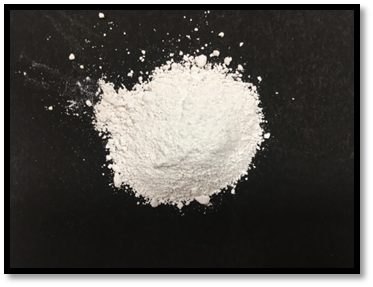
Fig. I: Zirconia powder

Fig. II: Heat cured polymer-Unfilled (left), with Zirconia filler (right)

Fig. III: Self cured polymer-Unfilled (left), with Zirconia filler (right)
B. Specimens with copper powder as filler:
Pure copper fine powder (Fig. IV) was added in a concentration of 10% of the acrylic polymer powder by weight, using an electronic balance. A thorough mixing of the two powders was done using porcelain mortar and pestle.

Fig. IV: Copper powder

Fig. V: Heat cured polymer- Unfilled (left), with Copper filler (right)

Fig. VI: Self cured polymer- Unfilled (left), with Copper filler (right)
Test specimens were of six groups depending on the filler particles.
The groups were:
- Group H includes heat cure resin as main resin matrix;
- Group S includes self cure resin as main resin matrix
|
Group H |
Control (heat cure resin) - no addition of filler particles. |
|
Group H-C |
Copper powder added to heat cure acrylic. |
|
Group H-Z |
Zirconia powder added to heat cure acrylic. |
|
Group S |
Control (self cure resin) - no addition of filler particles. |
|
Group S-C |
Copper powder added to self cure acrylic. |
|
Group S-Z |
Zirconia powder added to self cure acrylic. |
Fabrication of test specimens
Rectangular dies of dimensions 65 mm length × 10 mm width × 2.5 mm thickness were used to fabricate test specimens for measuring transverse strength, and 30 mm length × 10 mm width × 2.5 mm thickness to fabricate specimens for measuring surface hardness. This ensured standardization in size of test specimens.
Dies were placed in the silicone mould and molten wax was flown into it. The wax test specimens of each group were flasked at a time, in order to ensure uniformity of the mix during packing stage. This was followed by de- waxing.
The modified polymer powder and monomer liquid were mixed in the ratio 3:1 by volume. When the mix attained dough stage, it was packed into the de- waxed mould space. It was then cured according to the manufacturer’s instructions by compression moulding technique with a short curing cycle in an acrylizer for 1hr 20mins (heat cured resin).
For self cured resin, the modified polymer powder and monomer liquid were mixed in the given ratio and packed in the mould space at dough stage.
The specimens were retrieved from the flasks and excess material was trimmed and then the samples were polished
Testing of samples
The specimens were subjected to load under a universal testing machine to check for transverse strength and surface hardness.
Surface hardness was measured by indenting the surface with a small diamond indenter. The hardness was then inferred from the area or width of the indentation or from its depth.
Specimens were tested for transverse strength by three point bending test in universal testing machine. Specimens were loaded with a crosshead speed of 5mm/min until fracture occurred. A computer attached to the testing machine recorded the load at which fracture occurred.
The polished hardness test specimens were subjected to a 50 gf load for 5 s indentation time and VHN values were obtained digitally.
STATISTICAL ANALYSIS
SPSS software (version 22) was used for analyzing the data.
One-way ANOVA was conducted to test for significant difference of transverse strength and surface hardness between the test groups.
Post –Hoc test was performed to check for inter group significance of transverse strengths and surface hardness.
RESULTS
Table I: Descriptive statistical data on the quantitative transverse strength and surface hardness, with and without addition of fillers, incorporated in heat and self cured denture base resin

Control group (no filler) has the highest value of 180.73±53.3 MPa in transverse strength test. No significant difference is seen in groups with addition of copper and zirconia powder for both transverse strength test and surface hardness.
Table II: comparison of 3 groups of Heat cured denture base resin

p< 0.05 considered as significant.
A one way ANOVA was performed to determine the significant difference in the average transverse strength and surface hardness across different groups of Heat cured denture base resin .Statistically significant difference seen in the average surface hardness between the three groups. Thus a Post –Hoc test was further performed and significant intergroup differences were obtained.
Table III: Comparison of Surface hardness of Heat Cured resin groups

p< 0.05 considered as significant.
From the Post Hoc comparisons, a significant difference seen between copper powder and zirconia powder filler groups.
Table IV: Comparison of 3 groups of Self cured denture base resin

p< 0.05 considered as significant.
A one way ANOVA was performed to determine the significant difference in the average transverse strength and surface hardness across different groups of Self cured denture base resin. It was observed that there was statistically significant difference in the average transverse strength between the three groups. Thus a Post –Hoc test was further performed and significant intergroup differences were obtained.
From the Post Hoc comparisons we observed that there is a significant difference between copper powder filler and control (no filler) groups.
Graph I: Transverse strength test for Heat cured resin specimens

Graph II: Transverse strength test for Self cured resin specimens

Highest transverse strength was obtained in control (no filler) group and the least was seen in copper powder filler group. No significant difference was observed between copper powder and zirconia powder (filler) groups.
Control group (no filler) has the highest value of 180.73±53.3 MPa in transverse strength test.
Graph III: Surface hardness test for Heat cured resin specimens

Group with zirconia powder filler in Heat cured resin has the highest surface hardness whereas the group with copper powder as filler has the lowest value. No significant difference was shown between the three groups.
Graph IV: Surface hardness test for Self cured resin specimens

Highest surface hardness in Self cured resin specimens was obtained in zirconia powder filler group and the least was seen in control (no filler) group. No significant difference was observed between copper powder and zirconia powder (filler) groups.
DISCUSSION
Acrylic resins have been very popular since its introduction to dentistry in 1930’s. They are extensively used in construction of partial and complete dentures, maxillofacial prostheses like obturators, feeding plates etc. Polymethyl Methacrylate (PMMA) is most commonly used denture base acrylic resin.10 It has many favorable properties like light weight, translucency, biocompatibility, durability, low cost, easy repair.11 Though the material is considered to be gold standard, it is not an ideal material due to its low strength, allergic reactions etc.10,11
A study conducted by Hargreaves et al. on analysis of denture fractures suggested that 68% of dentures fractures within 3 years after fabrication.12 Impact failure extra orally and flexure fatigue failure intraorally are the two most important causes of fracture of denture bases.13
Impact failure is failure occurring through impact when the denture is dropped on the hard ground. Flexure fatigue failure is when fracture occurs intraorally due to the occlusal forces.14
Fracture of the prosthesis is an issue to both the patient and the clinician. Reinforcement of the denture base resins with suitable materials categorized as fibers, fillers and nanofillers, have been utilized as reinforcements. Some of the additives used as given in the literature are as follows:10
- Fibers- Glass fiber
Aramid etc.
- Fillers- Alumina
Silver
Copper etc.
- Nanofillers and others- Zirconia
Carbon
Hydroxyapatite etc.
In the present study two different fillers i.e. Copper powder and Zirconia powder, were used and the transverse strength and surface hardness were compared with each other and with that of unfilled (control) group..
Factors affecting the transverse strength and surface hardness are often related to the basic properties of the materials used as denture base.
Transverse Strength refers to a measure of strength when the load is applied across the longitudinal flow of the grain of a material.
Hardness is the ability of a material to resist deformation, which is determined by a standard test where the surface resistance to indentation is measured.
These properties are affected by grain size, configuration, quality etc. of the matrix material. It is also affected by any reinforcements incorporated into the matrix.10,11 Thus in this study, effect of addition of the above mentioned filler particles on PMMA (heat cured and self cured) resins were evaluated.
Zirconium dioxide, also known as zirconia, is a white crystalline oxide of Zirconium (atomic number- 40). It has been used as structural material for fixed dental prostheses, crowns, implants and abutments.6 Zirconia has enhanced material strength, improved esthethic and high biocompatibility which makes it a very superior material.15 The mechanical strength of zirconia dental implants is equivalent to teeth and this material possesses good fracture toughness. The lower elastic modulus and higher strength are the potential advantages of zirconia in load-bearing applications.16
Copper (atomic number- 29) is a soft, ductile and malleable metal with distinct pinkish red color. It also has very high electrical and thermal conductivity. In dentistry, copper, in the form of wires, has its use in denture repair.4 Copper content in amalgam alloy improves its mechanical properties, corrosion resistance, better marginal integrity and improved performance in clinical trial.5 In addition to these favourable properties, it also is biocompatible, antibacterial etc.17
Hence, they were chosen as the filler materials to evaluate the effect on PMMA resin after reinforcement. Enhancement in properties was anticipated.
Previous studies showed varying results with 10% addition of fillers. Asopa et al., Ayad et al. showed increased strength and Ergun et al. showed decrease in the strength.9,18,19 So, 10% concentration by weight was chosen in this study to evaluate its effects.
But in our study, the transverse strength of heat cured resin test specimens, with addition of 10% concentration of Zirconia powder, decreased to 75.7±16.8 MPa, which was comparable to that of the control (unfilled) specimens i.e. 81.7±15.7 MPa. In self cured resin matrix group, mean transverse strength was highest for the control group i.e 180.7±53.3 MPa. Zirconia filler group had a mean strength of 88.2±19.4 MPa, which was not statistically different when compared to the control group.
This finding was in accordance with a study by Ergun et al. (2018), where it was found that the increase in filler concentration did not increase mechanical strength. The transverse strength of the test specimens decreased with the increased nano-ZrO2 filler content due to defects that weakened the material.9
Similarly, for 10% concentration of Copper powder in heat cured resin specimens, mean transverse strength was 60.7±1.3 MPa.
The transverse strength should not be <65 MPa for heat cured acrylic resin according to ISO 20795-1. Thus, the addition did not breach the limit, except for Copper powder filler group.
This decrease in the strength might be because of following reasons:
- Flaws within the filler material-
Zirconia and Copper powders used in the present study as fillers though finely powdered, were not nano sized (≤100nm).
Zirconia exists in three crystallographic phases: cubic, tetragonal and monoclinic. Within these, monoclinic zirconia is the most thermodynamically stable phase at room temperature. The other phases are stable at high temperatures. By reducing the particle size to nano-range or by doping the zirconia, the high temperature phases can be stabilized at room temperature, which was not followed in this study. This additionally may have affected the result.
This particle size variation may have caused a non- homogeneous distribution of the filler particles in the resin matrix. A study by Wang et al. (2013) suggested that non- homogeneity results in poor load transfer. Thus resulting in lowering the strength of the material.20 And also there is no evidence for uniform finesse of the filler powders that were used in this study. Finer the particles, lesser the flaws according to Mansour et al. (2013)21
- Weak bonding between the filler and the resin matrix-
Zirconia or Copper doesn’t bond to acrylic resin matrix.18,22 Thus a coupling agent is recommended to enhance the bonding between these two materials. Zirconate coupling agent is the material of choice for bonding resin and Zirconia.18 But since the lack of availability of the suggested material, a Silane coupling agent was used to improve bonding of Zirconia and Acrylic resin in this study.
Wang et al. mentioned good wetting of the filler particles is crucial for good interfacial bonding. They also claimed complete wetting is difficult with increase in the filler concentration.20 Mansour et al. (2013) and Wang et al. (2013) suggested that a good interfacial interaction is required to prevent crack propagation near the interface20 and increase the flexural strength.20,21
In addition, no coupling agent was used for Copper filler in accordance with previous study by Sehajpal et al (1989).17
Increased concentration of Zirconia and Copper fillers; change in coupling agent used for Zirconia and lack of coupling agent in case of Copper, might have caused an adhesive failure and thus decreasing the strength by weakening the resin- filler interface.
Vuorinen et al. (2008) in his study with repair resin (autopolymerizing/ self cured resin) reported similar results i.e. lack of adequate interfacial adhesion between filler and matrix decreased the flexural strength of the resultant product.
- Porosity
Porosity in a material is of multifactorial origin. Some of the factors affecting porosity are: composition of matrix, processing techniques etc.23
Andreopoulos et al. (1991) mentioned the difficulty in dispersion of filler particles in the resin matrix is caused due to increased filler concentration.24 Wang at al. also mentioned that increased concentration of filler causes agglomeration of particles.20 This non- uniformity and agglomerated matter hinders the monomer to mix satisfactorily with the modified resin matrix. This may be a reason for porosities in the fabricated specimens. Mansour et al. reported that porosity might be one of the detrimental factors for strength.21
Thus it can be said that porosities caused by addition of 10% Zirconia powder or 10% Copper powder may have decreased the strength of test specimens.
Porosities due to processing errors were negligible as standard processing protocols were followed.
- Poor orientation of fillers in the resin matrix:
Orientation of filler particles along single plane is favourable for enhancing the properties of a material according to Mansour et al.21
There is no evidence to show the orientation of the fillers since this study did not involve any SEM analysis. And thus, the decrease in the strength may be because of lack of single plane orientation of the fillers.
In the present study, surface hardness of heat cured resin with unfilled, Zirconia powder filler and Copper powder filler are as follows: 19.7±1.2, 17.4±1.4 and 21.7±1.4 respectively, showing Zirconia filler group had the highest surface hardness. This is in accordance with the previous studies by Ahmed et al. (2014) and Ergun et al. (2018).8,9
Surface hardness of self cured resin with unfilled, Zirconia powder filler and Copper powder filler are as follows: 13.9±0.2, 16.6±0.4 and 16.9±0.4 respectively, again showing Zirconia filler group having the highest value. Moreover, both the filler groups have comparable values. This is in agreement with previous study by Vuorinen et al. (2008).
This increase in the hardness with modified resins may be possibly due to strong interatomic bonding of the filler particles and the filler concentration present in the resin matrix according to a study by Ergun et al.9
Another observation made in this study was that the trimming and polishability of the specimens in the group with copper filler was relatively easy when compared to the other groups.
CONCLUSION
Within the limitations of this study, the following conclusions were made:
- Transverse strength decreases with incorporation of both 10% Zirconia and 10% Copper filler particles into heat cured and self cured resin when compared to the unfilled group.
- Surface hardness of Zirconia filler group was increased when compared to both copper filler group and control group.
Acknowledgement :
Special thanks to Dr Jayaprakash (Department of Dental Materials) and Dr Riaz Abdulla (Department of Oral Pathology) for their immense support.
REFERENCES
- Driscoll CF, Freilich MA, Guckes AD, Knoernschild KL, Mcgarry TJ, Goldstein G, et al. The Glossary of Prosthodontic Terms: Ninth Edition. J Prosthet Dent. 2017;117(5):e1–105.
- Wiskott HW, Nicholls JI BU. Stress fatigue: basic principles and prosthodontic implications. Int J Prosthodont. 1995;8(2):105–16.
- Takahashi T, Gonda T, Mizuno Y, Fujinami Y, Maeda Y. Reinforcement in removable prosthodontics: a literature review. J Oral Rehabil. 2017;44(2):133–43.
- Golbidi F, Mousavi T. Transverse Strength of Repaired Denture Base Material with Wire and Two Auto Polymerized Acrylic Resin. J Dent Tehran Univ Med Sci. 2007;4(4):183–7.
- Solanki G. High Copper Amalgam Alloys in Dentistry. Int J of Pharmc Res [Internet]. 2012 Jul. 8 [cited 2021 Aug. 19];2(1):66-8. Available from: https://ssjournals.com/index.php/ijpr/article/view/1212
- Bona A Della, Pecho OE, Alessandretti R. Zirconia as a dental biomaterial. Materials (Basel). 2015;8(8):4978–91.
- Zhang XJ , Zhang XY , Zhu BS QC. Effect of nano ZrO2 on flexural strength and surface hardness of polymethylmethacrylate. Shanghai J Stomatol. 2011;20(4):358–63.
- Ahmed MA, Ebrahim MI. Effect of Zirconium Oxide Nano-Fillers Addition on the Flexural Strength, Fracture Toughness, and Hardness of Heat-Polymerized Acrylic Resin. World J Nano Sci Eng. 2014;04(02):50–7.
- Ergun G, Sahin Z, Ataol AS. The effects of adding various ratios of zirconium oxide nanoparticles to poly(methyl methacrylate) on physical and mechanical properties. J Oral Sci. 2018;60(2):304–15.
- Gad M, Fouda S, Al-Harbi F, Näpänkangas R, Raustia A. PMMA denture base material enhancement: a review of fiber, filler, and nanofiller addition. Int J Nanomedicine. 2017 May;Volume 12:3801–12
- Somani M, Khandelwal M, Punia V, Sharma V. The effect of incorporating various reinforcement materials on flexural strength and impact strength of polymethylmethacrylate: A meta-analysis. J Indian Prosthodont Soc. 2019;19(2):101.
- AS. H. The prevalence of fractured dentures. A survey. Br Dent journal. 1969;126(10):451.
- Singh B, Singh R, Singh K, Chand P, Patel CS. Mechanical properties of denture base resins: An evaluation. Indian J Dent Res. 2011;22(1):180.
- Arundati R, Patil N. An investigation into the transverse and impact strength of a new indigenous high-impact denture base resin, DPI- tuff and its comparison with most commonly used two denture base resins. J Indian Prosthodont Soc. 2006;6(3):133.
- Abd El-Ghany OS, Sherief AH. Zirconia based ceramics, some clinical and biological aspects: Review. Futur Dent J. 2016 Dec;2(2):55–64.
- Shanmugam K SR. Bioceramics—An introductory overview. In: Fundamental Biomaterials: Ceramics. 2018. p. 1.
- Sehajpal SB, Sood VK. Effect of metal fillers on some physical properties of acrylic resin. J Prosthet Dent. 1989 Jun;61(6):746–51.
- Ayad N, Badawi M, Fatah A. Effect of reinforcement of high-impact acrylic resin with zirconia on some physical and mechanical properties. Rev Clín Pesq Odontol. 2008;4(3):145–51.
- Asopa V, Suresh S, Khandelwal M, Sharma V, Asopa SS, Kaira LS. A comparative evaluation of properties of zirconia reinforced high impact acrylic resin with that of high impact acrylic resin. Saudi J Dent Res. 2015;6(2):146–51
- Wang R, Tao J, Yu B, Dai L. Characterization of multiwalled carbon nanotube-polymethyl methacrylate composite resins as denture base materials. J Prosthet Dent. 2014 Apr;111(4):318–26
- Mansour MM, Wagner WC, Chu T-MG. Effect of Mica Reinforcement on the Flexural Strength and Microhardness of Polymethyl Methacrylate Denture Resin. J Prosthodont. 2013 Apr;22(3):179–83.
- Gad M, Rahoma A, Al-Thobity AM, ArRejaie A. Influence of incorporation of ZrO2 nanoparticles on the repair strength of polymethyl methacrylate denture bases. Int J Nanomedicine. 2016 Oct;Volume 11:5633–43.
- Kasina SP, Ajaz T, Attili S, Surapaneni H, Cherukuri M SH. To evaluate and compare the porosities in the acrylic mandibular denture bases processed by two different polymerization techniques, using two different brands of commercially available denture base resins-an in vitro study. J Int oral Heal. 2014;6(1):72.
- Andreopoulos AG, Papaspyrides CD, Tsilibounidis S. Surface treated polyethylene fibres as reinforcement for acrylic resins. Biomaterials. 1991 Jan;12(1):83–7.
Disclaimer from Guident
The views and opinions expressed in articles published in Guident are solely those of the authors and do not necessarily reflect the views of the editors, the editorial board or the publisher, Ivory India. Guident does not endorse any product, technique or treatment described. Clinical content is intended for qualified dental and medical professionals and is not a substitute for individual clinical judgement. Guident, its editors and the publisher accept no liability for any consequence arising from the use of information published in the journal.
How to cite this article
Dr. Vidya S. Bhat, Dr. Varsha Bhatt, Dr. Sanath Kumar Shetty. Comparative Evaluation of Mechanical Properties of Acrylic Denture Base Incorporated with Copper and Zirconia Filler Particles. Guident. 2021 Sep;14(10). Available from: https://ivoryindia.in/articles/research/comparative-evaluation-of-mechanical-properties-of-acrylic-denture-base-incorporated-with-copper-and-zirconia.html