Comprehensive Management of Radix Entomolaris Associated with Furcal Perforation Using Mineral Trioxide Aggregate and Endocrown Rehabilitation: A Case Report
Department of Conservative Dentistry and Endodontics, D.J. College of Dental Sciences & Research, Modinagar, U.P
ABSTRACT
Radix entomolaris (RE) is an anatomical variation characterized by the presence of an additional distolingual root in mandibular molars. Failure to identify and treat this extra root may compromise endodontic success. Furcal perforation is a serious iatrogenic or pathological complication that can adversely affect prognosis if not managed appropriately. The present case report describes the comprehensive management of a mandibular right first molar i.e tooth number 46 exhibiting radix entomolaris associated with furcal perforation. Endodontic treatment was performed with careful identification and negotiation of the additional root canal, followed by furcal perforation repair using Mineral Trioxide Aggregate (MTA). The tooth was subsequently rehabilitated using a CAD/CAM endocrown to restore function and aesthetics. Clinical and radiographic evaluation demonstrated successful healing and satisfactory functional outcomes.
Keywords: Radix entomolaris, Furcal perforation, Mineral Trioxide Aggregate, Endocrown, Mandibular first molar, Root canal treatment.
INTRODUCTION
Successful endodontic treatment depends on a thorough understanding of root canal anatomy and its variations. One such variation is Radix Entomolaris (RE), first described by Carabelli in 1844, which refers to the presence of an additional root located lingually to the distal root of a mandibular molar.1 The prevalence of RE varies among different populations and ranges from less than 5% in Caucasians and Indians to over 30% in Mongoloid populations.2,3 Failure to identify and treat this additional root canal may result in persistent infection and treatment failure.
Furcal perforation is an unwanted communication between the pulp chamber floor and the periodontal tissues in the furcation area. The prognosis of perforations is influenced by factors such as location, size, degree of contamination, and time elapsed before repair.4 Mineral Trioxide Aggregate (MTA), introduced in endodontics in the early 1990s, has become the material of choice for perforation repair because of its excellent sealing ability, biocompatibility, and bioactive properties.5,6
Extensively damaged endodontically treated teeth often require indirect restorations for long-term functional and structural rehabilitation. Endocrowns provide a conservative and predictable alternative to conventional post-and-core systems by utilizing the pulp chamber for retention while preserving maximum tooth structure.7 This report presents the successful management of a mandibular first molar with radix entomolaris and furcal perforation repaired with MTA, followed by definitive restoration using an endocrown.
CASE REPORT
Patient Information
A 45-year-old female patient reported to the Department of Conservative Dentistry and Endodontics with the chief complaint of:
- Pain during mastication in the lower right posterior region for 2 weeks.
- History of deep caries in the mandibular right first molar (46).
Clinical Examination
Intraoral examination revealed:
- Extensive distal-occlusal carious destruction in tooth 46.
- Tenderness on percussion.
- Delayed response to pulp vitality tests.
- No mobility.
- Periodontal probing within normal limits.
Radiographic Examination
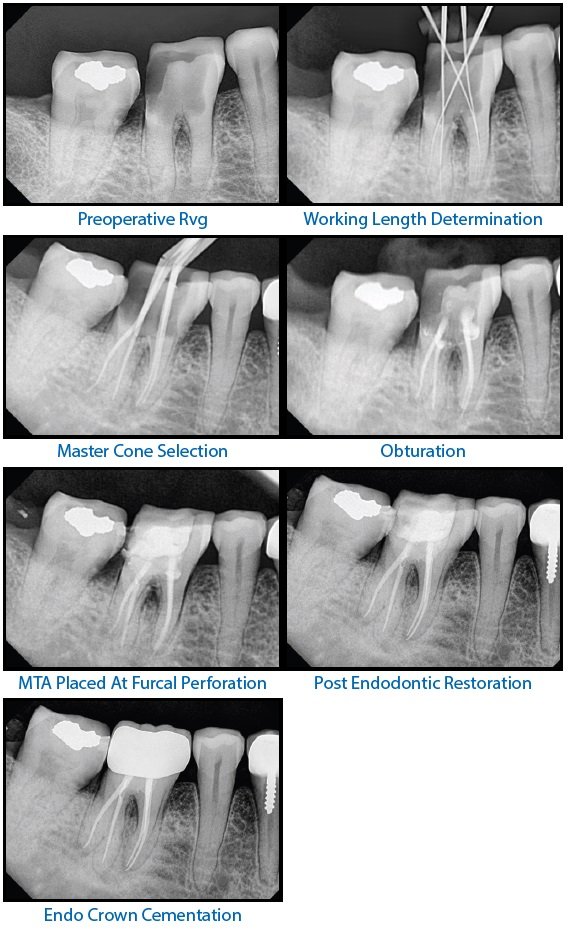
Preoperative intraoral periapical radiograph (IOPA) showed:
- Deep carious lesion approximating the pulp.
- Widening of periodontal ligament space.
- Presence of an additional distolingual root suggestive of radix entomolaris.
- Furcal radiolucency indicating possible furcal perforation.
Diagnosis
Based on clinical and radiographic findings, a diagnosis of:
Symptomatic Apical Periodontitis associated with Pulpal Necrosis in Tooth 46 with Radix Entomolaris and Furcal Perforation was established.
Treatment Plan
- Non-surgical root canal treatment of tooth 46.
- Identification and management of radix entomolaris.
- Repair of furcal perforation using MTA.
- Definitive rehabilitation with CAD/CAM endocrown.
CLINICAL PROCEDURE
First Visit
- Following administration of local anesthesia using an inferior alveolar nerve block with 2% lignocaine containing 1:80,000 epinephrine, the tooth was isolated under rubber dam to ensure an aseptic operating field. Access cavity preparation was initiated, and the conventional endodontic access was modified into a trapezoidal outline form to facilitate identification and negotiation of the additional distolingual canal associated with the radix entomolaris. Upon access opening, necrotic pulp tissue was encountered within the pulp chamber. Careful inspection of the pulpal floor revealed the presence of a furcal perforation accompanied by slight bleeding.
- Canal exploration was performed using a DG-16 endodontic explorer under magnification. Four distinct canal orifices were identified, namely the mesiobuccal (MB), mesiolingual (ML), distobuccal (DB), and an additional distolingual canal corresponding to the radix entomolaris (RE). Canal patency was established, and working length determination was carried out using an electronic apex locator (J. Morita, Japan), followed by confirmation with an intraoral periapical radiograph (RVG).
Cleaning and Shaping and Obturation
- Following working length determination, biomechanical preparation was carried out using nickel-titanium rotary instruments with a crown-down technique. The canals were irrigated copiously throughout the procedure using 3% sodium hypochlorite, followed by 17% EDTA to remove the smear layer and a final saline rinse. After completion of cleaning and shaping, final irrigation was performed and the canals were dried using sterile paper points. Obturation was completed using gutta-percha cones and a resin-based sealer by the cold lateral compaction technique. A post-obturation radiograph confirmed dense three-dimensional filling of all canals, including the canal within the radix entomolaris.
Furcal Perforation Repair
- Following obturation, attention was directed to the repair of the furcal perforation. The perforation site was thoroughly cleaned and hemostasis was achieved using sterile cotton pellets. Mineral Trioxide Aggregate (MTA) was mixed according to the manufacturer's instructions and carefully delivered into the perforation defect using an MTA carrier. The material was gently condensed with micropluggers to ensure adequate adaptation to the defect walls. A moist cotton pellet was placed over the MTA to facilitate setting, and the access cavity was temporarily restored. A postoperative radiograph confirmed satisfactory sealing of the furcal perforation.
SECOND VISIT
The patient remained asymptomatic after 48 hours, following which post-endodontic restoration was performed.
Endocrown Rehabilitation
- At the subsequent appointment one week later, the patient remained asymptomatic. Clinical examination revealed extensive coronal destruction of the tooth, making conventional crown preparation with post-and-core restoration less favorable. Therefore, an endocrown was planned as the definitive restorative option. A monolithic lithium disilicate ceramic endocrown was subsequently designed and fabricated using CAD/CAM technology. The restoration was luted using dual-cure resin cement under proper isolation. Excess cement was removed and occlusion was carefully adjusted to ensure optimal function.
DISCUSSION
Radix entomolaris represents a significant anatomical variation that requires modification of access cavity design and careful radiographic interpretation. Failure to identify the distolingual root may lead to untreated canals, persistent infection, and eventual treatment failure.1,2
The use of angled radiographs and magnification facilitated identification of the additional canal in the present case. Proper cleaning, shaping, and obturation of all canals contributed significantly to treatment success. Previous studies have emphasized the importance of careful radiographic assessment and knowledge of root canal morphology for successful management of teeth exhibiting radix entomolaris.1,2
Furcal perforation has historically been associated with poor prognosis because of bacterial contamination and periodontal destruction. Immediate sealing of perforations using Mineral Trioxide Aggregate (MTA) has been shown to improve prognosis significantly.3 MTA possesses superior sealing ability, excellent biocompatibility, and the capacity to promote cementogenesis and periodontal healing, making it the gold standard material for perforation repair.3,4
Following successful endodontic management, restoration of the tooth was essential to ensure long-term function and fracture resistance. Endocrowns, first proposed by Bindl and Mörmann, have gained popularity as a conservative restorative option for endodontically treated teeth.5 Their advantages include:
• Conservative tooth preparation.
• Preservation of radicular dentin.
• Reduced risk of root fracture.
• Enhanced stress distribution.
• Excellent esthetics and longevity.
In the present case, extensive coronal destruction combined with successful MTA repair made endocrown rehabilitation an ideal restorative option, providing both structural reinforcement and favorable long-term prognosis.
CONCLUSION
Successful management of mandibular molars with radix entomolaris requires careful diagnosis, modification of access cavity design, and thorough debridement of all canals. Early repair of furcal perforation using MTA provides a predictable biological seal and favorable healing. Subsequent rehabilitation with an endocrown offers a conservative and durable restorative solution for extensively damaged endodontically treated teeth. The combined approach employed in this case resulted in successful clinical and radiographic outcomes, demonstrating the importance of comprehensive multidisciplinary management.
REFERENCES
- Carabelli G. Systematisches Handbuch der Zahnheilkunde. Vienna: Braumüller und Seidel; 1844.
- De Moor RJG, Deroose CAJG, Calberson FLG. The radix entomolaris in mandibular first molars: an endodontic challenge. Int Endod J. 2004;37(11):789-99.
- Calberson FLG, De Moor RJG, Deroose CAJG. The radix entomolaris and paramolaris: clinical approach in endodontics. J Endod. 2007;33(1):58-63.
- American Association of Endodontists. Glossary of Endodontic Terms. 7th ed. Chicago (IL): American Association of Endodontists; 2003.
- Torabinejad M, Watson TF, Pitt Ford TR. Sealing ability of a mineral trioxide aggregate when used as a root-end filling material. J Endod. 1993;19(12):591-5.
- Pitt Ford TR, Torabinejad M, McKendry DJ, Hong CU, Kariyawasam SP. Use of mineral trioxide aggregate for repair of furcal perforations. Oral Surg Oral Med Oral Pathol. 1995;79(6):756-63.
- Bindl A, Mörmann WH. Clinical evaluation of adhesively placed Cerec endocrowns after 2 years—preliminary results. Quintessence Int. 1999;30(6):407-10.
Disclaimer from Guident
The views and opinions expressed in articles published in Guident are solely those of the authors and do not necessarily reflect the views of the editors, the editorial board or the publisher, Ivory India. Guident does not endorse any product, technique or treatment described. Clinical content is intended for qualified dental and medical professionals and is not a substitute for individual clinical judgement. Guident, its editors and the publisher accept no liability for any consequence arising from the use of information published in the journal.
How to cite this article
Dr. Nitu Khajuria, Dr. Anil Dhingra. Comprehensive Management of Radix Entomolaris Associated with Furcal Perforation Using Mineral Trioxide Aggregate and Endocrown Rehabilitation: A Case Report. Guident. 2026 Jul;19(8). Available from: https://ivoryindia.in/articles/endodontics/comprehensive-management-of-radix-entomolaris-associated-with-furcal-perforation-using-mineral-trioxide.html