Endodontic Management of Grossly Decayed Teeth with Compromised Intra Radicular Tooth Structure by Relining of Fiber Post
Department of Conservative Dentistry & Endodontics Dr. Ziauddin Ahmed Dental College and Hospital AMU, Aligarh, India
ABSTRACT
One of the clinically relevant problems dentists face when restoring endodontically treated teeth is the mismatch between fiber post and post space diameters in teeth with compromised intraradicular tooth structure. In these situations, if a prefabricated post is used, the excess space within the root canal would be taken up with a bulk of luting cement which results in a potentially weak area in the restoration, compromising the long-term prognosis. Fiber post relining appears as a solution for this problem. Relining of fiber post with composite resin seems to be an effective method to improve the retention of fiber posts in flared root canals. The main goal of fiber post relining is to reduce the thickness of the resin cement layer. Thin layers of cement present fewer bubbles, and other defects than thick ones, coz voids within the material may act as crack raisers and can decrease post retention resulting in post failure.
Key words-Endodontically treated teeth, Flared canal, Fiber Post, Post Relining
INTRODUCTION
Intraradicular posts are commonly used to restore endodontically treated teeth when their remaining coronal tissue can no longer provide adequate support and retention for the restoration.1,2 For decades, endodontically treated teeth have been restored using cast metal posts. Despite the high retention and thin cement layer, these conventional posts present high elastic modulus and can lead to root fracture, according to several in vitro studies3,4,though clinical evaluations have presented high success rates for cast metal posts.5,6 Another option to restore endodontically treated tooth is to use fiber posts. The fact that the fiber post, resin cement and dentin have similar elastic modulus has been considered as advantageous for improving the performance of restorations.7
However, the mismatch between fiber post and post space diameters post remains a clinical challenge.8 Although the use of size-matched drills supplied by post manufacturers permits good fitting of posts to the canal walls, some canals have an elliptical shape in cross-section while posts have circular shape9 In addition, flared canals from carious extension, trauma, pulpal pathosis and iatrogenic misadventure also compromise the adaptation of fiber post to canal walls. In these two cases, if the post does not fit well, especially at the coronal level, the resin cement layer would be excessively thick, and bubbles are likely to form in it, thus predisposing to de-bonding.10
One solution to overcome this problem is the use of dentin-bonded composite resin.11 This technique increases the internal thickness of dentin of root wall and reduces the resin cement thickness. However, the light-activation of composite resin in more apical regions of the root canal is difficult and this may compromise this technique.12 Another solution is to reline the fiber post with composite resin.13 This individual anatomic post increases the adaptation of the post to root walls and reduces the resin cement thickness.14
CASE REPORT
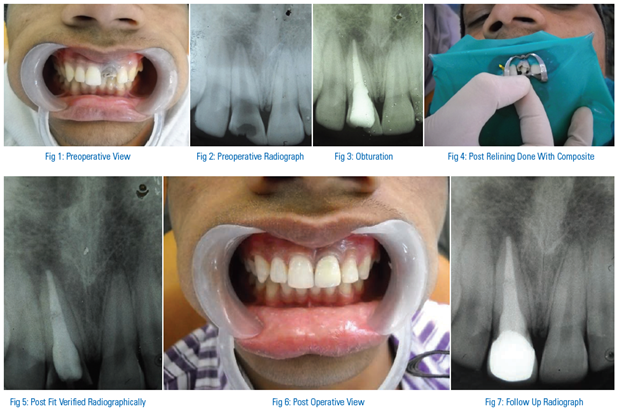
A 18 year old patient reported to Dept. of Conservative Dentistry and Endodontics, AMU, Aligarh with the chief complaint of pain in upper front tooth since a week. The patient wanted fabrication of crown on the same. Patient has a history of trauma at the age of 13 years after which he suffered a complicated crown fracture and the tooth became non vital (Fig1). Radiographic examination revealed previously access opened root canal with flared walls and signs of periapical radiolucency (Fig 2) .
Thorough cleaning and minimal shaping of the root canals were carried out. The access opening was refined and canal disinfection was carried out with intracanal irrigation of 2% sodium hypochlorite and intracanal dressings of calcium hydroxide. This was repeated until the canal became dry and ready for obturation.Obturation was done using thermoplastisized gutta-percha (Obtura, Spartan) (Fig 3), and patient was recalled further for permanent restoration.
Next the post space was prepared was prepared. The root canal anatomy was such that even largest sized prefabricated post could not satisfactorily adapt to it and amount of residual dentin on canal wall was such that contraindicated further removal of dentin so a decision was made to reline the post with composite resin and adapt it to canal dimensions. After application of rubber dam the root canal was irrigated and dried and walls were coated with Vaseline. Then the fiber post was relined with composite resin (Filtek Z 350 XT, Dentsply) (Fig 4) and was put to the canal to verify its fit. After verification of post fit radiographically (Fig 5), canal walls were treated with self etch adhesive (3M Single Bond Dental Adhesive), cured and the relined post was cemented in the canal using resin cement (Rely X 3M ESPE).
Composite core build up was done and crown preparation was completed. Gingival retraction was done (Pascal Dental) and impressions were taken (Aquasil impression material, Dentsply). Metal ceramic crown was fabricated on and luting was done (Fig 6).On follow up after 2 years, the restorations showed excellent esthetic results with no discoloration or debonding of the restoration and good signs of healing in the periapical area. (Fig.7)
DISCUSSION
Regarding the restoration of a severely damaged tooth, such as an endodontically treated tooth with thin root walls and flared canal, clinicians are continuously faced with a dilemma of whether to extract it or not. Due to loss of a large amount of radicular structure, a flared canal is structurally weak and poses a higher risk of biomechanical failure when compared to a tooth with ample radicular dentin structure. Weakened roots are often encountered in clinical practice and require a post system in order to continue being used as support for a crown or fixed partial denture.15
In the past, the cast metal post-and-core was widely accepted for every pulpless tooth irrespective of the amount of remaining supportive tooth structure. The mechanical properties of cast metal, in particular the modulus of elasticity, are far higher than those of dentin and fiber post leading to concentration of stress, mainly at the apical root third resulting in root fracture.16 Fiber posts have a low modulus of elasticity and the stress generated by the load is distributed evenly along the length of the post. Duret, et al.17 reported that this type of post transmits stress between the post and the remaining root structure, reducing stress concentration. Another factor that increases the stress distribution is the possibility of bonding between the fiber post and dentin root. The fiber post is covered by epoxy resin that can chemically bond to the resin cement through the silane agent. It is believed that the possibility of monoblock creation helps
transmitting stress applied over the tooth.Boudrias, et al 18 described the technique of relining of the fiber post into the root canal by the composite resin replacing the resin cement, which has better mechanical and physical properties. The enhanced mechanical properties lead to the direct anatomic post presenting fracture strength values similar to those of the cast metal post-and-core.By adding only a few more steps to those required to lute a conventional fiber post, it is possible to achieve better fitting quality. Moreover, the thickness of the cement layer, in which voids and bubbles are likely to develop, can be minimized.19
CONCLUSION
Relining of fiber post seems to be a good alternative for restoring flared root canals. Relined fiber posts present more intimate contact with the root canal walls than non-relined posts.This procedure can be used to reconstruct endodontically treated teeth when the canal anatomy is not perfectly round and when there is substantial loss of tooth structure at coronal level. In this manner it is possible to obtain a superior fit of individual post which is not possible with any prefabricated post.
REFERENCES
- Fernandes AS, Shetty S, Coutinho I. Factors determining post selection: a literature review. J Prosthet Dent. 2003;90:556-62.
- Hunter AJ, Feiglin B, Williams JF. Effects of post placement on endodontically treated teeth. J Prosthet Dent. 1989;62:166-72
- Dietschi D, Duc O, Krejci I, Sadan A. Biomechanical considerations for the restoration of endodontically treated teeth: a systematic review of the literature, Part II (Evaluation of fatigue behavior, interfaces, and in vivo studies). Quintessence Int. 2008;39:117-29.
- Nakamura T, Ohyama T, Waki T, Kinuta S, Wakabayashi K, Mutobe Y, et al. Stress analysis of endodontically treated anterior teeth restored with different types of post material. Dent Mater J. 2006;25:145-50.
- Balkenhol M, Wöstmann B, Rein C, Ferger P. Survival time of cast post and cores: a 10-year retrospective study. J Dent. 2007;35:50-8.
- Jung RE, Kalkstein O, Sailer I, Roos M, Hämmerle CH. A comparison of composite post buildups and cast gold post-and-core buildups for the restoration of nonvital teeth after 5 to 10 years. Int J Prosthodont. 2007;20:63-9.
- Schmitter M, Huy C, Ohlmann B, Gabbert O, Gilde H, Rammelsberg P. Fracture resistance of upper and lower incisors restored with glass fiber reinforced posts. J Endod. 2006;32:328-30.
- D'Arcangelo C, Cinelli M, De Angelis F, D'Amario M. The effect of resin cement film thickness on the pullout strength of a fiber-reinforced post system. J Prosthet Dent. 2007;98:193-
- De-Deus G, Murad C, Paciornik S, Reis CM, Coutinho-Filho T. The effect of the canal-filled area on the bacterial leakage of oval-shaped canals. Int Endod J. 2008;41:183-90.
- Grandini S, Goracci C, Monticelli F, Borracchini A, Ferrari M. SEM evaluation of the cement layer thickness after luting two different posts. J Adhes Dent. 2005;7: 235-40.
- Lui JL. Composite resin reinforcement of flared canals using light-transmitting plastic posts. Quintessence Int. 1994;25:313-9
- Lui JL. Depth of composite polymerization within simulated root canals using light-transmitting posts. Oper Dent. 1994;19: 165-8.
- Grandini S, Sapio S, Simonetti M. Use of anatomic post and core for reconstructing an endodontically treated tooth: a case report. J Adhes Dent. 2003;5 (3):243-7.
- Lui JL. Cermet reinforcement of a weakened endodontically treated root: a case report. Quintessence Int. 1992;23:533-8
- Sirimai S, Riis DN, Morgano SM. An in vitro study of the fracture resistance and the incidence of vertical root fracture of pulpless teeth restored with six post-and-core systems. J Prosthet Dent. 1999;81: 262-9.
- Sorensen JA, Engleman MJ. Ferrule design and Fracture resistance of endodontically treated teeth. J Prosthet Dent. 1990;63:529-35.
- Duret B, Reynaud M, Duret F. Un nouveau concept de reconstitution corono-radiculaire: le composipost. Chir Dent France. 1990;60:131-41.
- Boudrias P, Sakkal S, Petrova Y. Anatomical post design meets quartz fiber technology: rationale and case report. Compend Contin Educ Dent. 2001;22:337-40.
- Grandini S, Sapio S, Simonetti M. Use of anatomic post and core for reconstructing an endodontically treated tooth: a case report. J Adhes Dent. 2003;5:243-245
Disclaimer from Guident
The views and opinions expressed in articles published in Guident are solely those of the authors and do not necessarily reflect the views of the editors, the editorial board or the publisher, Ivory India. Guident does not endorse any product, technique or treatment described. Clinical content is intended for qualified dental and medical professionals and is not a substitute for individual clinical judgement. Guident, its editors and the publisher accept no liability for any consequence arising from the use of information published in the journal.
How to cite this article
Dr. Huma Iftekhar, Dr. Ashok Kumar, Dr. Mukhtar Andrabi. Endodontic Management of Grossly Decayed Teeth with Compromised Intra Radicular Tooth Structure by Relining of Fiber Post. Guident. 2013 Dec;7(1). Available from: https://ivoryindia.in/articles/endodontics/endodontic-management-of-grossly-decayed-teeth-with-compromised-intra-radicular-tooth-structure-by-relining.html