Oral Health Care in Aging
ABSTRACT:
Geriatric dentistry is a multidisciplinary and multidimensional approach to the management of oral health problems of the elderly. A rapid rise in the aging patients with a variety of dental needs can place significant stress on dental services. The dental needs of older people usually differ as these patients may have a medical history that modifies or limits treatment. Old peoples’ physical frailty and special needs form a distinct group in terms of provision of care. The intent of this paper is to provide the relevant information on the oral health problems of the elderly and important considerations for dental professionals in medically compromised older patients. This article can assist oral care professionals in the implementation of oral health care and to achieve and maintain an optimal oral condition in elderly patients.
Keywords: Geriatrics dentistry, Oral health care, Systemic diseases, Aging.
INTRODUCTION
The aging phenomenon has surfaced as the most important health issue of the twenty-first century1. The theme of World Health Day 2012, marked on 7 April 2012, is dedicated to "Aging and Health"2. Life expectancy is escalating in most countries, meaning more and more people survive longer and get into an age when they may require health care. Meanwhile birth rates are generally falling which has been brought about by improved health care facilities and improvement in living standards.
Any nation’s social and health institutions are anticipated to face the altering demands for social and health care services in the coming years because of the expected growth in the elderly. Countries and health care systems will have to find new and sustainable methods to deal with the demographic shift. Rapid growth of this population will dramatically impact the dental profession and the delivery of oral health services to the older adult residents, whose oral health needs differ from those of younger adults3.
The aged body is different physiologically from the younger adult body, and during old age, the decline of various organ systems becomes manifest. Older adults are more susceptible to oral conditions or diseases due to an increase in chronic conditions and physical/mental disabilities. Caring for older people can be complicated. This article gives essential information for providing competent and compassionate oral health care to older people.
GERIATRIC ORAL HEALTH:
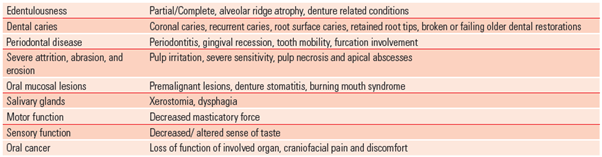
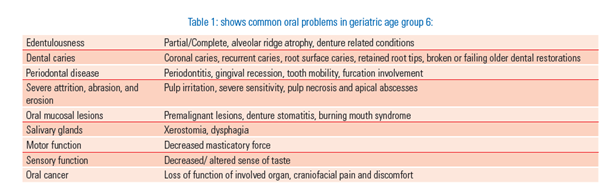
Oral diseases are cumulative and become more complex over time. Elderly have oral health challenges related to a changing dentition status, caries, periodontal pocketing and loss of attachment, edentulousness, denture related conditions, poor oral hygiene, retained root tips, attrition, abrasion and erosion, broken or failing older dental restorations, xerostomia, alveolar ridge atrophy, oral cancer, craniofacial pain and discomfort4, 5. The following table shows the common oral problems in geriatric age group (table1).
Many of these are the sequel of ignorance in the early years of life, for example, consumption of a cariogenic diet, lack of awareness regarding preventive aspects, and habits like smoking and/or tobacco, pan, and betel nut chewing. All these problems may increase in extent because of the deteriorating immunity in old age and because of concomitant medical problems. Moreover, monetary constraints and lack of family support or of transportation conveniences can further affect access to dental services in later life.
RELATIONSHIP BETWEEN ORAL AND GENERAL HEALTH:
The interrelationship between oral health and general health is exceptionally marked among older people. Dental diseases have a significant impact on general health and have negative impact on the quality of life of older adults. The incident of pain, struggle with eating and chewing, embarrassment pertaining to the shape of teeth or about missing, discoloured or damaged teeth can negatively affect people’s daily lives, confidence, self-esteem, happiness, comfort and security. Compromised chewing and eating abilities can interfere with mastication and can affect their nutritional intake. These factors can lead to inadequate diet, malnutrition, inadequate oral hygiene due to poor dexterity or limited mobility, compromised chewing and functioning abilities, lowered self-esteem, and social isolation 4, 5.
Simultaneously, most of these people have variety of systemic diseases that will have an impact on their oral health care. These are degenerative diseases of heart and blood vessels, hypertension, diabetes, arthritis, osteoporosis, respiratory illnesses like chronic obstructive pulmonary disease, cancer etc 5, 7, 8. Also, older people tend to be more sensitive to drugs and to trauma. In addition, medications like antihypertensives, antipsychotics, anxiolytics, etc., lead to xerostomia and, the lack of the defensive influences of saliva in the oral cavity augments the predisposition to oral diseases.
As a consequence of inferior systemic health, the elderly patient often does not give enough attention to oral health. The untreated oral cavity has its detrimental effects on comfort, aesthetics, speech, mastication and, consequently, on quality of life in old age. Hence, the dental management of medically compromised older patients can be problematic in terms of oral complications, dental therapy, and emergency care.
GERIATRIC ORAL HEALTH CARE
Gerodontics is the branch of dentistry that deals with the diagnosis, prevention, and treatment of dental diseases and problems specific to old people. Providing quality dental care for older patients can be very rewarding but also very challenging due to an array of complex dental and medical conditions that become more common as age progress. There is abundant of general health, functional, cognitive, social and financial problems among the group of older adults.
To provide good oral health care, dental professionals must understand the complexities of older people and their special needs. Dentists should be prepared to manage oral problems and emergencies that more commonly occur in older people. Without adequate knowledge of various social, psychological, economic aspects and systemic problems and medicines of old age; it’s difficult for dental surgeons to provide a satisfactory treatment to these patients.
Aging has an impact on oral tissues just as it has on other tissues throughout the body. As teeth age, the enamel, dentin, and pulp undergo progressive changes (table 2). Pulpal sensitivity is diminished in older teeth, and normal symptoms of dental decay or pulpal infections are reduced, altered, or eliminated. All these changes in the teeth have implications for many dental restorative procedures. The ageing of the teeth affects techniques, the design of cavity preparations, the choices of restorative materials and the anatomy and aesthetics of the final restorations. The radiographic appearance of teeth is also affected by aging, requiring modified interpretations and diagnosis5.
Many older adults can be seen at a dental office, provided that they are mobile and the office is accessible and senior friendly. More severe functionally dependent elderly persons benefit from receiving on-site, mobile care and oral health programmes. There are interdisciplinary team efforts designed to systematically address the oral health needs of nursing home residents. The provision of dental care involves not only dental staff, but also nursing staff, primary care physicians, patient representatives, and third-party payers who each have important roles to play5.
Treatment planning begins with an interview of the patient to determine his/her concerns and perceived needs followed by the objective assessment of the patient by the dentist.
The dentist must assess the patient’s ability to tolerate the potential stress of treatment and the functional capability of the patient to maintain restorations, prostheses, and periodontal health successfully and also, resources for maintaining oral health. In addition, other risk factors that could cause treatment failures need to be assessed along with a variety of factors that can affect patient’s manual dexterity. The focus should be on identifying levels of care and seeking a level of care that is optimal for the patient, given all the factors that have been assessed5.
The elderly receive a full range of dental services from examinations and preventive services to complex restorative and periodontal services. Types of dental treatments generally required by elderly patients are oral prophylaxis, treatment of caries and its complications, partial dentures with wrought wire clasps to facilitate easy removal, fixed partial dentures, implants, complete dentures and prevention and treatment of oral malignancy6.
As for other age groups, use of fluoride is effective in prevention of both coronal and root surface caries in elderly. Rinsing with a chlorhexidine solution tends to reduce gingival inflammation, pocket depth, and incidence of denture stomatitis. Further, chewing chlorhexidine acetate/xylitol gums may reduce denture stomatitis and angular cheilitis prevalence in frail older people4.
Elderly patients almost always have one or more chronic medical conditions, so it is especially important to review the medical history each time the patient visits the office5, 7, 8.
The following are some of the management issues associated with selected systemic diseases which are most common in older adults:
ARTHRITIS 7, 14,15
- Patients with rheumatoid arthritis may experience restricted manual dexterity, which may compromise their ability to maintain adequate oral hygiene. These patients may need toothbrushes with specially adapted handles (such as a handle with a ball added to help the patient grip) or may benefit from using electric toothbrushes.
- Since joint stiffness tends to improve during the day, short appointments in the late morning or in the early afternoon are recommended for patients with arthritis.
- When treating a patient with arthritis, the dentist should consider the patient’s tendency to bleed as well as any need for corticosteroid supplementation or antibiotic coverage before performing any invasive procedures.
DIABETES 7,8, 16,17
- Dentists can reduce the morbidity and mortality associated with diabetes by maintaining their patients’ oral health and by referring patients with signs and symptoms of oral complications suggestive of diabetes to physicians for further evaluation.
- Patients should receive short morning appointments to reduce stress.
- With respect to surgical procedures, the dentist should also test the patient’s blood sugar with a glucometer to avert emergency-related events such as insulin shock (profound hypoglycemia) or ketoacidosis with severe hyperglycemia before, during or after an invasive procedure.
- The dentist must consult with the patient’s physician to discuss any modifications to the dental treatment plan particularly when surgical procedures are anticipated and if systemic complications are present and/or assess the use of medications to treat oral complications.
- For patients with diabetes, the main hazard during dental treatment is hypoglycemia, the dentist can prevent this by planning, such as by administering oral glucose just before the appointment if a patient has taken his or her medication but has not had the appropriate meal.
- It is also important to have a dental office properly equipped with immediate sources of glucose in case a diabetic-induced hypoglycemic event occurs.
- The dentist should avoid administering tetracyclines, aspirin and corticosteroids, since they can disturb diabetic control.
- The dentist should manage infections aggressively and may indicate antibiotics particularly in poorly controlled diabetes, as people with diabetes may be immuno compromised.
- People who are insulin dependent can undergo minor surgical procedures within two hours of eating breakfast and receiving their morning insulin injection, with no change needed in the insulin regimen.
- Patient with diabetes who is going to receive extensive procedures should be given dietary instructions after surgery.
- Schedule patients for frequent recall visits to monitor and treat oral complications and maintain optimal oral hygiene and diet.
HYPERTENSION 7,8, 18,19
- It is particularly important to help a patient with hypertension avoid anxiety and pain.
- Blood Pressure should be controlled before the dentist begins elective dental treatment.
- If the patient has a persistently high BP, the dentist should seek the opinion of the patient’s physician before commencing dental treatment and continuous or periodic BP monitoring may be indicated.
- If the patient’s BP rises, the dentist should discontinue dental treatment, place the patient in a supine position, allows the patient to rest, and re-check the BP after five minutes.
- If at that point the blood pressure is consistently high, the dentist should call for emergency medical help.
- By the end of the dental session, aged patients under antihypertensive drugs may suffer with orthostatic hypotension, and so the dentist should elevate the back of the dental chair to the upright position slowly and in stages.
CARDIOVASCULAR DISEASES 7,8, 20-23
- All staff members in a dental office should be certified in basic cardiopulmonary resuscitation (CPR), and the dentist should have the entire team rehearse emergency protocol procedures regularly, including knowing how to gain access to nitroglycerin, oxygen and emergency medical help.
- Patients with heart disease should take their medications as usual on the day of the dental procedure, and they should bring all their medications to the dental office for review at the time of the first dental appointment.
- The dentist should keep on the patients’ records all medications in use as well as update this information on each and every appointment.
- Since cardiac events are most likely to occur in the early morning, dentists should see patients with cardiac disease in late morning or early afternoon appointments.
- Prophylactic administration of 0.3 to 0.6 mg of nitroglycerine may be indicated if the patient has angina more than once a week.
- The dentist should consult the patient’s physician before providing dental care for patients with unstable angina or to patients who have had a recent myocardial infarct (MI), angioplasty or stent placement.
- During the first 6 months after an ischemic episode, dental treatment should be limited to emergency situations aimed at providing pain relief.
- The dentist and team should provide dental care with a stress reduction protocol and with good analgesia.
- Dentists should be cautious about the use of certain drugs with patients who have heart disease like anticoagulants, antiplatelet drugs, etc.
- If discontinuation of thrombolytic medication is required, the decision to provide dental treatment must be taken in coordination with the physician supervising the patient medication.
- When the antiplatelet medication cannot be interrupted at the time of an invasive dental treatment and a risk of bleeding is anticipated, local hemostatic measures must be applied such as sutures, platelet-rich plasma, electric or laser scalpel.
- Antihypertensive drugs may lead to orthostatic hypotension, so the dentist should raise the back of the patient’s reclined dental chair to the upright position slowly and in stages.
- According to the American Heart Association revised guidelines for infective endocarditis (IE), individuals considered at the highest risk for adverse outcome from endocarditis and to whom antimicrobial prophylaxis is advised are those with prosthetic cardiac valve or prosthetic material used for cardiac valve repair, previous IE, congenital heart disease and cardiac transplantation recipients who develop cardiac valvulopathy.
STROKE 7,8, 24-26
- It is recommended that the first post-stroke dental appointment is scheduled only six months after the CVA episode.
- Support with preventive care is critical; oral hygiene tends to deteriorate on the paralyzed side, and impaired manual dexterity may interfere with toothbrushing. Use of an electric toothbrush or adaptive holders may help.
- Dentists should defer elective and invasive dental care for patients who have had transient ischemic attacks or strokes for three months after the event.
- Short treatment sessions in midmorning are desirable for these patients.
- They are best treated in the upright position, with extra care taken to avoid foreign bodies’ entering the pharynx.
- The practitioner needs to monitor BP and anticoagulation status before beginning any dental treatment.
- It is important to communicate clearly with the patient who has experienced a cerebrovascular accident by not wearing a mask, by facing the patient and by speaking slowly and clearly and by using language that is not complex.
- Patients with stroke are frequently treated with oral anticoagulants, such as warfarin sodium (antivitamin K), and the dentist must consult the patient’s physician about the need of altering the drug regimen before undergoing invasive therapies.
- In order to prevent a subsequent stroke, the dentist must treat active infections aggressively, since even a minor infection may alter blood coagulation, trigger thrombus formation and cause cerebral infarction.
- The dentist may initiate a long-term regimen of chlorhexidine mouthrinses to aid in plaque control.
CONCLUSION
Improved oral health will lead to improved quality of life through increased personal dignity, improved nutrition, better appearance, better hygiene, and greater comfort or relief from pain. Caring for aging population presents enormous challenges to healthcare providers and the entire healthcare system. Meeting the oral health needs of elderly adults requires approaches to dental treatment planning that take into account the special needs of the elderly.
Education and continuous training must ensure that oral health care providers have skills in and a profound understanding of the biomedical and psychosocial aspects of care for older people. Also, special knowledge, attitudes, and skills are necessary for oral health providers to provide oral health care to the elderly. The ultimate goal of geriatric treatment is to seek the highest level of care that is appropriate and necessary to maintain the individual patient’s oral and general health.
REFERENCES
- UNDESA, World Population Ageing 2011 (2012; forthcoming), based on UNDESA Population Division medium projection scenario, World Population Prospects: The 2010 Revision.
- World Health Day 2012 – Ageing and Health. http://www.who.int/kobe_centre/ageing/world_health_day_2012/en/ (accessed on 16-1-2013)
- Murdock SH, Hoque MN. Current patterns and future trends in the population of the United States: implications for dentistry and the dental profession in the twenty-first century. J Am Coll Dent. 1998; 65(4):29-35.
- Petersen PE, Yamamoto T. Improving the oral health of older people: the approach of the WHO Global Oral Health Programme. Community Dent Oral Epidemiol 2005; 33: 81–92.
- Michael J. Helgeson, Barbara J. Smith, Mary Johnsen, Carl Ebert. Dental Considerations for the Frail Elderly. Spec Care Dentist 2002; 22(3):40S-55S.
- Satish Chandra and Shaleen Chandra. Textbook of Community Dentistry published by Jaypee brothers’ medical publishers (P) LTD, first edition 2000, Page 242, 249.
- Crispian Scully and Ronald L. Ettinger. The influence of systemic diseases on oral health care in older adults. JADA 2007; 138 (9 supplement):7S-14S.
- Carolina Beraldo Meloto; Célia Marisa Rizzatti-Barbosa; Simone Guimarães Farias Gomes; William Custodio. Dental practice implications of systemic diseases affecting the elderly: a literature review. Braz J Oral Sci.2008; 7(27):1691-1699.
- Morse DR, Esposito JV, Schoor RS, Williams FL, Furst ML. A review of aging of dental components and a retrospective radiographic study of aging of the dental pulp and dentin in normal teeth. Quintessence Int 1991; 22:711.
- Kochavi D, Gedalia I, Anais J. Effect of conditioning with fluoride and phosphoric acid on enamel surfaces as evaluated by scanning electron microscopy and fluoride incorporation. J Dent Res 1975; 4:304.
- Mendis BR, Darling AL. Distribution with age and attrition of peritubular dentine in the crowns of human teeth. Archs Oral Biol 1979; 24:131.
- Pashley DH. Clinical correlations of dentin structures and function. J Prosthet Dent 1991; 66:777.
- Burke FM, Samarawickrama DYD. Progressive changes in the pulpo-dentinal complex and their clinic consequences. Gerodontology 1995; 12:57.
- Montandon AA, Pinelli LA, Fais LM. Quality of life and oral hygiene in older people with manual functional imitations. J Dent Educ 2006; 70(12):1261-2.
- Ettinger RL. Oral care for the homebound and institutionalized. Clin Geriatr Med 1992; 8(3):659-72.
- Anthony T. Vernillo. Dental considerations for the treatment of patients with diabetes mellitus. J Am Dent Ass: 2003; 134 (1): 24S-33S.
- Ship JA. Diabetes and oral health. J Am Dent Ass. 2003; 134(1):4S-10S.
- Yagiela JA, Haymore TL. Management of the hypertensive dental patient. J Calif Dent Assoc. 2007; 35: 51-9.
- Herman WW, Konzelman JL Jr, Prisant LM; Joint National Committee on Prevention, Detection, Evaluation, and Treatment of High Blood Pressure. New national guidelines on hypertension: a summary for dentistry. J Am Dent Assoc. 2004; 135 (5):576-84.
- Niwa H, Sato Y, Matsuura H. Safety of dental treatment in patients with previously diagnosed acute myocardial infarction or unstable angina pectoris. Oral Surg Oral Med Oral Pathol Oral Radiol Endod. 2000; 89: 35-41
- Miloro M. Congestive heart failure. Oral Surg Oral Med Oral Pathol Oral Radiol Endod. 2000; 90: 9-11.
- Hupp JR. Ischemic heart disease: dental management considerations. Dent Clin North Am. 2006; 50: 483-91.
- Daniel NG, Goulet J, Bergeron M, Paquin R, Landry PE. Antiplatelet drugs: is there a surgical risk. J Can Dent Assoc. 2002; 68: 683-7.
- Little JW, Falace DA, Miller CS, Rhodus NL. Diabetes. In: Little JW, editor. Dental management of the medically compromised patient. 6th ed. St. Louis: Mosby; 2002. p. 248-70.
- Rose LF, Mealey B, Minsk L, Cohen W. Oral care for patients with cardiovascular disease and stroke. J Am Dent Assoc. 2002; 133(1): 37S-44S.
- Syrjanen J, Peltola J, Valtonen V, Iivanainen M, Kaste M, Huttunen JK. Dental infections in association with cerebral infarction in young and middle-aged men. J Intern Med. 1989; 225: 179-84.
Disclaimer from Guident
The views and opinions expressed in articles published in Guident are solely those of the authors and do not necessarily reflect the views of the editors, the editorial board or the publisher, Ivory India. Guident does not endorse any product, technique or treatment described. Clinical content is intended for qualified dental and medical professionals and is not a substitute for individual clinical judgement. Guident, its editors and the publisher accept no liability for any consequence arising from the use of information published in the journal.
How to cite this article
Dr. Nishu Singla, Dr. Ritesh Singla. Oral Health Care in Aging. Guident. 2013 Nov;6(13). Available from: https://ivoryindia.in/articles/general/oral-health-care-in-aging.html