Molar Protraction: A Physiologic Alternative to Prosthesis
Terna Dental College, Terna Dental College, A.B.Shetty Memorial Institute of Dental Sciences Mangalore, India, Department of Orthodontics and Dentofacial Orthopaedics
Abstract
A missing tooth in a dental office is always a potential case for a bridge or an implant. Advantage of a prosthesis is that treatment outcome is predictable and the time taken is shorter.Another possibility that can be explored in some cases, especially in young individuals is the closure of such spaces to give a physiologically balanced occlusion, thus avoiding the lifelong maintenance of prosthesis. Many orthodontic patients have posterior spacing due to either a missing tooth or extracted due to caries.This article deals with posterior bilateral (iatrogenic) extraction spaces closed orthodontically by molar protraction.
INTRODUCTION
Edentulous spaces in the dental arches can be managed with various treatment modalities, depending on the location and the amount of space present. Conventionally they have been managed with either implants or other fixed prosthesis like veneers or bridges. Another possibility is closing these spaces, orthodontically. This allows the elimination of the need for prosthesis and therby avoids all the complications of the same. It also allows restoration of an ideal occlusion and arch integrity without resorting toartificial alternative. Minor edentulous spaces do not need complex orthodontic treatment. However closure of the entire extraction space may require use of appropriate mechanics for its success. This article presents an unusual case report where the extraction spaces created for retraction were closed orthodontically by protracting the molars.
Molar protraction can be an alternative to restoration with posterior dental implants or fixed partial dentures. The case report presented in this article deals with closure of the posterior edentulous spaces by molar protraction (mesial movement of the molar into the edentulous space) with loop mechanics.
CASE REPORT
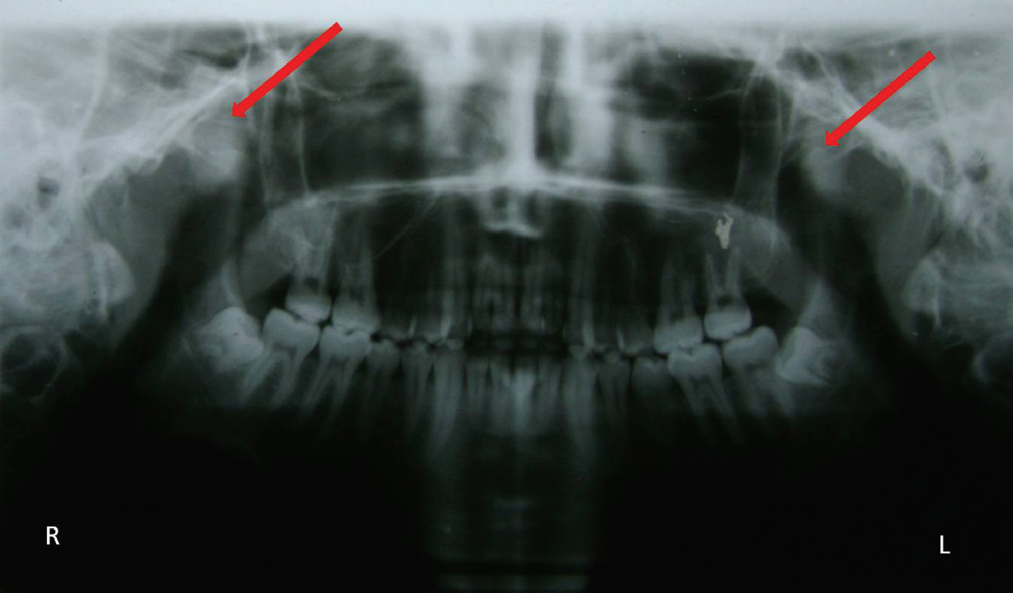
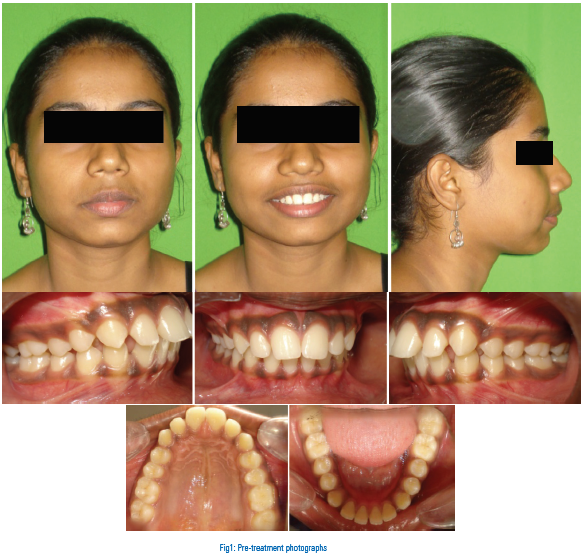
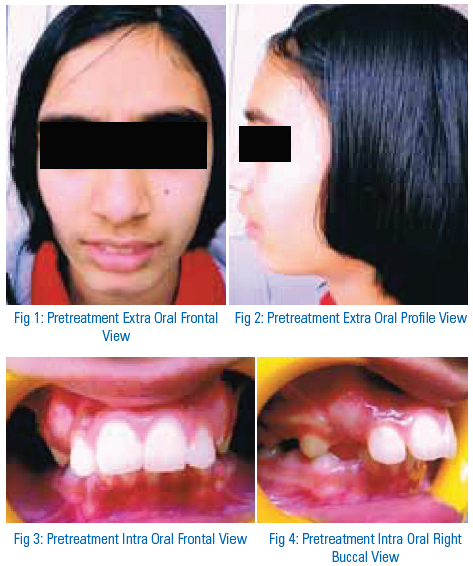
A 20 yr. old young female reported to the Department of Orthodontics with bilateral extraction spaces in the upper arch, which had been extracted for orthodontic purpose by a clinician. On clinicalexamination, she presented an excessive overjet and overbite. Therewas around 10 mm spacing in the upper anterior region. Molar and canine relations were class I on both the sides and curve of spee was accentuated. Since the patient had a good facial profile with spacing in the anterior region, extraction of the lower premolars was not considered.
For the closure of the extraction spaces the following options were considered.
Restoration of the edentulous space by an implant followed by prosthesis. 2) Restoring the space by means of a Fixed partial denture. 3) Closure of the extraction space by protraction of themolars mesially. The patient discarded the first two and opted for the closing of the extraction space orthodontically by protraction of molars and second premolars.
The treatment plan included bonding of both the arches, closureof the anterior spaces by retraction to reduce the overjet and then protraction of the molars and second premolars to close the

extraction space. Space closure was done using loop mechanics with an Omega loop bilaterally.
The initial leveling and alignment was carried out with the help of flexible nickel-titanium wires and the curve of spee was levelled. The upper anterior teeth were retracted sufficiently to eliminate their proclination and to establish an ideal overjet and an overbite relationship the total duration of the treatment was 8 months.
The post -treatment photographs show the complete closure of the extraction space with molars ending in a full cusp class II relation. The final result shows a comfortable occlusion, an ideal overjet and overbite and a good posterior intercuspation. At the end of the treatment. The patient was happy to have straighter teeth, a pleasant smile and above all, the edentulous space had been closed completely, without the need for any prosthesis.


DISCUSSION
Although much easier than Mandibular molar protraction, the large root surfaces of maxillary molars make their movement uncertain. It can also simultaneously cause unwanted tooth movements such as lingual tipping of the incisors. The advent of the skeletal anchorage systems like mini implants or mini plates have overcome this disadvantage to a large extent. But due to its high cost and invasive nature it is not often the method of choice. Loop mechanics offers many distinct advantages over sliding
mechanics during protraction of molars like reduced friction and its ability to adapt to differential tooth movement. The desired type of

tooth movement can be produced by altering the moment to force (M: F) ratio.
Omega loop is a variation of the open vertical loop. It is named so, because of its resemblance to the greek letter Omega. It tends todistribute the stresses more evenly through the curvature instead of concentrating the stress at the base. The alpha bend was increasedfor reinforcing the anterior anchorage. In a case like this where loss of anchorage was unacceptable and patient was not willing for placement of an implant, Protraction of the molars with omega loop proved to be advantageous.
CONCLUSION
A fixed prosthesis has always been the preferred option for patients with large edentulous spaces However, prostheses have certain limitations: initial cost, partial destruction of abutment teeth, secondary caries, and mechanical failures to name a few. Hence, closure of the space orthodontically has become a preferred alternative. Although it involves good skills and a thorough knowledge of biomechanics, the end result and retention might be superior in the long run. From a clinical perspective, this case demonstrates that by using the loop mechanics we can efficiently protract the molars without resorting to other complex and invasive treatment modalities.
REFERENCES
- Best prosthesis is no prosthesis: Molar protraction, a case report Goyal Amit, Shivalinga BM,
- Jyothikiran H Journal of Pharmaceutical and Biomedical Sciences Vol. 18, Issue 18.
- Moyers RE. Handbook of orthodontics. Chicago: Year Book Medical Publishers; 1988
- Graber TM. Orthodontics: principles and practice. Philadelphia: Saunders; 1972.
- O.P Kharbanda , Orthodontics Diagnosis and management of malocclussion and dentofacial deformities
- Vijay Jayade, Essentials of orthodontic biomechanics, Basic and Applied
- Creekmore TD, Eklund MK. The possibility of skeletal anchorage. J Clin Orthod 1983;17:266-9.
Disclaimer from Guident
The views and opinions expressed in articles published in Guident are solely those of the authors and do not necessarily reflect the views of the editors, the editorial board or the publisher, Ivory India. Guident does not endorse any product, technique or treatment described. Clinical content is intended for qualified dental and medical professionals and is not a substitute for individual clinical judgement. Guident, its editors and the publisher accept no liability for any consequence arising from the use of information published in the journal.
How to cite this article
Dr. Prakash Mudaliar, Dr. Shailesh Shenava, Dr. Prajwal Shetty. Molar Protraction: A Physiologic Alternative to Prosthesis. Guident. 2013 Nov;6(13). Available from: https://ivoryindia.in/articles/orthodontics/molar-protraction-a-physiologic-alternative-to-prosthesis.html