Predictors of Interest for COVID-19 Vaccination Among the Indian Population Using Health Belief Model
Department of Public Health Dentistry A.J Institute of Dental Sciences, AJ Campus, Kuntikana, Mangalore
ABSTRACT
BACKGROUND:
Several life threatening viruses have emerged recently and have been responsible for increase in the mortality rate and also raising serious health problems throughout the world.COVID-19 has been labelled as Public Health Emergency of International Concern. At the beginning and during the pandemic, there was widespread media coverage about the novel Corona virus but little was known about the perceptions of the people towards the vaccine. Hence the aim of the study was to assess the predictors of interest of the participants towards COVID-19 vaccination
METHODS:
A cross sectional study was conducted for a period of 2 months. The study participants included in the study were above the age of 18 years, those who consented to be a part of the study. The data was collected using convenience sampling. A pre-tested questionnaire was prepared consisting of 25 questions. The questions consisted of 2 parts; the first part consists of basic demographic data and the second part consists of the questions based on the constructs of the Health Belief Model. The questions were circulated through google forms. The questions were checked for validity and reliability.
RESULTS:
A total of 260 participants completed the questionnaire. 48.8% of the study participants agreed that they are at the risk of getting infected with COVID-19 virus if they were not vaccinated. 52.7% of the study participants agreed that the severity of the infection would be more if they were not vaccinated. The need for social distancing, wearing mask and washing hands regularly was not required if vaccinated was agreed by 70.4% of the study participants. 52.3% of study participants agreed that they did not have adequate information regarding the vaccine, however 42.7% disagreed that vaccination is not good for health. Social media played a vital role to provide information regarding vaccination to the study participants. Primary health care workers played a very important part in recommending vaccine to the study participants.
CONCLUSION:
The study concludes that though the participants had the fear of getting infected with the COVID-19 virus, their awareness towards vaccine acceptance and uptake was minimal. This may be influenced by complex psychological, social, political and cultural factors. Hence awareness program needs to be geared up to share many insights regarding maintaining the vaccine demand during and after the COVID infection.
KEY WORDS:
Vaccination, pandemic, coronavirus, public health, Health Belief Model
INTRODUCTION
Several life threatening viruses have emerged recently which have been responsible for increase in the mortality rate and also raising serious public health concerns throughout the world. In these modern lifestyle, travel of humans and goods, outbreak of a disease in any part of the world could lead to a risk everywhere.2
In the past 2 decades, this is the third instance of emergence of novel virus after Middle East Respiratory Syndrome Corona Virus (MERS-CoV) and Severe Acute Respiratory Syndrome Corona Virus (SARS-CoV). The repeated emergence, global scale of transmission, increase in number of deaths have been the major cause of concern. COVID-19 has been labelled as a Public Health Emergency of International Concern (PHEIC) and the epidemic curves are still on rise.3
The virus has already affected in most of the nations all over the world. The novel corona virus has infiltrated into India too affecting more than 7 million people. With a huge population of 1.3 billion people, India could become the new epicentre of COVID-19. The WHO has stated that “future of the pandemic will depend on how India handles it” because of the population density, poor socio economic conditions and lack in health care resources.4
At the beginning and during the pandemic, there was widespread media coverage about the novel corona virus but little was known about the perceptions of the people towards the vaccine.1 Vaccines work by training and preparing the body’s immune system to recognize and fight off the viruses and bacteria they target. The vaccination of COVID-19 is in its clinical trial phase.
The Health Belief Model is a tool which is used to explain patients behaviour in the face of an illness or the risk of falling ill. The HBM comprises several main constructs: perceived susceptibility, perceived severity, perceived benefits, perceived barriers, self-efficacy to engage in a behavior and cues to action. Perceived susceptibility refers to beliefs regarding vulnerability to infection, while perceived severity refers to beliefs regarding the negative effects of contracting the infection. In relation to vaccination, perceived benefits are defined as an individual’s beliefs about being vaccinated, and perceived barriers are described as the belief that being vaccinated is restricted due to psychosocial, physical or financial factors. Cues to action include information, people and events that guide an individual to be vaccinated.5
Hence the aim of the study is to assess the predictors of interest for the COVID-19 vaccination among the Indian population using Health Basic Model (HBM)
MATERIALS AND METHODS
A cross sectional questionnaire study was conduct ed for a period of 2months. The data was collected using convenience sampling. Ethical clearance was obtained from the Institutional Ethics Committee before the commencement. A pre-tested questionnaire was prepared consisting of 25 questions. The questions consisted of 2 parts; the first part consists of basic demographic data and the second part consists of the questions based on the constructs of the Health Belief Model. The questions were circulated through google forms. The questions were checked for validity(face and content)and reliability. The questions were made in English as well as in the regional language. The questionnaire derived from the constructs of the Health Belief Model was divided into Perceived Susceptibility, Perceived Severity, Perceived Benefits, Perceived Barriers and Cues to action.
INCLUSION CRITERIA
- Study participants should be above the age group of 18 years of age
- Study participants for whom the informed consent had been obtained in an electronic format
EXCLUSION CRITERIA
- Study participants who are not willing to participate
STATISTICAL ANALYSIS
The data was fed into Excel sheet and descriptive analysis was done using SPSS Software Version 23
RESULTS
A total of 260 participants completed the questionnaire. The first part consisted of the demographic details which had 3 questions. The study participants were mostly males (64.2%) and 35.4% were females. The age group ranged from 18-81 years with the mean age group being 28years. 56.9% of the population had graduated with a degree, 22.7% had a post-graduation degree, 15.8% having intermediate or diploma and with 3.8% having a high school education level and 0.8% with middle school education (Table No 1).
The second part of the questionnaire was divided into 5 sections based on the construct of the Health Belief Model which had a total of 21 questions.
Perceived Susceptibility (Table No 2) comprised of 3 questions: 48.8% of the study participants agreed that they are at the risk of getting infected with COVID-19 virus if they were not vaccinated. 51.5% agreed that the family members are at risk of getting infected with the virus if not vaccinated and 81.9% were aware about the risk of getting infected with the virus if not vaccinated.
Perceived Severity (Table No 3) consisted of 5 questions: 52.7% agreed that the severity of getting infected was more if not vaccinated. 35.4% disagreed that they will lose income if they get infected. 70% agreed that other members in the home will also fall sick if they got infected while 60.8% disagreed that of they got infected, it maybe fatal and 52.7% agreed that they would develop complications if they get infected.
Perceived Benefits (Table No 4) had 4 questions: 63.8% agreed that by getting vaccinated it will reduce their chance of contracting the disease. 70.4% agreed that need not follow social distancing, wearing mask and washing hands if vaccinated. 60.4% agreed they will get back to their routine early if vaccinated and 71.4% agreed vaccination would reduce stress due to the virus.
Perceived Barriers (Table No 4) contained 5 questions: 52.3% agreed that they did not have enough information about the vaccine. 56% had neutral opinion about developing side effects due to getting vaccinated. 54% had neutral opinion about the vaccine not being good for health. 58% agreed that they will not be able to afford the vaccine. 50% doubted the efficacy of the vaccine.
Cues to action (Table No 5) consisted of 2 questions which were vaccine information sources and about the source of vaccination recommendations. Majority of the vaccine information sources was through the social media (47.3%) followed by newspaper (23.1%), television (20%) and the least being through advertisement (1.5%). 67.3% got recommended about vaccination through the physicians while 84.2% recommendations were by the primary health care workers and the highest recommendation was through the pharmacist (87.7%)
TABLE NO 1: SHOWING THE DEMOGRAPHIC DETAILS OF THE STUDY PARTICIPANTS
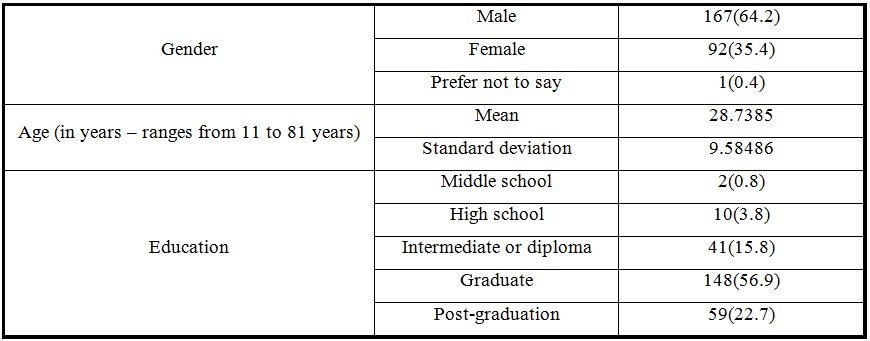
TABLE NO 2 :QUESTIONS RELATED TO PERCEIVED SUSCEPTIBILITY

TABLE NO 3 :QUESTIONS RELATED TO PERCEIVED SEVERITY
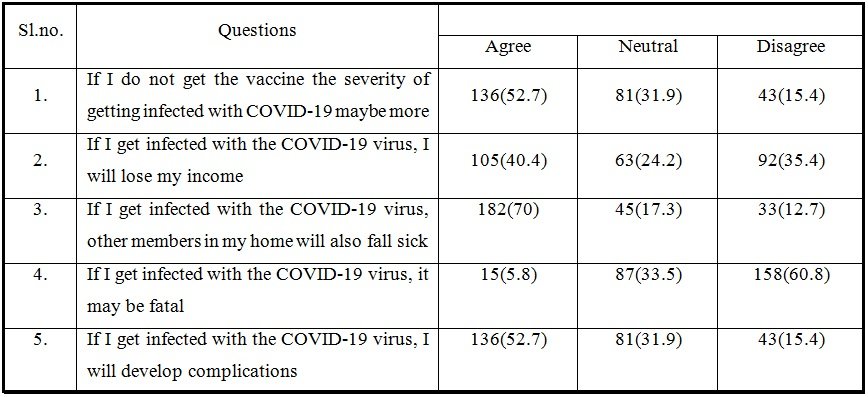
TABLE NO 4 :QUESTIONS RELATED TO PERCEIVED BENEFITS
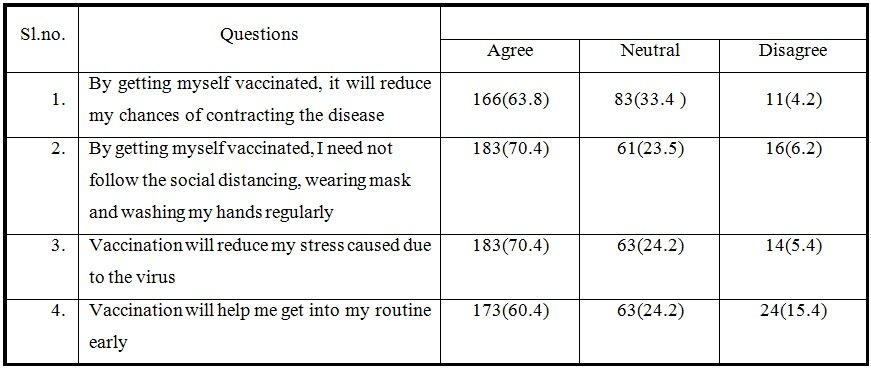
TABLE NO 5 :QUESTIONS RELATED TO PERCEIVED BARRIERS

TABLE NO 5 :QUESTIONS RELATED TO CUES TO ACTION:

DISCUSSION
The Indian Government started administration of vaccine against COVID-19 on 16 January 2021. Covishield and Covaxin received permission for emergency use. Lately Sputnik V was approved as the 3rd vaccine in April 2021.11
This study was conducted to assess the predictors of interest of the participants towards COVID-19 vaccination using the Health Belief Model (HBM) and investigated various socio-demographic factors. The HBM is a model that is used to guide health promotion and disease prevention programs. It is used to explain and predict individual changes in health behaviours which are most widely used models for understanding health behaviours. The key elements of this model include the Perceived Susceptibility, Perceived Severity, Perceived Benefits, Perceived Barriers and Cues to Action.
Findings in relation to health beliefs and the descriptive findings regarding the perceived susceptibility towards the COVID-19 vaccination showed that despite the fact that many are worried about them getting infected with COVID-19, very few viewed themselves as becoming infected with the virus if they were not vaccinated. This brings us to the notice that we need to increase the perception among the people. Most of the study participants had high perceptions towards the severity of the disease if they did not get vaccinated. The various barriers towards receiving COVID-19 vaccination were about the introduction of a new vaccine, worrying about the side effects, its availability and its affordability. When comparing with the Perceived benefits and the Barriers, the study participants were less concerned about the cost of the vaccination when compared to that of the safety and efficacy of the vaccine. Social media was the source through which study participants received the information regarding the vaccine. Most of them had not recommended about the vaccination through their physician.
The present study aimed to analyse the predictors of interest and barriers against COVID-19 vaccine. Majority of the study participants were educated. The mean age of the study participant was 28.73 years. Majority of them felt that vaccination would reduce the threat of being infected. This is in accordance to a study done Sharun K.12
Majority of the study participants believed that the chances of getting the infection would be less after getting vaccinated which are similar to the results among the general population of Russia.9
It was observed that most of the participants gave a positive response towards the perceived susceptibility, perceived severity and perceived benefits towards receiving the vaccine which is equivalent to a study done in Malaysia where the Health Belief Model was used to assess COVID-19 vaccine intake among the general population.5
A study which was conducted in Hong Kong reported that COVID-19 vaccine intake was associated with the trust in the healthcare system which was provided to them by their physicians.10 It was observed in the present study that the physicians had not recommended regarding the vaccination. Hence the healthcare professionals and physicians should encourage the public towards receiving the vaccination creating more awareness about the vaccination and its benefits.
It was found that the participants who had disagreement on perceived barriers where still likely to accept the COVID-19 vaccine which was in contrast with the study done in Hong Kong where no correlation was found between the perceived barriers and the intention to receive the vaccine.5
The acceptance towards the vaccination varies depending on various factors such as the socio demographic factors, psychological factors, socio economic status etc. The main barrier towards the public not getting vaccinated maybe because of the side effects, safety and the necessity of the vaccines. Myths regarding the vaccine not being important should be eliminated. More awareness and studies needs to be done regarding the safety and effectiveness of the vaccine is required so that we can remove the vaccine related concerns which people have. The sooner people will accept the COVID-19 vaccine, the better the world will come out of the pandemic.11
CONCLUSION
The study concludes that the major source of information regarding the vaccine was from social media. Though the study participants perceived their susceptibility to get infected enough information was not provided regarding the benefits of vaccination by the health professionals, Hence there is a need to compel the health professionals to take, or more active role in promotion of vaccination, as well as the barriers that they need to overcome to achieve a COVID free world.
REFERENCES
- Coe AB, Gatewood SB, Moczygemba LR. The use of the health belief model to assess predictors of intent to receive the novel (2009) H1N1 influenza vaccine. Innovations in pharmacy. 2012 Jan 1;3(2):1.
- Al-Hazmi A. Challenges presented by MERS corona virus, and SARS corona virus to global health. Saudi journal of biological sciences. 2016 Jul 1;23(4):507-11.
- Chatterjee P, Nagi N, Agarwal A, Das B, Banerjee S, Sarkar S, Gupta N, Gangakhedkar RR. The 2019 novel coronavirus disease (COVID-19) pandemic: A review of the current evidence. Indian Journal of Medical Research. 2020 Feb 1;151(2):147.
- Pal R, Yadav U. COVID-19 pandemic in India: present scenario and a steep climb ahead. Journal of Primary Care & Community Health. 2020 Jul;11:2150132720939402.
- Wong LP, Alias H, Wong PF, Lee HY, AbuBakar S. The use of the health belief model to assess predictors of intent to receive the COVID-19 vaccine and willingness to pay. Human vaccines & immunotherapeutics. 2020 Aug 1:1-1.
- Costa MF. Health belief model for coronavirus infection risk determinants. Revista de Saúde Pública. 2020 May 20;54:47.
- Kartheek AV, Gara KH, Vanamali DR. Knowledge, attitude and practices towards COVID-19 among Indian residents during the pandemic: A cross-sectional online survey. Journal of Dr. NTR University of Health Sciences. 2020 Apr 1;9(2):107.
- Dash R, Agrawal A, Nagvekar V, Lele J, Di Pasquale A, Kolhapure S, Parikh R. Towards adult vaccination in India: a narrative literature review. Human Vaccines & Immunotherapeutics. 2020 Apr 2;16(4):991-1001.
- Tran, V.D.; Pak, T.V.; Gribkova, E.I.; Galkina, G.A.; Loskutova, E.E.; Dorofeeva, V.V.; Dewey, R.S.; Nguyen, K.T.; Pham, D.T. Determinants of COVID-19 vaccine acceptance in a high infection-rate country: A cross-sectional study in Russia. Pharm. Pract. 2021, 19, 2276.
- Mahmud I, Kabir R, Rahman MA, Alradie-Mohamed A, Vinnakota D, Al-Mohaimeed A. The health belief model predicts intention to receive the covid-19 vaccine in saudi arabia: Results from a cross-sectional survey. Vaccines. 2021 Aug;9(8):864.
- Das B, Padhey A. Public Perception and Potential Acceptance of COVID-19 Vaccine in India. Public Health Rev Int J Public Health Res. 2021;8(2):23-31
- Sharun K, Rahman CF, Haritha CV, Jose B, Tiwari R, Dhama K. Covid-19 vaccine acceptance: Beliefs and barriers associated with vaccination among the general population in india. Journal of Experimental Biology and Agricultural Sciences. 2020 Jan 1;8(Special Issue 1).
Disclaimer from Guident
The views and opinions expressed in articles published in Guident are solely those of the authors and do not necessarily reflect the views of the editors, the editorial board or the publisher, Ivory India. Guident does not endorse any product, technique or treatment described. Clinical content is intended for qualified dental and medical professionals and is not a substitute for individual clinical judgement. Guident, its editors and the publisher accept no liability for any consequence arising from the use of information published in the journal.
How to cite this article
Dr. Pramada Prabhakar, Dr. Vijaya Hegde. Predictors of Interest for COVID-19 Vaccination Among the Indian Population Using Health Belief Model. Guident. 2021 Jul;14(8). Available from: https://ivoryindia.in/articles/general/predictors-of-interest-for-covid-19-vaccination-among-the-indian-population-using-health-belief-model.html