Recent Advancements of Plaque Control
K.D Dental College & Hospital, Mathura, India
INTRODUCTION
Damocrates, a Greek physician, considered cleanliness as the indispensable condition for avoiding disease of theteeth and gums.1 The main aim of periodontal treatment is to achieve the healthy status of periodontium. Dental plaque and oral biofilms are the main causative factors for periodontal diseases. The term plaque control, refers to the preventive measures aimed at removing dental plaque andpreventing it from recurrence. Plaque control can be achieved eithermechanically or chemically as well as by the combination oftwo procedures.2The new therapeutic approaches that will be discussed in this review are divided into twocategories: probiotics and vaccines.3The present article provides a review on recent advancements in mechanical plaquecontrol aids.2Recent advances in oral hygiene aids including improvement toothbrushes, dentifrices, replacement therapy, immunization, photodynamic therapy and laser, would helps to achieve better plaque control.
SMART TOOTHBRUSHES
These advanced toothbrushes do not justrestrict their functions of scrubbing teeth with a plastic handle;they also promote better oral health with less effort using theiradditional cleaning mechanisms.2
POWERED TOOTHBRUSEHED
Today, many types of powered toothbrushes designed for home use are available, some with reciprocating bristle tufts and brushes that use low-frequency acoustic energy to enhance cleaning ability. Powered toothbrushes that have shaped tips designed for interproximal cleaning are also available. All powered toothbrushes rely on mechanical contact between the bristles and the tooth to remove plaque.4

IONIC/PROTON TOOTHBRUSH
Ionic toothbrushes charge the surface charge of a tooth by an influx of positively charged ions. The plaque with a similar charge is thus repelled from the tooth surface and is attracted by the negatively charged bristles of the tooth brush.5
ULTRASONIC TOOTHBRUSH
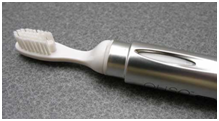
The ultrasonic toothbrush is a manual toothbrush, in which apiezoelectric ultrasonic emitter is embedded in the brush head. It works motionlessly as an ultrasonic rather than an electronic toothbrush whichreduces plaque and lowers risk for periodontal disease. Itis also beneficial in destroying bacteria and for removal of stains ofcoffee, wine, nicotine, and food.2

ULTRAVIOLETSTERILIZED TOOTHBRUSH SYSTEM
The ultraviolet (UV) sterilized toothbrush system concept,is helpful for those who have habit of keeping everythingclear and germfree. On an average, 10,000,000 bacteria liveon a toothbrush. In the UV‑sterilized toothbrush system, UVbase helps to sterilize the toothbrush whenever it is placedand can hold up to a quartet of UV pods to keep a smallfamily`s toothbrushes safe and bacteria free whenever theyare not in use. Recently, few studies indicated the use of UV light as the mosteffective household method to sanitize the toothbrushes aftercontamination.2

LASER TOOTHBRUSHES
Dentinal hypersensitivity is one of the most commoncomplications that affect patients both in daytoday lifeas well as after periodontal therapy. Laser toothbrushes are an improved version of the modern toothbrush that emitsred (635 nm) light in the visible spectrum produced by adiode laser inside the toothbrush powered with an AA battery.Another advantage of using laser in toothbrush is that the patient can use it at home, whichis costeffective, less timeconsuming and easily used bypatients.
Ko et al. in 2014 and Yaghini et al. in 2015 tested the efficacyand the safety of a lowlevel laseremitting toothbrush on themanagement of dentinal hypersensitivity and concluded thatthe use of the lowlevel laseremitting toothbrush is a safeand effective treatment option for the management of dentinalhypersensitivity.2

REPLACEMENT THERAPY
To replace potential pathogenic micro-organisms with genetically modified organisms that are less virulent. This can be done in following two ways.
A. Probiotics
The term probiotic was originally proposed in 1965 asan antonym to the term antibiotic, and probioticsare currently defined by the Word Health Organizationas live micro-organisms which, when administered inadequate amounts, confer a health benefit on the host.3
Probiotics can be defined as “Live microorganisms that, when administered in adequate amounts, confer a health benefit to the host”.The International Study Group on New Antimicrobial Strategies (ISGNAS) developed a concept for the detailed definition of probiotics in three categories:
- Medical probiotics (drugs): A medical probiotic is a microbial preparation which contains live and/or dead microorganisms including their components and products determined to be employed as a drug for therapeutic purposes.
- Pharmaceutical probiotics (food supplements): A pharmaceutical probiotic is a microbial preparation designed for production of food supplements.
- Alimentary probiotics (food): An alimentary probiotic is a microbial preparation designed for use in food fermentation or food production.
Some of the usually known probiotics are lactose, inulin, fructo-oligosacccharides, galacto- oligosaccharides and xylo-oligosaccharides. Naturally found probiotics include certain fruits like bananas, asparagus, garlic, tomato and onion.6
B. Immunization
Porphyromonas gingivalis, a Gram-negative anaerobe, has beenimplicated as an important periodontal pathogen interms of its virulence.Gingipains are present in large quantities on the cell surface of Porphyromonas gingivalis, and play a major rolein the pathogenesis of periodontitis by dysregulating thehost defense mechanisms and degrading various hostproteins.3
These vaccines can be of three types which include:
1) Vaccines prepared from pure cultures of streptococci, and other oral microorganisms.
2) Autogenous vaccines
3) Stock vaccines
There are many limitations in periodontal vaccination, which may include:
- High risk of reactivity with the human counterparts.
- Contamination with unwanted proteins, toxins or live viruses in hypersensitive individuals.
- If killed vaccines are not completely killed they may cause serious problems in immune-compromised patients.6
NEW TREATMENT APPROACHES
Laser
A laser is defined as a photo-thermal device that produces a monochromatic, coherent, and collimated light with a specific wavelength. It acts right on cellular structures, destroys cell walls, altering DNA, modifying metabolic processes, and ungluing the polysaccharidestructure of the biofilm. The laser light can be used as a new modality of anti-infective approach to treat biofilm/plaque-induced periodontal diseases. The laser light eliminates periodontal pathogens through its antibacterial property and promotes the return of the periodontium to a state of health through its anti-inflammatory effect.6
Photodynamic Therapy
As the chemical antimicrobial agents are difficult to maintain at a therapeutic concentration in the oral cavity and can be rendered ineffective by resistance development in the target organisms, there is a need to develop alternative antimicrobial approaches. Photosensitizers like, methylene blue, toluidine O blue, tolonium chloride are applied to the biofilm and are transformed by laser light into a reactive state which forms free radicals, oxidizing cellular constituents, causing cell death.There are many advantages of this approach, which include:
1. The bacteria can be eradicated in very short periods of time (seconds or minutes).
2. Resistance development in the target bacteria is unlikely.
3. Avoids damage to adjacent host tissues and disruption of the normal microflora.
Hence, this approach may be a useful alternative to antibiotics and antiseptics in eliminating periodontopathogenic bacteria from disease lesions.6
THE FUTURE OF DENTIFRICES
Nanotechnology dentifrice: Nanotechnology deals with the physical, chemical, and biological properties of structures and their components at nanoscale dimensions. Nanodentistry is defined as the science and technology of diagnosing, treating and preventing oral and dental diseases, relieving pain, and of preserving and improving dental health, applying materials structured on the nanometer scale.With the use of this technology, it can lead to a whole new future of Nanodentistry.1
Coconut might make the perfect dentifrice of the future: In Ireland researchers of Athlone Institute of Technology (AIT) have found that growth of harmful bacteria can be inhibited effectively by coconut oil and thus can prevent tooth decay and oral infections. Coconut oil not only helps protect the teeth against bacterial decay, but also helps to improve digestion and metabolism and strengthen immunity.
Dentifrice in tablet form: There is a new innovation in the world of dental disposables that will help to prevent the spread of germs. A concern for many households is that bacteria can be transferred from the brush to the tube, so various cold and flu are more likely to spread, when the dentifrice is shared between members of the family.
The £10 dentifrice that can 'rebuild' teeth: Unilever has unveiled new dentifrice (Regenerate) and it claims that it can regenerate 82 percent of tooth enamel after just three days of use. The company claims this has the effect of restoring teeth to their original whiteness while making them much stronger, which means they are less likely to develop cavities. The technology requires the use of a ‘Boosting Serum’ treatment, which is applied using two custom-fit mouth trays. The two key ingredients in the dentifrice are calcium silicate and sodium phosphate.7
CONCLUSION
With continuously developing lifestyle, methods of plaquecontrol are also getting advanced daybyday.Harnessing technical improvements in mechanical and chemical plaque control methods can lead to benefits that are significant in ways more than just efficient plaque removal. Further developments are going onand the day is not very far when plaque can be controlledmore easily, effectively, and accurately within few secondsof time.
REFERENCES
- Songa Vajra Madhuri, Lahari Buggapati. Dentifrices: An overview from past to present. International Journal of Applied Dental Sciences 2017; 3(4): 352-355.
- Arnab Mandal, Dhirendra Kumar Singh, Humaira Siddiqui, Diptajit Das, Arka Kanti Dey. New dimensions in mechanical plaque control: an overview. Indian Journal of Dental Sciences2017;9:133-139.
- Naoyuki Sugano. Biological plaque control: novel therapeutic approach to periodontal disease. Journal of Oral Science 2012; 54(1): 1-5.
- C Penick. Power Toothbrushes: A Critical Review. Int J Dent Hygiene 2004; 2:40-44.
- Deshmukh J, Vandana KL, Chandrashekhar KT, Savitha B. Clinical evaluation of an ionic tooth brush on oral hygiene status, gingival status, and microbial parameter. Ind J Dent Res 2006; 17(2):74-77.
- Suchetha A, Spandana Andavarapu, Sapna N, Divya Bhat, Apoorva, Chitra Jayachandran.Biofilm and its therapeutic approaches. Journal of Applied Dental and Medical Sciences2017; 3(2): 229-230.
- Garg R, Thakar S, Gupta P, Bansal M. Recent advances in dentifrices. Journal of Applied Dental and Medical Sciences 2016; 2(3):140-14
Disclaimer from Guident
The views and opinions expressed in articles published in Guident are solely those of the authors and do not necessarily reflect the views of the editors, the editorial board or the publisher, Ivory India. Guident does not endorse any product, technique or treatment described. Clinical content is intended for qualified dental and medical professionals and is not a substitute for individual clinical judgement. Guident, its editors and the publisher accept no liability for any consequence arising from the use of information published in the journal.
How to cite this article
Dr. Himanshu Gupta Dr. D. J. Bhaskar Dr.Navpreet Kaur Department of Public Health Dentistry. Recent Advancements of Plaque Control. Guident. 2018 Mar;11(4). Available from: https://ivoryindia.in/articles/general/recent-advancements-of-plaque-control.html