A PEEK into PEEK-an Innovative Biomaterial
INTRODUCTION
Newer treatment modalities, materials and techniques have not only expanded the dental literature but also the prosthodontic treatment alternatives available to dentist and their patients. Technology has bought some exciting advances in dentistry. Advances in dentistry as well as increased desire of patients to maintain their dentition have led to treatment of teeth that once would have been removed. Prosthetic treatment should focus at rehabilitation of mastication, phonetics and aesthetic function of the patients. There is a continued improvement of materials and techniques used in dentistry especially in the branch of prosthodontics. One such material is polyether ether ketone (PEEK).1
Polyether ether ketone (PEEK) is a colourless organic thermoplastic polymer in the polyaryletherketone (PAEK) family, used in engineering applications. It was originally introduced by Victrex PLC, then Imperial Chemical Industries (ICI) in the early 1980s.2
Polyetheretherketone (PEEK) is a synthetic, tooth colored polymeric material that has been used as a biomaterial in orthopedics for many years. The monomer unit of etheretherketone monomer polymerizes via step-growth dialkylation reaction of bis-phenolates to form polyetherether- ketone. A common synthesis route for PEEK is the reaction between 4, 4-difluorobenzophenone and the disodium salt of hydroquinone in a polar solvent such as diphenyl sulphone (Fig.1) at 30000C. It is a semicrystalline material having a melting point around 33500C. PEEK can modified either by the addition of functionalized monomers (pre-polymerization) or post- poly- merization modifications by chemical processes such as sulphonation, amination and nitration.3
The major beneficial property for orthopedics implant application remains its lower Young’s (elastic) modulus (3– 4 GPa) being close to human bone. PEEK can be modified easily by incorporation of other materials. The titanium and its alloys have elastic modulus significantly higher than bone and resulting in severe stress-shielding and failure. The modulus of carbon-reinforced PEEK is Department of Prosthodontics Thai Moogambigai Dental College and Hospital, Chennai, India also comparable to those of cortical bone and dentin so the polymer could exhibit lesser stress shielding when compared to titanium which used as an implant material.5
In contrast to titanium, PEEK has very limited inherent osteoconductive properties. Hence, a considerable amount of research has been conducted to improve the bioactivity of PEEK implants. There are a number of methods that have been proposed to improve the bioactivity of PEEK including coating PEEK with synthetic osteoconductive hydroxyl apatite, increasing its surface roughness and chemical modifications and incorporating bioactive particles. PEEK has white color and excellent mechanical properties, hence it has been proposed for other prosthodontic applications such as fixed prostheses and removable prostheses.3

Fig. 1: Chemical structure of PEEK
HISTORY OF PEEK
By the late 1990s, PEEK had emerged as the leading high performance thermoplastic candidate for replacing metal components, especially in orthopedics and trauma. In 1992, PEEK was used for dental applications, first in the form of aesthetic abutments and later as implants, since then many variations in composition have been carried out to modify and improve upon working characteristics of the implant. In recent years with confirmation of its biocompatibility, PEEK has been increasingly employed as an effective biomaterial for implantable medical devices such as orthopedic, spinal and cranial implants. The availability of polyaromatic polymers arrived at a time when there was growing interest in development of “isoelastic” hip stems and fracture fixation plates with stiffness comparable to bone.5
ADVANTAGES OF PEEK
- Excellent dimensional stability.
- High mechanical properties, tough and durable, melting point 340°C.
- Good wear and frictional resistance, elastic modulus similar to bone.
- High temperature resistance and high comfort due to immediate absorption of body heat.
- Metal free hence no metal allergy and no metallic taste.
- Digitally designed to match patient’s anatomy.
- Pure material, no additives, no coloring.
- No abrasion of antagonist.
- No veneer chipping, no framework fracture.
MODIFICATIONS OF PEEK SURFACE
In recent years, PEEK has also been modified at the nano-level in order to improve its bioactivity and osseo-conductive properties. Conventionally, PEEK has been coated using bioactive materials such as osseo-conductive calcium hydroxyapatite (HAp) or titanium by means of plasma-spraying. In this process, particles are sprayed onto the surface of an implant through a plasma torch. The plasma melts the particles to deposit on the implant surface and producing a rough surface layer. Although spraying of a bioactive layer may be suitable for larger implants, the coating produced is not suitable for the relatively smaller dental implants. This is because the highly rough (Ra 7 mm) and very thick apatite layer that may get delaminated leading to implant failures. Another disadvantage of using plasma-spray to coat PEEK with HAp are the high temperatures involved in the process. High temperatures could damage PEEK structure due to its relatively low melting temperature (ca. 34000 C). Furthermore, the low bond strength (2.8 MPa) of plasma-sprayed HAp coatings on CFR-PEEK has been suggested to result from the evaporation of carbon fibers from the surface of the implant due to the high temperatures during the coating process.
Osteogenic implant coatings are used to modify the surface properties of dental implants. Bioactive surface coatings can improve the interaction with bony tissues and results in better osseointegration of implant materials. Spin-coating is another method for coating a thin layer of nanoscale calcium hydroxyapatite on PEEK surface. In this process apatite dissolved in organic solvents is slowly dropped onto the surface of an implant rotating at high speeds. Upon heat-treatment a thin layer of HAp is formed on the implants. Alternatively, nanoscale surface modifications of PEEK can be produced using plasma-gas etching. In this process, low-pressure gases are used to introduce nano-level surface roughness and functional group on the surface of PEEK implants and inducing more hydrophilicity for a better material–tissue interaction.6
In vitro evaluation of gas-plasma modified PEEK implants has shown promotion of proliferation and differentiation of human mesenchymal cells seeded on the implant. Conversely, PEEK modified by low-pressure oxygen plasma implanted into the bones of rabbits has not shown significantly higher BIC than that around unmodified PEEK. In order to improve biological and physical properties of PEEK, a variety of nano-modification have been attempted. Electron-beam (e-beam) deposition involves decomposing and depositing a very thin, nano-rough layer of a material on a substrate by exposing the material to a beam of electrons. Coating PEEK with titanium using this method has shown to increase the hydrophilicity leading to enhanced cellular proliferation. An anodized nano-porous layer of e- beam coated titanium can carry immobilized bone morphogenic protein-2 (BMP-2). BMP-2 is a growth factor that has been shown to increase the bone deposition in implant sites. A PEEK implant coated with a titanium/BMP-2 coating could be an attractive aspect and a great potential for PEEK oral implantology applications. However, e-beam coated implants have not been tested in vivo so their clinical prospects are still not very clear. A substrate placed in plasma of particles connected to a high voltage can get coated by a thin layer of the particles of that material. This process is known as plasma immersion ion implantation (PIII). Although, PEEK coated with TiO 2 using PIII has shown partial activity against Staphylococcus aureus and Eschrechia coli, its antimicrobial effects against periodontal pathogens is yet to be determined. Similarly, in case of apatite-coated PEEK implants, no human trials investigating the use of e-beam coated PEEK.3 (Fig. 2)

Fig. 2: Modification of PEEK implant surfaces
PEEK AS AN IMPLANT MATERIAL
According to Wolff’s Law, the bone remodels according to the load that has been applied to it. Finite-element analysis (FEA) of carbon-fibre reinforced PEEK (CFR-PEEK) implants suggested that they could induce lesser stress shielding than titanium. However, since PEEK dental implants have not been used widely clinically, it is unknown if there is a difference between the bone resorption around PEEK and titanium implants in human subjects. Moreover, a more recent FEA study by Sarot et al. suggests there is no difference between the stress distribution around PEEK and titanium dental implants. Indeed, more clinical trials are vital to conclude whether or not PEEK implants produce lesser stress-shielding than titanium implants. Quite a few studies suggested that there is no significant difference between the osseointegration of PEEK and conventional implant materials such as zirconia and titanium.3 Although unmodified PEEK, is considered as a biointert material however, there has been no conclusive evidence of osseoconductive effects of PEEK in vivo and in vitro. Hence, in its unmodified form, the long term survival rate of PEEK implants is questionable. In order to improve the mechanical and biological proper- ties, a number of modifications have been attempted in PEEK materials. However, PEEK dental implants have not been extensively used clinically and there is insufficient data to deduce their long-term efficacy in human subjects.5 (Fig.3)

Fig. 3: PEEK dental implants
PEEK AS IMPLANT ABUTMENTS
Considering adequate biocompatibility, implant healing abutments can be constructed using PEEK. A randomized, controlled clinical trial (RCT) conducted by Koutouzis et al. suggested that there is no significant difference in the bone resorption and soft tissue inflammation around PEEK and titanium abutments. Furthermore, the oral microbial flora attachment to PEEK abutments is comparable to those made of titanium, zirconia and polymethylmethacrylate. A close match of elastic moduli of bone and PEEK surface reduces the stress shielding effects and encourage bone remodeling. Hence, PEEK could prove to be a viable alternative to titanium in constructing implant abutments.3(Fig.4)

Fig. 4: PEEK dental implant abutments
PEEK AS REMOVABLE PROSTHESIS MATERIAL
Traditional removable dental prostheses (RDPs) with chrome cobalt frameworks and clasps have been an inexpensive and predictable treatment option for the rehabilitation of partially edentulous patients. The aesthetically unacceptable display of metal clasps, the increased weight of the prosthesis, the potential for metallic taste, and allergic reactions to metals led to the introduction of a number of thermoplastic materials in clinical practice such as nylon and acetal resins. An alternative restoration material (PEEK) has been successfully used over the last years in the medical field, and orthopedics, specifically.7 A modified PEEK material containing 20% ceramic fillers is a high performance polymer which presents high biocompatibility, good mechanical properties, high temperature resistance, and chemical stability. Due to a 4 GPa modulus of elasticity, it is as elastic as bone and can reduce stresses transferred to the abutment teeth. Furthermore, the white color of PEEK frameworks provides a different aesthetic approach than the conventional metal framework display does. Additional advantages of this polymer material are elimination of allergic reactions and metallic taste, high polishing qualities, low plaque affinity, and good wear resistance.8 (Fig.5)


Fig. 5: PEEK removable prosthesis.
PEEK CROWNS
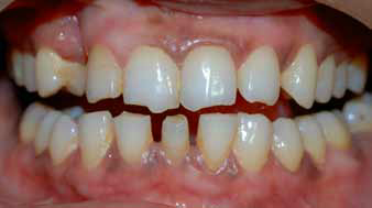
Etching with sulphuric acid creates a rough and chemically altered surface which enables it to bond more effectively with hydrophobic resin composites . It has been observed that etching with sulfuric acid for 60–90 s can exhibit shear bond strength to resin composite cements as high as 15.3 7.2 MPa after being stored in water for 28 days at 3780 C. Etching with piranha acid and using a bonding agent have been shown to produce tensile bond strength to composite resin as high as 23.4+/-9.9MPa in aged PEEK specimens. No significant differences were observed in the tensile bond strength of PEEK crowns and dentin abutments using air abrasion and sulphuric acid etching techniques. These studies suggest that PEEK can be used under resin- composite as a coping material.3 (Fig.6)

Fig. 6: PEEK Crowns
PEEK CAD-CAM MILLED FIXED PARTIAL DENTURES
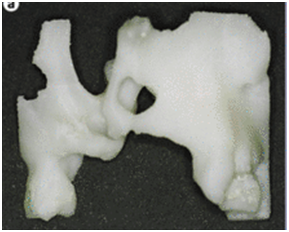
CAD-CAM designed composites and polymethylmethacrylate (PMMA) fixed dentures have superior mechanical properties compared to conventional fixed dentures. PEEK is another material that can be used an alternative to PMMA for CAD-CAM restorations. Three-unit PEEK fixed partial denture manufactured via CAD-CAM has been suggested to have a higher fracture resistance than pressed granular- or pellet- shaped PEEK dentures. The fracture resistance of the CAD- CAM milled PEEK fixed dentures is much higher than those of lithium disilicate glass-ceramic (950N), alumina (851N), zirconia (981-1331N).9
The abrasive properties of PEEK are excellent. Despite of significantly low elastic moduli and hardness, abrasive resistance of PEEK is competitive with metallic alloys. However, no clinical studies have attempted to compare the abrasion produced by PEEK crowns on teeth to that produced by other materials such as alloys and ceramics. Hence, it is still unknown if PEEK crowns can function efficiently in harmony with dentin and enamel. Considering good abrasion resistance, mechanical attributes and aforementioned adequate bonding to composites and teeth, a PEEK fixed partial denture would be expected to have a satisfactory survival rate.3(Fig.7)

Fig. 7: PEEK CAD-CAM milled ï¬ÂÂxed partial dentures
PEEK IN VENEERING SYSTEM
Standard techniques can be used to fabricate restorations from the PEEK- based dental polymer substructure. Good results can be achieved with a range of commercially available veneering composite. In case of veneer chipping, PEEK substructure can allow repair without the need for crown or bridge replacement.10
CEMENT SYSTEMS AND SURFACE PREPARATIONS OF PEEK SUBSTRUCTURE
Restorations fabricated with PEEK-based dental polymer can be cemented using a range of commercially available systems. Certain studies have demonstrated that sulphuric acid etching can improve bond strength of resin cements to PEEK surfaces. However, no general recommendations can be made for individual dental luting materials on the market. The use of methyl methacrylate (MMA)-based adhesives allows bonding between PEEK and self- adhesive resin cements, however plasma treatment has no impact on bond to resin cements.11
COLOUR AND RADIOLUCENCY
PEEK polymer is naturally radiolucent and compatible to imaging techniques such as X-ray, MRI and CT. PEEK dental polymer allows clinical diagnostics and treatment through PEEK substructure without need for substructure removal and replacement. PEEK is available in natural and white for improved aesthetics.10
CONCLUSION
Because of its mechanical and physical properties being similar to bone and dentin, PEEK can be used for a number of applications in dentistry including dental implants. Increasing the bioactivity of PEEK dental implants without affecting their mechanical properties is a major challenge. PEEK is also an attractive material for producing CAD-CAM fixed and removable prosthesis owing to its superior mechanical properties compared to materials such as acrylic. Further research and clinical trials are required to explore this material and possible modifications for further dental applications.
REFERENCES
1. Rekow ED. High technology innovations and limitations for restorative dentistry. Dent Clin North Am 1993;37(3):513–524.
2. Wikipedia contributors. “Polyether ether ketone.â€Â Wikipedia, The Free Encyclopedia. Wikipedia, The Free Encyclopedia, 10 Jan. 2018. Web. 16 Mar. 2018.Najeeb S, Zafar MS, Khurshid Z, Siddiqui F. Applications of polyetheretherketone (PEEK) in oral implantology and prosthodontics. Journal of prosthodontic Research. 2016 Jan 1;60(1):12-9.
3. Najeeb S, Zafar MS, Khurshid Z, Siddiqui F. Applications of polyetheretherketone (PEEK) in oral implantology and prosthodontics. Journal of prosthodontic Research. 2016 Jan 1;60(1):12-9.
4. Skinner HB. Composite technology for total hip arthroplasty. ClinOrthop 1988;235:224–36
5. Razzaque A, Dhaded S. An Insight into a Novel Material: PEEK. Research and Review in Prosthorestorative Dentistry. 2016 Oct 10;1(1).
6. Chan C, Ko T, Hiraoka H. Polymer surface modification by plasmas and photons. Surf Sci Rep 1996;24:1–54.
7. Zoidis P, Papathanasiou I, Polyzois G. The use of a modified poly-ether-ether-ketone (PEEK) as an alternative framework material for removable dental prostheses. A clinical report. J Prosthodont2015;1–5.
8. Behr M, Zeman F, Passauer T, et al. Clinical performance of cast clasp-retained removable partial dentures: A retrospective study. Int J Prosthodont2012;25:138–144.
9. Alt V, Hannig M, Wo stmann B, Balkenhol M. Fracture trength of temporary fixed partial dentures: CAD/CAM versus directly fabricated restorations. Dental Mater 2011;27:339–47.
10. New material options for innovation in restorative and prosthetic dentistry- invibio biomaterial solutions.
Disclaimer from Guident
The views and opinions expressed in articles published in Guident are solely those of the authors and do not necessarily reflect the views of the editors, the editorial board or the publisher, Ivory India. Guident does not endorse any product, technique or treatment described. Clinical content is intended for qualified dental and medical professionals and is not a substitute for individual clinical judgement. Guident, its editors and the publisher accept no liability for any consequence arising from the use of information published in the journal.
How to cite this article
Dr. Sonu Elsa John, Dr. Sheela Kumari, Dr. Rathika Rai. A PEEK into PEEK-an Innovative Biomaterial. Guident. 2018 Mar;11(4). Available from: https://ivoryindia.in/articles/prosthodontics/a-peek-into-peek-an-innovative-biomaterial.html