Management of Dento-Alveolar Fracture of Anterior Maxilla in Esthetically Conscious Adolescent: A Case Report
Wisdom Dental Clinics ®, Jaipur, India, The Tooth Clinic, Bareilly, Uttar Pradesh, India
ABSTRACT
In children and adolescents, trauma is a regular occurrence. Twenty percent of these patients had dentoalveolar fractures. Teeth luxation is the most frequent cause of this condition, with invasive luxation being the most serious kind. The structure and function of the patient's oral complex are greatly preserved by prompt clinical and radiographic diagnosis and treatment. This case report details the diagnosis, treatment, and multidisciplinary approach of management for a dentoalveolar fracture of the anterior maxilla caused by accidental injury to the maxillary anterior teeth. Timely treatment was done with arch bar fixation, implant placement followed by orthodontic space management. Patient now is doing well with the two years of follow-up.
Keywords: dental trauma, Dental trauma, Dental implant, Tooth fracture
INTRODUCTION
Dento-alveolar trauma with avulsion accounts for large number of injuries in paediatric maxillofacial trauma. Because of the dynamic state of the alveolar and dental development, occlusion, and facial growth, these injuries are extremely difficult to treat in early adolescents.
The incidence of dental avulsion ranges from 0.5 to 16% of all traumatic injuries to the permanent teeth and from 7 to 13% of injuries in the primary dentition.1 Various causes of avulsion consist of falls, fights, sport injuries, automobile accidents, and child abuse.2,3 Early tooth loss not only has a negative aesthetic effect but also reduces proper alveolar growth, impairs function, and has an impact on psychosocial development.4 Replantation of avulsed tooth within 20 to 30 minutes of the accident or keeping it in a protective transport medium (Hank's solution, milk, saline, or saliva) until the patient sees a dentist about replantation is the conventional strategy for managing the tooth.5
Replantation isn't always an option, though, in situations where the cortical plate has fractured or an avulsed tooth has been lost. There are a number of treatment options available if replantation is unsuccessful or an avulsed tooth is lost too soon.6,7 These options include auto-transplantation of a premolar in development or another suitable donor tooth, an implant-supported prosthesis for a single tooth, orthodontic space closure, a combination of auto-transplantation and space closure, or a traditional fixed partial denture.
These days, the most popular and recommended treatment option for anterior missing tooth rehabilitation is the use of dental implants.7 In addition to maintaining the alveolar bone, implants also provide good function and aesthetics, as well as restoring patient confidence and social acceptability.7,8 Achieving Osseo integration and a seamless mix of the crown in the dental arch are prerequisites for clinical success.8 But due of their growing skeletons, young teenagers require special concerns when it comes to dental implants. These must be taken into account before starting any therapy.9 This case report delineates the management of dento-alveolar fracture with avulsion in a young adolescent patient who was esthetically conscious.
CASE REPORT
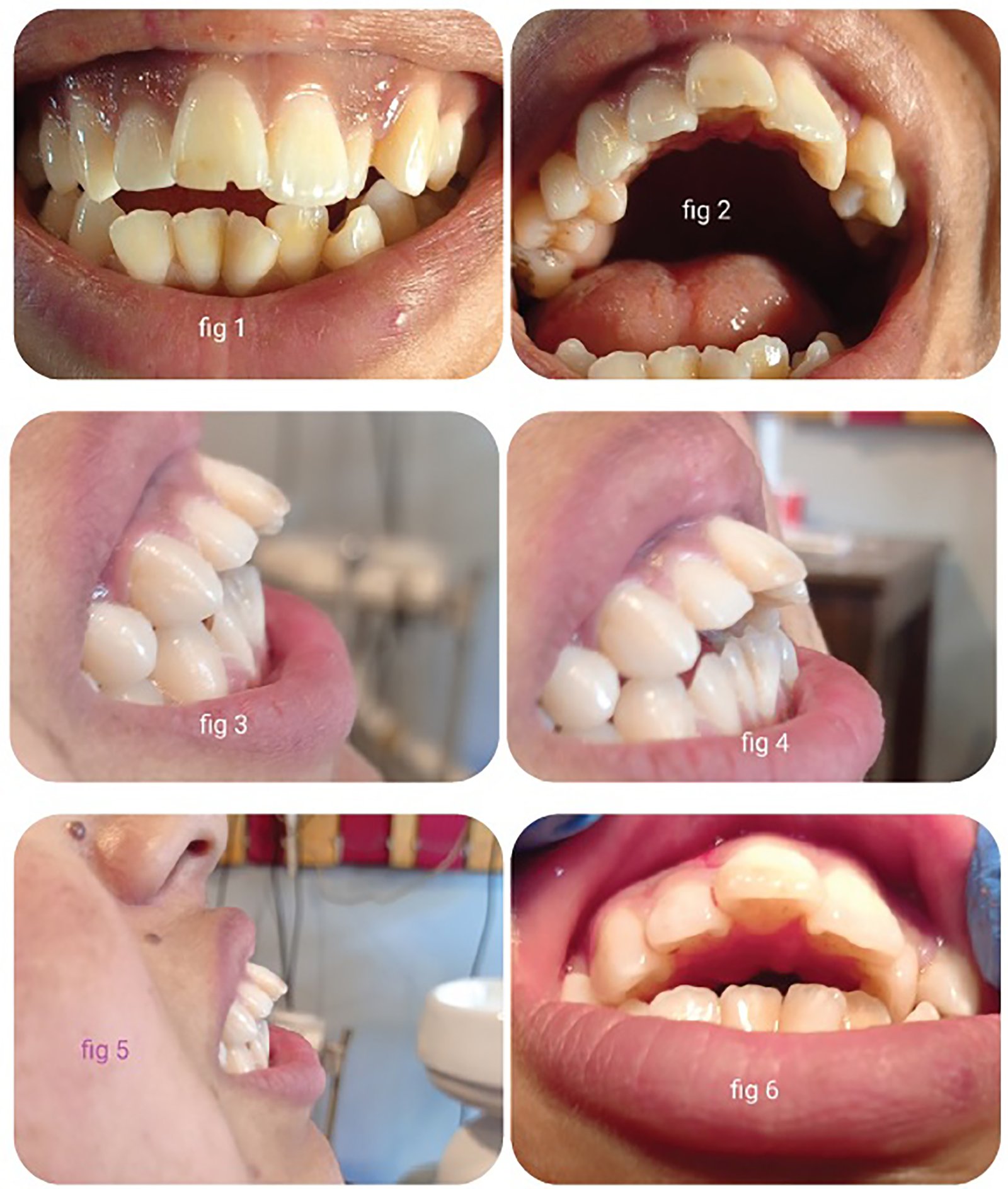
A 15- year- old female reported to the dental clinic after road side accidental trauma from a two wheeler in a very bad condition for the management of dento-alveolar fracture of upper anterior region. Clinical and radiological examination revealed dento-alveolar fracture of anterior maxilla with complicated fracture in upper right maxillary central incisor and also injuries to adjacent teeth, as well as laceration of labial mucosa along with extra oral facial injuries. Radiographic examination revealed missing tooth. Thus diagnosis was Dento-alveolar fracture with avulsion of tooth #11 and crown fracture to adjacent teeth. (Figure.1a,b,c)

Figure.1a,b. Pre-treatment images

Figure. 1c. Pre-treatment radiograph
As the patient came with dental trauma, initially her emergency management was done. Patient was managed for repaired lacerations of extra-oral tissues and arch bar fixation was done. She desired for fixed, permanent and aesthetic treatment option. After three weeks we decided to go for multidisciplinary approach by placing implant to get satisfactory outcome after orthodontic space management along with endodontic treatment i.r.t to adjacent tooth. An informed consent was obtained from the parents for treatment.
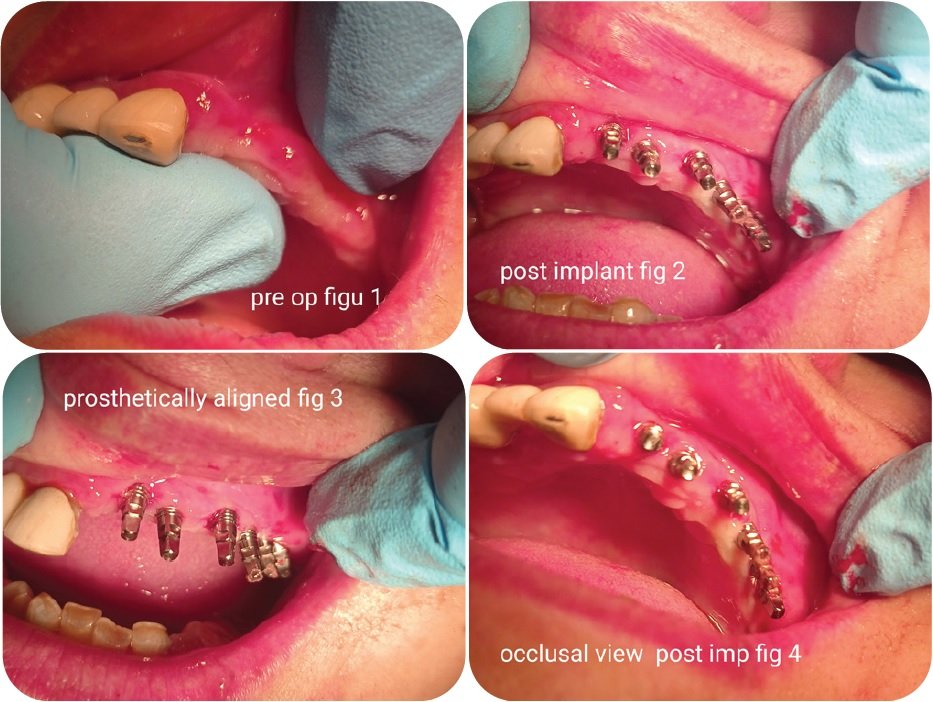
Instead of the removable prosthesis natural tooth crown was repositioned temporarily for space maintenance. After placing implant, patient was asked to follow standard post-operative protocol followed with radiographs to check for implant positioning. Root canal was performed in adjacent tooth; Orthodontic treatment was continued on both the arches to maintain spaces and harmonize the occlusion, treatment was further proceeded in order to align the teeth; after an year, orthodontic brackets were removed, with completion of the orthodontic treatment. Subsequently, abutment crown was placed in order to improve the frontal aesthetics. (Figure.2a,b, c,d,e,f)

Figure2.a,b Orthodontic space management with natural tooth

Figure. 2c,d: Implant placement

Figure. 2e Harmonization of occlusion after implant placement
Follow-up of clinical photographs was taken which revealed acceptable and functional esthetic outcome. Occlusion was stable and from an aesthetic point of view, ?nal crown was integrated with neighbouring teeth and gingival tissues. (Figure.3a,b,c,d)

Figure.3a,b Final outcome

Figure.3c,d Follow-up OPG and aesthetic smile
DISCUSSION
Although damage to the anterior maxillary region is unfortunately quite common in young children, treatment of dento-alveolar fracture with avulsed tooth is typically difficult and problematic.1,10 Thus, to increase the effectiveness and prognosis of these injuries, proper treatment planning is necessary.
The primary challenge in this case was that the affected teeth were located in the aesthetic smile zone and there were high aesthetic demands of the patient. The case was further complicated by the decision regarding the optimal course of treatment, which involved replacing the maxillary incisor that had been lost due to trauma.
The definitive treatment plan that was considered in this case was dental implant placement for tooth #11 followed with orthodontic space management. The rationale behind consideration of early implant placement in this case seeking was that patient was non-compliant, young and esthetically conscious.
According to Oesterle et al.11, implant placement in the pubertal era has a better prognosis than post-pubertal era, but it is still less favorable. In a similar vein, Cronin et al.12 found that implant insertion yields the most predictable results when done after the ages of 15 for girls and 18 for boys.
Fortunately, the patient in this instance was 15 years old when she came in for a permanent replacement. Based on her chronological and dental ages, we estimated that her growth spurt and vertical development pattern had nearly finished, allowing for the safe insertion of the implant.
In this case, however, because the labial alveolar bone plate was preserved, the teeth were vital and the periodontal ligament was intact, only one tooth were not subjected to root canal treatment followed by a follow-up which showed uneventful healing. In our instance, the patient was placed under close follow-up to look for any indications of inflammation or root resorption, which would have required prompt attention; nevertheless, the healing process proceeded without incident, obviating the need for additional care.
CONCLUSION
In young teens, dental implant insertion may be a viable rehabilitation option for a permanent replacement of an avulsed lost tooth. Not only does it restore appearance and functionality, but it also protects the alveolar bone and gives the youngster back their self-esteem and social acceptance. A child's chances of receiving an implant successfully can be increased and desirable esthetics can result from appropriate treatment planning.
REFERENCES
- J.O. Andreasen. Etiology and pathogenesis of traumatic dental injuries. A clinical study of 1298 cases Scand J Dent Res, 78 (4) (1970), pp. 329-342. View at publisher CrossRefView in ScopusGoogle Scholar
- D. Brüllmann, R.K. Schulze, B. d'Hoedt. The treatment of anterior dental trauma. Dtsch Arztebl Int, 108 (35) (2010), pp. 565-570. Google Scholar
- H. Karayilmaz, Z. Kirzioglu, O. Erken Gungor. Aetiology, treatment patterns and long-term outcomes of tooth avulsion in children and adolescents. Pak J Med Sci, 29 (2) (2013), pp. 464-468 Google Scholar
- M.T. Flores, J.O. Andreasen, L.K. Bakland, B. Feiglin, J.L. Gutmann, K. Oikarinen, et al. Guidelines for the evaluation and management of traumatic dental injuries. Dent Traumatol, 17 (5) (2001), pp. 1-4. Google Scholar
- N. Agarwal, D. Kumar, A. Anand, S.K. Bahetwar. Dental implants in children: a multidisciplinary perspective for long-term success. Natl J Maxillofac Surg, 7 (2) (2016), pp. 122-126
- J. Chesterman, R. Chauhan, M. Patel, M.F. Chan. The management of traumatic tooth loss with dental implants: Part 1. Br Dent J, 217 (12) (2014), pp. 627-633
- B.U. Zachrisson. Planning esthetic treatment after avulsion of maxillary incisors. J Am Dent Assoc, 139 (11) (2008), pp. 1484-1490
- R.E. Jung, B.E. Pjetursson, R. Glauser, et al. A systematic review of the 5-year survival and complication rates of implant-supported single crowns. Clin Oral Implants Res, 19 (2) (2008), pp. 119-130
- R.A. Shah, D.K. Mitra, S.V. Rodrigues, P.N. Pathare, R.S. Podar, H.N. Vijayakar. Implants in adolescents. J Indian Soc Periodontol, 17 (4) (2013), pp. 546-548
- S. Shahdad, E. Gamble. The role of dental implants in the management of dento-alveolar trauma part. Dent Update, 42 (1) (2014), pp. 920-930
- L.J. Oesterle, R.J. Cronin Jr., D.M. Ranly. Maxillary implants and the growing patient. Int J Oral Maxillofac Implants, 8 (4) (1993), pp. 377-387
- R.J. Cronin Jr., L.J. Oesterle, D.M. Ranly. Mandibular implants and the growing patient. Int J Oral Maxillofac Implants, 9 (1) (1994), pp. 55-62
Disclaimer from Guident
The views and opinions expressed in articles published in Guident are solely those of the authors and do not necessarily reflect the views of the editors, the editorial board or the publisher, Ivory India. Guident does not endorse any product, technique or treatment described. Clinical content is intended for qualified dental and medical professionals and is not a substitute for individual clinical judgement. Guident, its editors and the publisher accept no liability for any consequence arising from the use of information published in the journal.
How to cite this article
Dr. Gaurav Gupta, Dr. D.K. Gupta, Dr. Richa Gupta. Management of Dento-Alveolar Fracture of Anterior Maxilla in Esthetically Conscious Adolescent: A Case Report. Guident. 2024 Jun;17(7). Available from: https://ivoryindia.in/articles/implantology/management-of-dento-alveolar-fracture-of-anterior-maxilla-in-esthetically-conscious-adolescent-a-case-report.html