Narrow Diameter Implants- Size, Does It Really Matter?
A.B Shetty Memorial Institute of Delhi Science, Nitte Uniersity, Deralakatte, Mangalore, India.
Abstract
The use of dental implants is not very new to dentistry and various researches world over are going on to make it the best treatment modality in rehabilitating edentulous patients. Standard diameter implants are commonly used in various clinical conditions and various clinical studies have proved their success in long term period. But clinicians come across various situations where the patients do not have sufficient bone to place standard diameter implants. Patients with narrow bucco-lingual and mesio-distal dimensions pose problems in placing standard diameter implants and in such condition bone grafting become unavoidable. In such situations narrow diameter implants can be successfully used without grafting and clinicians can save their valuable clinical time.
This review article discusses about use of narrow diameter implants, advantages, disadvantages and gives a fair idea of comparison with standard diameter implants.
KEY WORDS: Dental implant, Narrow diameter implant, Bone grafting.
INTRODUCTION
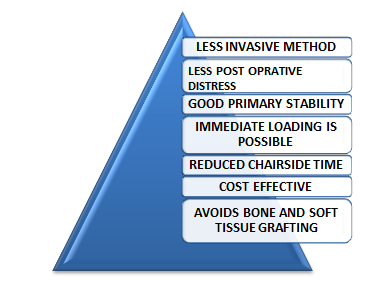
Implant dentistry is growing at a great pace and there are hundreds of implant manufacturing companies coming up with variety of features in terms of size, diameter, surface treatment, shape of implants. Implants of standard diameter are commonly used successfully and we get many documented evidences that can prove its success over a long period of time. But it is not always possible to have a good width of available bone at implant site which can accommodate standard diameter implant without grafting. Many a time’s clinicians come across such a situation when there is not enough width of bone available to place implant of larger diameter. Clinicians often come across cases of periodontal diseases, trauma, failed endodontics in which patient shows a lot of localized bone loss. In such situations dental implant placement and restoration of defect especially in aesthetics region becomes most challenging, and clinician has to think of placing a bone grafts to achieve the ultimate goal. But as we all know bone or soft tissue grafting procedures are technique sensitive, time taking and expensive. In such conditions, narrow diameter implants (NDI) or mini implants (MDI) can achieve the purpose and one can achieve good results without grafting. Implants smaller than 3.5 mm diameter are considered narrow diameter implants. These implants are frequently used in cases of limited bone availability. Some of the MDIs are available in a diameter range of 1.8mm to 2.4 mm. in early years mini implants were used as the provisional instrument for insertion of provisional restorations during the Osseo integration phase of standard (larger diameter) implants. The assumption was that as they have small diameter mini implants cannot bear the masticatory load well and cannot be used as a permanent treatment option. But recent studies have clearly mentioned that NDIs and MDIs can be successfully used in selected cases.
ADVANTAGES
DISADVANTAGES
- Implants cannot be placed in areas of high masticatory load
- Implant and /or abutment fracture is seen more with narrow diameter implants
SELECTION CRITERIAS

A systemic review was conducted to evaluate success of narrow diameter implants in different clinical situations. They had categorized the diameter of implant into 3 categories. Category 1 included implant diameter of less than 3 mm and are called mini implants. Category 2 had implant diameter ranging from 3 -3.25 mm and called small diameter implants, and category 3 included implants of 3.3-3.5 mm diameter called narrow diameter implants. From a literature search they concluded that narrow diameter implants with diameter of 3.3-3.5 mm are well documented in literature for all indications including posterior load bearing region of mouth with 1 year of follow up. Small diameter implants are only documented for non-load bearing single implant placement conditions. Mini implants are documented only for edentulous jaw and non-loadbearing single implant cases.1
A clinical retrospective study was done to evaluate clinical outcome of narrow diameter implants. During the period of November 1996 to February 2004, 237 patients were selected and 510 narrow diameter implants were placed. Diameter of implants varied between 3.0 to 3.5 mm and 255 implants were restored immediately without loading. Marginal bone height was considered as an indicator of success rate to evaluate host, surgery and implant related factors. Statistical significance was evaluated by general linear model. Results showed that only 3 implants failed (survival rate of 99.4%) and there was no statistical difference between studied variables. They concluded that delayed loading of longer and larger (3.3-3.4mm) narrow diameter implants had reduced marginal bone loss.2
A study was done to evaluate the effect of immediate loading and delayed loading of NDI (narrow diameter implants) on bone and soft tissue healing. 3mm diameter implants were placed in a single maxillary lateral incisor region. Sixty patient, 30 in each group were selected and implants were placed in healed maxillary lateral incisor region with minimum torque of 25 Ncm. Implants in both group received final prosthesis after 6 months and parameters like bleeding on probing, marginal bone loss and probing depth were evaluated at every six month follow up for 3 years. Results showed that all the sixty implants Osseo integrated and there was no significance statistical difference in bleeding and plaque index, marginal bone loss and sulcus probing depth. So the conclusion drawn was, if proper clinical protocol is followed, 3mm diameter implants can be best use for immediate loading cases in selected cases.3
A clinical and radiographic study was done to compare effect of standard (4.1 mm) and narrow diameter (3.3 mm) implants on implant success and marginal bone loss over a period of 7 years. The study concluded that there was no statistical difference in both groups, and narrow diameter implants can be used as alternative to standard diameter implants in selected cases.4
In a recent review study regarding various reasons of implant failure, they concluded that the main reason involved in implant failure is metal fatigue. Factors such as implant diameter, implant surface characteristics, occlusal force magnitude, prosthetic structure design exerts large amount of forces on implant and abutment and this can lead to fracture of implant due to metal fatigue over a period of time.5 Nagasawa and colleagues showed that the use of narrow (<3.3 mm) implants increased the magnitude of thestressappliedtotheabutmenthead.Thelatterwas found to be concentrated around the implant neck.6
A study was done to evaluate the fatigue resistance of three different diameters of implants. Three different diameter 5mm, 3.75mm and 3.3mm were studied. The 5mm and 3.75-mm implants showed classic comparable fatigue behaviour, while the 3.3-mm implant did not show typical fatigue behaviour at all. The study clearly concluded that implant diameter has direct relation with fatigue resistance of implants.7 Various studies in literature show that implant diameter can compensate for implant length. Himmolova and colleagues suggested that an increase in the implant diameter decreases the stress around the implant neck more than an increase in the implant length, as the masticatory stresses are well distributed. It is believed by many researchers that cortical bone is much stronger and denser than cancellous bone and the highest load concentrates in the cortical region, so implant width is more important than implant length.8 Various studies are done to evaluate the effect of implant diameter on primary stability of implant in different types of bone. A study was done to check primary stability of 3 different diameter implants like narrow platform (NP 3.4mm), regular platform (RP4.3mm) and wide platform (WP 5mm). They checked the implant stability quotient (IST) with the use of Osstell mentor device. They concluded that NP implants presented a significantly lower ISQ when compared with RP and WP implants, especially in D3 bone type.9
Another study conducted by Rokn et al on Noble Biocare Replace Select TiUnit Tapered implants using regular platform and narrow platform implants to evaluate primary stability. Results showed that RP (4.3 mm) implants presented a significantly higher primary stability compared to NP (3.5mm) implants.10 Carcia et al. studied the effect of implant diameter on implant primary stability in D1 and D2 bone types and concluded that the implant diameter did not have any significant effects on primary implant stability.11
CLINICAL APPLICATIONS OF NARROW-DIAMETER IMPLANTS

DISCUSSION
After the loss of teeth it is often observed that the mesio distal space which was previously occupied by natural tooth has reduced due to migration of neighbouring teeth into that space. Clinicians often come across situations when there is reduced bucco lingual width of ridge is present at the site of implant placement, mainly due to loss of buccal bone plate. In cases of accidental trauma where patient lose tooth, it is often noticed that there is fracture of buccal plate of bone. In traumatic extraction case also buccal bone plate is lost due to improper technique of tooth extraction. Patients who have poor oral hygiene and severe periodontal conditions can also lead to loss of bone. These conditions are challenging to treat as loss of bone and narrow ridges are common findings in such cases. Esthetics is a prime concern especially in maxillary anterior region. To achieve good pink esthetics and emergence profile in the maxillary anterior region, patient has to have a good amount of bone. It is known fact that there should be minimum inter implant distance of 3 mm and minimum 1.5 mm distance between implant and adjacent tooth. On buccal and palatal side also there should be minimum of 1 mm bone has to be present. If sufficient quantity of bone is not present and the edentulous area has a narrow ridge it becomes difficult to place a narrow diameter implant. If placed it will get perforated and there will be exposure of implant from buccal aspect and if it is not covered with bone graft the implant will not get osseointegrated and will eventually fail. In such situations it becomes difficult to place implant of standard diameter without performing lateral bone augmentation or ridge split technique.
Even though bone augmentation procedures are well documented in literature and it has predictable results, one cannot be 100% sure about the treatment outcome. Another disadvantage of bone augmentation procedure is that it is more time taking. Grafted implant sites take more time to heal and to form new bone which can take the masticatory load. But many a time clinicians face cases in which more invasive surgical procedure is contraindicated due to systemic illness of patient. In such condition one has to think of another option of rehabilitating patient with minimal trauma to the tissues. Narrow diameter implants can best serve in these situations.
It is clear from various studies that narrow diameter implants can serve equally well as standard diameter implants in various clinical conditions. But narrow diameter implants do have few limitations over standard diameter implants.
Narrow diameter implants have several limitations like less surface area, low fatigue resistance and high chances of screw loosening and sometimes fracture of implant. As these implants have smaller surface area and less implant bone contact, the forces are not well distributed. It is known from studies that larger diameter implants are less likely to be overloaded during function.12 it is observed that a 1mm decrease in implant diameter decrease the surface area of an implant by more than 40 percent.13Hence, a 3mm diameter implant will have almost one-third less surface area of contact with surrounding bone as compared to a 4mm diameter implant.
Fatigue strength also has direct relation with implant diameter. Larger the diameter less the fatigue and vice versa.14 Fatigue resistance and fracture toughness both are mainly dependant on the diameter of implant and material used in fabrication of implants. Most of the implants are fabricated from titanium and there are five different grades of titanium available for manufacturing implants. Each has different fracture toughness. Grade one to four has 99 percent titanium and Grade five has titanium alloy (90 percent titanium, six percent vanadium and four percent aluminium). Grade five is four times tougher than grade one. So it is inappropriate to use grade one titanium for narrow diameter implant fabrication for permanent restorations.it is favourable to use grade five titanium for narrow diameter implant fabrication.
Fracture of implant is also related to amount of force generated on the implant. Greater force is more likely to fracture an implant than lesser force. So it is advisable to use narrow diameter implants in anterior region of mouth as lesser forces are generated as compared to posterior region of mouth.15
The more chances of implant abutment screw loosening is seen in two piece implants. Smaller the connection between implant and abutment more stresses are concentrated at the implant abutment junction when occlusal forces are applied.16That leads to more chances of abutment screw loosening and, when abutment screw loosening occurs it becomes mandatory to cut the crown to gain access to abutment. In contrast to it one piece implants have distinct advantages over two piece implant. There are no chances of screw loosening and since there is no micro gap between implant and abutment, less chances of crestal bone loss around implant.12
CONCLUSION
Placement of implant becomes challenging task when patient presents with limited amount of bone and other systemic complications. It becomes even more difficult in the maxillary anterior region as esthetics is major concern in this area of oral cavity. Conclusion can be drawn from above discussion that yes, diameter does matter in selection of implant.
Selection of implant should be based on factors like available bone, patients’ systemic condition and area of implant placement. Though few studies have shown that narrow diameter implant can be placed in all conditions and in all areas of oral cavity but it is proved from mechanical analysis that narrow diameter implants are not as fatigue resistant as standard diameter implants. So it is safe to use these implants in the areas of mouth where less masticatory forces are acting mainly maxillary and mandibular anterior region.
REFERENCES
- Degidi M, Piattelli A, Carinci F. Clinical outcome of narrow diameter implants: a retrospective study of 510 implants. . J Periodontol. 2008 Jan; 79(1): 49-54..
- Marc O. Klein, EikSchiegnitz, Bilal Al-Nawas. Systematic Review on Success of Narrow-Diameter Dental Implants .The International Journal of Oral & Maxillofacial Implants 2014; 29(): 43-54..
- Degidi M, Nardi D, Piattelli A. Immediate versus one-stage restoration of small-diameter implants for a single missing maxillary lateral incisor: a 3-year randomized clinical trial. . J Periodontol2009 Sep; 80(9): 1393-8.
- Romeo E, Lops D, Amorfini L, Chiapasco M, Ghisolfi M, Vogel G. Clinical and radiographic evaluation of small-diameter (3.3-mm) implants followed for 1-7 years: a longitudinal study.Clin Oral Implants Res 2006 Apr; 17(2): 139-48.
- Gealh WC, Mazzo V, Barbi F, Camarini ET. Osseointegrated implant fracture: causes and treatment. J Oral Implantol 2011; 38:499–503.
- NagasawaS, HayanoK, NiinoT, etal.Nonlinearstressanaly- sis of titanium implants by ï¬nite element method. Dent Mater 2008; 27:633–639.
- Shemtov-Yona K, Rittel D, Levin L, Machtei E. Effect of dental implant diameter on fatigue performance. Part I: mechanical behavior. Clin Implant Dent Relat Res 2012
- Bilhan H, Geckili O, Mumcu E, Bozdag E, Sunbuloglu E, Kutay O. Influence of surgical technique, implant shape and diameter on the primary stability in cancellous bone. J Oral Rehabil. 2010 Dec; 37(12):900-7.
- Hamidreza B, Shadab R, Soolmaz A, Badri S, Niloufar D, Rokn A. The Effect of Implant Length and Diameter on the Primary Stability in Different Bone Types .Journal of Dentistry September 2013; 10(5): 449-456.
- Rokn A, Ghahroudi AARR, Mesgarzadeh A, Miremadi A, Yaghoobi S. Evaluation of Stability Changes in Tapered and Parallel Wall Implants: A Human Clinical Trial. JDent (Tehran). 2011 Fall; 8(4):186-200.
- Gonzalez-Garcia R, Monje F, Moreno- Garcia C. Predictability of the resonance fre- quency analysis in the survival of dental implants placed in the anterior non-atrophied edentulous mandible. Med Oral Patol Oral Cir Bucal. 2011 Aug; 16(5):E664-9.
- Misch CE. Early crestal bone loss etiology and its effect on treatment planning for implants. Post grad Dent 2 (3):3-17, 1995.
- Misch CE. Divisions of available bone in implant dentistry. Int J Oral Implant 7(1):9-17, 1990.
- Bidez MW, Misch CE. Clinical biomechanics in implant Dentistry. In Contemporary Implant Dentistry, CE Misch (ed) 303-316, Mosby St. Louis MI, 1999.
- Helkimo E, Carlsson GE, Helkimo M, Bite force and state of dentition. ActaOdentol Sand 35:297-303, 1977.
- Boggan S, Strong JT, Misch CE, Bidez MW. Influence of hex geometry and prosthetic table width on static and fatigue strength of dental implants. J. Prosthe Dent 82 (4): 436-440, 1999.
Disclaimer from Guident
The views and opinions expressed in articles published in Guident are solely those of the authors and do not necessarily reflect the views of the editors, the editorial board or the publisher, Ivory India. Guident does not endorse any product, technique or treatment described. Clinical content is intended for qualified dental and medical professionals and is not a substitute for individual clinical judgement. Guident, its editors and the publisher accept no liability for any consequence arising from the use of information published in the journal.
How to cite this article
Dr. Krishna Prasad D., Dr. Anupama Prasad D., Dr. Manan Buch Department of Prosthodontics. Narrow Diameter Implants- Size, Does It Really Matter?. Guident. 2015 Apr;8(5). Available from: https://ivoryindia.in/articles/implantology/narrow-diameter-implants-size-does-it-really-matter.html