Tantalum Implants - an Insight
Department of Prosthodontics & Implantology, K.D. Dental College & Hospital, Mathura (U.P) India
ABSTRACT
Porous tantalum trabecular metal has been incorporated in titanium dental implants as a new form of implant surface enhancement. However, there is little information on the applications of this material in implant dentistry Porous tantalum metal is used to improve the contact between osseous structure and dental implants; and therefore presumably facilitate osseo integration. Success of porous tantalum metal in orthopedic implants led to the incorporation of porous tantalum metal in the design of root-from endosseous titanium implants. The porous tantalum three-dimensional enhancement of titanium dental implant surface allows for combining bone ongrowth together with bone ingrowth, or osseoincorporation. While little is known about the biological aspect of the porous tantalum in the oral cavity, there seems to be several possible advantages of this implant design.
INTRODUCTION
Tantalum is a highly corrosion resistant transitional metal with atomic number 73 extracted from the mineral, tantalite.
Tantalum is extremely inert and resistant to acid corrosion. Only hydrofluoric acid and acid solutions containing fluoride and sulfur trioxide can dissolve tantalum. This inertness is ideal for fabrication of orthopedic implants. The inertness and biocompatibility of tantalum is a result of tantalum oxides forming on the surface of tantalum—similar to titanium and its oxides.
Similar to titanium, tantalum is very reactive to oxygen and the oxide layer of tantalum can form on the metal surface immediately after the surface is exposed to oxygen. Annealed tantalum has great ductility. However, grinding annealed tantalum is very difficult. Because tantalum is reactive to oxygen, it cannot be soldered and welding can only be done under inert gas environment. Tantalum is used in electrodes for pacemakers, devices for nerve repair, radiographic markers, and cranioplasty plates.
HISTORY
The word tantalum was coined from Tantalus, a Greek mythology figure who was eternally punished to stand in a pool of water under a tree with low hanging fruit. When Tantalus reached to get the water, the water would recede. And when he reached for the fruit the tree branch would move higher. This “tantalizing” property of Ta was seen by the early chemists when Ta was immersed in acids. Tantalum, they found, was highly unreactive in almost all acids, except hydrofluoric acid and acids containing fluoride and sulfur trioxide. Tantalum is a member of the refractory metals group, which are widely used as components in alloys. The Swedish chemist, Anders Gustav Ekebereg, discovered Tantalum in 1802. Tantalum, in the early years of discovery, was found in its oxide form—as columbium, which is a combination of columbite and tantalite. William Hyde Wollaston, an English chemist, showed that both columbite and tantalite are derivatives of the same element and kept the name, tantalum
PRODUCTION OF POROUS TANTALUM TRABECULAR METAL (PTTM)
The development of porous tantalum metal has allowed for stronger, more biocompatible orthopedic, craniofacial, and dental implants
Titanium alloys,cobalt chromium and stainless steel have been the conventional materials used for orthopedic implants. With alterations and enhancements including surface coatings and porous designs, these materials have shown a high clinical effectiveness. Nevertheless, they still have several limitations including low volumetric porosity, relatively high modulus of elasticity and low frictional characteristics
The structure of porous tantalum metal affords a high volumetric porosity, a low modulus of elasticity, and relatively high frictional characteristics
PTTM, known commercially as Trabecular Metal Material (Zimmer, Trabecular Metal Technology, Inc., Parsippany, NJ) is an open-cell porous biomaterial with a structure similar to trabecular bone by having three-dimensional dodecahedron repeats.The structure of porous tantalum metal affords a high volumetric porosity, a low modulus of elasticity, and relatively high frictional characteristicsThe open-cell dodecahedron repeats are fabricated by a foam-like vitreous carbon scaffold, which forms an initial general scaffold and eventually becomes the internal skeleton of the PTTM implant device.
PTTM is, therefore, superior to other metal implant technologies such as titanium because it has a high degree of porosity. The vitreous carbon skeleton comprising the trabecular framework of the implant can be altered. This means that a variety of designs of PTTM may be created, which is utilized especially in creating orthopedic implants.
Review of the literature on PTTM as an orthopedic implant material suggests that this material has great biocompatibility, osteoconductivity, bone ingrowth and vascularization in both in vitro/in vivo experiments and in human studies. The PTTM allows an implant surface enhancement not only for bone ongrowth but also bone ingrowth. PTTM structure allows neovascularization and new bone formation directly into the implant. This concept is known as “osseoincorporation”.
PTTM-ENHANCED TITANIUM DENTAL IMPLANTS
While the PTTM technology has had great success in the orthopedic field for almost two decades, the technology has not been applied to dental implants until recently (Figure 1b). The designs of modern root-form endosseous implants date back even before the discovery of osseointegration by P. I. Branemark in the early 1970s to 1980s.
PTTM technology was introduced to create a three-dimensional bone ingrowth scaffold around dental implants (Figure 1b–c). The PTTM material was added to the middle section of the Titanium multi-threaded self-tapping
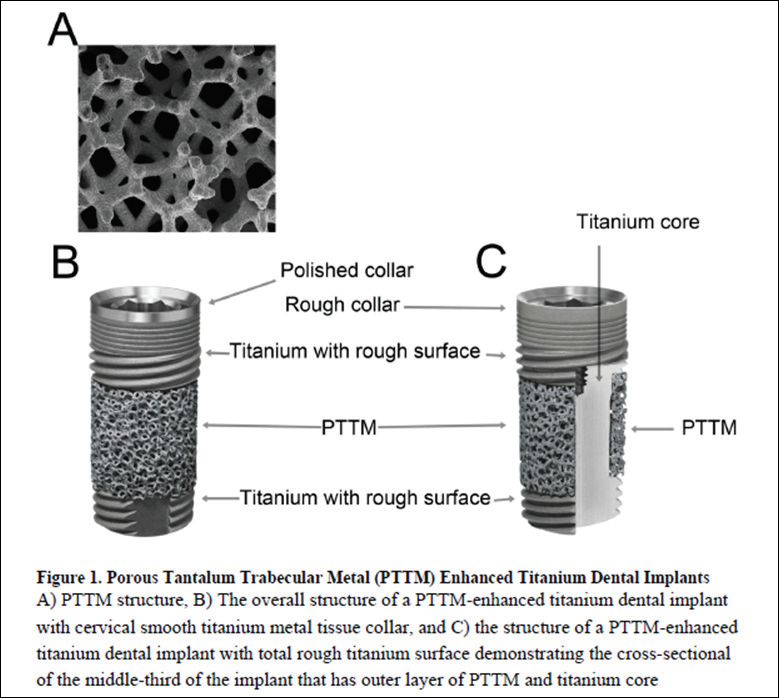
endosseous dental implant (Tapered Screw-Vent® Implant. Zimmer Dental Inc.).The apical and cervical sections of this PTTM-enhanced titanium dental implant retain the screw-type design with a rough surface created
by grit-blasting with hydroxyapatite or HA particles (MTX surface, Zimmer Dental Inc). The titanium alloy (Ti-6Al-4V grade 5) and the PTTM components of the implant are manufactured separately. The cervical portion and the middle core of the titanium alloys are milled in one piece. Similarly the apical portion is milled separately. The PTTM sleeve, ~ 2 mm cylinder, is composed of 2% vitreous carbon core scaffold and 98% tantalum coating. The PTTM sleeve is then placed into the middle titanium alloy core and the core is then laser welded to the apical portion.22
ADVANTAGES OF PTTM-ENHANCED TITANIUM DENTAL IMPLANTS
- The PTTM portion of the implant has an open-cell dodecahedron repeat structure which allows for rapid endothelial budding and ingrowth through the expanded structure in response to the angiogenic and anabolic growth factor gradient produced within the scaffold by the metal surface interacting with the initial blood clot
- Tantalum layer of PTTM, when oxidized, is highly unreactive, and therefore, biocompatible in the body.
- Tantalum does not exhibit toxicity to surrounding cells, nor does it inhibit local cell growth, i.e. osseous ingrowth of surrounding bone
- The open cell structure of PTTM is superior to other surface treatment methods that attempt to produce porosity of the implant, but does not achieve complete porosity. Pore size can also be altered with PTTM to match the surrounding bone.
- PTTM-enhanced titanium dental implants can also improve osseointegration simply by increasing bone-implant interface area in the three-dimensional manner promoting angiogenesis and mimicking natural osseous structure
- PTTM exhibits an elastic modulus similar to bone and is mechanically superior to other alloys used in dental implants
- PTTM allows for elastic deformation and load distribution. This means it is able to avoid placing local stress on the surface of articular cartilage in orthopedic artificial joint. Also, bone resorption is less likely since the stress is distributed throughout the structure to the surrounding bone.
- The advantages of high biocompatibility, similar porous structure to natural bone, and excellent mechanical properties of PTTM-enhanced titanium dental implants may give them an advantage over other dental implants, particularly for patients through enhancement of osseointegration, or osseoincorporation
CLINICAL APPLICATIONS FOR PTTM-ENHANCED TITANIUM DENTAL IMPLANT
Because of high success rate, titanium implants are commonly used ,but in cases like diabetes, osteoporosis, irradiated bone, and heavy use of tobacco, may benefit from PTTM implant .when there is insufficient remaining bone structure that requires simultaneous bone augmentation or in the newly grafted bone, PTTM in orthopedic cases have shown adequate healing of the grafted tissues
In the oral cavity, PTTM may help in cases that need simultaneous implant placement and horizontal/vertical bone augmentation or cases with simultaneous implant placement with sinus augmentation or cases with newly grafted sinuses or sockets
In subjects with Type 3 or 4 bone or with impaired wound healing due to systemic complications, the improved and enlarged surface area that is provided by the PTTM collar may result in faster and more robust osseointegration in the normal dental implant cases that require immediate provisionalization and loading or sooner insertion of permanent prostheses, due to patient’s demand, faster healing time may be needed
PTTM-enhanced titanium dental implants may give patients and clinicians another treatment option for immediate placement and loading of implant .We may assume that immediate and early loading of PTTM-enhanced titanium dental implants is recommended based on orthopedic literature, there is currently no study on such topics. Prospective clinical trials will be needed to examine if this type of implants is really superior to conventional titanium dental implants
POTENTIAL PROBLEMS WITH PTTM-ENHANCED TITANIUM DENTAL IMPLANTS
These implants have been used extensively in orthopaedics but unlike other surgical sites oral cavity is highly unsterile which can harbor over 500 different bacterial species. Various microorganisms live in the oral cavity. The interactions of the host tissue, saliva, and microorganisms can make it difficult to predict how PTTM implants would react to this complex environment
Titanium implants can be susceptible to infection because of: (1) surface biofilm and (2) compromised immune ability at implant tissue interface.46 While tantalum itself is similar to titanium in that it is highly biocompatible and corrosion resistant, the interactions with oral fluid, oral microbes and biofilm of the PTTM portion are not known. The concern can extend into the case of peri-implantitis and how we may treat it in the case of PTTM-enhanced titanium dental implant
This concern will remain unanswered until we see the results of long-term studies of these implants
CONCLUSION
These implants allows for true enhancement of osseointegration in a three-dimensional manner, which may be a major breakthrough compared with the current focus on titanium implant surface technologies. Based on assumptions from orthopedic clinical studies, this type of implant may be indicated in poor healing situations, immediate/early loading of implants, and missing osseous structure requiring simultaneous implant placement and bone grafting. Moreover good clinical judgement and proper case selection is needed until furthur research is going on
BIBLIOGRAPHY
- Sompop Bencharit. Development and Applications of Porous Tantalum Trabecular Metal Enhanced Titanium Dental Implants. Clin Implant Dent Relat Res. 2014 December ; 16(6): 817–826.
- Kock W, Paschen P. Tantalum - Processing, Properties and Applications. Jom-J Min Met Mat S. Oct; 1989 41(10):33–39
- Levine BR, Sporer S, Poggie RA, Della Valle CJ, Jacobs JJ. Experimental and clinical performance of porous tantalum in orthopedic surgery. Biomaterials. Sep; 2006 27(27):4671–4681. [PubMed: 16737737]
- Aycan S. Chemistry education and mythology. J Social Sciences. 2005; 1(4):238–239.
- Colakis, M.; Masello, MJ. Classical Mythology and More: A Reader Workbook. Bolchazy-Carducci Publishers; 2007. p. 204
- . Greenwood, N.; Earnshaw, A. Chemistry of the Elements. 2. Oxford: Butterworth–Heinem; 1997. p. 1138
- Weeks ME. The discovery of the elements. VII. Columbium, tantalum, and vanadium. J Chem Educ. May; 1932 9(5):867–872.
- . Griffith WP, Morris PJT. Charles Hatchett FRS (1765–1847), chemist and discoverer of niobium. Notes Rec Roy Soc. Sep; 2003 57(3):299–316
- Kaplan, RB. Open cell tantalum structures for cancellous bone implants and cell and tissue structures. US Patent No. 5282861. 1994.
- Cohen R. A porous tantalum trabecular metal: basic science. Am J Orthop. Apr; 2002 31(4):216–217. [PubMed: 12008853]
- Bobyn JD, Stackpool GJ, Hacking SA, Tanzer M, Krygier JJ. Characteristics of bone ingrowth and interface mechanics of a new porous tantalum biomaterial. J Bone Joint Surg Br. Sep; 1999 81(5):907–914. [PubMed: 10530861]
- . Heiner AD, Brown TD, Poggie RA. Structural efficacy of a novel porous tantalum implant for osteonecrosis grafting. Trans Orthop Res Soc. 2001; 26:480.
- Miyazaki T, Kim HM, Kokubo T, Ohtsuki C, Kato H, Nakamura T. Mechanism of bonelike apatite formation on bioactive tantalum metal in a simulated body fluid. Biomaterials. 2002; 23(3):827–32. [PubMed: 11771702]
- . Bobyn JD, Poggie RA, Krygier JJ, et al. Clinical validation of a structural porous tantalum biomaterial for adult reconstruction. J Bone Joint Surg Am. 2004; 86-A(Suppl 2):123–129. [PubMed: 15691117]
- . Christie MJ. Clinical applications of Trabecular Metal. Am J Orthop. Apr; 2002 31(4):219–220. [PubMed: 12008854]
- Roberts WE, Simmons KE, Garetto LP, DeCastro RA. Bone physiology and metabolism in dental implantology: risk factors for osteoporosis and other metabolic bone diseases. Implant Dent. 1992; 1(1):11–21. [PubMed: 1288794]
- . Taylor TD, Worthington P. Osseointegrated implant rehabilitation of the previously irradiated mandible: results of a limited trial at 3 to 7 years. J Prosthet Dent. Jan; 1993 69(1):60–69. [PubMed: 8455170]
- . Brogniez V, Lejuste P, Pecheur A, Reychler H. Dental prosthetic reconstruction of osseointegrated implants placed in irradiated bone. Int J Oral Maxillofac Implants. Jul-Aug;1998 13(4):506–512. [PubMed: 9714957]
- . Bain CA, Moy PK. The association between the failure of dental implants and cigarette smoking. Int J Oral Maxillofac Implants. 1993; 8(6):609–615. [PubMed: 8181822]
- . Schwartz-Arad D, Samet N, Mamlider A. Smoking and complications of endosseous dental implants. J Periodontol. Feb; 2002 73(2):153–157. [PubMed: 11895279]
Disclaimer from Guident
The views and opinions expressed in articles published in Guident are solely those of the authors and do not necessarily reflect the views of the editors, the editorial board or the publisher, Ivory India. Guident does not endorse any product, technique or treatment described. Clinical content is intended for qualified dental and medical professionals and is not a substitute for individual clinical judgement. Guident, its editors and the publisher accept no liability for any consequence arising from the use of information published in the journal.
How to cite this article
Dr. Shaivy Ambuj, Dr. Manesh Lahori. Tantalum Implants - an Insight. Guident. 2019 Feb;12(3). Available from: https://ivoryindia.in/articles/implantology/tantalum-implants-an-insight.html