An Unusual Case of Impacted Lower First Molar: A Case Report
Wisdom Dental Clinics ®, Jaipur, India, Department of Periodontics, Institute of Dental Sciences, Bareilly, Uttar Pradesh, India
ABSTRACT
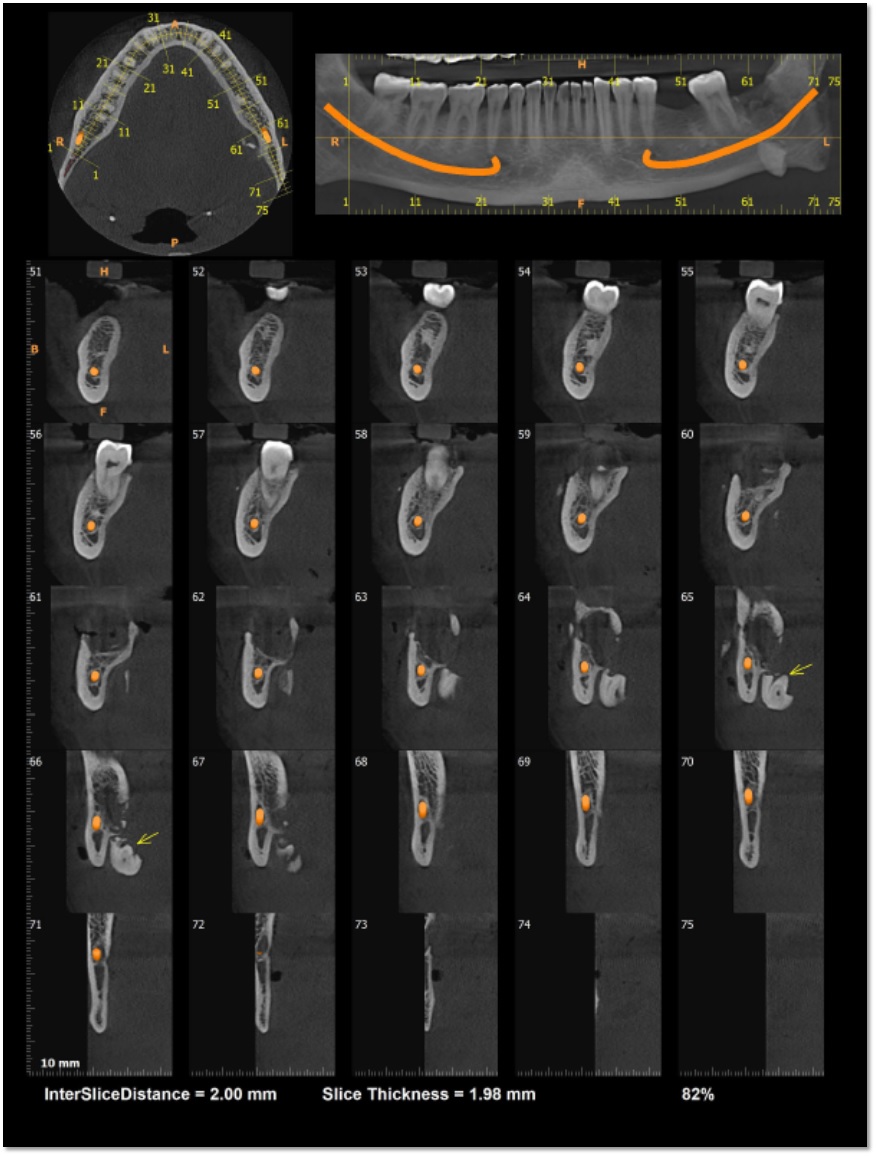
Impaction of permanent teeth is not uncommon, but impaction of permanent teeth are like mandibular first molars are rare. In deeply impacted mandibular first molars case, it requires delicate technique as well as careful management to minimize risks of injury to the adjacent teeth, neurovascular bundle and the mandibular fracture. Here, we report an unusual case of impacted mandibular first molar in a male patient of 30-year-old which was located near inferior border of mandible, almost horizontal. Hence transalveolar extraction of tooth and endodontic treatment of adjacent teeth was done with 6 months of follow up.
Keywords: First molar, Impaction, Mandibular, Transalveolar, Ectopic
INTRODUCTION
Impacted tooth is defined as a tooth that cannot erupt into its normal functioning position and is pathologic, hence require treatment. Usually, impaction of permanent teeth occurs in the descending order - third molars, followed by maxillary cuspids, mandibular premolars, mandibular canine, maxillary premolars, maxillary central incisors, and mandibular second molars but first mandibular molars and maxillary second molars are rarely impacted.1
In 1961 Dachi and Howell2 found the incidence of impacted canine in maxilla as 0.92% and of other non-third molar impaction to be 0.38%. Besides this first permanent molar impaction is still rare, with prevalence rates of 0.02% for the maxillary first molar and of less than 0.01% for the mandibular first molar.3,4 According to review of literatures it was found that impaction of first permanent molars is due to ectopic eruption which cause resorption of distal root of deciduous second molars or even premature exfoliation of the same. The causes for impaction are both systemic and local. Systemic factors, such as cleidocranial dysplasia, endocrine deficiency (hypothyroidism and hypopituitarism), febrile disease, Down Syndrome and irradiation, other systemic factors may influence impaction of permanent teeth.
In all these conditions generally, multiple teeth are involved. The local factors which are more commonly involved in permanent tooth impaction are prolonged retention of deciduous tooth, premature loss of primary molars, ankylosis of primary molars, arch length deficiency, supernumerary tooth, malposed tooth germ, dentigerous cyst, odontogenic tumors, abnormal path of eruption, trauma and cleft lip and palate, may be the cause for molar impaction.5,6,7,8
Treatment options for an impacted molar include extraction, surgical uprighting, transplantation, surgical-orthodontic approach, and dental implant replacement.9,10,11 In choosing a treatment plan for removal of impacted molar the decision-making process must be handled very cautiously as a result of the uncertain etiology, the lack of standard therapy, and the paucity of cases reported.
CASE REPORT
A thirty-year-old man was referred to dental clinic with chief complaint of swelling in lower right region of jaws. The history suggested intermittent pain with associated swelling. No symptoms of syndrome were evident and also his history did not reveal dental trauma or any infection. [Figure 1}

Figure 1: Extraoral photograph
There was evidence of intra oral soft tissue swelling over the right side of mandible at region of missing tooth. Intra-oral examination showed normal development except confirmed absence of mandible right first molar. [Figure 2]

Figure 2: Intraoral photograph
Surgical extraction of un-erupted first molar was planned. A mucoperiosteal flap was raised and surgical extraction of impacted primary first molar was carried out. Suture were placed, which were removed after a week. [Figure 3a,3b]

Figure 3a,3b: Surgical removal of 1st molar
DISCUSION
In the literature very few cases have reported for first molar impactions, which are rare. Overall impacted mandibular molars incidence is 18%.2 However, according to the study by Grover and Norton3 there is 0% and 0.06% incidence of impaction of first molar and second molar. With slight female predilection, second molar impactions are thought to occur more frequently in the mandible than in the maxilla and most often are unilateral with mesial inclination.12 According to the literature, the most frequent non-third molar tooth impacted is canine which is identified, followed by premolars and second molars.8,13
In 1973 Thilander & Myrberg14 found prevalence of impacted teeth excluding third molars is 5.4%. Dachi and Howell2 found 0.92% incidence of impacted canines in the maxilla and 0.38% of other non-third molar teeth. Though impactions of first molars and incisors are relatively uncommon they are often diagnosed as ectopic eruption, whereas impaction of second molars is usually associated with arch-length deficiency.6,15 Usually, the gubernacular canals are said to guide erupting permanent teeth into their correct positions.16 Heredity is also mentioned as an etiologic factor. Recently it has been identified in several familial cases of primary failure of eruption is the mutations in parathyroid hormone receptor 1. 17,18
We think that in the present case, the causes of impacted permanent teeth might have been influenced by local factors, such as malposed tooth germs, but not arch-length deficiency and supernumerary. The molar tooth may not follow the correct gabernacular canals guide as a cause of this the unerupted teeth inverts uncommon position. Kokich in 199319 described the surgical and orthodontic management of impacted tooth and identifies the position and angulation of the impacted tooth, length of treatment time, space availability and the presence of keratinized gingiva as a critical factor that will affect prognosis and treatment outcome. The cost involved in orthodontic traction for impacted tooth may also influence the type of treatment options.
In this present case we did not go for orthodontic traction because it was almost horizontally impacted with the anatomy of adjacent teeth and their proximity was not in favor of doing so. Also, the patient would not be able to afford it for time and cost. It was impacted for more than 24 yrs. which made us to opt for surgical extraction as soon as possible. Other factors such as patients’ medical history, dental status, oral hygiene, functional and occlusal relationship, attitude towards orthodontic treatment and compliance with treatment will influence the choice of treatment options. Leaving such cases untreated always has a constant threat of development of dentigerous cyst, pre-eruptive caries, periodontal problems or infection from the impacted tooth. It is essential to diagnose and treat eruption disturbances as early as possible (ideally during the early mixed-dentition period) because treatment at a later stage is usually more complicated.
Therefore, an impacted permanent molar should be treated as soon it is diagnosed. Surgical removal of the impacted permanent first molar is indicated where there is no hope for its eruption and when it causes pathological root resorption of the adjacent tooth. Most importantly, clinicians must inform the patient of the potential risks and possible benefits of treatment alternatives before making the final decision, which should be evaluated on an individual case basis.
CONCLUSION
Absence of posterior teeth is an incidental discovery during a dental examination implies a late diagnosis of the abnormality and an unfavorable prognosis. In order to prevent this situation, a radiographic examination, ideally during the mixed dentition period for early detection of eruption disturbances of permanent teeth is recommended, especially when considering that these abnormalities are associated with high rate of occlusal disturbances and need surgical intervention. Also complete understanding of impaction, primary retention and secondary retention is necessary for differential diagnosis.
REFERENCES
- Damm N, Bouquot A, Oral and maxillofacial Pathology 2nd ed (New Delhi: Elesevier Publication; 2004) p. 66. Chap 1.
- Dachi SF, Howell FV, A survey of 3,874 routine full mouth radiographs II. A study of impacted teeth, Oral Surg Oral Med Pathol,14, 1961, p1165-9.
- Grover PS, Lorton L, The incidence of unerupted permanent teeth and related clinical cases, Oral Surg Oral Med Oral Pathol, 59, 1985, 420–425.
- Valmaseda-Castello ?n E , De-la-Rosa-Gay C, Gay-Escoda C, Eruption disturbances of the first and second permanent molars: results of treatment in 43 cases, Am J OrthodDentofacialOrthop, 116,1999, 651–658.
- Jacoby H, The etiology of maxillary canine impactions, Am. J. Orthod, 84(2), 1983, 125-32.
- Raghoebar GM, boering G, Vissink A, Stegenga B, Eruption disturbances of permanent molars: a review, J Oral Pathol, 20, 1991, 59-66.
- Moyres RE, Handbook of orthodontics, 4 thed( Chicago, Year Book Medical Publishers, 1988. p.387).
- Miloro M, Management of Impacted Teeth Other than Third Molars, Peterson's Principals of Oral and Maxillofacial Surgery, 2 nded, (London, B. C Decker Inc., 2004. pp. 131-7).
- McAboy CP, Grumet JT, Siegel EB, Iacopino AM, Surgical uprighting and repositioning of severely impacted mandibular second molars, J Am Dent Assoc, 134, 2003, 1459–1462.
- Kurol J, Impacted and ankylosed teeth: why, when, and how to intervene, Am J OrthodDentofacialOrthop , 129, 2006, 86–90.
- Motamedi MH, Shafeie HA, Technique to manage simulta- neously impacted mandibular second and third molars in adolescent patients, Oral Surg Oral Med Oral Pathol Oral RadiolEndod , 103, 2007, 464–466.
- Frank C, Treatment options for impacted teeth, J Am Dent Assoc, 131, 2000, 623–32.
- Ahlqwist M, Grondahl HG, Prevalence of impacted teeth and associated pathology in middle-aged and older Swidish women, Community Dent Oral Epidemiol, 19(2), 1991, 116-9.
- Thilander B, Myrberg N, The prevalance of malocclusion in Swedish schoolchildren, Scand J Dent Res, 87(1), 1973, 12-21.
- Raghoebar GM, van Koldam WA, Boering G, Spontaneous reeruption of a secondarily retained permanent lower molar and an unusual migration of a lower third molar, Am J OrthodDentofacialOrthop, 97(1), 1990, 82-4.
- Williams RL, Bannister LH, Berry MM, Collins R, Dyson M, Dussek JE, Ferguson MWJ, Alimentary system in Gray's Anatomy, Section ed: Bannister LH, 38th ed (London, Churchill-Livingstone, 1995. pp.1700-18).
- Frazier-Bowers SA, Simmons D, Koehler K, Zhou J, Genetic analysis of familial non-syndromic primary failure of eruption, OrthodCraniofac Res, 12, 2009, 74–81.
- Frazier-Bowers SA, Simmons D, Wright JT, Proffit WR, Acker-man JL, Primary failure of eruption and PTH1R: the importance of a genetic diagnosis for orthodontic treatment planning, Am J OrthodDentofacialOrthop, 137, 2010, 160.e1–160.e7.
- Kokich VG, Methews DP, Surgical and orthodontic management of impacted teeth, Dent Clin North Am, 37(2), 1993, 181-204.
Disclaimer from Guident
The views and opinions expressed in articles published in Guident are solely those of the authors and do not necessarily reflect the views of the editors, the editorial board or the publisher, Ivory India. Guident does not endorse any product, technique or treatment described. Clinical content is intended for qualified dental and medical professionals and is not a substitute for individual clinical judgement. Guident, its editors and the publisher accept no liability for any consequence arising from the use of information published in the journal.
How to cite this article
Dr. Gaurav Gupta, Dr. D.K. Gupta, Dr. Neeraj Chandra. An Unusual Case of Impacted Lower First Molar: A Case Report. Guident. 2023 Jun;16(7). Available from: https://ivoryindia.in/articles/oral-surgery/an-unusual-case-of-impacted-lower-first-molar-a-case-report.html