Hide & Seek Neoplasms of Oral Cavityseries of 4 Cases
Department of Oral & Maxillofacial Surgery Narayana Dental College & Hospital Nellore, A.P, India
Abstract
Distant metastasis of malignant tumors to the oral cavity is very rare and account for 1-1.5% of all malignant oral tumors. These oral metastatic tumors are found to be the first sign of metastatic spread in 25% of cases and in 23% of cases they are an indication for unidentified primary malignancy of a distant site. Metastasis to soft tissues of oral cavity is extremely rare than the jaw bones. Hence, diagnosis of these types of metastatic lesions can often be deceiving and posses a great challenge. We report here 4 cases of incidental finding of distant metastatic tumors in oral cavity which was diagnosed by a histopathological examination and confirmed by other investigations.All patients were sent for management of primary tumors.
Keywords: Metastatic oral lesion; retrograde diagnosis;lung cancer; uterus cancer.
INTRODUCTION
Metastasis of lesion to the oral cavity is very rare more commonly affecting the jaw bones than the soft tissues. Most of the patients will be aware of primary tumors due to their symptoms. This article is worth reporting because all the patients were unaware of their primary tumors. We report here 4 unusual cases who had lesions of oral cavity which were thought to be hyperplastic lesions or benign tumors. Histopathological examination of these lesions revealed malignant lesions. Ultrasonography of abdomen revealed a primary female genital organ lesions in 2 case and X-ray chest revealed lesion in lung in 2 cases. Lesions of oral cavity poses a challenge in diagnosis which can be made easier by taking a patient’s remote medical history , biopsy of the lesion for histopathological examination and some target organ investigations of brain , lungs , liver and abdomen to establish a correct diagnosis.
CASE REPORTS
CASE 1-
A 49 year old male patient reported to our department of oral and maxillofacial surgery with a slow growing , painless swelling in the upper jaw posterior region from 2 months . Clinical examination revealed 2x2 cm circular, painless, non tender, firm swelling in the left side at junction between hard and soft palate (Fig 1). No cervical lymphadenopathy. Patient was hypertensive from 9 years and was under medication. Patient was a chronic smoker and drinker from 18 years. Fine needle aspiration biopsy was inconclusive. A provisional diagnosis of malignant tumor of minor salivary gland, mucoepidermoid carcinoma was made. Incisional biopsy was done which revealed squamous cell carcinoma. CT chest was done which revealed parenchymal lesion in the hilar region of the left lung . Specific investigation like bronchoscopy was done and specimen was sent for histopathological examination which revealed primary squamous cell carcinoma of lung. Patient was sent to cancer institute for management of primary tumor however patient died after few months due to multiple metastasis.
CASE 2-
A 61 year old female patient reported to our department of oral and maxillofacial surgery with a complaint of a slow growing painless
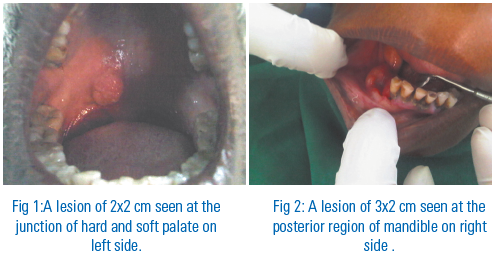
swelling in lower right side posterior region from past 4 months. Clinical examination revealed 3 x 2 cm non tender, firm swelling arising from gingiva in right posterior region of mandible (Fig 2). Missing 45, 46, 47 & 48. Rest of the teeth were periodontally compromised. No cervical lympadenopathy. Her medical history was non contributory. A provisional diagnosis of peripheral giant cell granuloma was made. Fine needle aspiration biopsy was inconclusive. Incisional biopsy was done which revealed well differentiated squamous cell carcinoma. Patient was sent for specific investigations like ultrasonogram abdomen and histopathological examination which revealed squamous cell carcinoma of uterus. Patient was sent for cancer institute for management of primary tumor.
DISCUSSION
Considerable evidence reveal that metastasis to distant organs is not a random event, but is a regulated and a site-specific process. Distant metastasis of malignant tumors to the oral cavity are very rare and accounts for 1-1.5% of all malignant oral tumors1. These oral metastatic tumors are found to be the first sign of metastatic spread in 25% of cases and in 23% of cases they are an indication for unidentified primary malignancy of a distant site. In such cases, these tumor cells bypass the lungs, probably through the valveless vertebral venous plexus called as batson venous plexus (Sir Vivian batson)2 which cases head and neck distant metastasis. Distant metastasis to soft tissues of oral cavity was less than the jaw bones in a ratio of 1:2.51, 3, 4.
According to Van der waal et al, most of the patients are aware of primary tumors before the metastatic spread to oral cavity1. This article is unique because a retrograde diagnosis of the primary tumors were made from metastatic oral lesions which were diagnosed by histopathological examination and other supporting investigations. The major primary sites of metastasis were the lung, liver and prostrate in men and breast, female genital organs like uterus and ovaries in women4, 5.
The pathogenesis of secondary metastasis to the oral cavity is still unclear. Red bone marrow is the main site of metastatic cell deposits. They most commonly metastasize to jawbones and are the main target. Expression of CXC chemokine receptor and its ligand
are the main enzymes known to be involved in cancer metastasis which is highly present in bone marrow6. Though the jaw bones have little active red marrow in elderly, there are remnants of hematopoietic cells especially in the posterior areas of mandible. These cells attract metastatic tumor cells. Oral soft tissues with chronically inflamed gingiva can entrap malignant cells. They have rich vascular supply which has fragmented basement membranes through which tumor cells penetrate easily.
In males, lung carcinomas metastasis is very common with 31% and usually seen in soft palate and gingiva than jaw bones7. It has a mortality of approximately 170000 deaths per year. Only 10-15% of the patients survive8. In our findings, 2 patient were affected with primary lung cancer with secondary metastasis to soft palate (Fig3) and left posterior mandibular gingiva (Fig 3).
In Females , breast cancer metastasis is very common with 24% to oral soft tissues while female genital organs like uterus , ovaries , fallopian tubes is 14.8%. In our cases 1 patient had primary uterus cancer with secondary in gingival soft tissue of right posterior mandible (Fig 2) and the other had primary ovarian cancer with secondary in left buccal mucosa(Fig 4).

Fig 3: A lesion of 4x3 cm seen arising from soft tissue in interdental region of posterior teeth on left side of mandible

Fig 4: A lesion of 2x1 cm seen on left buccal mucosa.
These tumors often mimic hyperplastic lesions or sometimes benign tumors of oral cavity. Proper clinical examination with patient’s past medical history will help the surgeon to achieve a diagnosis. Clinical symptoms are lump in soft tissues of oral cavity, swelling, pain and parathesia in jaw bones. When there is progression of disease especially in soft tissues, there might be pain, bleeding, superinfection, dysphagia, interference with mastication. Sometimes it may occur in extraction socket which is accompanied by soft tissue mass extruding out from the socket with pain. Tooth extraction can serve as a promoting factor in the metastatic process.
In our case, patients were symptomless of primary tumors and it was the secondary metastatic lesions in oral cavity which made them to seek treatment. Retrograde diagnosis with other specific investigations like ultrasonography and CT was done to confirm the histopathological findings and locate the primary tumor. All patients were sent to cancer institute for the management of primary tumors.
CONCLUSION
Distant metastatic lesions have a poor prognosis especially in cases where the primary is unknown or patient is not aware of it. A systematic clinical examination, patient’s medical history, histopathological examination and other specific investigations has to be done to achieve a proper diagnosis. More often retrograde diagnosis is often required when primary is unknown which poses a challenge to the surgeon for appropriate management.
REFERENCES
- Van der Waal RI, Buter J, van der Waal I. Oral metastases: Report of 24 cases. Br J Oral Maxillofac Surg. 2003;41:3–6.
- Batson OV (1940 Jul). The function of the vertebral veins and their role in the spread of metastasis”. Annals of Surgery 112 (1): 138–49.
- Hirshberg A, Leibovich P, Buchner A. Metastases to the oral mucosa: analysis of 157 cases. J Oral Pathol Med. Oct 1993;22(9):385-90.
- Hirshberg A, Leibovich P, Buchner A. Metastatic tumors to the jawbones: analysis of 390 cases. J Oral Pathol Med. Sep 1994;23(8):337-41.
- Hirshberg A, Shnaiderman-Shapiro A, Kaplan I, Berger R. Metastatic tumours to the oral cavity -Pathogenesis and analysis of 673 cases. Oral Oncol. 2008;44:743–52
- Balkwill F. Cancer and the chemokine network. Nat Rev Cancer. Jul 2004;4(7):540-50.
- Olak J, Ferguson MK. Surgical management of second primary and metastatic lung cancer. In: Pass H, Mitchell B, editors. Lung cancer. Philadelphia: Lippincott Williams &Wilkins; 2000. p. 731–9.
- Huang CH, Chang YL, Yang MC, Hsueh C, Yu CT. Lung cancer metastatic to the maxillary gingiva––a case report and literature review. Oral Oncol Extra 2005;41:118–20.
Disclaimer from Guident
The views and opinions expressed in articles published in Guident are solely those of the authors and do not necessarily reflect the views of the editors, the editorial board or the publisher, Ivory India. Guident does not endorse any product, technique or treatment described. Clinical content is intended for qualified dental and medical professionals and is not a substitute for individual clinical judgement. Guident, its editors and the publisher accept no liability for any consequence arising from the use of information published in the journal.
How to cite this article
Dr. Mohammad Akheel. Hide & Seek Neoplasms of Oral Cavityseries of 4 Cases. Guident. 2013 May;6(7). Available from: https://ivoryindia.in/articles/oral-surgery/hide-and-seek-neoplasms-of-oral-cavity-series-of-four-cases.html